

How Much Does Packaging Drop Test Cost in Bangladesh?
A packaging drop test drops a complete, filled shipping carton from a set height onto a hard surface. This guide explains ISTA and ASTM methods, carton failure modes, quote drivers, timelines and documents for buyers sourcing from Bangladesh.
Short answer
A packaging drop test drops a complete, filled shipping carton from a set height onto a hard surface, on a named face, edge, or corner, and records what happens to the carton and its contents. This guide explains the ISTA and ASTM method families, how to read a drop test report, what moves a lab quote in Bangladesh, and the terms to agree before cartons leave the factory.

On this page
Key takeaways
ASTM D5276 is a test method for loaded containers by free fall, while an ISTA procedure or buyer specification sets the sequence, heights, and acceptance rule for a packed carton.
ISTA 1A covers individual packages up to 68 kg, with vibration before a 10-drop shock sequence, and its weight-based heights apply to that procedure only.
No figure in this guide decides a pass: the buyer specification governs acceptance, and every result is judged against the failure definitions written into the purchase specification.
A lab quote follows carton count, sizes, weights, procedures, sequence length, conditioning, photographs, report detail, and retest terms, so compare itemized written quotes for the same scope and hold shipment until each carton size is cleared in writing.
A packaging drop test drops a complete, filled shipping carton from a set height onto a hard surface, on a named face, edge, or corner, and records what happens to the carton and its contents. This guide explains the ISTA and ASTM method families used for that test, how to read a drop test report, what moves a lab quote in Bangladesh, and the terms to agree in writing before cartons leave the factory.
A drop test is a transit simulation, not a test of the product alone. A carton that survives storage can still fail when tipped off a tailgate or struck corner-first on a warehouse floor. The test reproduces that hazard in a controlled way, with inspection after each drop. It does not replace vibration, compression, or climate testing.
Two method families frame most bookings, with different roles. ASTM D5276 is a test method for free-fall drops, while an ISTA procedure or buyer specification sets the sequence, heights, and acceptance rule. A report naming only a method, with no sequence and no acceptance rule, cannot say whether the carton passed.
ASTM D5276-19 covers loaded boxes, cylindrical containers, and bags and sacks tested by free fall, evaluating free-fall shock resistance and inner-packaging protection.1 The container is packed with its actual contents, dropped onto a horizontal, flat surface of concrete, stone, or steel, and its rupture resistance is reported.1 It is intended only for containers under 110 lb (50 kg) handled manually at some point in distribution.1
That method alone does not set the pass mark. ASTM D5276 is a test method only; it does not specify drop heights on its own and is typically paired with an acceptance standard such as ASTM D4169 or an ISTA protocol.2 The apparatus must position the container within 2 degrees of target at impact, control height accurately, lift it without damage, and release it without rotational, sideways, or pitching forces, so the fall is a true free fall.2 Height is measured from the striking surface, edge, or corner to the impact surface, with inspection for structural failure or content damage after each drop.2
ISO 2248 gives the international equivalent: a vertical impact test by dropping a complete, filled transport package, as a single test or as part of a sequence for a system with a vertical impact hazard.3 Its principle is raising the package above a rigid plane surface and releasing it in free fall, with conditions, height, and attitude predetermined.3 The impact surface must be horizontal, flat, immovable, and non-deformable, normally integral with a mass at least 50 times the heaviest package tested, flat within 2 mm.3 The package is normally filled with its intended contents and closed as if ready for distribution.3
ISTA procedures set a full transit sequence for a defined package type. ISTA 1A is a basic, non-simulation procedure for individually packaged products weighing 150 lb (68 kg) or less, using fixed displacement vibration and shock in the form of drops, without simulating logistics routes or testing moisture or temperature.4 Before testing, the manufacturer must define what counts as a damaged product, what tolerance is acceptable, and the acceptable packaging condition at the end.4 The acceptance definition comes from the parties, not the procedure alone, and the same applies to a buyer specification outside any ISTA procedure.
The ISTA 1A sequence runs in three stages on the same sample: ambient preconditioning, fixed-displacement vibration, and a multi-angle shock sequence.4 In vibration, the package sits on a table subjected to a 1-inch (25 mm) peak-to-peak movement, with frequency raised until the package momentarily leaves the plate.4 The shock stage then uses 10 precise free-fall drops, with heights set by package weight, as shown below.4
Packaged weight under ISTA 1A, as reported by the opened guide | Drop height under ISTA 1A, as reported by the opened guide |
|---|---|
0 to 10 kg | 760 mm |
10 to 19 kg | 610 mm |
19 to 28 kg | 460 mm |
28 to 45 kg | 310 mm |
45 to 68 kg | 200 mm |
This table is the ISTA 1A table for that procedure only, not a universal drop height, and it must not be copied into another booking. Heavier packages are generally tested from lower heights, and height is set by the applicable standard, weight, distribution environment, and severity.2 The ISTA 1A drop order runs from the most fragile corner, then the three shortest, three medium, and three longest edges, then six flat face drops.4 A buyer specification may set a shorter order, such as weakest face, strongest face, longest edge, shortest edge, and most vulnerable corner, but the exact sequence and heights are governed by the acceptance standard referenced alongside the method.2
Why this matters for buyers and sellers
For a buyer, carton failure is discovered late, at the destination warehouse after freight has been paid. A laboratory drop result, taken before bulk shipment, gives a dated record tied to a named procedure, carton, height, and acceptance rule.
For a seller, the same record protects good packing. When the tested carton matches production exactly, a result inside the buyer specification shows the packing held, and a failure, with the exact impact point and photographs, tells the packing team where to look first. A factory failure costs a redesign; a destination failure costs a claim and a return.
Keep neighbouring checks apart; each is quoted and reported separately.
Seam-strength cost covers a separate cost guide for a different laboratory test.
Colorfastness cost covers a separate cost guide for a different laboratory test.
Shrinkage cost covers a separate cost guide for a different laboratory test.
Fabric 4-point scoring covers a separate fabric roll scoring scope.
This guide covers only packaging drop testing.
Step-by-step: how it works
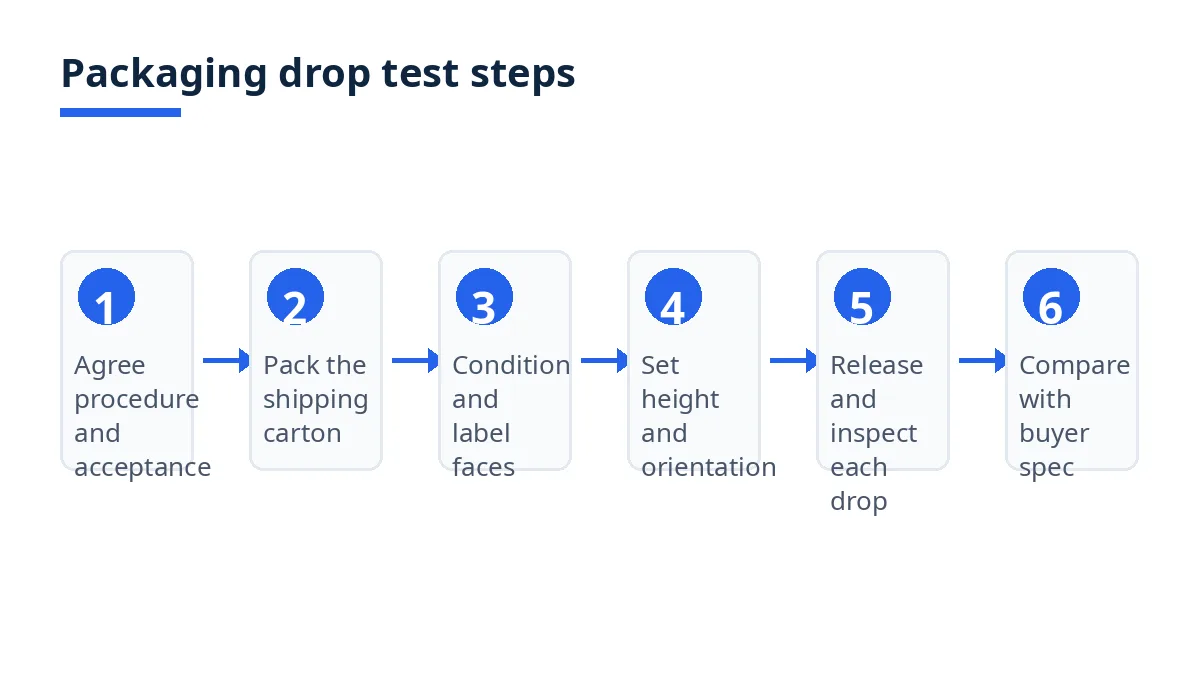
Agree the procedure, sequence, and acceptance rule in writing. Name the method and edition, the acceptance procedure or buyer specification, every impact point in order, the height for the carton weight, the conditioning, and the exact damage counting as failure for carton and contents. The acceptance rule is a buyer specification, and no figure in this guide replaces it.
Pack the test carton exactly as production will pack it. Use the production carton, board grade, dividers, cushioning, void fill, and closure, filled with the intended contents or dummy contents as close as possible to them, closed normally.3 An empty carton or a hand-packed sample with extra cushioning tests a different carton.
Label every face, edge, and corner before the first drop. Use the identification system of the named procedure, so the report can name each impact point. Photograph the sealed carton, and record dimensions, gross weight, board grade, cushioning, and contents.
Condition the carton under the agreed conditions. Fiberboard and paperboard containers are conditioned per the specified atmospheric conditions before testing.2 Record the conditioning.
Set the height and orientation for each drop in turn. Measure height from the striking surface, edge, or corner to the impact surface.2 Position the carton within the orientation tolerance, and release it without rotation or sideways push.2 For ISTA 1A, follow the agreed corner, edge, and face order, with vibration before shock where required.4
Inspect after each drop, and stop or continue as the procedure directs. Check the carton for crushing, bursting, tearing, and closure failure, and the contents for breakage and leakage. Photograph each failure. Inspecting only at the end hides which drop caused it.
Compare each result with the buyer specification and hold shipment on a fail. Judge carton and contents separately against the rule in step 1, for every carton size and packing pattern tested. On a fail, agree the correction, retest source, and retest sequence before the bulk lot ships.
Costs, timelines and documents
No single packaging drop test fee applies across Bangladesh. A quote is built from carton count, sizes and weights, procedures, sequence length, orientations, conditioning, specimen supply, photographs, report detail, and retest terms. A quote for one carton and a short sequence cannot be compared with one for three carton sizes and a full ISTA sequence.
Example figures: how a quote adds up
Every money figure in this table is an Example figure, invented to show the arithmetic, not quoted from any lab and not a market rate. Confirm every figure in the lab written quote.
Example case | Example figures arithmetic | Example figures total |
|---|---|---|
Example A: one master carton, one procedure, standard report | Example figures: 1 sequence at 120 plus 1 report at 60 | Example figures: 180 |
Example B: two carton sizes, full sequence, photographs | Example figures: 2 sequences at 120 plus photographs at 40 plus 1 report at 60 | Example figures: 340 |
Example C: one master carton plus a retest after a corner failure | Example figures: 1 sequence at 120 plus 1 report at 60 plus 1 retest sequence at 120 | Example figures: 300 |
Example A and Example C differ only in the retest sequence. Example B costs more because it tests two carton sizes with photographs.
Example timeline only, not a promise
Example timeline only. This timeline is an illustration, not a promise and not a lab turnaround. Confirm every date in the lab written booking confirmation, and receive the written report before authorizing shipment.
Documents to prepare
Send the lab a reference set before testing: the purchase order; the carton specification with board grade, dimensions, and gross weight; the packing specification with dividers, cushioning, void fill, and closure; the named method and edition; the acceptance procedure or buyer specification with sequence, heights, and failure definitions; the carton list; the report format; the payer, fail, and retest terms; and a shipment hold instruction until each carton size is cleared in writing.
Bangladesh-specific rules and tips
Drop testing in Bangladesh usually runs through a commercial laboratory rather than at the factory. Intertek describes ISO 17025-accredited laboratories in Dhaka, Chattogram, and Gazipur, with testing and inspection services for textiles, garments, and related goods.5 Ask whether its accreditation covers the exact procedure you named.
For the service listing, note this caveat exactly: the Exportain inspection services page currently renders "No services published in this category yet", so use the link as a category page to watch rather than as a list of available providers. The link is inspection services with that caveat stated.
Plan around the factory calendar and courier time, not only lab time. A carton damaged in transit to the lab tests the courier journey, not the agreed sequence, so pack test cartons in outer protection the lab removes before testing, and label them not to be opened before the test. Where a shipment uses both an inner and a master carton, test the unit actually handled in transit, because an inner-carton result does not clear a master carton.
Mistakes and red flags
Booking drops with no named procedure or acceptance rule. Insist the method, acceptance procedure or buyer specification, sequence, heights, and failure definitions appear in the booking.
Testing an empty carton or a hand-packed sample. Test the production carton, packed as production will pack it.
Booking only drops when the procedure includes vibration first. Where ISTA 1A or another full procedure applies, vibration comes before shock on the same sample.4
Reusing the same carton across sequences without recording cumulative damage. Each drop adds damage, so a carton that passed a short sequence after surviving another has not passed either cleanly.
Accepting a report with no orientation, height, or conditioning for each drop. Ask for the impact point, height, and conditioning for every drop, with photographs of any failure.
Treating a method height table as a universal rule. Use only the heights of the named procedure or buyer specification for the carton weight.
Shipping before the report arrives. Hold shipment until each carton size and packing pattern is cleared in writing.
Red flags: no procedure, no sequence, no heights, no failure definitions, one averaged verdict for several carton sizes, a retest from a different packing pattern, and no photographs of the failed impact point.
Checklist
Procedure, method, and edition named, current edition confirmed by the lab.
Acceptance procedure or buyer specification named, with sequence, heights, and failure definitions.
Test carton packed exactly as production, with production board, dividers, cushioning, void fill, and closure.
Every face, edge, and corner labeled before testing, with pre-test photographs.
Conditioning named in the booking and recorded in the report.
Height and orientation recorded for every drop, with inspection and photographs after each drop.
Written quote received with carton count, sizes, sequences, conditioning, photographs, and retest terms.
Report received before shipment, with procedure, sequence, heights, and conditioning.
Failed sequences corrected and retested from the same production packing pattern before shipment.
How Exportain helps
Exportain connects international buyers with Bangladeshi sellers and service providers. Write the carton sizes, packing pattern, procedure, sequence, heights, and acceptance rule into the order, then ask the seller which laboratory will run the test. Keep the report with the shipment documents, and read it beside the finished-goods inspection.
FAQs
What should I know first about packaging drop testing?
A packaging drop test drops a complete, filled shipping carton from a set height onto a hard surface, on a named face, edge, or corner, and records what happens to carton and contents. ASTM D5276 is the free-fall method, while an ISTA procedure or buyer specification sets the sequence, heights, and acceptance rule. No figure here decides a pass: the buyer specification governs acceptance.
What are the typical costs and timelines?
There is no typical fee or turnaround across Bangladesh, because a quote follows carton count, sizes and weights, procedures, sequence length, orientations, conditioning, photographs, report detail, and retest terms. Use the Example figures table, and confirm every figure and date in the lab written quote.
Which documents are needed?
Send the purchase order, carton specification, packing specification, named method and edition, acceptance procedure or buyer specification with sequence, heights, and failure definitions, carton list by size, contents, and pattern, report format, and payer, fail, and retest terms.
What are the most common mistakes?
The most common mistakes are booking drops with no named procedure or acceptance rule, testing an empty carton or a hand-packed sample, booking only drops when the procedure includes vibration first, reusing a carton across sequences without recording cumulative damage, accepting a report with no orientation, height, or conditioning per drop, and shipping before the report arrives.
Next steps on Exportain
Start with the pre-shipment inspection guide, then read the AQL guide to set acceptance limits for finished-goods checks. When ready to source packing or testing support, post your requirement through Exportain RFQs.
Sources
- Drop Test of Loaded Containers by Free Fall in ASTM D5276. ANSI (accessed )
- Drop Testing Services: Free-Fall Drop Tests & Drop Heights. Infinita Lab (accessed )
- ISO 2248:1985 - Packaging - Complete, filled transport packages - Vertical impact test by dropping. International Organization for Standardization (accessed )
- All You Need to Know About ISTA 1A Package Testing. HQTS (accessed )
- Softlines Bangladesh. Intertek (accessed )
About the author
Sourcing from Bangladesh?
Post a request for quotation and suppliers on Exportain can send you their quotes directly.
Post an RFQ


