Organic Cotton T-Shirts Exporters in Bangladesh: Verified Supplier Checklist
An organic cotton T-shirt exporter checklist for Bangladesh: GOTS scope and transaction certificates, approved dye and print inputs, fabric weight, cut grading, label grades and packing, with stop rules for every failed check.
Short answer
Before ordering organic cotton T-shirts from Bangladesh, check the exporter in organic order: a current GOTS scope certificate covering garment making, transaction certificates for the full shipped quantity, approved dye and print inputs at every wet stage, bulk fabric weight and full graded-set measurements, and a label grade that matches the fibre recipe.
On this page
Key takeaways
Read the GOTS scope certificate line by line: it must name the exporter, cover T-shirt garment making, list every subcontracted dyeing and printing stage, and still be in date.
Require a transaction certificate for the full shipped quantity with your company named as buyer, and reconcile certified input against cut, sewn and shipped quantities before shipment.
Check dye and print inputs separately: ask each wet stage for its approved-input evidence, and treat any banned input or missing recipe as a stop item.
Lock bulk fabric weight and the full graded set in the tech pack, and check the label grade against the fibre recipe with written certifier label release before labels are printed.
An organic cotton T-shirt looks the same as a conventional one on a hanger, so the organic claim cannot be judged by hand feel or appearance. It stands or falls on a paper chain: a scope certificate that covers garment making, a transaction certificate for the quantity shipped, approved dye and print inputs at every wet stage, and a label grade that matches the fibre content. Work through this checklist before you pay a deposit, and treat any missing link as a stop, not as a detail to sort out after shipment.
A T-shirt order also concentrates risk in a small set of measurements. Chest width, body length, shoulder width and neck-rib recovery decide whether the shirt fits after washing, and fabric weight decides whether it drapes and wears the way the sample did. Those checks belong in the same pass as the organic papers, because a shirt that loses its shape still fails even when its certificates are in order.
Why this checklist matters
Most organic sourcing trouble is a mismatch between the claim and the coverage. A scope certificate may cover spinning or fabric but not garment making, a transaction certificate may cover part of the quantity, a print shop may sit outside the certified chain, or a label may use the word organic for a blend that only qualifies for a lower label grade. Each gap is cheap to catch at quotation stage and expensive to fix once cartons are sealed.
Score every item in one of three ways. Pass means the evidence was seen and matches the order. Conditional means the gap is written down, dated and owned by a named person, with closure before shipment. Stop means the order waits until new evidence arrives. A name that differs across documents, an expired scope certificate, an uncertified subcontractor, a transaction certificate shortfall, or a label grade that does not match the fibre content are all stop items.
Before you start
Settle four decisions before contacting exporters. First, the label grade you will sell: the grade for 95 to 100 percent organic fibre differs from the grade for 70 to 94 percent, and the wording on the garment must follow the grade, not the marketing plan.1 Second, the fibre composition of each style, including any elastane or other additional fibre, so the label grade can be checked against a real recipe. Third, the target markets and their fibre and care labelling rules, because a label pack agreed late is hard to reprint. Fourth, who makes the stop decision and who holds the certificate file, so a missing transaction certificate is noticed before the ship date rather than after it.
Ask every exporter for the same paper set, and compare answers side by side. A supplier that answers slowly but completely is easier to work with than one that answers fast with a logo image and no certificate behind it.
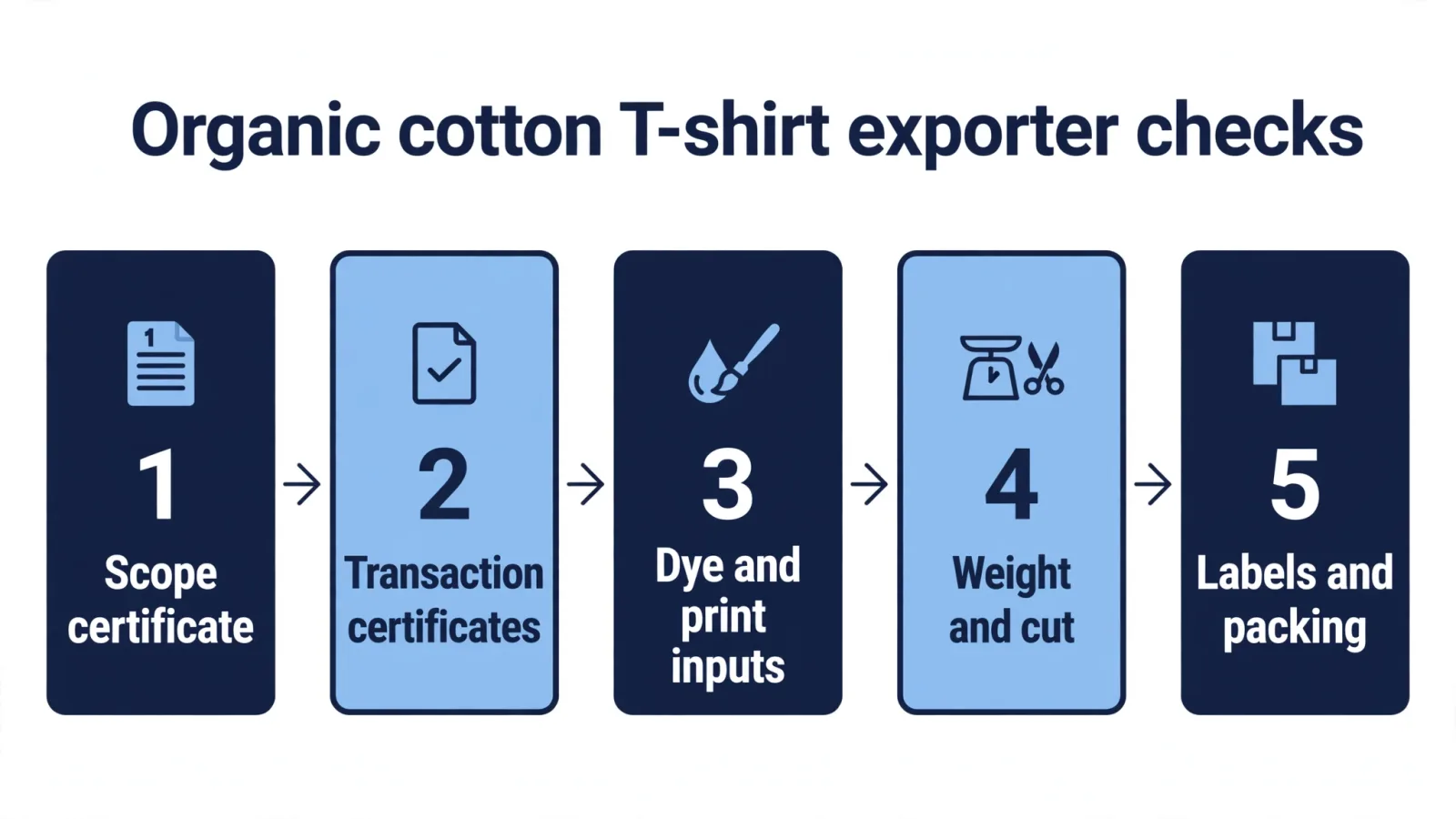
The full checklist
A. Papers and export identity
Confirm one legal name across the trade licence, tax papers, VAT registration, export registration, quotation, purchase order and bank account, and stop on any unexplained difference.
Check the Export Registration Certificate (ERC). An ERC is a mandatory requirement for business entities exporting goods from Bangladesh, and the Office of the Chief Controller of Imports and Exports is the sole authority that provides it.2 Record the number, the name on it and the expiry date.
Check association membership only as a business-identity check, not as a quality guarantee. BGMEA states that, before granting membership, it ensures through on-site inspections and verification that applicant factories meet the required standards.3 Confirm the membership is current and in the exporter's own name, and still run the organic checks below in full.
Confirm who will actually make the shirts: the exporter's own cutting and sewing lines, and every subcontracted stage by name, including knitting, dyeing, printing and packing. GOTS requires that all companies involved in producing a GOTS-labelled product be certified by approved independent certification bodies.4
Ask for two references from buyers of a comparable organic T-shirt style, and call them. Ask whether transaction certificates arrived on time and whether the shipped quantity matched the certified quantity.
B. GOTS scope certificate
Ask for the current scope certificate before ordering, and read it line by line rather than accepting a summary page. The retailer checklist published by GOTS gives the same first step: ask the direct supplier for a valid scope certificate before ordering.1
Check the certificate holder name against the legal name in section A, the certifier name and reference, the licence number, and the validity dates. An expired certificate, or one in a different company name, is a stop item.
Check the product categories and processes listed on the certificate. It must cover the product you are buying, in this case T-shirts or the garment category the certifier uses for them, and the processes the exporter will perform, such as cutting, sewing and packing. A certificate covering yarn or fabric alone does not cover a finished T-shirt.
Check every subcontractor against the same test. Dyeing, printing, embroidery and any other processing stage performed outside the exporter's own unit must sit inside the certified chain, because GOTS certification covers every step from fibre processing and spinning to wet processing, manufacturing and trading.4 Name each subcontractor in the purchase order.
Cross-check the certificate in the GOTS public database where the certifier's entry can be found, and keep a dated copy of the certificate and the database result in the order file. If the two do not agree, ask the certifier to clarify in writing before production starts.
C. Transaction certificates and volume balance
Require a transaction certificate (TC) for the full quantity of GOTS goods purchased, with the exporter noted as seller and your company noted as buyer. The GOTS retailer checklist states this requirement in exactly those terms, and adds that the buyer must be listed on the TC for it to serve as proof.1
Check the TC fields against the shipment: product description, quantity, certifier reference and the seller and buyer names. A TC for a different style, a smaller quantity or a different buyer does not cover your order.
Reconcile volumes across the chain before shipment. The certified organic yarn and fabric entering production, the quantity cut, the quantity sewn and the quantity shipped must balance within the waste and loss the exporter can explain in writing. An unexplained surplus of finished shirts over certified input is a stop item, because it points to uncertified material entering the order.
Keep the TCs with the invoice and packing list for the order, and do not accept a promise that a TC will follow after the goods have shipped. If the certifier has not issued the TC by the ship date, hold the organic label claim until it arrives, and agree that step in the purchase order in advance.
Where the order is split across shipments, require a TC per shipment rather than one TC stretched across the whole order, and check the running total after each shipment so a shortfall is caught early.
D. Dye, print and chemical inputs
Ask for the approved-input evidence for every dye, print paste, auxiliary and finish used on the order. Under GOTS, only pre-approved dyestuffs, auxiliaries and finishes are allowed, and all chemicals must meet strict biodegradability and toxicity limits.5
Check the print method and print inputs separately from the dye inputs. Plastisol-style prints that rely on phthalates and PVC, and discharge printing with aromatic solvents, are the methods buyers most often miss, because the finished print looks ordinary while the input sits outside the approved list. Ask the printer, by name, for its input approvals.
Check the prohibited list against the actual recipe: azo dyes that release carcinogenic amines, heavy metals, formaldehyde, PVC and genetically modified enzymes are banned under GOTS.5 A recipe sheet that names a banned input, or a supplier that cannot produce the recipe sheet at all, is a stop item.
Ask how wet processing waste water is handled at each dyeing and printing unit, and record the answer as a site fact rather than a claim. GOTS requires functional wastewater treatment at wet-processing units so discharged water is clean and safe.5 If a dyeing subcontractor cannot describe its treatment route, treat that stage as uncertified for your order until it can.
Confirm that no unapproved finish, softener or coating is added at the end of the line to improve hand feel. A finish applied after the approved recipe changes the chemical story of the shirt, so any late addition needs its own approval evidence before it is used.
E. T-shirt weight, cut and grading
Lock the fabric weight in the tech pack as a target figure with a tolerance agreed in writing, and measure it on bulk fabric rather than on the salesman sample. Do not accept a universal weight figure for organic cotton T-shirts: the right weight depends on the style, the yarn and the end use, so the tech-pack figure is the only figure that matters for your order.
Measure the graded set, not only the sample size. Check chest width, body length, shoulder width, sleeve length and hem width on the smallest, middle and largest sizes, and record actual measurements against the size chart rather than pass marks alone.
Check the neck rib and cuffs for recovery: stretch each by hand, release, and compare the relaxed shape with the approved sample. A neck that stays stretched on the sample size will read as a defect on every size once the shirts are worn and washed.
Ask for dimensional-change evidence on the bulk fabric and colour, using the method the purchase order names. ISO 5077 specifies a method for determining the dimensional change of fabrics, garments or other textile articles when subjected to specified washing and drying procedures.6 Agree the wash and dry procedure in advance, so the result can be compared with the care label.
Check stitching, seam appearance and print placement on the graded set, not only on one shirt. Print position drifts across sizes when the print frame is set for the sample size alone, so check the smallest and largest sizes for print height and centring.
Hold bulk cutting until the production sample in bulk fabric, bulk dye lot and bulk print has been approved in writing. A sample made from different fabric or a different print run proves nothing about the bulk order.
F. Labels, packing, terms and acceptance
Check the label grade against the fibre composition before labels are printed. GOTS labelling uses 95 to 100 percent organic fibre for the organic grade and 70 to 94 percent for the made-with-organic grade, with the certifier reference and licence number shown on the label.1 A blend below 70 percent organic fibre cannot carry either grade.
Ask for written label release from the exporter's certifier for the exact artwork, including the logo, the label grade, the certifier reference and the licence number. GOTS labelling must be approved by the certified entity's approved certifier in advance of application.1 Keep the release with the order file.
Check fibre wording for each target market before bulk labels are printed. For the European Union, Regulation (EU) No 1007/2011 governs textile fibre names and the labelling and marking of fibre composition.7 Confirm fibre names and percentages on the label match the recipe in section D and the composition agreed in the tech pack.
Check care symbols against the wash evidence, not against another style's label. ISO 3758 establishes a system of graphic symbols for care labelling, based on the most severe treatments that do not cause irreversible damage during care.8 A symbol promising a hotter wash than the bulk fabric survives will fail in the customer's home.
Check packing for segregation: organic shirts must not share a carton, polybag lot or carton mark with non-organic shirts of the same style, and carton labels must carry the style, size, colour and quantity that the packing list states. Mixed cartons are a stop item, because they break the chain the TCs document.
Set the sampling plan, stage checks and failure procedure in the purchase order: which stages are checked, who checks them, what evidence closes a conditional item, and what happens to a lot that fails. GOTS requires annual on-site audits of certified facilities and transaction-based verification to support product integrity through the supply chain,4 but your own stage checks are what catch a grading or print error before shipment.
Record every item as pass, conditional or stop, and close all stop items with new evidence before shipment. A shipment that leaves with an open stop item on a certificate, a TC shortfall or a label grade is a shipment whose organic claim cannot be defended.
Common failures and how to fix them
The most frequent failure is a scope certificate that covers the wrong stage: yarn or fabric is certified, garment making is not, and the finished shirt is labelled anyway. Stop, check the processes listed on the certificate, and either move garment making to a certified unit or drop the organic label claim for that order.
The second failure is a transaction certificate shortfall: the TC covers part of the quantity, and the balance ships on the strength of the scope certificate alone. Stop, reconcile the certified input against the shipped quantity as in item 13, and hold the label claim on the uncovered balance until a TC covers it.
The third failure is an uncertified print or dye stage. The garment unit is certified, the print shop is not, and the print inputs never enter the approved list. Fix it by naming every wet stage in the purchase order and asking each one for its input approvals before bulk starts, not when cartons are already packed.
The fourth failure is weight and grading drift: bulk fabric runs lighter than the sample, or the largest size is graded from the sample size without a full measurement check. Fix it by measuring bulk fabric weight and the full graded set before cutting is released, and by holding cutting until the bulk production sample is approved.
The fifth failure is a label grade error: a blend is labelled with the organic grade when its organic fibre share only qualifies for the made-with-organic grade, or the certifier reference and licence number are missing. Fix it by checking the grade against the recipe and by getting written label release for the exact artwork before labels are printed.
Summary table
Check | Evidence to hold | Stop rule |
|---|---|---|
Legal name and ERC | Matching papers, current ERC number and expiry | Any unexplained name difference, or an expired ERC |
Scope certificate | Current certificate covering T-shirt making, plus database check | Wrong product, wrong process, expired, or another company name |
Transaction certificates | TC per shipment, buyer named, quantity covering the shipment | TC shortfall, wrong buyer, or TC promised after shipment |
Dye and print inputs | Approved-input evidence per dye, print paste and finish | Banned input, missing recipe, or uncertified wet stage |
Weight, cut and grading | Bulk fabric weight and full graded-set measurements | Unmeasured bulk, ungraded sizes, or cutting before sample approval |
Labels and packing | Label release, grade matching the recipe, segregated cartons | Wrong grade, missing certifier reference, or mixed cartons |
FAQs
When should this checklist be used?
Use it before you pay a deposit or sign a purchase order for organic cotton T-shirts, and again when you renew terms, change a style, add a size range, or move production to a new unit. Any change to the fibre recipe, the dye or print route, or the subcontractor list reopens the certificate checks, because the chain that supports the claim has changed.
Who should complete it?
The buyer, or a person the buyer appoints, should complete it, because the buyer carries the label claim in its own market. The exporter supplies the certificates, TCs, recipes and measurements, and the certifier confirms scope and label release, but the buyer decides whether the evidence covers the order. Keep the completed checklist in the order file with the certificates it cites.
What are the most common failures?
A scope certificate covering the wrong stage, a transaction certificate that falls short of the shipped quantity, an uncertified dye or print subcontractor, bulk fabric weight or grading that drifts from the sample, and a label grade that does not match the fibre recipe. Each one is covered in the common-failures section above, with the evidence that closes it.
Can a third party do it?
Yes. A third-party inspector or auditor can run the document checks, measure the graded set and check packing, provided the buyer names the inspector, the scope of the visit and the stop rules in advance. The third party still needs the same evidence: the scope certificate, the TCs, the input approvals and the label release. A visit report that records no certificate numbers and no measurements does not replace this checklist.
Next steps on Exportain
Shortlist factory types with the organic cotton T-shirts manufacturers in Bangladesh guide, then check the goods themselves against the cotton T-shirts quality control checklist. For the exporter behind a conventional cotton quote, run the same paper discipline through the cotton T-shirts exporters in Bangladesh checklist.
Sources
- GOTS Labelling: Legal Conditions and GOTS Requirements - Dhaka Seminar. Global Organic Textile Standard, (accessed )
- Bangladesh Trade Portal FAQ: Export Registration Certificate (ERC). Bangladesh Trade Portal (accessed )
- BGMEA Strengthens Membership Verification and Compliance Standards. BGMEA, (accessed )
- GOTS – How the system works. Global Standards, (accessed )
- Global Organic Textile Standard (GOTS). ECQA (accessed )
- ISO 5077:2007 - Textiles — Determination of dimensional change in washing and drying. International Organization for Standardization (accessed )
- Regulation (EU) No 1007/2011 on textile fibre names and related labelling and marking of the fibre composition of textile products. European Union, (accessed )
- ISO 3758:2023 - Textiles — Care labelling code using symbols. International Organization for Standardization (accessed )
About the author
Sourcing from Bangladesh?
Post a request for quotation and suppliers on Exportain can send you their quotes directly.
Post an RFQ