

Quality Control Checklist for Office Furniture From Bangladesh
A numbered QC checklist for office furniture from Bangladesh: chair adjustment and castors, desk and sit-stand mechanisms, storage and panel fit, cable management, assembly, labels and packing, with fixes for common failures.
Short answer
Use this office furniture quality control checklist to check task chairs, desks, sit-stand workstations, storage units and modular panels from Bangladesh before shipment. Check chair adjustment and castors, desk height mechanisms and stability, drawer runners and panel fit, cable management, edges and finishes, assembly instructions and carton packing against the approved sample, agreed measurements and the test reports named in the purchase order.

On this page
Key takeaways
Agree the sample, measurement chart, tolerances, test methods and acceptance numbers before inspection, and draw the sample randomly across models, finishes and cartons.
Test chairs seated and desks loaded: adjustment range, gas lift hold, tilt lock, castor roll, sit-stand travel and stability are use checks, not visual checks.
Match every test report to the exact model, mechanism, gas lift, base, caster and finish on the order, since a report for one configuration does not cover another.
Test loaded drawers, extended storage and assembled benching runs, because binding runners, anti-tip failure and panel gaps only show under use and assembly.
If you buy desks, task chairs, workstations or storage units from Bangladesh, this office furniture quality control checklist gives you a practical way to check a shipment before it leaves the factory. Office furniture fails in use, not only on arrival: a chair that sinks, a sit-stand desk that drifts, or a drawer that binds all show up after the cartons are opened. Use an agreed sampling plan, not pieces the factory selects. ISO 2859-1 specifies an acceptance sampling system for inspection by attributes, indexed by the acceptance quality limit (AQL).1
Why this checklist matters
Desks, chairs and storage units are working equipment, so a visual check alone is not enough. Each item has moving parts, adjustment ranges and load-bearing joints: a weak gas lift drops during the day, and an out-of-square panel run leaves gaps at every joint.
A written checklist removes interpretation. Each point is checked against the approved sample, purchase order, measurement chart and packing specification, and recorded as pass, fail or not applicable. Set acceptance numbers per defect class in the purchase order, and name the test method behind each claim.1
Before you start
Do not begin until the references are complete: an approved sample of each model and finish, the purchase order and measurement chart with tolerances, the assembly instructions, the packing specification, and the test reports named in the order. Draw the sample randomly across models, finishes and cartons, and include assembled units.
Match each model to the standard that fits its market and type. EN 1335-1:2020 sets dimensional requirements for office work chairs, including seat height ranges by chair type.2 EN 1335-2 sets safety requirements for office work chairs, including rounded edges and controls operable from the seated position.3 EN 527-2 specifies safety, strength and durability requirements for work tables and desks used in seated, sit-stand or standing positions.4 ISO 9241-5 covers workstation layout and posture, including worksurface support, clearances and stability.5 For North American orders, the applicable ANSI/BIFMA standard depends on the product: X5.1 for general-purpose office chairs, X5.5 for desk and table products, X5.6 for panel systems and X5.9 for storage units.6 A report for one model does not cover a different mechanism, gas lift, base, caster or finish.
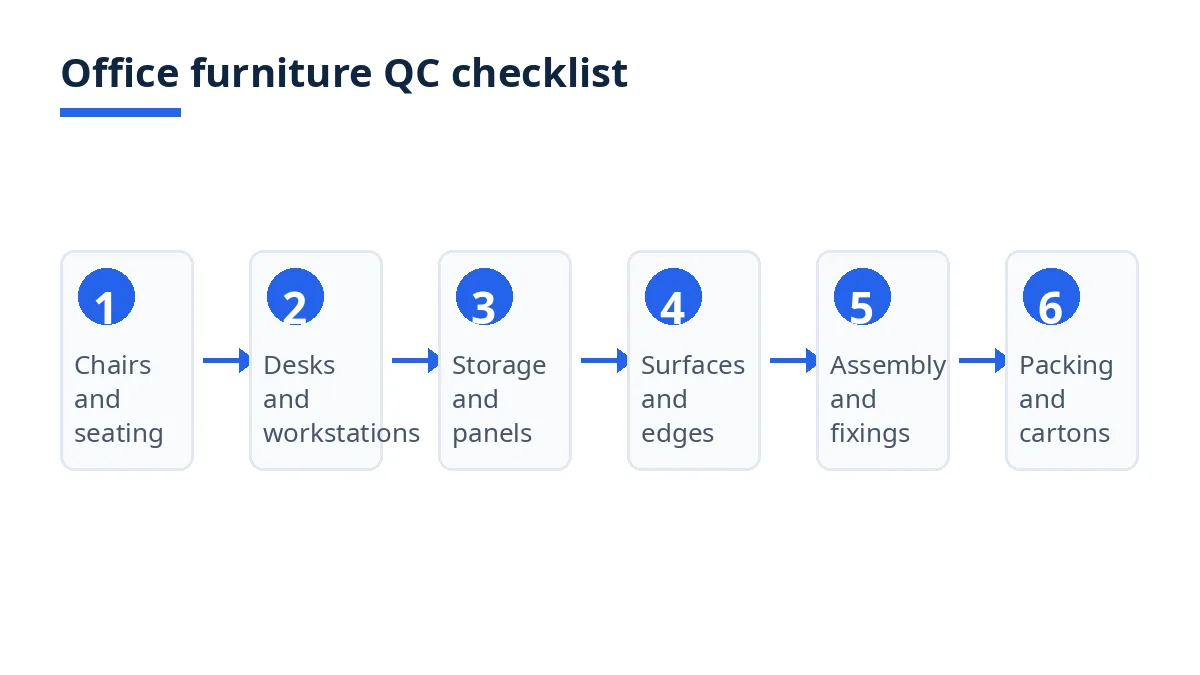
The full checklist (numbered, printable)
Chairs and seating
Check the chair type and adjustment range against the approved sample and chart, including seat height and depth, backrest height and armrest position. EN 1335-1:2020 gives seat height ranges by chair type, for example 400 to 520 mm for Type A chairs.2
Sit in each sampled chair and run every adjustment through its full range: seat height and depth, backrest height and angle, lumbar position, armrest position, and tilt tension and lock.
Check that each adjustment locks where specified, holds under load, and can be operated from the seated position without tools, unless the specification says otherwise.3
Check the gas lift: the chair rises and lowers smoothly, holds height under load, and does not sink or creep when loaded.
Check the tilt mechanism: the chair tilts and returns without sticking or noise, and the lock engages at each stated position.
Check the base and castors: all castors touch the floor, roll freely in every direction, and match the floor type named in the order. Check castor stems, fixings and any locking caster for secure fitting.
Check stability: tilt the chair back, lean to each side and reach forward as a user would, and confirm it does not tip or feel unstable.
Check armrests for secure fixing, even height on both sides where required, and no sharp edges, cracks or loose pads. Accessible edges of the seat, backrest and armrests must be rounded or chamfered, with a minimum radius of 2 mm under EN 1335-2.3
Check upholstery and mesh: even tension, no wrinkles, puckering, sagging, tears or loose stitching, and no frame edge pressing through the cover.
Check foam and seat comfort against the sample by sitting, and record any chair that bottoms out.
Desks, workstations and sit-stand mechanisms
Measure each desk and workstation against the chart: length, width, height, worksurface thickness and legroom, and record actual values.
Check desk stability: press down and push from each side and corner with the desk loaded as used, and confirm it does not rock or tip. ISO 9241-5 requires that a loaded worksurface does not tip over when a person leans on any side or sits on the edge.5
For height-adjustable desks, run the full travel under load, and check for even, level movement on both legs, with no judder, drift or noise.
Check sit-stand controls: the handset is reachable, the display where fitted matches the actual height, presets hold, and any anti-collision stop works as specified.
For electrically driven desks, check the motor, control box, cables and power supply for secure fixing, strain relief and tidy routing, and confirm the instructions name the correct power rating.
Check worksurface quality: flatness, even finish, secure edge banding with no lifting or sharp burrs, and no chips or dents, especially at corners and cut-outs.
Check cable management: trays, grommets, cable ports and modesty panels are fitted as specified, hold their cables, and leave no sharp edge where cables pass through.
Check monitor arms, CPU holders and screen mounts where supplied: secure fixing, full movement range without fouling the desk edge, and a load rating that matches the equipment they will carry.
Check modular and benching runs: bays line up, shared legs and beams are level, panel joints close without gaps, and levelling feet adjust for an uneven floor.
Storage units and panels
Check each storage unit against the chart: overall dimensions, drawer and door sizes, shelf positions and the load each shelf and drawer must carry.
Open and close every drawer, door and flap on sampled units: runners run smoothly under load, drawers do not bind or sag when extended, and doors close flush.
Check drawer and door locks: keys match the specification, locks engage and release cleanly, and any keyed-alike requirement is confirmed.
Check anti-tip behaviour: extend the drawers as specified, including the upper drawers, and confirm the unit stays stable and any anti-tip device is present.
Check panels, dividers and carcasses for square assembly, secure fixings, even gaps at joints, and no cracked board or exposed raw board where a finished edge is required.
Check handles, hinges and runners for correct type, secure fixing and matching finish across the unit.
Assembly, fixings and instructions
Assemble at least one sampled unit of each model using only the supplied instructions, fixings and tools. Record missing or incorrect fixings, unclear steps and any part that needs force to fit.
Check all fixings after assembly: bolts, cams, dowels and brackets are tight and complete, with no stripped threads, cracked inserts or loose joints.
Check labels and markings: model, finish, care and assembly warnings, and any market label required in the order are present, legible and match the purchase order.
Packing and cartons
Check that each carton contains the correct model, finish, quantity and fixings, and that the packing list and barcodes match the order.
Check protection: corners, edges, worksurfaces, glass where fitted, and moving parts are protected as specified, and nothing inside the carton can scratch or dent the furniture.
Weigh and measure sample cartons, check carton strength and sealing, and confirm flat-packed parts cannot shift enough to damage edges or mechanisms.
Check that instructions, keys and small parts are packed where specified, and that nothing required for assembly is loose.
Common failures and how to fix them
The most frequent failure is a chair that adjusts on the sample but not in bulk, usually because the gas lift, mechanism or caster specification changed. Stop, compare the bulk parts against the approved sample and the test report, and only then restart the line. Next is a sit-stand desk that drifts or runs unevenly: run the full travel under load on a sampled desk before more units are packed.
Desks that rock often trace to an out-of-square frame or a levelling foot that was never adjusted: assemble a sampled desk on a flat surface and re-check the frame jig. Drawer failure usually starts at the runner, so test loaded drawers, not empty ones. Panel gaps in a benching run point to one bay being out of level: level the run, then measure joint by joint.
Above the agreed acceptance level, options are re-inspection after sorting or rework, documented partial acceptance, or rejection. Record the decision and the re-check result.
Downloadable template / summary table
Copy the checklist into your inspection sheet, add the measurement chart and acceptance numbers, and record a result per unit.
Section | Checks | Evidence |
|---|---|---|
Chairs and seating | Adjustment range, gas lift, tilt, castors, stability, edges | Seated checks, measurements |
Desks and workstations | Dimensions, stability, height travel, cable management, panel fit | Measurements, loaded checks |
Storage and panels | Drawers, doors, locks, anti-tip, panel joints | Loaded checks, photos |
Assembly and fixings | Sample assembly, fixings, labels | Assembly record |
Packing | Contents, protection, carton marks | Packing list, carton checks |
How Exportain helps
Exportain is a B2B marketplace connecting buyers with Bangladeshi suppliers of office furniture, so the specifications behind this checklist can be agreed at the enquiry stage. Browse suppliers, read the furniture sourcing guide, and use inspection services when you plan the check. Exportain is not a party to the goods contract and does not inspect goods.
FAQs
When should this checklist be used?
Use it at final inspection, when goods are finished and largely packed. For larger and first orders, also use it in production, while mechanisms and desk frames can still be corrected.
Who should complete it?
The buyer, a local agent or an independent inspector can complete it, using the approved sample, measurement chart and a random sample.
What are the most common failures?
Chair adjustment and gas lift failure, uneven sit-stand travel, rocking desk frames, binding drawers, panel gaps and missing fixings are the failures buyers find most often.
Can a third party do it?
Yes, if you share the approved references, tolerances, test reports and acceptance levels first, and name the models and mechanisms the report must cover.
Next steps on Exportain
Before production starts, agree your measurement chart, tolerances, test methods and acceptance numbers, then read the AQL acceptance quality limit explainer and the pre-shipment inspection guide, and plan the check with inspection services.
Sources
- ISO 2859-1:1999 - Sampling procedures for inspection by attributes — Part 1: Sampling schemes indexed by acceptance quality limit (AQL) for lot-by-lot inspection. International Organization for Standardization (accessed )
- EN 1335-1:2020 - Office furniture - Office work chair - Part 1: Dimensions - Determination of dimensions. European Committee for Standardization (accessed )
- EN 1335-2:2018 - Office furniture - Office work chair - Part 2: Safety requirements. European Committee for Standardization (accessed )
- EN 527-2:2016 - Office furniture - Work tables - Part 2: Safety, strength and durability requirements. European Committee for Standardization (accessed )
- ISO 9241-5:2024 - Ergonomics of human-system interaction — Part 5: Workstation layout and postural requirements. International Organization for Standardization (accessed )
- BIFMA Product Conformance Program Announced. Bureau Veritas (accessed )
About the author
Sourcing from Bangladesh?
Post a request for quotation and suppliers on Exportain can send you their quotes directly.
Post an RFQ


