Quality Control Checklist for Nakshi Kantha From Bangladesh
A numbered QC checklist for nakshi kantha from Bangladesh: running stitch and motif alignment, thread color and dye bleeding, layer evenness, measurements, washing and care labels, and folding and packing, with fixes for common embroidery failures.
Short answer
Use this nakshi kantha quality control checklist to check running-stitch density and consistency, motif alignment and completeness, thread color and dye bleeding, layer evenness, measurements, washing and dimensional change, care and fibre labels, and folding and packing on kanthas from Bangladesh before shipment. Agree tolerances, test methods and acceptance numbers in the purchase order.
On this page
Key takeaways
Agree the sample, motif chart, tolerances, test methods and acceptance numbers before inspection, and draw the sample randomly across colors, sizes and cartons.
Judge embroidery stitch by stitch: count running stitches over an agreed length, check motif alignment and completeness, and inspect the back as carefully as the face.
Treat color as a lot-level risk: compare thread shade across pieces, check dark threads against light grounds for bleeding, and name the test method in the purchase order where lab evidence is required.
Fold and pack for embroidery: protect the embroidered face, avoid hard inserts that mark the stitching, and confirm carton contents and ratios against the packing list.
If you buy nakshi kantha from Bangladesh, use this checklist to judge a shipment before it leaves the factory. A kantha is judged on its embroidery: even running stitches, motifs placed as the sample shows, colors that do not bleed, and layers that lie flat. Check each sampled piece against the approved sample, size chart and packing specification, recording every point as pass, fail or not applicable.
Why this checklist matters
Nakshi kantha is an embroidered quilt made by layering cloth and quilting it with the simple running stitch, which typically produces a rippled effect.1 That construction concentrates risk in the stitching: a missed stitch, a knot left on the face, or a motif that drifts off center cannot be pressed out or hidden by folding, and a dye that bleeds in the first wash reaches the customer stained.
A written checklist removes interpretation: agree defect classes, the sampling plan and acceptance numbers in the purchase order, drawing the sample at random across colors, sizes and cartons. ISO 2859-1 provides sampling schemes indexed by acceptance quality limit (AQL) for lot-by-lot inspection by attributes.2 See the AQL acceptance quality limit explainer.
Before you start
Do not begin until the references are complete: an approved sample per design and color, the purchase order and packing specification, the size chart with tolerances, and a motif chart or photograph showing the intended placement of the central motif, borders and corner motifs. Most kanthas follow a basic pattern with a central motif and corner motifs pointing towards it, with smaller motifs filling the spaces between.1 Judge any departure against the approved sample.
Agree the sampling plan in advance.2 Check the label plan before bulk labels are printed. Under Regulation (EU) No 1007/2011, a textile product shall be labeled with the name and percentage by weight of all constituent fibers in descending order.3 For embroidered textiles, the regulation allows the composition to be given for the product as a whole, or stated separately for the base fabric and the embroidery yarn.3 ISO 3758 establishes a system of graphic symbols for care labelling.4
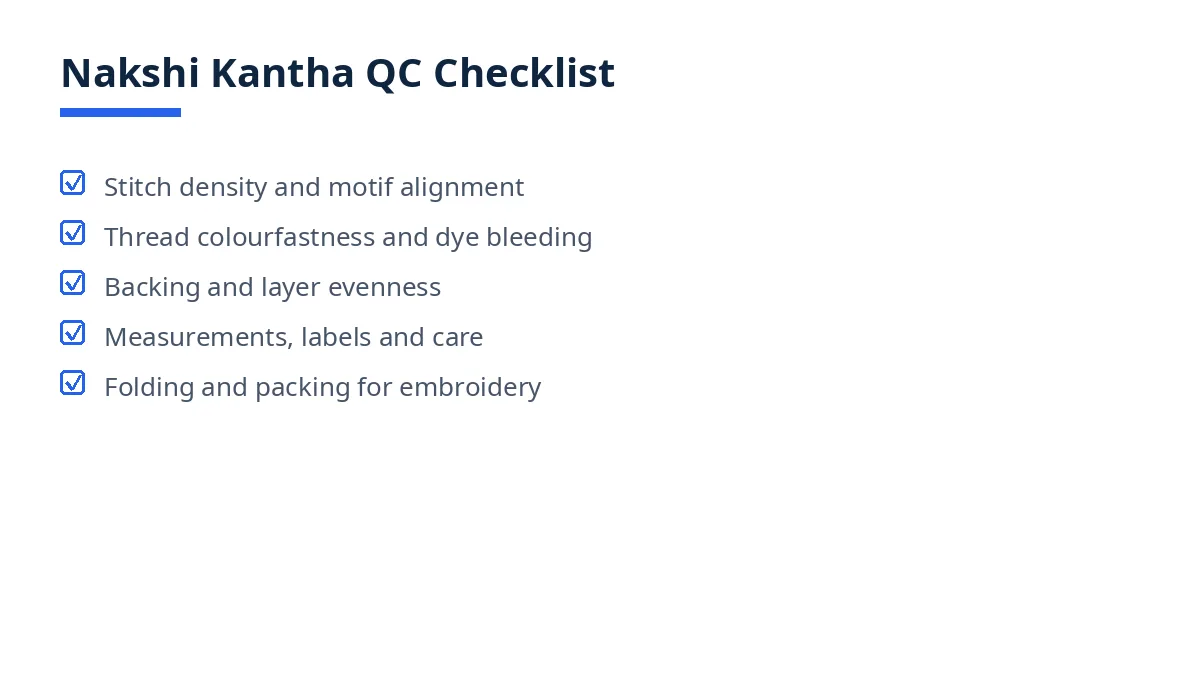
The full checklist
Measurements and overall size
Measure length and width of each sampled kantha laid flat and smoothed without stretching, comparing each measurement with the size-chart tolerance and recording actual values, not pass marks alone.
Check that opposite sides match and the piece lies flat, with no side pulled shorter by a tighter layer.
For sets or matched pairs, measure every piece, confirming pieces match each other in size and design.
Running stitch, motif and embroidery
Count running stitches over an agreed length in several places on each sampled piece, including center, border and corner motif, comparing density and length with the sample.
Check stitch consistency along each line: stitches stay even in length and spacing, with no long gaps where the needle skipped, no bunched stitches where tension changed.
Check every motif for completeness: no motif left half finished, no outline left open where the sample closes it, and no motif repeated, omitted or swapped with a motif from another design.
Check motif alignment: the central motif sits where the motif chart puts it, corner motifs point as the sample shows, borders run parallel to the edges, and spacing between repeated border units stays regular.
Check the back as carefully as the face: no missed stitches showing as gaps, no long floats of thread carried across the back, and no area where stitching has pulled through the cloth.
Check the whole piece for hand-embroidery defects: missed stitches, puckering, knots visible on face or back, and loose or unsecured thread ends.
Check edges and borders: border stitching is complete all the way around, corners match the sample, and no border unravels when pulled gently.
Thread, color and dye
Check thread colors against the approved sample under the same light for every sampled piece, including center, borders and corner motifs, recording any bulk substitution of thread color as a failure.
Check shade within each piece, between pieces of the same color, and across the order: thread from more than one dye lot can shift shade, so sort before packing.
Check for dye bleeding and staining on face and back, especially where dark thread sits against a light ground or a dark border meets a pale field.
Review washing fastness evidence where required. ISO 105-C06 specifies methods for determining the resistance of textile color to domestic or commercial laundering using a reference detergent.5
Review rubbing fastness evidence where required, because a kantha rubs against bedding and laundry in use. ISO 105-X12 specifies a method for determining the resistance of textile color to rubbing off and staining other materials, with dry and wet tests.6
Review perspiration fastness evidence where required for pieces used close to the skin. ISO 105-E04 specifies a method for determining the resistance of textile color to human perspiration.7
Confirm every color report names the bulk thread, color tested and lot, covering the darkest threads in the order.
Layers, backing and cloth
Check layer evenness: layers lie flat together with no bunching, no layer slipping out at an edge, and no empty patch where a layer is missing.
Check backing and face cloth for holes, stains, oil marks and weaving defects, panel by panel so the center is not missed.
Check that the cloth and thread named in the purchase order are the cloth and thread in bulk, recording any substitution as a failure.
Check the rippled texture the running stitch produces: it should be regular across the piece, not flat in one area and heavily gathered in another, which points to uneven tension.
Check for making damage: needle holes larger than the stitch, torn cloth at a knot, scissor nicks, and frame marks that do not wash out.
Washing, dimensional change and care labels
Review dimensional change evidence where required, for length and width after washing and drying. ISO 5077 specifies a method for determining dimensional change in specified washing and drying procedures.8
Check appearance after washing where required: motif shape, border straightness, layer flatness, puckering, and color migration onto the ground cloth.
Check the care label against the washing evidence: the label must describe a care routine the piece has actually passed, with symbols following ISO 3758.4
Check the care label states the agreed fiber composition in the destination market's required fiber names, and is legible, correctly positioned and secure.
Labels, claims and packing
Check size, brand and origin labels are present, legible and correctly positioned, and that barcode, size and design stickers scan and match the purchase order.
Check any claim on the product, such as a fiber claim or a handmade claim, matches the evidence agreed, recording unsupported claims as failures.
Check folding: fold each sampled kantha as the packing specification directs, with the embroidered face protected, so the fold does not crease across a motif.
Check packing materials: no hard insert, clip or tie can press a mark into the embroidery, no polybag or tissue can transfer color or lint onto the face, and pieces are not packed damp.
Check carton contents and ratios against the packing list, confirming set contents are complete before sealing.
Weigh and measure sample cartons, checking markings and carton count against the packing list.
Common failures and how to fix them
The most frequent failure is uneven running stitch: stitch length drifts across a piece, or one maker stitches tighter than another on the same order. Stop, compare the faulty piece with the approved sample stitch by stitch, and re-brief on stitch length and tension before more pieces are finished. Sort pieces already made; do not mix them into good cartons.
Next is motif drift: a central motif placed off center, or corner motifs that do not match the sample. This usually traces to marking, so check the marking template and motif chart before blaming the maker, and compare a re-marked test piece with the sample before bulk marking continues.
Dye bleeding is the failure buyers discover last, because it shows after washing. Where a dark thread bleeds, isolate that thread color, review the washing fastness evidence for that color,5 and do not ship the affected color on a visual check alone. Puckering usually starts at tension: re-stitch a test section at corrected tension before bulk rework.
Above the agreed acceptance level, options are re-inspection after sorting or rework, documented partial acceptance, or rejection.
Downloadable template and summary table
Copy the checklist into your inspection sheet, adding the size chart, motif chart, tolerances and acceptance numbers, and record results per piece.
Section | Checks | Evidence |
|---|---|---|
Measurements | Length, width, symmetry | Measurements |
Embroidery | Stitch density, motif alignment | Stitch counts, photos |
Color and dye | Shade, bleeding, fastness | Reports per color |
Layers and cloth | Layer evenness, cloth defects | Panel check |
Washing and care | Dimensional change, care label | Reports |
Packing | Folding, labels, ratios | Packing list |
How Exportain helps
Exportain is a B2B marketplace connecting buyers with Bangladeshi suppliers of nakshi kantha and home textiles, so checklist specifications can be agreed at the inquiry stage. Use inspection services when you plan the check, and read the pre-shipment inspection guide for how a final inspection is booked and run. Supplier profiles show which document and photo checks have been recorded, not factory inspections. Exportain is not a party to the goods contract and does not inspect goods.
FAQs
When should this checklist be used?
Use it at final inspection, when goods are finished and largely packed. For larger and first orders, also use it during production, while stitching errors can still be corrected.
Who should complete it?
The buyer, a local agent or an independent inspector can complete it, using the approved sample, size chart, motif chart and a randomly drawn sample.
What are the most common failures?
Uneven running stitch, motif drift, missed stitches and puckering, knots and loose ends, dye bleeding, shade differences between pieces, and layer bunching.
Can a third party do it?
Yes, if you share the approved sample, motif chart, tolerances and acceptance levels first, and confirm the inspector will check the embroidery stitch by stitch rather than measuring only.
Next steps on Exportain
Before production, agree your size chart, motif chart, stitch standard, tolerances, test methods and label wording, then read the AQL acceptance quality limit explainer and the pre-shipment inspection guide, and plan the check with inspection services.
Sources
- Nakshi Kantha. Banglapedia, Asiatic Society of Bangladesh (accessed )
- ISO 2859-1:1999 - Sampling procedures for inspection by attributes — Part 1: Sampling schemes indexed by acceptance quality limit (AQL) for lot-by-lot inspection. International Organization for Standardization (accessed )
- Regulation (EU) No 1007/2011 on textile fibre names and related labelling and marking of the fibre composition of textile products. European Union, (accessed )
- ISO 3758:2023 - Textiles — Care labelling code using symbols. International Organization for Standardization (accessed )
- ISO 105-C06:2010 - Textiles — Tests for colour fastness — Part C06: Colour fastness to domestic and commercial laundering. International Organization for Standardization (accessed )
- ISO 105-X12:2016 - Textiles — Tests for color fastness — Part X12: Color fastness to rubbing. International Organization for Standardization (accessed )
- ISO 105-E04:2008 - Textiles — Tests for color fastness — Part E04: Color fastness to perspiration. International Organization for Standardization (accessed )
- ISO 5077:2007 - Textiles — Determination of dimensional change in washing and drying. International Organization for Standardization (accessed )
- pre-shipment inspection
- quality control
- home textiles
- Bangladesh home textiles
- Nakshi kantha
- Embroidery inspection
About the author
Sourcing from Bangladesh?
Post a request for quotation and suppliers on Exportain can send you their quotes directly.
Post an RFQ