Quality Control Checklist for Mobile Phones From Bangladesh
A numbered QC checklist for mobile phones from Bangladesh: IMEI, software build, function, bands, battery and charging, accessories, labels and packing, with fixes for common failures.
Short answer
Use this mobile phones quality control checklist to check function, network bands and software build, IMEI agreement across device, label and carton, battery and charging, accessories, labels and packing on mobile phones from Bangladesh before shipment. Agree the sampling plan, inspection level and acceptance limits in the purchase order.

On this page
Key takeaways
Agree the specification, destination band list, sampling plan and acceptance limits before inspection, and draw the sample randomly across models, colors and cartons.
Check the IMEI on the device against the label and the carton for every sampled unit, and record any mismatch as a failure.
Review the battery file for the exact cell used, including IEC 62133-2 safety evidence and the UN 38.3 test summary, before cartons are closed.
Test the phone as a buyer will use it: calls on a test SIM, data, cameras, charging with the packed charger, and the full accessory set.
Use this mobile phones quality control checklist to check a shipment before it leaves Bangladesh. A phone can look correct in its carton and still fail on first use: the wrong software build, a band missing for the destination market, or an IMEI that does not match its label. Use an agreed sampling plan rather than units the factory selects. ISO 2859-1 specifies an acceptance sampling system for inspection by attributes, indexed in terms of the acceptance quality limit (AQL), applicable to end items.1
Why this checklist matters
Mobile phones concentrate risk in identity, software and the battery. A mismatched IMEI, a build loaded for another market, or a battery document naming a different cell creates returns and blocked sales after arrival.
Each point is checked against the approved sample, specification and purchase order, and recorded as pass, fail or not applicable. Set the inspection level and acceptance limits per defect class in the purchase order, using the ISO 2859-1 AQL-indexed system.1 See the AQL acceptance quality limit explainer and how to import mobile phones from Bangladesh.
Before you start
Do not begin until the references are complete: an approved sample per model, color and variant, the purchase order, the specification covering bands, languages, build and charger type, and the packing specification. Agree the sampling plan in advance,1 and draw the sample randomly across models, colors and cartons.
Check destination documents before labels are printed. For the European Union, Directive 2014/53/EU sets rules for putting radio equipment on the EU market and applies to devices such as mobile phones, with essential requirements for safety and health, electromagnetic compatibility and efficient use of the radio spectrum.2 Check the battery file at the same stage: IEC 62133-2 specifies requirements and tests for the safe operation of portable sealed secondary lithium cells and batteries, under intended use and reasonably foreseeable misuse.3
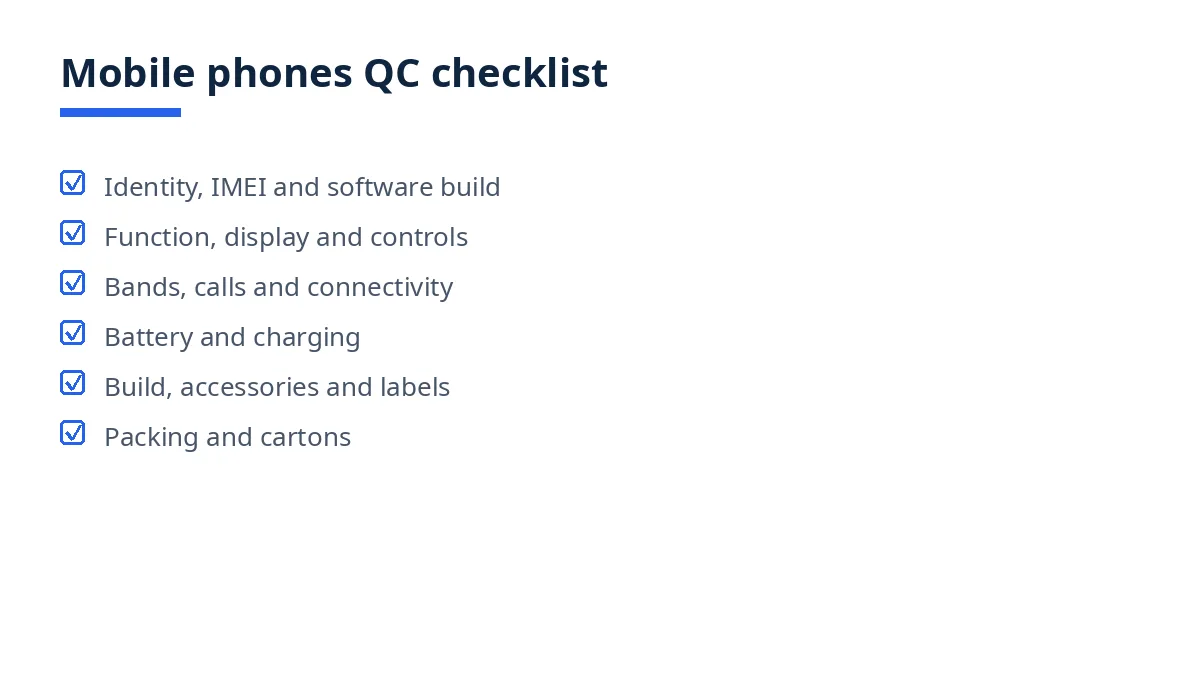
The full checklist (numbered, printable)
Identity, IMEI and software build
Record the model, color, memory and storage variant of each sampled unit and compare them with the purchase order and carton marking.
Display the IMEI and compare it with the device label and retail carton. The GSMA states that the IMEI is the 15 digit electronic serial number of a GSM technology cellular device, displayed by entering *#06# on the keypad, and on some devices also printed on a label behind the back cover or underneath the battery.4
Where a model carries a second IMEI, check both numbers the same way. Record any unit where device, label and carton disagree as a failure.
Check the serial number the same way across settings, label and carton, and keep the list with the report for warranty traceability.
Open settings and record the build, operating system version, languages and pre-loaded applications, against the specification.
Confirm the phone starts to the destination setup screen, with no carrier lock message, no activation block and no test account left signed in.
Function, display and controls
Power each sampled unit on and off, check it restarts cleanly, and check that no warning or battery alert appears at start-up.
Check the display for dead pixels, uneven backlight, lines, touch dead zones and discoloration, on white, black and color screens.
Swipe, tap and type across the whole screen, including corners, and check response follows the finger without ghost touches.
Check every button for travel, click and correct action, and test the fingerprint reader or face recognition named in the specification.
Make a test call: check earpiece, speaker, microphones, mute, speakerphone and the proximity sensor.
Test the cameras named in the specification, front and rear: focus, flash, video, playback, and no spots or haze in saved files.
Check vibration, the charging port, the SIM and memory card trays, and any headphone connection named in the specification.
Bands, calls and connectivity
Compare the bands and modes in the specification with the bands the destination networks require, and record the comparison in the report.
Insert a test SIM and confirm the phone registers, shows the correct network name, and holds signal during a call and data session.
Check Wi-Fi, Bluetooth pairing, location services and, where named, near field communication, each against a known test device.
Check the build carries the destination language, keyboard, time zone and emergency-call behavior agreed in the specification.
For EU orders, check the model against the radio equipment file for that market, because Directive 2014/53/EU applies to mobile phones and sets essential requirements covering safety and health, electromagnetic compatibility and efficient use of the radio spectrum.2
Where the order names a harmonised charging arrangement, check the receptacle against it. The EU summary of Directive 2014/53/EU, as amended, states that new handheld mobile phones in the covered categories must be equipped with the harmonised charging interface, namely a USB-C charging port.2
Battery and charging
Check the battery marking, model and rating in the phone or on the battery against the specification, and check for swelling, dents or loose fit.
Review battery safety evidence for the exact cell in this model. IEC 62133-2 specifies requirements and tests for the safe operation of portable sealed secondary lithium cells and batteries containing non-acid electrolyte, under intended use and reasonably foreseeable misuse.3
Review the transport evidence before cartons close. Under sub-section 38.3 of the UN Manual of Tests and Criteria, the test summary that shall be made available identifies the manufacturer, the test laboratory, a unique report number and date, a description of the cell or battery including its watt-hour rating, the tests conducted and their results, and a signature.5
Charge each sampled unit with the packed charger: check charging starts, the indicator agrees with the battery level, and neither phone nor charger overheats or stops.
Use a working sample during the inspection, through calls, video and data, and record any sudden drop, shutdown or restart as a failure.
Check the charge level at packing against the level the purchase order and the carrier require for a phone shipped with a battery installed.
Build, accessories and labels
Check case, screen and camera lenses for scratches, cracks, dust under the glass, gaps and color differences against the approved sample.
Check seams, screws and tray edges sit flush, with no sharp edge and no flex beyond the sample.
Open each sampled retail pack and check the accessory set against the specification: charger, cable, earphones where listed, SIM tool, case and guides.
Check the charger plug type, input rating and cable connectors against the destination market, and test one charger and cable from each carton group.
Check model, IMEI, serial, rating and origin labels on device and carton for presence, legibility and position, and that barcodes scan and match the packing list.
Check that any claim on the pack, such as memory size, camera count or charging claim, matches the unit inside and the evidence agreed.
Packing and cartons
Confirm each phone is packed as directed, with screen protection and inserts as specified, and that the box closes without forcing.
Check that set contents and unit ratios per export carton match the packing specification, and recount one opened export carton in full.
Check export cartons carry the markings and lithium battery marks the order and carrier require for phones shipped with batteries installed.
Weigh and measure sample export cartons, and check carton count, weights and dimensions against the packing list.
Photograph opened units, labels, failures and closed cartons, and attach them to the signed report.
Common failures and how to fix them
The most frequent failure is an IMEI mismatch between phone, label and carton, from labels applied in the wrong sequence or cartons mixed between variants. Stop packing, isolate those cartons, and re-check every unit in them before any replacement label is printed. Next is the wrong software build loaded in bulk: hold the lot and approve a re-flashed sample before the rest are touched.
A missing band or a carrier lock message points to the wrong variant: separate variants and re-check registration with a test SIM. Charging failures usually trace to a substituted charger or cable: replace the set from approved stock and retest. A swollen battery is not a rework item: remove the unit and review the battery evidence for that cell.
Above the agreed acceptance level, options are re-inspection after sorting, documented partial acceptance, or rejection.
Downloadable template / summary table
Copy the checklist into your inspection sheet, add the specification, band list and acceptance numbers, and record a result per phone.
Section | Checks | Evidence |
|---|---|---|
Identity and software | IMEI, serial, variant, build | IMEI list, settings photos |
Function | Display, touch, buttons, calls, cameras | Test call and photo records |
Bands and connectivity | Bands, SIM registration, Wi-Fi, Bluetooth | Band comparison, test SIM log |
Battery and charging | Battery marking, charging, documents | IEC 62133-2 file, UN 38.3 test summary |
Build and accessories | Case, lenses, charger, cable, guides | Accessory set check |
Packing | Retail box, labels, cartons, marks | Packing list, carton photos |
How Exportain helps
Exportain is a B2B marketplace connecting buyers with Bangladeshi suppliers of mobile phones and electronics, so the specification, band list and battery documents can be agreed at the enquiry stage. Browse suppliers, see the electronics, electrical and solar category and use inspection services when you plan the check. Profiles show which document and photo checks have been recorded, not factory inspections. Exportain is not a party to the goods contract and does not inspect goods.
FAQs
When should this checklist be used?
Use it at final inspection, when phones are finished and largely packed. For first orders, also use it on an early sample, while build, labels and accessories can still be corrected.
Who should complete it?
The buyer, a local agent or an independent inspector can complete it, using the approved sample, specification and a random sample.
What are the most common failures?
IMEI mismatches, the wrong regional build, a missing destination band, substituted chargers, and battery documents naming a different cell are the most common failures.
Can a third party do it?
Yes, if you share the sample, specification, band list and acceptance levels first.
Next steps on Exportain
Before production, agree your specification, band list, battery documents and label wording, then read the pre-shipment inspection guide and how to import mobile phones from Bangladesh, and plan the check with inspection services. You can also post a free RFQ via RFQs.
Sources
- ISO 2859-1:1999 - Sampling procedures for inspection by attributes — Part 1: Sampling schemes indexed by acceptance quality limit (AQL) for lot-by-lot inspection. International Organization for Standardization (accessed )
- Directive 2014/53/EU harmonising the laws of the Member States relating to the making available on the market of radio equipment - Summary. European Union (accessed )
- IEC 62133-2:2017 - Secondary cells and batteries containing alkaline or other non-acid electrolytes — Safety requirements for portable sealed secondary lithium cells and batteries, for use in portable applications — Part 2: Lithium systems. International Electrotechnical Commission (accessed )
- GSMA Device Check - What is the IMEI, MEID and ESN of the device. GSMA (accessed )
- Lithium Battery Test Summary in accordance with sub-section 38.3 of the UN Manual of Tests and Criteria. Transportation Development Group, (accessed )
About the author
Sourcing from Bangladesh?
Post a request for quotation and suppliers on Exportain can send you their quotes directly.
Post an RFQ