Men's Woven Shirts Price in Bangladesh: FOB Cost Breakdown for Buyers
No single FOB price for men's woven shirts in Bangladesh: what the shirting, collar and cuff build, buttons, wash and pressing add to the quote, and how to compare suppliers on the same specification.
Short answer
There is no single FOB price for men's woven shirts from Bangladesh. Each factory prices your shirting by the metre, collar and cuff construction, buttons and trims, sewing, washing and pressing, packing, and delivery to the vessel, so the FOB figure is a build-up, not a number to compare alone. Ask every supplier for the same specification, the same delivery term, and the same named port, with the figure broken into lines.
On this page
Key takeaways
There is no single FOB price for men's woven shirts from Bangladesh, because each factory prices your shirting, collar and cuff construction, buttons, wash, and packing for your specification.
Shirting bought per metre is usually the largest line, and consumption per shirt turns the metre price into the shirt price.
Collar and cuff construction, button material and size, and the wash and press standard are separate lines that move the quote independently.
Compare quotations only on the same tech pack, the same delivery term, and the same named port, with the FOB figure broken into lines.
Verification on Exportain is a document and photo review, not a factory inspection, and a badge is not a guarantee.
A men's woven shirt carries its price in parts a buyer can point to: the shirting cloth, the collar and cuffs, the buttons down the placket, the wash, and the press and fold at the end. Change any one of those parts and the quotation moves, even when the shirt still looks the same in a photograph. That is why a single unit price, on its own, tells a buyer very little about what is actually on offer.
Read a woven-shirt FOB figure as a build-up to the ship's rail, not as one number to push down. Free On Board is one of the 11 Incoterms 2020 rules, which allocate cost, risk and obligations between seller and buyer.1 The seller's price runs through shirting, cutting, sewing, washing, pressing, packing and delivery to the vessel at the named port; ocean freight and the buyer's import duty sit outside it, so two quotations compare only when they name the same term and the same port.
Woven shirts sit in a different part of the trade system from knitted tops. The Bangladesh Garment Manufacturers and Exporters Association (BGMEA), founded in 1983, is a trade association for the Bangladeshi apparel industry, and around 60 percent of its member factories are woven garment manufacturers.2 For classification, heading 6205 covers men's or boys' shirts, with cotton shirts under 6205 20 and shirts of man-made fibres under 6205 30.3 The tariff notes add that shirts are garments designed to cover the upper part of the body, having long or short sleeves and a full or partial opening starting at the neckline, and that they may also have a collar.3 State the fibre mix and the sleeve length in every enquiry, because each answer moves the cloth line and the classification line at once.
Why this matters for buyers and sellers
For the buyer, the FOB build-up is the baseline for the landed cost. A shirt quoted cheaply because its collar interlining is light, its buttons are thin, or its wash is skipped can cost more once returns, rework, or a replacement shipment are counted. The saving sits in a part of the shirt the buyer never priced, and it shows up only after the goods reach the store.
For the seller, the FOB figure has to absorb shirting bought by the metre, collar and cuff parts cut and fused separately, buttons ordered per style and colour, a wash lot, and a pressing line. None of those inputs can be shortened without changing the shirt itself. Quote comparison therefore starts with specification: ask every candidate to quote the same cloth, collar construction, button type, wash, and packing, on the same delivery term and named port.
Step-by-step: how it works
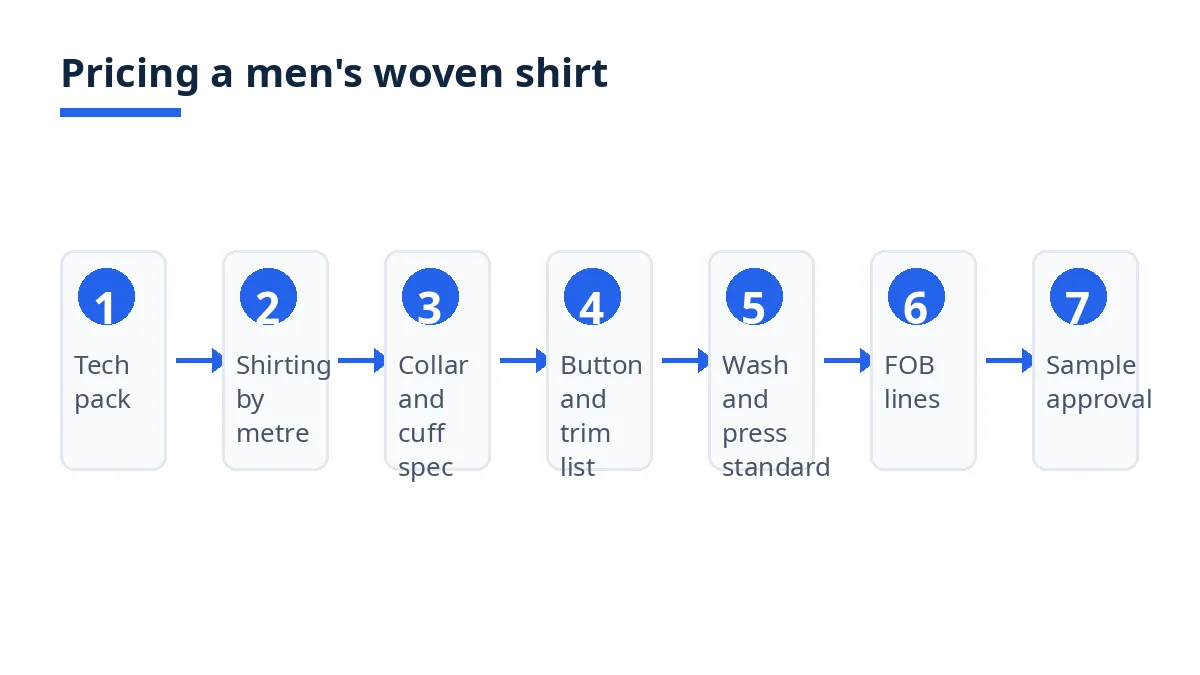
Fix the shirt on paper before any cloth is cut. Send a tech pack with the fit block, collar style and size, cuff style, placket type, pocket and flap details, yoke, sleeve length, size chart, measurement points and tolerances, stitching details, and button specification.
Choose the shirting by metre, weave and yarn count. State the fibre composition by percentage, the weave, such as poplin, oxford or twill, the yarn count, the weight, and whether the cloth is stocked, woven to order, or imported. Shirting is priced per metre, so consumption per shirt matters as much as the metre price.
Lock the collar and cuff construction. Name the collar style, the interlining weight and type, whether the collar is fused or sewn, the cuff shape and closure, and the buttonhole and button sewing standard. Collar and cuff work is the most labour-heavy part of a woven shirt, and a fused collar and a sewn collar are different offers.
Lock the button and trim list. List every button by size, material and colour, plus thread, pocketing where used, woven labels, care labels, hang tags, pins, clips, and carton, each with its material and finish. A shell or horn-look button ordered late can hold up an otherwise finished order.
Agree the wash and press standard in writing. Name the wash type, such as a simple rinse, an enzyme wash, or a silicone softening treatment, the target hand feel with a reference sample, and the pressing and folding standard. Ask whether washing and pressing are in-house or subcontracted, and whether the charge is per shirt or per wash lot.
Ask for the FOB figure broken into lines. Request shirting, collar and cuff construction, buttons and trims, cutting, sewing, washing and pressing, labels and packing, and inland delivery to the vessel as separate lines, with the delivery term and named port stated. A single lump sum cannot be compared or audited.
Approve samples in production order. Approve the proto sample for fit and construction, then a sample in the actual shirting with the agreed collar, buttons and wash, then a pre-production sample covering fit after washing, collar shape, button colour, labels and folding. Record each approval in writing, with measurements taken after washing.
Costs, timelines and documents
Reading an FOB build-up, line by line
Every FOB line answers its own question and moves for its own reason — shirting, construction, trims, wash and delivery each have their own driver.
FOB line | What it covers | What moves it |
|---|---|---|
Shirting fabric | Woven shirting bought per metre, cut per shirt | Weave, yarn count, fibre mix, consumption per shirt |
Collar and cuff construction | Collar and cuff parts, interlining, fusing or sewing | Collar style, interlining weight, fused or sewn build |
Buttons and trims | Buttons, thread, labels, tags, pins, carton | Button material and size, label print runs |
Cutting and sewing | Marker laying, cutting, stitching, placket and pocket work | Fit complexity, pocket and flap count, stitch density |
Washing and pressing | Wash lot, softening treatment, pressing, folding | Wash type, lot size per wash, folding standard |
Packing and inland delivery | Polybags, cartons, transport to the vessel | Packing style, carton size, distance to the port |
Example figures: a worked build-up for one shirt might read as shirting 3.40 dollars, collar and cuff construction 0.65 dollars, buttons and trims 0.35 dollars, sewing 1.20 dollars, washing and pressing 0.45 dollars, and packing and inland delivery 0.35 dollars, giving an example FOB figure of 6.40 dollars per shirt (3.40 plus 0.65 plus 0.35 plus 1.20 plus 0.45 plus 0.35 equals 6.40). These are example figures only, shown so the arithmetic of a build-up is visible, not a market price for any specification.
Consumption turns the metre price into a shirt price. Example figures: if one shirt consumes 1.6 metres of shirting, an order of 3,000 shirts needs 4,800 metres of cloth (1.6 multiplied by 3,000 equals 4,800), before cutting waste is allowed for. A long sleeve, a chest pocket with a flap, or a larger size range raises consumption per shirt, and a finer yarn count raises the cost of every metre consumed, so fit and cloth move the FOB figure together.
Timelines
Sampling depends on shirting availability and correction rounds, and bulk production depends on weaving or dyeing, collar fusing capacity, button delivery, wash lots and line capacity. Ask for sampling, shirting ready, production, wash and press, inspection, and shipment dates as separate lines, not a single delivery week. A delay in button delivery or in a wash lot moves the rest, even when sewing stays on schedule.
Documents in one line
For export clearance, confirm with the supplier which papers it files and check the set before shipment; the customs guidance names the export declaration and the papers enclosed with it.4
Bangladesh-specific rules and tips
Confirm association claims at the source. If a supplier claims BGMEA membership, confirm it with the association itself. BGMEA is a trade association for the apparel industry whose member base includes woven garment manufacturers,2 so membership signals an active garment business, not the collar construction, wash standard, or capacity on offer for your shirt.
State the fibre mix for the market you sell into. Regulation (EU) No 1007/2011 covers textile fibre names and the labelling and marking of the fibre composition of textile products.5 Send the fibre composition by percentage with the tech pack, and check that the care label and the fibre label on the approved sample match it, since a label correction after bulk cutting is slow and costly.
Ask where the wash and press happen. Some shirt factories wash and press in-house, while others send shirts to a laundry and finishing unit. A subcontracted wash adds a transport step and a lot queue, so ask which applies, what the lot size per wash is, and how shade and hand feel are checked across lots.
Agree the size ratio per colour before cutting. A woven shirt order spreads across sizes and colours, and the collar and cuff parts are cut per size. A ratio agreed late, or changed after cutting, leaves small sizes short and large sizes overstocked, so lock the ratio in writing with the purchase order.
Mistakes and red flags
Comparing shirts on unit price alone. A lower price on a lighter shirting, a fused collar instead of a sewn collar, a cheaper button, or a skipped wash is a different shirt. Compare only replies to the same tech pack on the same delivery term and named port.1
Leaving the collar out of the specification. The collar is the part a customer sees first and the part most likely to lose shape after washing. A quotation that names the shirting but not the collar interlining, fusing method, or collar point measurement is incomplete, whatever its price.
Accepting a wash standard verbally. Record the wash type, the reference sample, and the pressing and folding standard on the quotation and purchase order. A wash agreed in conversation cannot be checked when the bulk shirts arrive.
Treating a profile or a badge as a capacity check. A profile is a starting point for enquiries. A badge records a document and photo review, not a factory inspection, and it is not a guarantee of capacity, quality or delivery.6
Skipping the washed sample to save time. Collar shape, button colour, and measurements all shift in the wash. Approve the shirt after washing, in the actual shirting, before bulk cutting is released.
Checklist
Before you confirm, every line should be answered in writing.
Tech pack sent: fit, collar and cuff construction, placket, pocket, buttons, sizes, packing.
Shirting stated: fibre mix by percentage, weave, yarn count, weight, stocked or woven to order.
Collar and cuff construction stated: interlining weight and type, fused or sewn, cuff closure.
Button and trim list stated: button size, material and colour, labels, tags, carton.
Wash and press standard agreed: wash type, reference sample, pressing and folding standard.
FOB figure broken into lines, with the delivery term and named port stated.1
Size ratio per colour agreed before cutting.
Washed sample measured and approved in writing.
Export paper set confirmed with the supplier before shipment.4
Quotations compared on the same specification and delivery term.1
How Exportain helps
On Exportain, browse suppliers and post a request for quotation (RFQ) on the RFQ board with your tech pack summary, collar and cuff construction, button list, wash standard, and delivery term, so suppliers quote against the same specification. Ask each reply for its FOB figure broken into lines. When you accept a quotation, Exportain creates one order and issues one proforma invoice from the accepted terms.6
Verification on Exportain is a document and photo review, not a factory inspection, and a badge is not a guarantee.6 7 Read how supplier verification works on Exportain before relying on any badge, and read the MOQ definition guide before fixing your order quantity.
FAQs
What should I know first about men's woven shirts?
Start with the shirt itself, not the unit price. The FOB figure is a build-up of shirting bought per metre, collar and cuff construction, buttons and trims, sewing, washing and pressing, packing, and delivery to the vessel, all under one delivery term and named port.1 Men's or boys' shirts fall under heading 6205, with cotton shirts under 6205 20 and shirts of man-made fibres under 6205 30.3
What are the typical costs and timelines?
There are no typical figures a buyer can rely on, because each factory prices your shirting, collar build, buttons, wash, and packing for your specification, and each factory schedules sampling, weaving or dyeing, wash lots, and line time separately. Example figures in this guide show only how a build-up adds up, not a market price, and timelines should be requested as separate dates for sampling, shirting ready, production, wash and press, inspection, and shipment.
Which documents are needed?
The order documents are the tech pack, the itemized quotation, and the purchase order, with the collar and cuff construction, button list, wash standard, size ratio, and delivery term on both the quotation and the order. For export clearance, confirm the paper set with the supplier before shipment, following the customs guidance on the export declaration and its enclosures.4
What are the most common mistakes?
The most common mistakes are comparing unit prices on different shirts, leaving the collar construction out of the specification, accepting a wash standard verbally, and reading a badge as a guarantee. A badge records a document and photo review, not a factory inspection, and it is not a guarantee of capacity, quality or delivery.6
Next steps on Exportain
Browse men's woven shirts manufacturers in Bangladesh, check wholesale men's woven shirts in Bangladesh, then read the MOQ definition guide before posting your specification.
Sources
- Incoterms® 2020. International Chamber of Commerce (ICC) (accessed )
- Bangladesh Garment Manufacturers and Exporters Association (BGMEA). Sidley Austin LLP (accessed )
- Men's or boys' shirts - Northern Ireland Online Tariff. GOV.UK (accessed )
- Customs Clearance Procedures for Export. Bangladesh Customs, National Board of Revenue (accessed )
- Regulation (EU) No 1007/2011 on textile fibre names and related labelling and marking of the fibre composition of textile products. European Union, (accessed )
- Trust & Safety Center. Exportain (accessed )
- Supplier verification: Earn trust badges buyers can see. Exportain (accessed )
- supplier verification
- buyer guide
- Bangladesh sourcing
- bangladesh garments
- Men's woven shirts
- Woven apparel
About the author
Sourcing from Bangladesh?
Post a request for quotation and suppliers on Exportain can send you their quotes directly.
Post an RFQ