Men's Woven Shirts Exporters in Bangladesh: Verified Supplier Checklist
A numbered supplier checklist for men's woven shirts from Bangladesh: export papers, shirting fabric and yarn count, collar and cuff construction, pattern grading, washing and pressing, labels, packing and acceptance terms, with fixes for common failures.
Short answer
Use this checklist before paying a deposit to a men's woven shirts exporter in Bangladesh: confirm export registration, check shirting fabric and yarn count against the specification, examine collar and cuff construction on a washed sample, verify pattern grading across the full size range, review washing and pressing evidence, and agree labels, packing, sampling and acceptance terms in writing.
On this page
Key takeaways
Check export papers and factory control first, and name every subcontracted stage in writing before a deposit is paid.
Compare bulk shirting cloth with the approved sample on yarn count, weave, weight and shade, and treat any substitution as a stop until approved.
Judge collar and cuff work on a washed sample, since interlining, button placement and placket lie only show their faults after washing and pressing.
Measure grading at the smallest and largest sizes, not only the sample size, and write tolerances and acceptance numbers into the purchase order.
A woven shirt gives itself away at arm's length: collar points that mirror each other or do not, a cuff that closes flat or gaps, a button stance that runs straight or wanders. No drape or stretch hides a weak collar, a tired interlining, or an ungraded size curve. This article works in that order of visibility: cloth, collar and cuff, pattern, wash and press, labels and packing, with papers and terms last.
Mark each item clear, query, or block: clear means seen and matching, query means a dated written gap, block means the order waits.
Why this checklist matters
A shirt order puts most of its risk where the eye lands first. Collar, cuffs, and placket carry the finish of the whole garment, and shirting cloth carries a quieter risk behind them: two cloths can look alike on a hanger yet differ in yarn count, weave, and weight, showing only after washing, when a chest pulls or a sleeve comes up short.
Bangladesh supplies woven shirts at a scale that rewards comparison. Ready-made garment exports rose 6.10 per cent to US$10.58 billion in the July-September quarter of fiscal 2026-27, according to reporting in The Financial Express.1 The Bangladesh Garment Manufacturers and Exporters Association has also set membership criteria covering factory safety and operational standards.2 Neither fact certifies any single exporter, so request the same cloth, collar, grading, and wash evidence from each one first.
Before you start
Assemble the reference set before any exporter is contacted: the approved sample shirt, the tech pack with collar and cuff drawings, the size chart with tolerances for chest, body length, sleeve length, and collar circumference, the cloth specification naming yarn count, weave, and weight, care wording and packing specification. Agree a collar tolerance before sampling if the chart lacks one.
Ask each candidate for the same shirts-first evidence: cloth specifications and mill evidence, a washed sample shirt, graded measurements across the full size range, wash reports tied to the bulk cloth and colour, label proofs and maker papers.
The full checklist
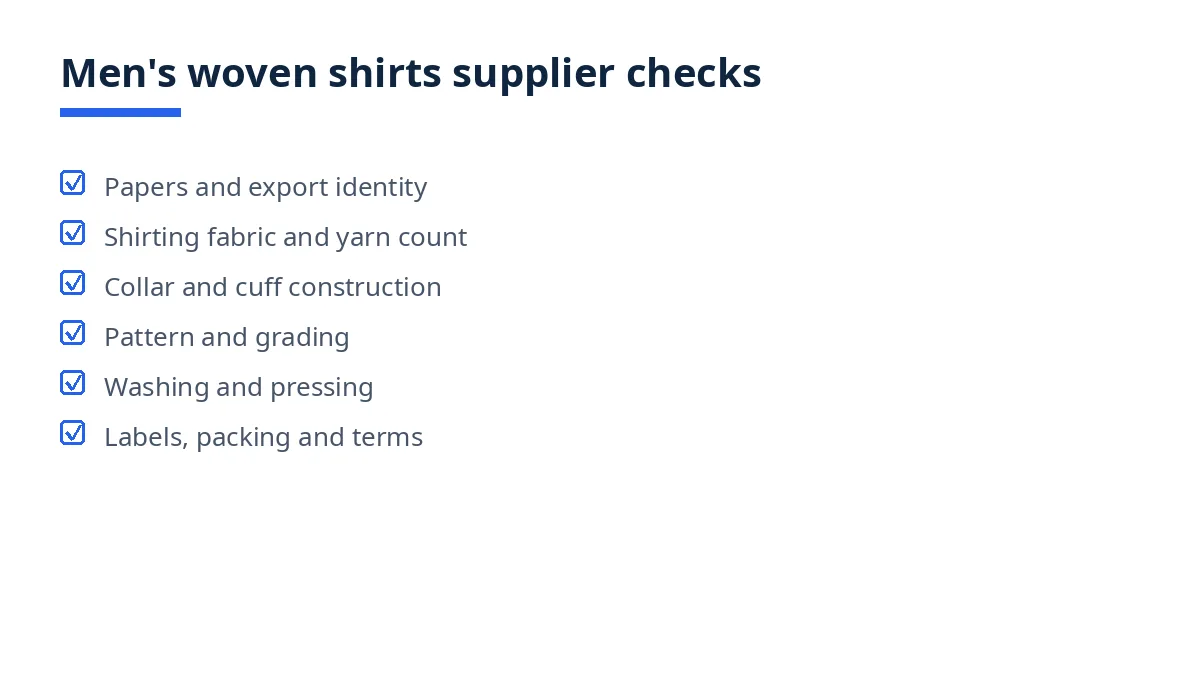
A. Shirting cloth: yarn count, weave, and shade
Compare the cloth specification with the approved sample cloth: fibre, yarn count, weave, weight, and finish, recorded side by side, not from memory.
Ask for the bulk cloth's mill certificate or test report; it must name the specification's yarn count, or the item blocks. Name the cloth supplier before cutting; a later mill change needs a fresh swatch and approval.
Lay a bulk swatch beside the sample and confirm the weave, whether poplin, oxford, twill, or another construction named in the pack.
Check shade and stripe or check alignment on swatches from different rolls, viewed together in the same light.
Ask how dye lots are kept apart in storage and cutting, and insist each complete size run comes from a single lot where the pack requires it.
B. Collar, cuff, and placket bench checks
Study the sample collar from both sides: points that match, a band of even width, and topstitching equidistant from the edge throughout.
Confirm collar interlining type and weight against the specification, then wash one sample collar and look for bubbling, creasing, or stiffening the flat sample hides.
Check both cuffs together: button positions that match, edges that sit square, and buttonholes cut cleanly without fraying at the ends.
Pull each collar, cuff, and placket button firmly by hand, confirm the thread shank lets it sit flat, and confirm buttons and thread match the trim description.
Button the shirt fully: the placket must lie flat, button spacing must match the tech pack, and buttonholes must line up without pulling the front askew.
Ask how collar and cuff settings are held across the size curve, since settings tuned for the sample size can drift at the smallest and largest sizes.
C. Pattern, grading, and sleeve behaviour
Measure the sample shirt and record every figure: chest, waist, body length, sleeve length, shoulder, and collar circumference, against the chart tolerances.
Measure the smallest and largest sizes, not only the sample size, against the chart. A curve that holds in the middle and drifts at the ends is a pattern fault, not a sewing fault.
Try the fit on a form or wearer in the sample size and one size either side, checking yoke, sleeve hang, and any pulling, gaping, or riding up.
Check the sleeve cap and armhole: a cap that puckers or an armhole that binds reads as a fit fault even when body measurements are correct.
Write the size chart, tolerances, and grading rules into the purchase order, so a bulk shirt outside tolerance is a defined failure, not a matter of opinion.
D. Wash, press, and finished appearance
Review washing evidence for bulk cloth and finished shirt: the change after washing decides whether chest, length, and sleeve stay inside tolerance. ISO 5077 specifies a method for determining the dimensional change of textiles in specified washing and drying procedures.3
Judge washed appearance on a sample shirt beside an unwashed approved sample: collar shape, cuff flatness, placket lie, seam puckering, button security, and any change in feel, shade, or size, recorded as a query with cloth and lot named. Every wash report must name its cloth, colour, and lot, so one cloth's report never clears another.
Check pressing on the washed sample: no shine marks on dark shirting, no creases pressed in where none belong, and collars and cuffs pressed to the same shape.
E. Labels, carton, and presentation
Approve fibre and care labels before bulk printing, checking care wording against wash evidence rather than habit. ISO 3758 establishes a system of graphic symbols for care labelling, covering the most severe treatments that do not cause irreversible damage.4
For the European Union, check fibre names against Regulation (EU) No 1007/2011 on textile fibre names and labelling of fibre composition.5
Confirm size, origin, and brand labels match the purchase order, and that care wording matches the wash evidence for the bulk cloth actually used.
Check packing against the specification: shirts folded or hung as specified, collars supported so they cannot crush, carton ratios matching the order, and carton markings matching the packing list.
F. Maker identity, papers, and order terms
Confirm the Export Registration Certificate (ERC); the export guide lists ERC registration with the Office of the Chief Controller of Imports and Exports (CCI&E) as step one of the export process.6 Licence, tax identification, and VAT registration (BIN) must match the ERC name; any mismatch blocks.
Confirm association membership and what it covers for this factory in practice, including its safety and operational criteria.2
Ask whether shirts are made in-house or subcontracted, and name every subcontracted stage, from cutting through washing and pressing, in writing before a deposit is paid.
Contact two references about repeat woven-shirt orders specifically, asking about collar and cuff consistency and grading across repeat runs, not about general garment supply.
Agree sampling plan, acceptance numbers, payment, lead time, minimum order quantity per style and colour, and rework terms in writing, including who bears the cost of collar, cuff, or grading failures. ISO 2859-1 covers acceptance sampling by attributes, indexed by acceptance quality limit (AQL); the numbers are yours to set.7
Common failures and how to fix them
A collar that looks correct flat and stands unevenly once buttoned usually traces to interlining that differs from the sample or to collar points cut from different cloth layers. Compare bulk interlining with the specification, cut and wash a fresh collar from bulk cloth, and hold the line until it stands evenly.
A cuff that closes on one wrist and gaps on the other usually traces to button placement. Re-check button positions against the tech pack across a full size run, and reset the line before more cuffs are finished.
A sleeve that comes up short after washing points to the cloth or the wash method. Re-check the wash report for the bulk lot, wash a finished sample, and hold further cutting until the washed sleeve length is inside tolerance.
Shade that shifts across a size run usually traces to more than one dye lot in the run. Re-sort size runs from single lots before packing; keep lots unmixed within each carton. If a lot crosses the level written in the order, settle it under that order: sort and re-inspect, rework, accept part of it in writing, or turn it away.
Summary table
Block | What to check | Evidence to keep |
|---|---|---|
Shirting cloth | Yarn count, weave, weight, shade, lots | Specification, mill evidence, swatches |
Collar and cuff | Points, interlining, buttons, placket | Washed sample, pull checks |
Pattern and grading | Measurements, size curve, yoke, sleeve | Graded measurements, fit notes |
Wash and press | Dimensional change, appearance, pressing | Wash reports, washed sample |
Labels and packing | Fibre, care, size, ratios, cartons | Label proofs, packing list |
Maker and terms | ERC, licences, maker stages, references, acceptance | Documents, references, purchase order |
How Exportain helps
Use Exportain to compare supplier profiles and read how supplier verification works on Exportain before sending the cloth specification, collar drawings, and size chart with an enquiry. Any agreement on cloth, collar, and grading still sits between buyer and supplier.
FAQs
When should this checklist be used?
Work through it during shortlisting, before funds move, and run it again whenever the cloth supplier, the collar or cuff design, or the commercial terms change.
Who should complete it?
Give the list to whoever stands in the factory with the sample: the buyer, a nearby agent, or a hired inspector. Work from the approved sample and written specifications, never a verbal brief.
What are the most common failures?
An uneven collar, a gapping cuff, a pulling placket, a sleeve that shortens after washing, shade differences across lots, and grading drift at the smallest and largest sizes.
Can a third party do it?
Yes. Share the approved sample, tech pack, tolerances, and acceptance levels before the visit, and require evidence per numbered item. A single overall verdict, without item notes, does not satisfy the list.
Next steps on Exportain
Once the cloth specification, collar and cuff drawings, size chart, and acceptance numbers are settled, shortlist through men's woven shirts manufacturers in Bangladesh and wholesale men's woven shirts in Bangladesh, then send the pack as an enquiry through RFQs.
Sources
- RMG exports rise 6.10pc to US$10.58b in July-Sept of FY27. The Financial Express, (accessed )
- BGMEA sets new membership criteria to ensure factory safety, operational standards. The Financial Express, (accessed )
- ISO 5077:2007 - Textiles — Determination of dimensional change in washing and drying. International Organization for Standardization (accessed )
- ISO 3758:2023 - Textiles — Care labelling code using symbols. International Organization for Standardization (accessed )
- Regulation (EU) No 1007/2011 on textile fibre names and related labelling and marking of the fibre composition of textile products. European Union, (accessed )
- Start an Export Business in Bangladesh (2026 Guide). Entrepreneurs.bd (accessed )
- ISO 2859-1:1999 - Sampling procedures for inspection by attributes — Part 1: Sampling schemes indexed by acceptance quality limit (AQL) for lot-by-lot inspection. International Organization for Standardization (accessed )
- supplier verification
- buyer guide
- woven garments
- Bangladesh sourcing
- bangladesh garments
- Men's woven shirts
About the author
Sourcing from Bangladesh?
Post a request for quotation and suppliers on Exportain can send you their quotes directly.
Post an RFQ