

Top Medical Scrubs Manufacturers in Bangladesh: How to Find and Verify Them
Medical scrubs supply in Bangladesh, sorted by factory type: what each type controls, why it matters on a ward, and the check that proves it before ordering.
Short answer
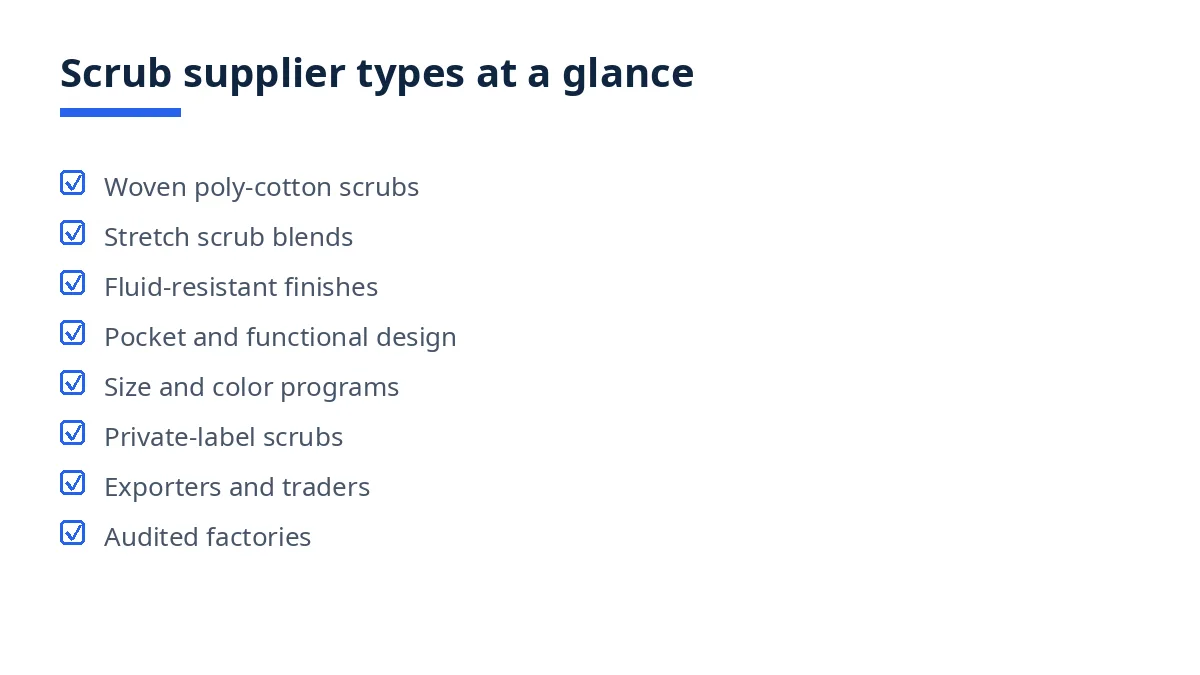
Medical scrubs manufacturers in Bangladesh fall into seven types: woven poly-cotton specialists, stretch and knit-blend makers, fluid-resistant finish-led makers, pocket and functional-design makers, size-range and colour-coded program suppliers, private-label OEM and ODM suppliers, and exporters, traders and compliance-audited factories. Match the type to the clinical role, then prove fabric, finish durability and pocket strength with a washed production sample before paying.
On this page
Key takeaways
Scrubs are work uniforms, not surgical barrier garments: scrub suits are excluded from the US surgical apparel definition, so judge fabric and finish claims on test evidence, not barrier levels.
Woven poly-cotton in 65/35 or 55/45 is the common general-program cloth; stretch blends suit high-movement roles but must prove recovery after washing.
Finish claims are only as good as their wash durability: ask for test results after a stated number of washes, and wash-test the production sample through the end user's real cycle.
Verification is a sequence: BGMEA listing, certificate scope check, washed production sample, pocket and size-range checks, and an agreed AQL inspection before payment.
A scrub set is worn for a full shift, moved in constantly, and washed again and again. That working life, rather than the color on a catalog page, decides whether a Bangladeshi supplier is right for a hospital, clinic, staffing agency or uniform brand. Bangladesh exports woven garments at scale: woven shipments earned US$4,614.80 million in the first quarter of fiscal 2026-27, up 5.11 per cent year on year, within ready-made garment exports of US$10,578.56 million, according to Export Promotion Bureau (EPB) data reported by The Financial Express.1 BGMEA, the woven and knitwear trade body, describes more than 4,000 factories in Bangladesh and lists the assessment frameworks its factories are measured against, including BSCI, WRAP, SMETA, ICS, the Higg Index, ZDHC and OEKO-TEX.2 The pool is large, so sorting it by what each supplier actually controls is more useful than sorting it by price alone.
One distinction shapes the whole purchase. Scrub suits are work uniforms, not surgical barrier garments: the United States surgical apparel regulation expressly excludes surgical suits and dresses, commonly known as scrub suits, from its surgical apparel definition.3 A supplier that quotes an AAMI barrier level for an ordinary scrub set is therefore describing the wrong product class. Ask instead what the fabric itself does: how it handles fluid, how it survives repeated washing, and what test evidence supports each claim. The types below follow that logic, from cloth to finished set to paperwork.
The list: medical scrubs manufacturers in Bangladesh by type
No single type covers every scrub program. A factory that sews crisp woven uniforms may still fail on stretch recovery, and a stretch specialist may have no answer for a fluid-resistant finish that must survive industrial washing. Read each type for what it controls, why that control matters on a ward, and the check that proves it before an order.
1. Woven poly-cotton scrub specialists
What they control. Factories whose regular output is woven poly-cotton scrub cloth and sets, most often in a 65/35 or 55/45 polyester-to-cotton balance. A scrub procurement guide describes poly-cotton blends in those ratios as the industry standard, with cotton supplying softness and breathability and polyester supplying wrinkle resistance and shape retention.4
Why it matters for scrubs. Poly-cotton is the default for general ward and clinic programs because it balances comfort, appearance after washing, and cost. Pure cotton breathes well but wrinkles and shrinks more under repeated industrial laundering, which is why the same guide notes it is less common for bulk hospital orders.4
Check before ordering. Ask for the exact blend, cloth weight and weave, then wash-test the sample in the production cloth rather than a showroom swatch. Confirm shrinkage and color change after washing, and ask whether the dye lot for a reorder will be matched to the first shipment or simply remade.
2. Stretch and knit-blend scrub makers
What they control. Suppliers working with polyester, rayon and spandex blends, or knit scrub fabrics, built for movement: bending, lifting, reaching and long periods on foot. The procurement guide notes that performance and stretch fabrics are increasingly chosen for comfort and range of motion during long shifts, with a warning to check durability under high-heat commercial laundering.4
Why it matters for scrubs. A scrub top that pulls across the shoulders or a trouser waist that loses recovery after twenty washes becomes a comfort complaint across a whole staff group, even when the seams hold. Stretch is a performance claim, not a fabric label, so it needs a wash test, not a brochure line.
Check before ordering. Measure stretch recovery on the washed sample, not the unwashed one, and check the waistband, knee and back panel after repeated washing. Ask which parts of the garment carry stretch and which are stable woven panels, because a fully stretchy trouser and a stable-waist trouser behave differently over a shift.
3. Fluid-resistant and finish-led scrub makers
What they control. Factories and finishers that apply fluid-resistant, soil-release or antimicrobial finishes to scrub cloth, and can state how long each finish lasts. The procurement guide lists fluid-resistant and antimicrobial finishes as important for high-exposure departments such as emergency, operating and intensive care areas, while noting that treatments must resist fluid penetration without giving up breathability.4
Why it matters for scrubs. A finish that beads water on a new sample but washes out in ten cycles leaves the buyer paying for protection that disappears early in the garment's life. Fluid resistance on a scrub is a fabric finish claim, and it must never be presented as surgical barrier certification, since scrub suits sit outside that device definition.3
Check before ordering. Ask for the finish name, the test method used, and test results after a stated number of washes, not only on new cloth. Wash the sample through the same cycle the end user will use, then repeat the fluid-beading check. If the supplier cannot produce wash-durability evidence, treat the finish as unproven and price the garment without it.
4. Pocket and functional-design scrub makers
What they control. Suppliers whose pattern work centres on how a scrub is used: chest and cargo pockets, pen slots, badge loops, reinforced pocket corners, and closures that survive repeated use. The procurement guide lists pocket configuration, reinforced stitching at pocket seams and inseams, and moisture-wicking properties among the functional specifications buyers should request.4
Why it matters for scrubs. Pockets carry phones, badges, pens and shears, so a pocket that gapes, tears at the corner or dumps its contents when the wearer bends is a daily failure, not a cosmetic one. Pocket placement also differs by role: a theatre nurse, a ward nurse and a technician do not carry the same tools in the same places.
Check before ordering. Send a pocket map with the tech pack showing every pocket, its size and what it must hold, then load-test the sample pockets and check the bartacks at each corner. Ask the supplier to confirm that pocket positions stay fixed across the full size range, since a pocket drawn for a medium can drift on very small or very large sizes.
5. Size-range and color-coded program suppliers
What they control. Suppliers set up for full staff programs: a wide size range, consistent grading from the smallest to the largest size, and color discipline across departments and reorders. The procurement guide warns that poor sizing range is a common procurement failure, and notes that many hospitals assign scrub colors by department or role for quick identification.4
Why it matters for scrubs. A program fails when new starters cannot be fitted, when a reorder arrives in a visibly different shade, or when one department's color drifts into another's. For a hospital system, the set is a roster tool as much as a uniform, and gaps in sizes or colors become staffing problems.
Check before ordering. Ask for the full size chart with garment measurements, not letter sizes alone, and order samples at the extremes of the range. Agree a shade standard for each color and a rule for reorders, and confirm that the supplier holds the same cloth and dye reference for top-up orders between main seasons.
6. Private-label OEM and ODM scrub suppliers
What they control. Suppliers that make scrubs under the buyer's own label, either to the buyer's tech pack (OEM) or from the supplier's own developed styles (ODM). The procurement guide notes branding and customization, including embroidered logos, department names and consistent color palettes across batches, as part of hospital and agency programs.4
Why it matters for scrubs. A brand or agency program lives or dies on repeatability: the same fit, the same pocket map, the same logo position and the same color on the tenth reorder as on the first. A supplier without pattern and grading discipline will drift, and the drift shows first on the largest and smallest sizes.
Check before ordering. For OEM work, judge the counter-sample against the tech pack line by line, including logo placement, label wording and packing. For ODM work, confirm the offered styles are the supplier's own and agree in writing who owns the patterns, grading files and embroidery files if the program moves supplier later. For how order quantity works across a range, read the guide to MOQ in the supply chain.
7. Exporters, trading companies and compliance-audited factories
What they control. Two different offers that buyers often confuse. An exporter or trading company sells garments made in partner factories and handles export documentation, while a compliance-audited factory holds current audits or certifications under schemes its buyers require. BGMEA lists BSCI, WRAP, SMETA, ICS, the Higg Index, ZDHC, GOTS and OEKO-TEX among the frameworks factories in Bangladesh are assessed against.2
Why it matters for scrubs. A trading company's export record says nothing about which sewing line makes a scrub set, and a certificate says nothing outside its scope. Both can be useful, but neither replaces a fabric wash test or a pocket check, and a buyer who accepts either as a shortcut will discover the gap at delivery.
Check before ordering. With a trader, get the producing factory named in writing before paying a deposit, and inspect that factory's scrub work specifically. With an audited factory, check the certificate number with the issuing body, confirm the address on it matches the producing site, and confirm the expiry date and the exact standard and product category it covers.
Summary table
Type | Best for | Main check before ordering |
|---|---|---|
Woven poly-cotton specialist | General ward and clinic programs | Washed sample in production cloth, shrinkage and shade |
Stretch and knit-blend maker | High-movement roles, long shifts | Stretch recovery after washing, waist and knee panels |
Fluid-resistant and finish-led maker | High-exposure departments | Finish test results after stated wash cycles |
Pocket and functional-design maker | Role-specific tool carrying | Loaded pocket test, bartacks, pocket position across sizes |
Size-range and color-coded program supplier | Whole-staff programs, reorders | Extreme-size samples, shade standard for reorders |
Private-label OEM / ODM supplier | Own-label brands and agencies | Tech pack match, pattern and embroidery file ownership |
Exporter, trader or audited factory | Mixed orders, audited programs | Producing factory named, certificate scope and expiry |
How Exportain helps
Exportain is a B2B marketplace for sourcing from Bangladesh. Buyers search published products by keyword and category, and can filter to suppliers holding the Exportain Verified badge, sample availability and OEM or ODM capability, and sort by MOQ or lead time.5 Each supplier profile shows its verification level, location, main products and the certifications the supplier has declared.5 Buyers then post a request for quotation stating quantity, target price, destination, Incoterm, required certifications and deadline, and suppliers in that category quote against it.5
Treat the profile as a shortlist, not a conclusion. Verification on Exportain is a document and photo review by the Exportain team, not a factory inspection, and membership never grants a badge.6 Run the scrub-specific checks above on every shortlisted supplier, including the fabric wash test and the finish-durability question, and keep the agreed specification, sample approval and inspection terms in the quotation thread. Agree inspection and payment terms in writing before any payment.
FAQs
What is the biggest mistake?
Ordering scrubs as if they were an ordinary uniform, on color and unit price, without testing the cloth the way the end user will wash it. A set that looks right on arrival can lose its finish, its shade or its fit within weeks of industrial laundering, and by then the whole program is affected. The mistake is treating the sample as the product and the wash test as optional.
How can I avoid it?
Write one specification that covers fabric blend and weight, finish and its wash durability, pocket map, size range with garment measurements, color standard and packing, and send the identical document to every supplier quoted. Approve a sample made from production cloth, wash it through the end user's cycle, and check shrinkage, shade, pocket strength and finish behavior before confirming the order. For traditional hot-water healthcare laundry cycles, CDC guidance cited by a linen specialist specifies washing with detergent at 160 degrees Fahrenheit (71 degrees Celsius) or higher for at least 25 minutes, so a wash test that never reaches the real cycle proves little.7
Who is responsible?
Both sides, at different points. The factory is responsible for making sets to the agreed specification and the approved sample, including the stated fabric, finish and size range. The buyer is responsible for making that specification complete and checkable, and for inspecting against it before shipment. Set the inspection standard in the order: ISO 2859-1 specifies sampling schemes indexed by acceptance quality limit (AQL) for lot-by-lot inspection, so a shipment can be accepted or rejected against a published rule instead of an opinion.8 When a dispute starts, the side holding the written specification, the washed sample and the inspection report holds the stronger position.
Where can I get help?
Start with the records that exist: BGMEA member listings for registration and the certificate issuer for any audit or fiber claim.2 For fabric and finish questions, ask an accredited textile laboratory for test reports on the production cloth, and ask the supplier for wash-durability evidence rather than a finish claim alone. On Exportain, read what each profile badge covers before relying on it, and message the supplier through its profile so questions and answers stay in one thread.6
Next steps on Exportain
Browse Bangladeshi suppliers and filter the scrub and woven listings by badge, MOQ and OEM or ODM capability. Before you order, read how supplier verification works on Exportain so you know what each badge covers. Then post a free RFQ with your scrub specification, fabric and finish requirements, size range, quantity, destination and Incoterm, and compare the versioned quotations that come back.
Sources
- RMG exports rise 6.10pc to US$10.58b in July-Sept of FY27. The Financial Express, (accessed )
- BGMEA | Home. Bangladesh Garment Manufacturers and Exporters Association (BGMEA) (accessed )
- Surgical Gown (K192560) — FDA 510(k). Innolitics (FDA 510(k) record), (accessed )
- Nurse Scrub Uniform Requirements: A Procurement Guide. Xingye Textile, (accessed )
- How to source and buy from Bangladesh. Exportain (accessed )
- Supplier verification: Earn trust badges buyers can see. Exportain (accessed )
- Healthcare Linen and Infection Prevention, Part 1: Proper Handling of Soiled Linen. Superior Linen Service, (accessed )
- ISO 2859-1:2026 — Sampling for Inspection by AQL. American National Standards Institute (ANSI) (accessed )
About the author
Sourcing from Bangladesh?
Post a request for quotation and suppliers on Exportain can send you their quotes directly.
Post an RFQ


