Typical MOQ for Live Eels in Bangladesh (and How to Negotiate It Down)
No single live-eels MOQ in Bangladesh: how tank batches, size bands, shipment quantity, transit limits, and mortality buffers set the minimum, and how to negotiate it down.
Short answer
There is no single typical MOQ for live eels from Bangladesh. Each supplier sets a minimum per size band and grade, per holding-tank batch, and per live-transport shipment, within the transit-time limit for the route and an agreed mortality buffer. Ask for each line separately in writing, then negotiate the structure: one size band, one consolidated shipment, and a written repeat commitment.
On this page
Key takeaways
There is no single typical MOQ for live eels from Bangladesh, because each supplier sets a minimum for your specification rather than a shared standard figure.
Five lines set the floor: the size and grade mix, the holding-tank batch, the live-transport shipment quantity, the transit-time limit, and the mortality buffer.
Ask for the minimum per size band, per tank batch, and per shipment in writing, and record which line is binding for your quantity.
Negotiate the structure first: one size band, one consolidated shipment, and a written repeat quantity and price for the same specification.
Exportain verification is a document and photo review, not a factory inspection, and a badge is not a guarantee of capacity, quality, or delivery.
A buyer asking a Bangladeshi supplier for a small trial shipment of live eels often hears a minimum far larger than the trial. The gap is rarely a refusal to sell small amounts. It comes from how the minimum is built: one holding-tank batch, one size and grade mix, one live-transport shipment, and a transit window that cannot be stretched. There is no published standard minimum for live eels from Bangladesh. Each supplier sets a minimum for your specification, and the binding line is usually not the order total.
What builds the minimum for live eels
What should I know first about live eels?
The minimum is set by living stock and moving water, not a warehouse shelf. Five pieces stack into the quoted number, and each can be negotiated separately.
Size and grade mix. A shipment sorted into several size bands and grades needs a separate holding, grading, and counting pass for each band, so more bands mean a higher minimum per band. One size band in one grade grades once and packs once, so it prices lowest.
Holding-tank batch. Eels are held in tanks before packing, and a tank batch is run as a unit. Water, oxygen, labour, and observation go into the batch whether it is full or partial. A quantity below one batch still uses the batch, so the supplier either refuses it or prices the unused capacity into your order.
Live-transport shipment quantity. A live shipment is packed in bags or tanks with water and oxygen, inside outer boxes, and travels as one air consignment. Packing, documentation, and handling are fixed for the consignment, so a very small shipment carries the same fixed work as a larger one. Ask for this line separately, because the higher line binds.
Transit-time limit. Live aquatic animals travel under density and oxygen limits. The World Organisation for Animal Health states that stocking densities for transport by air should be set by the total volume of space for each type of aquatic animal and the oxygenation capacity available on the ground and during all stages of the flight, with the space for each species complying with acceptable densities for that species.1 A longer route or a missed connection can therefore change the shipment.
Mortality buffer. Some eels may not survive transit, so buyers and suppliers agree in advance how dead-on-arrival stock is counted and credited. The buffer is a commercial term, not a standard percentage. Ask whether it is counted in pieces or weight, at loading or arrival, and who carries the cost above it.
Piece of the minimum | What sets it | Ask for it in writing |
|---|---|---|
Size and grade mix | Grading and counting per band | Quantity per size band and grade |
Holding-tank batch | Tank, water, oxygen, and labour per batch | Tank batch size and batches used |
Live-transport shipment | Packing, documentation, and handling per consignment | Minimum shipment quantity |
Transit-time limit | Space and oxygen capacity on the route | Route, connections, and missed-flight plan |
Mortality buffer | Agreed counting point and credit rule | Buffer, counting point, and credit |
Example figures: a supplier defines one tank batch as 400 kg and one shipment as 300 kg. A buyer ordering 250 kg in two bands fills neither line, at 125 kg per band. The same 400 kg in one band fills one tank batch and clears the shipment line. The figures show structure only, not a typical MOQ, price, or transit time.
Why this matters for buyers and sellers
For the buyer, the minimum decides how much live stock is at risk in one shipment and how much cash sits in a tank at the destination. A first order too large for the destination tank creates a second problem on arrival, so a minimum that fits the tank and sales pace beats a lower price on an unmanageable quantity.
For the seller, the minimum protects a batch that cannot return to a general pool once graded and packed for one buyer. A short shipment still uses the tank batch, packing line, and consignment handling.
Two controls keep the discussion grounded: classification, where heading 0301 covers live fish and subheading 0301.92 covers eels of the genus Anguilla,2 and one delivery term for every quotation. The Incoterms 2020 rules allocate cost, risk, and obligations,3 so compare minimums only on the same term and route.
Step-by-step: how it works
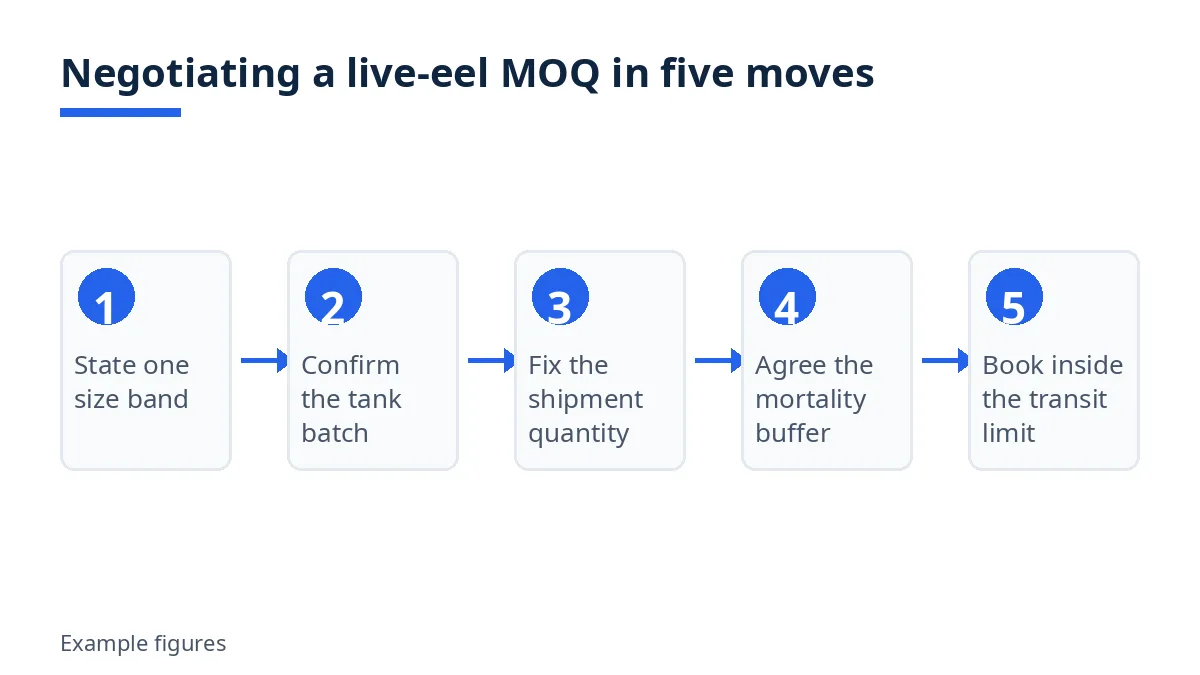
State one specification for every candidate. Give the species and scientific name, the size band, the grade, the quantity per band, the destination, and the route. Without a size band, the supplier cannot count the grading passes.
Ask for the minimum line by line. Ask for the tank batch size, the minimum per band and grade, the minimum shipment quantity, and the transit limit on your route. Record which line binds.
Confirm the holding and packing plan. Ask how the eels are held and how oxygen and water are set for the transit time. Containers for aquatic animals must be designed to withstand the weight of the animals and water and to ensure their safety during transportation, and containers in transit must prevent accidental release of water.1
Agree the mortality buffer and the counting point. Write the buffer, whether it is counted in pieces or weight, at loading or arrival, and what credit applies above it. Count the arrival using the agreed procedure, and report any loss within the agreed window.
Approve a trial shipment on trial terms. Price a trial as a trial: one size band, one shipment, a stated buffer, and a written repeat quantity and price. Do not treat it as a promise of a lower standing minimum until the repeat terms are written down.
Confirm documents and the delivery term before you confirm. Write the delivery term and named place into the purchase order, following the Incoterms 2020 rules,3 and confirm the export set.
Levers that lower the minimum without cutting corners
Negotiation works when you change the piece that sets the floor, not when you ask for an exception. Each lever trades something you control for a lower minimum, and each one should be written into the quotation.
Use one size band. Cutting three size bands to one removes grading passes and raises the quantity per band. If your market needs more than one band, ask whether bands can ship separately.
Consolidate into one shipment. Two small shipments on two dates use two tank batches, packing lines, and consignments. One consolidated shipment uses each once, and if the destination can hold it, consolidation is often the largest lever.
Commit to a repeat. A written repeat for the same specification lets the supplier plan the next tank batch around your first one. Offer a repeat quantity and window, and ask for the repeat minimum in writing.
Costs, timelines and documents
What are the typical costs and timelines?
There are no typical costs or timelines a guide can state as fact, because each supplier prices your species, size band, tank batch, packing, route, and delivery term separately. The drivers are the tank batch, grading passes, packing and oxygen for the route, freight, and buffer term. Ask for unit price, packing and consignment costs, freight, and buffer credit as separate lines, and compare quotations only on the same size band, route, and delivery term.3
For timelines, ask for holding ready, packing, departure, and arrival dates as separate lines, and agree the missed-connection plan.
Which documents are needed?
For export clearance in Bangladesh, goods may not be loaded unless a Bill of Export or Shipping Bill is submitted to Customs and approved.4 Enclosed documents include the export contract or purchase order where there is no export letter of credit, the commercial invoice, the packing list, the EXP form certified by an authorized dealer, and a certificate of origin from the EPB or a Chamber of Commerce and Industry.4 Bangladesh Customs also lists product-wise additional documents, including a Department of Fisheries quality control certificate where the destination requires one for fish products.4 Ask the supplier and destination authority whether a health or quality certificate is required, and get the answer in writing before packing.
The order documents are the specification, the itemized quotation with the minimum per band, batch, and shipment, and the purchase order with the buffer, counting point, and delivery term. The species and scientific name should match on every paper, because heading 0301.92 covers eels of the genus Anguilla while other live fish fall under subheading 0301.99.2 If the stock is not Anguilla, do not let it be declared as 0301.92.
Bangladesh-specific rules and tips
Confirm the species before you discuss quantity. Grading, holding, and transit limits are set per species.1 State the scientific name in the enquiry and ask the supplier to confirm it. A quotation naming only "live eels" cannot be compared with one naming a species and size band.
Keep one legal name across every paper. The export declaration names the exporter and the foreign buyer,4 so the name on the trade licence, quotation, proforma invoice, and payment account should match. A mismatch can delay clearance, and a live shipment has less time to absorb a delay.
Ask which destination papers apply to live stock. Destination rules for live aquatic animals are set by the destination country, and Bangladesh Customs notes additional product-wise documents may be necessary for some categories.4 Confirm the destination import, health, and quarantine papers with the destination authority, not only the supplier, before grading.
Do not let a profile stand in for a holding check. A profile can show a business, but not tank capacity, grading practice, or packing for your route. Ask for dated photos of the holding facility, grading area, and packing set-up, and how many batches it can hold at once.
Mistakes and red flags
What are the most common mistakes?
Asking for a total MOQ only. The binding line is usually per band, per tank batch, or per shipment. An order can clear the total and still fall below the per-band line for one band, which then carries a surcharge, a removal, or a refusal.
Comparing minimums on different size bands or routes. A lower minimum on a single band, a shorter route, or a different term is a different offer. Compare only replies to the same specification, route, and Incoterm.3
Accepting a verbal mortality buffer. A buffer agreed in conversation and counted differently on arrival is a dispute waiting for a shipment. Write the buffer, counting point, and credit rule into the quotation and purchase order.
Ignoring the transit limit. A quantity that fits the tank but not the route will be repacked, split, or delayed. Agree the route and missed-flight plan before grading.
Treating a badge as a holding check. A badge records a document and photo review, not a factory inspection, and guarantees neither capacity, quality, nor delivery.5 Trial and arrival-count discipline stay with you even with badges.
Paying fixed costs twice. Keep the paid packing and consignment lines from the first order and attach them to the repeat enquiry, so the repeat is priced on the same structure.
Checklist
Before you confirm, every line should be answered in writing.
Species and scientific name confirmed on the quotation.
Size band and grade stated, with quantity per band.
Tank batch size confirmed, and batches used named.
Minimum per band, batch, and shipment confirmed; binding line named.
Route, connections, and missed-flight plan agreed.
Mortality buffer, counting point, and credit rule in the quotation and purchase order.
Packing, consignment, and freight costs itemized apart from unit price.
Trial terms stated, with a written repeat quantity and price.
Export set agreed: Bill of Export, invoice, packing list, EXP form, certificate of origin, plus any destination health or quality paper.4
Quotations compared on the same specification, route, and delivery term.3
Arrival count procedure agreed, with a reporting window.
How Exportain helps
On Exportain, browse suppliers and post a request for quotation (RFQ) on the RFQ board with your species, size band, quantity per band, route, and delivery term, so suppliers quote on the same specification. Ask each reply for its tank batch, minimum per band, minimum shipment quantity, and mortality buffer term.
Read the badges for what they record. Exportain Verified means Exportain has checked identity, phone, email, and business registration, and Export Verified means it has checked the Export Registration Certificate (ERC).5 Factory Verified means it has reviewed photos of the manufacturer factory, while Trading Company Verified means it has reviewed photos of the trading company office or warehouse.5 Verification is a document and photo review by staff, free, and never granted by membership plans.5 6 It is not a factory inspection,5 6 so tank and arrival checks stay with you. See how supplier verification works on Exportain.
When you accept a quotation, Exportain creates one order and issues one proforma invoice from the accepted terms.5
FAQs
What should I know first about live eels?
The minimum is built from the size and grade mix, the tank batch, the shipment quantity, the transit-time limit, and the mortality buffer. Heading 0301 covers live fish, and subheading 0301.92 covers eels of the genus Anguilla.2 Ask for each line separately, because the total alone cannot tell you whether the order can run.
What are the typical costs and timelines?
There are no typical figures a buyer can rely on, because each supplier prices your species, size band, tank batch, packing, route, and delivery term separately. Tank batch, grading passes, packing and oxygen, freight, and the buffer term drive the price,3 and holding, grading, packing, and connections drive the timeline. Ask for each cost and date as a separate line.
Which documents are needed?
The order documents are the specification, the itemized quotation, and the purchase order with the minimum per band, batch, and shipment, the buffer, and the delivery term. The export set is the Bill of Export, commercial invoice, packing list, EXP form certified by an authorized dealer, and a certificate of origin from the EPB or a Chamber of Commerce and Industry,4 plus any health or quality paper the destination requires for live fish products.4
What are the most common mistakes?
The most common mistakes are asking only for a total MOQ, comparing minimums on different bands, routes, or terms,3 accepting a buffer verbally, ignoring the transit limit, and reading a badge as a guarantee. A badge is not a guarantee of capacity, quality, or delivery.5
Next steps on Exportain
Browse suppliers, then post your species, size band, and route on the RFQ board so suppliers state their tank batch, per-band minimum, and shipment minimum. Before you confirm, read how supplier verification works on Exportain and the MOQ definition guide.
Sources
- Control of risks associated with the transport of aquatic animals. World Organisation for Animal Health (accessed )
- Chapter 3: Fish and crustaceans, molluscs and other aquatic invertebrates, Australian Customs Tariff. Australian Border Force (accessed )
- Incoterms® 2020. International Chamber of Commerce (ICC) (accessed )
- Customs Clearance Procedures for Export. Bangladesh Customs, National Board of Revenue (accessed )
- Trust & Safety Center. Exportain (accessed )
- Supplier verification: Earn trust badges buyers can see. Exportain (accessed )
About the author
Sourcing from Bangladesh?
Post a request for quotation and suppliers on Exportain can send you their quotes directly.
Post an RFQ