Top Live Crabs Manufacturers in Bangladesh: How to Find and Verify Them
Find and verify live crabs manufacturers in Bangladesh with eight live-specific checks: holding, grading by size, sex and shell hardness, vigour, packing, routing, mortality terms, and documents that match the boxes.
Short answer
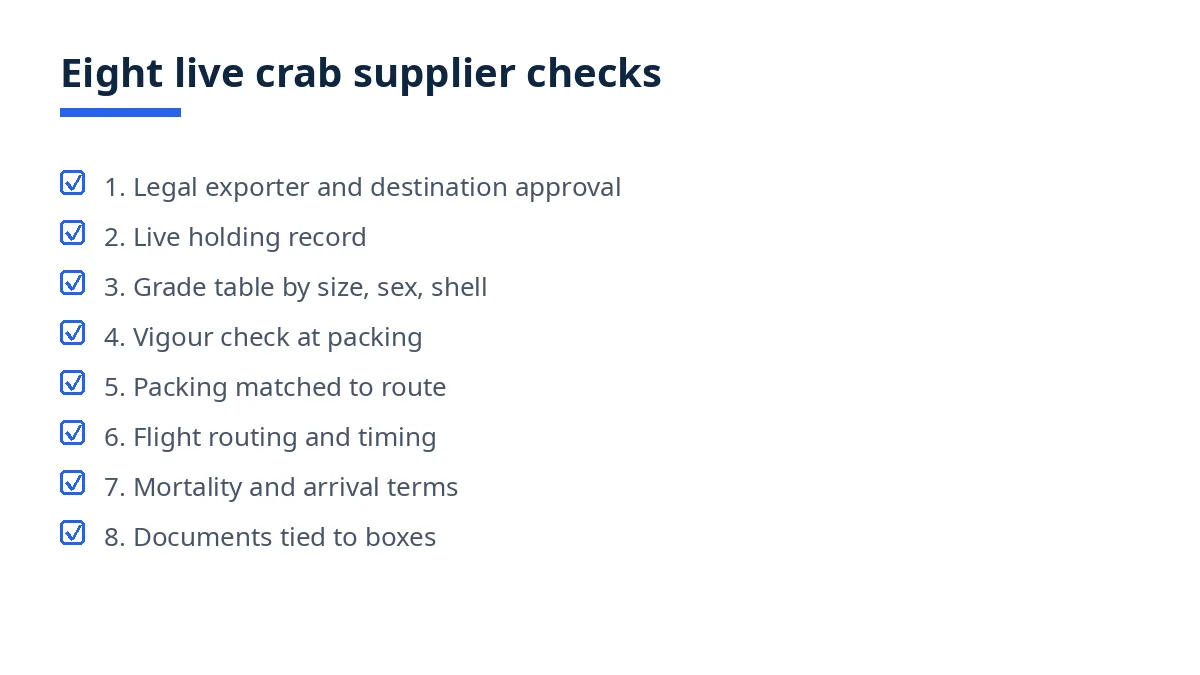
Find live crabs manufacturers in Bangladesh by checking eight pieces of evidence in order: the legal exporter and destination approval, the live holding record, a written grade table by size, sex and shell hardness, vigour at packing, a packing method matched to the flight route, locked flight routing, written mortality and live-arrival terms, and documents that match the boxes. A supplier passes only when every check is documented, not when a quotation looks low.

On this page
A live crab order is judged at arrival, not at loading. A crab that arrives dead, soft-shelled, or wrongly graded has lost its value even when the paperwork is correct, so a buyer of live crabs from Bangladesh needs a different set of checks from a buyer of frozen seafood. Live mud crabs and eels are usually exported by air, and consignments for some destinations require clinical compliance certification by the state veterinary office, with the animals examined and confirmed healthy, free of clinical symptoms of contagious disease, and suitable for transport.1 That single fact shapes the whole sourcing job: the supplier must control live holding, grading, packing, and flight timing, and must prove each step in writing.
This article names no factory and ranks none. It gives eight checks that separate a supplier who can keep crabs alive and correctly graded from a trader who only forwards a quotation. Run the checks in order, and do not place a bulk order until every check has a document or a written term behind it.
Key takeaways
A live crab supplier is checked on live holding, grading, vigour, packing, routing, and live-arrival terms, not on a frozen-product record.
Grade in writing before you quote: size, sex, and shell hardness decide the price, and mixed grades hide the real cost of a shipment.
Soft-shell, slow, or one-clawed crabs belong in separate grades, never mixed into a premium live grade.
The contract must state how dead-on-arrival crabs are counted, evidenced, and settled, and who bears that loss.
A supplier passes only when the holding batch, the packing list, and the health certificate describe the same crabs.
The list
The eight checks below follow the crab, from the holding tank to your receiving dock. Each check states what to ask, why it matters for live product, and how to test the answer before you commit.
1. Confirm the legal exporter and the destination approval
What to check. The legal name on the export licence, the export registration, and any destination-specific approval for live aquatic animals, for the exact market you are buying for. Approval for one market does not transfer to another.
Why it matters. Live animals face health and quarantine controls that frozen product does not. A supplier that can export frozen fish may still lack the route, the sampling step, or the certificate a live shipment needs, and that gap is usually found only when the shipment is already packed.
How to check it. Ask for the licence and registration copies, then ask which destination approvals the supplier currently holds for live crabs and what certificate accompanies each shipment. In Bangladesh, licences, health certificates, additional health certificates required by the importing country, sample collection, inspection, test reports, and certificate issuance are handled through the Department of Fisheries e-certification system, which is connected to customs.2 Match the certificate type to your destination before you discuss price.
2. Inspect the live holding, not just the sales office
What to check. Where crabs are held between collection and packing, how long they are held, how water quality and aeration are managed, and how different batches are kept apart. Ask for dated holding photos and a holding record for a recent shipment.
Why it matters. Holding is where live quality is made or lost. Overcrowded tanks, long holding without water management, and mixed batches produce weak crabs that die in transit, and no packing method rescues a crab that was already stressed before it was boxed.
How to check it. Ask for the holding capacity in kilograms, the usual holding period, the water-change and aeration routine, and the mortality record for the last three shipments, stated as a count rather than a reassurance. A supplier that cannot show a holding record is asking you to trust the weakest link in the chain.
3. Agree the grade table before any quotation
What to check. A written grade table covering size, sex, and shell hardness, with each grade priced separately and packed separately. Confirm how females with ripe ovaries, one-clawed crabs, and slow crabs are graded, since each is a different product in the market.
Why it matters. Grading decides what you actually receive. A mixed box priced as a premium grade is a price increase disguised as a shipment, and it is hard to prove after the crabs have been sold onward.
How to check it. Ask the supplier to grade a sample shipment by the table and to list the count and weight for each grade on the packing list. In mud crab grading, top-quality hard-shell crabs with both claws intact and strong movement are the premium live grade, and that grade is further sorted by sex and size, while one-clawed crabs are usually graded and packed separately at a lower price.3 Reject any quotation that gives one price for mixed grades.
4. Test vigour at packing, grade by grade
What to check. How the supplier tests that each crab is alive and vigorous at packing: leg and antennae movement, claw condition, shell hardness, and the exclusion of recently moulted soft-shell crabs. Ask who performs the test and what happens to crabs that fail it.
Why it matters. A crab that is slow at packing is unlikely to survive a flight, and a soft-shell crab that was recently moulted is fragile in transit.
How to check it. Require a packing check by grade, with slow and soft-shell crabs removed and recorded, not packed in the hope that they recover. Ask for a short packing video for the trial order, showing the grade separation and the removal of weak crabs. For the detailed packing and arrival checks, use the live crabs quality control checklist alongside this article.
5. Match the packing method to the route and the flight time
What to check. The exact packing method for your route: moist or water-based packing, ventilation, claw tying, box size, crabs per box, and labelling. Confirm the method for the longest leg of your journey, not for the shortest.
Why it matters. Packing is life support. A method that works for a short domestic transfer can fail on a long air leg, and overcrowding raises stress and mortality. The method must also keep crabs secure, since untied crabs can damage boxes and other crabs in transit.
How to check it. Ask for the packing specification in writing, including crabs per box, box ventilation, and the maximum transit time the method is rated for. In wet transport, water is typically supplied in a plastic bag with sufficient oxygen above the water, and shelter is also required, while dry transport uses moist materials as shelter.4 Handling guidance also stresses keeping crabs moist, avoiding overcrowding to reduce stress and mortality, and sorting by size, species, and sex.5 Test the stated method on the trial order and record the arrival condition by box.
6. Lock the flight routing and the timing window
What to check. The departure airport, the flight schedule, the total door-to-door time, and what happens if a flight is missed or delayed. Confirm who books the air freight, who receives the shipment at arrival, and how quickly the receiver must inspect it.
Why it matters. Live crabs are perishable in hours, not days. A missed connection turns a good packing job into a dead shipment, and a slow arrival inspection makes it impossible to tell whether mortality came from holding, packing, or transit.
How to check it. Ask for the routing in writing with the latest acceptable departure time, and set an inspection window in the order terms, such as inspection within a stated number of hours of landing, with dated photos. Agree a fallback flight and a named contact for delays before the shipment leaves Bangladesh.
7. Put mortality and live-arrival terms in the contract
What to check. How dead-on-arrival crabs are counted, what evidence is required, what remedy applies, and who bears the loss for each cause. State whether the remedy is a credit, a replacement, or a refund, and the deadline for claiming it.
Why it matters. This is the term buyers most often leave vague, and it is the term that decides who pays when part of a shipment dies. Without it, a supplier can blame the airline, the airline can blame the packing, and the buyer carries the loss while the argument continues.
How to check it. Write the term as a sequence: count on arrival by grade, photograph each dead crab with the box label visible, notify the supplier within the agreed window, and settle by the agreed remedy. Example figures: a trial order of 200 kilograms split across two grades, with a written dead-on-arrival count by grade and a credit for each dead crab above an agreed threshold, gives you a testable record for the first bulk order. Keep the term in the order document, not in a chat message.
8. Tie the documents to the crabs in the boxes
What to check. That the health certificate, the packing list by grade, the invoice, and the airway bill describe the same shipment, the same grades, and the same weights. Confirm the customs heading with your broker before the first order.
Why it matters. A document mismatch can hold a live shipment at the border while the crabs deteriorate, and a grade mismatch between the packing list and the boxes is the most common source of arrival disputes. Documents are part of live quality control, not an afterthought to it.
How to check it. Ask for a document set from a recent comparable shipment, with names and prices removed, and check that grades, weights, and certificate details line up. Heading 0306 covers crustaceans, whether in shell or not, live, fresh, chilled, frozen, dried, salted, or in brine, and the current listing places crabs under that heading.6 For the classification steps, read the HS code guide for live crabs and confirm the final code with your broker for your destination.
Summary table
Check | What it proves | Evidence to file |
|---|---|---|
Legal exporter and destination approval | The supplier may legally ship live crabs to your market | Licence, registration, destination approval |
Live holding | Crabs arrive at packing in good condition | Holding record, mortality count, dated photos |
Grade table | Price matches the crabs in the box | Written grades, price per grade, sample count |
Vigour at packing | Only strong crabs are shipped | Packing check by grade, trial video |
Packing method | Crabs survive the stated route | Packing specification, crabs per box |
Flight routing | Transit time fits live product | Routing, departure deadline, fallback plan |
Mortality and arrival terms | Losses are settled, not argued | Written count, evidence, and remedy terms |
Documents and traceability | Papers match the boxes | Certificate, packing list, invoice, airway bill |
What moves MOQ and price is the grade mix, not the total weight alone. A single-grade order is simpler to fill than the same weight split across many grades, and a supplier may set a higher minimum for a scarce grade. Packing, air freight, and the live-arrival term also move the landed cost, so compare quotations on the same grade table, packing method, and delivery term. The guide to MOQ in the supply chain explains how a minimum is set per combination rather than per order total.
How Exportain helps
Exportain is a B2B marketplace for sourcing from Bangladesh. Buyers search published products by keyword and category, and can filter by supplier badge, sample availability, and MOQ, then post a request for quotation stating quantity, target price, destination, delivery term, and deadline.7 Each supplier profile shows its verification level, location, and main products, and supplier badges record the document and photo checks the Exportain team has reviewed and approved.8
Use the platform to build a shortlist and to keep the grade table, the packing specification, and the live-arrival term in the quotation thread, so the agreed terms are recorded in one place. Badges are a starting filter, not a substitute for the eight checks above: they record a document and photo review, not a holding inspection or a live-arrival guarantee.
FAQs
What is the biggest mistake?
Buying live crabs on price alone, without a written grade table and without a live-arrival term. A low price for mixed grades, weak packing, or an unsettled mortality term is not a saving. It is a loss that arrives with the shipment, after the freight has already been paid.
How can I avoid it?
Send every shortlisted supplier the same grade table, the same packing specification, and the same live-arrival term, and compare their quotations and trial-order arrivals on those identical terms. Start with a trial order, record the arrival condition by grade, and place a bulk order only with a supplier whose trial record matches its written claims.
Who is responsible?
Both sides, for different parts. The supplier is responsible for holding, grading, packing, and documenting crabs that match the agreed specification. The buyer is responsible for writing that specification completely, inspecting on arrival within the agreed window, and evidencing any loss in the agreed form. When a dispute arises, the written grade table, the packing specification, and the arrival record decide it.
Where can I get help?
Start with the records that exist: the Department of Fisheries e-certification route for licences and health certificates, your customs broker for the heading and destination rules, and an inspection provider for the packing and arrival checks.2 On Exportain, read what each profile badge covers before relying on it.8 The guide to importing live crabs from Bangladesh covers the ordering and shipping steps that follow these checks.
Next steps on Exportain
Browse Bangladeshi suppliers and filter the listings by badge and MOQ for live seafood. Before you order, read how supplier verification works on Exportain so you know what each badge covers. Then post a free RFQ with your grade table, packing specification, destination, and live-arrival term, and compare the quotations that come back on those identical terms.
Sources
- Compliance certificate for exporting crab, eel mandatory under Chinese protocol. The Financial Express (accessed )
- Bangladesh rolls out online certification system to simplify fish and seafood trade. International Collective in Support of Fishworkers (ICSF) (accessed )
- Mud crab aquaculture: A practical manual. Academia.edu (accessed )
- A Review of the Nursery Culture of Mud Crabs, Genus Scylla: Current Progress and Future Directions. PubMed Central (accessed )
- Mud Crab Harvesting Techniques. Profitable Livestock (accessed )
- HS Code 0306: Crustaceans (Live / Fresh / Frozen). The Dollar Business (accessed )
- How to source and buy from Bangladesh. Exportain (accessed )
- Supplier verification: Earn trust badges buyers can see. Exportain (accessed )
About the author
Sourcing from Bangladesh?
Post a request for quotation and suppliers on Exportain can send you their quotes directly.
Post an RFQ