Live Crabs Lead Time From Bangladesh: Production and Shipping Timeline
No single live crabs lead time from Bangladesh: mortality risk sets the timeline. How holding, packing, air freight and destination inspection protect the live-arrival count, and what to agree in writing.
Short answer
There is no single typical lead time for live crabs from Bangladesh. The timeline is set by mortality risk: time out of water, gill drying, handling, and the flight and destination inspection. Plan backward from a live-arrival count agreed in writing, with holding, packing, certification, and air freight protecting that count, and count live crabs on arrival.

On this page
Key takeaways
There is no single typical lead time for live crabs from Bangladesh, because mortality risk, not a production line, sets the timeline.
Time out of water, gill drying, handling, temperature change, oxygen shortage, and ammonia build-up all add stress before the flight.
Agree the live-arrival count, mortality allowance, counting method, and notification period in writing before the order is confirmed.
Certify first and pack second: once crabs are packed, a pending certificate or a missed flight becomes lost condition, not a delay.
Exportain verification is a document and photo review, not a factory inspection, and a badge is not a guarantee of live arrival.
There is no single typical lead time for live crabs from Bangladesh, because the clock is set by living animals, not a production line. A frozen order can wait in cold storage while a document is corrected. A live order cannot: every hour holding, packing, waiting for a flight, or clearing at destination is an hour in which crabs lose condition, and some do not survive. The timeline is therefore planned backward from live arrival; every stage before the flight protects that arrival count.
That is what differs from a frozen-seafood timeline. A frozen timeline is governed by cutting, freezing, and cold storage. A live-crab timeline is governed by mortality risk: time out of water, gill drying, handling, and whether the flight and destination inspection leave time to recover. An order can be on time in calendar terms and still fail at destination, because the buyer counts live crabs, not boxes. The usable questions are therefore: time out of water, mortality allowance, who counts on arrival, and what happens to the dead count. Those answers must be in writing before the order is confirmed.
Why this matters for buyers and sellers
For the buyer, the risk is a delivery arriving on schedule with fewer live crabs than paid for, or crabs too weak to sell at grade, after freight has been paid. For the seller, the risk is the mirror image: a sound-looking plan that produces a mortality claim wiping out the margin.
What should I know first about live crabs?
First, live crabs are handled as live animals throughout the chain, not as chilled cargo. The World Organisation for Animal Health states that containers for aquatic animals must be designed to withstand the weight of the animals and water and to maintain optimal conditions during transport, and that air-transport stocking densities must take account of both the space available for each species and the oxygenation capacity on the ground and during all stages of the flight.1 The International Air Transport Association's Live Animals Regulations cover container requirements, stocking density, marking, labeling, handling, and documentation for live animal shipments, and the regulations are the reference airlines use when accepting live cargo.2
Second, handling before packing matters as much as the flight. The Food and Agriculture Organization's mud crab manual describes crabs taken from the water being stored in crates covered with dampened material to reduce drying out, kept in the shade and kept moist to avoid dehydration and heat stress, with a spray system used to keep crabs moist, temperatures moderate, and humidity high.3 The same manual lists the stressors from harvest to market: handling and grading; breeze, which increases dehydration; temperature too high, too low, or changing suddenly; time; insufficient oxygen; starvation; and ammonia build-up.3 It also records post-harvest mortalities of 4 to 10 percent when crabs are harvested in localities remote from markets and supply chains stress the crabs significantly.3 That figure warns about remote, stressful chains; it is not a standard allowance and should never be copied into a contract as an expected loss.
Third, classification and destination rules sit on top of the live-animal rules. In the Harmonized System, heading 0306 covers crustaceans, whether in shell or not, live, fresh, chilled, frozen, dried, salted, or in brine, and related products fit for human consumption.4 See the HS code for live crabs.
Step-by-step: how it works
The steps below follow the live animal. Paperwork runs in parallel and must be ready before the crabs leave holding.
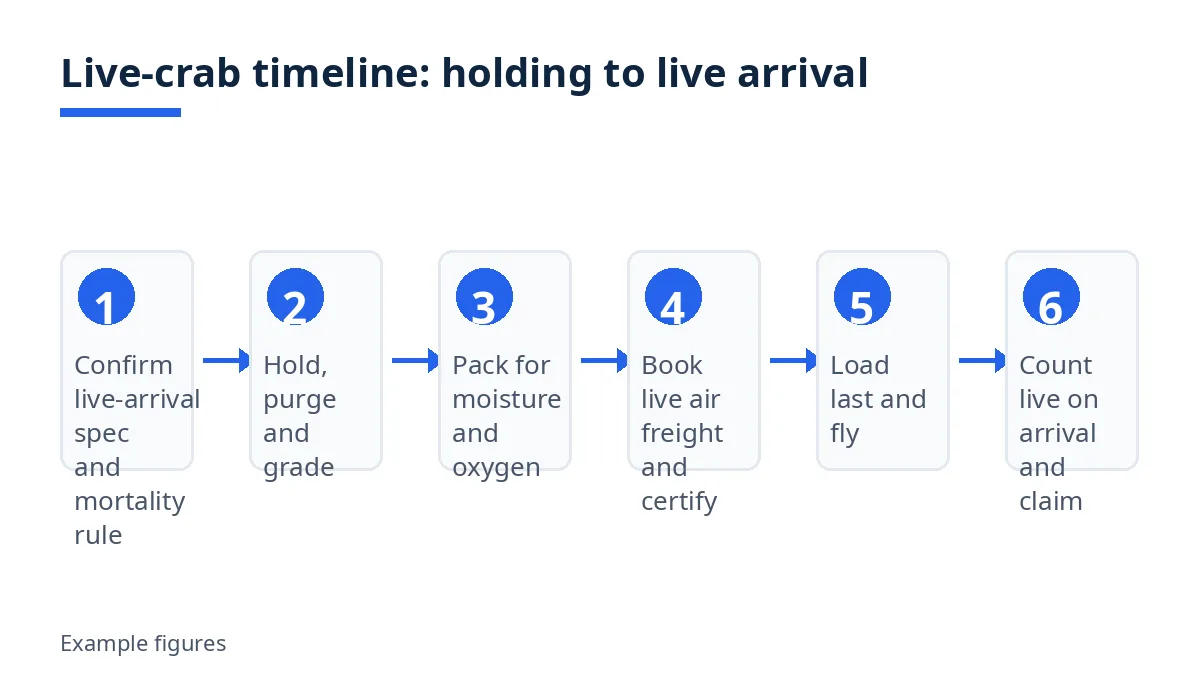
Confirm the live-arrival specification and the mortality rule. State the species and grade, the size range, the live-arrival count basis, the mortality allowance, and who counts at destination and how. Agree what happens to dead crabs: rejected, discounted, or replaced.
Hold, purge, and grade. Hold the crabs in shaded, moist conditions, grade by size and condition, and remove weak, damaged, or empty crabs before packing. The FAO manual notes that crabs found to be empty, watery, or thin should be returned to the facility or sent for fattening rather than shipped.3 A crab weak before packing will not improve during a flight.
Pack for moisture and oxygen, not for appearance. Tie claws so crabs cannot damage one another, pack in layers separated by moistened material, keep the load shaded and cool, and leave ventilation as the carrier requires. The IATA regulations cover container requirements, stocking density, and marking,2 and WOAH requires stocking density to reflect space and oxygenation capacity at every stage of the flight.1 Overpacking is a timeline error, because crowded crabs dehydrate and stress faster.
Book live air freight and certify in parallel. Book the flight on a routing the crabs can actually survive, with the earliest workable arrival and fewest changes of aircraft. Complete the export and health documents while the booking is held, so certification does not become the reason the crabs wait.
Load last and fly. Load the crabs as late as the airline allows, keep them out of sun and wind on the tarmac, and protect them from heat on the ground. Time on the ground counts against the same survival budget as time in the air. A missed connection is not a one-day delay; it is a second holding period with no holding facility.
Count live on arrival and claim promptly. Count live, weak, and dead crabs on arrival, photograph the count, and notify the seller and the carrier within the period the contract states. A claim made days later, after retail holding, is difficult to attribute to the shipment. The arrival count settles the order.
Costs, timelines and documents
What are the typical costs and timelines?
There are no typical costs or timelines that a guide can state as fact for live crabs, for the same reason there is no typical mortality figure. Price depends on species, grade, size, season, availability, packing, air freight routing, and the delivery term. The Incoterms 2020 rules set out 11 rules with a clear allocation of cost, risk, and obligations,5 so compare quotations only on the same rule and the same live-arrival basis. A lower price on a longer routing with more handling is a different offer. See the Incoterms for shipments from Bangladesh guide and the live crabs price breakdown.
There is no single typical timeline. The stages are holding, grading, packing, certification, flight, destination clearance, and live-arrival counting, each set by the supplier, the airline, and the destination authority for that order. Ask for each stage as a separate date and time, not as a single delivery week, and ask which stage has no slack: usually the flight and the destination inspection.
Example figures: consider two orders of the same grade. In the first, graded crabs are held shaded and moist, packed in the morning, loaded onto a direct flight the same day, and counted live on arrival the next morning. In the second, ungraded crabs wait an extra day for a certificate, miss the direct flight, and spend a night in transit. The survival difference is the extra day out of water, handling, and heat exposure. The example shows structure only, not a typical timeline, price, or mortality rate.
Which documents are needed?
For export clearance in Bangladesh, goods may not be loaded unless an export declaration, the Bill of Export or Shipping Bill, is submitted to Customs and approved.6 Enclosed documents include the export contract or purchase order where there is no export letter of credit, the commercial invoice, the packing list, the EXP form certified by an authorized dealer, and a certificate of origin issued by the EPB or a Chamber of Commerce and Industry.6 For some categories, additional certification is necessary, and the Department of Fisheries issues quality control certificates where the destination country requires them.6
On top of the export set, the live-animal order needs the destination health certificate and airline acceptance documents. The IATA regulations cover shipper certification, the air waybill, captain notification, and the acceptance checklist.2 Confirm in writing which certificate the destination requires, who issues it, and how long issuance takes, before the crabs leave holding.
Bangladesh-specific rules and tips
Confirm the destination gate before you confirm the order. For the European Union, Commission Implementing Regulation (EU) 2021/405 lays down the lists of third countries from which entry of certain animals and goods intended for human consumption is permitted, and Bangladesh appears in the fishery-products list in Annex IX.7 That is a country-level gate, not approval of any supplier or consignment, which still needs its own health certificate.
Treat China as a separate timeline. Live crabs and eels exported to China require clinical compliance certification by the state veterinary office under the protocol communicated by the Chinese customs authority, and consignments without it are not allowed.8 The protocol places inspection, quarantine, and health certificate issuance with the fisheries and livestock ministry, and requires examination by an official veterinarian before export, confirming the animals healthy, free of clinical symptoms of contagious disease, and suitable for transportation.8 A China order therefore needs that examination booked before packing, not after.
Use the e-certification channel, but do not assume it removes the wait. Bangladesh has automated licences and product test certificates for fish and seafood trade, including health certificates as required by the importing country, inspection, test reports, and certificate issuance, connected directly to customs.9 That automation reduces office visits, but the inspection and certificate still take their time, and the crabs must not leave holding until the certificate is in hand.
Ask where the crabs are held, and how far holding is from the airport. The FAO manual's warning about remote harvest localities and stressed crabs applies directly to timeline planning.3 A supplier whose holding is far from the airport, or who cannot describe shade, moisture, and temperature control, is describing a longer and riskier timeline, whatever the quoted flight time says.
Mistakes and red flags
What are the most common mistakes?
Buying on calendar days instead of live-arrival condition. A timeline that promises an arrival date without stating the live-arrival count, the mortality allowance, and the counting method is not a live-crab timeline. It is a freight booking.
Packing more crabs to cover expected deaths. Adding extra crabs to absorb mortality increases crowding, dehydration, and stress, and can raise the death count it was meant to cover. The WOAH guidance ties stocking density to space and oxygenation capacity for the species,1 so density is a survival decision, not a buffer.
Letting certification trail the packing. Once crabs are packed, the clock is running. If the health certificate, the export declaration, or airline acceptance is still pending, the packed crabs are waiting in the worst possible place. Certify first, pack second.
Accepting a routing with a long ground wait. A cheaper routing with a long layover, a change of aircraft, or a hot tarmac wait can cost more in dead crabs than it saves in freight. Ask for the full routing, including ground time, and reject a routing the crabs cannot survive.
Counting late or counting boxes. A destination count made after retail holding, or a count of boxes rather than live crabs, cannot settle a mortality claim. Agree the count method, time, and notification period in the purchase order.
Treating a profile or a badge as a survival guarantee. A profile is a starting point for enquiries. A badge records a document and photo review, not a holding facility inspection or a flight outcome. See the live crabs quality control checklist.
Checklist
Species, grade, and size range stated, with the live-arrival count basis.
Mortality allowance agreed, with counting method, count time, and notification period.
Holding described: shade, moisture, temperature control, distance from the airport.
Weak, damaged, and empty crabs removed before packing.3
Packing density set for space and oxygenation, not maximum boxes per flight.1
Flight routing confirmed with ground time and earliest workable arrival.
Export declaration, invoice, packing list, EXP form, certificate of origin agreed.6
Destination health certificate confirmed: issuer, examination timing, issuance time.
One Incoterm and named place on every quotation.5
Arrival inspection plan agreed: who counts, when, how dead crabs are recorded.
How Exportain helps
On Exportain, browse suppliers and post a request for quotation (RFQ) on the RFQ board with your live-arrival specification, grade and size range, mortality rule, destination market, and delivery term, so suppliers quote against the same live-animal basis. Ask each reply for its holding arrangement, packing density, flight routing with ground time, and certificate timing. When you accept a quotation, Exportain creates one order and issues one proforma invoice from the accepted terms.10
Read the badges for what they record. Exportain Verified means Exportain has checked identity, phone, email, and business registration, and Export Verified means it has checked the Export Registration Certificate (ERC).10 Factory Verified means it has reviewed photos of the manufacturer factory, while Trading Company Verified means it has reviewed photos of the trading company office or warehouse.10 Verification is a document review by staff, free, and never granted by membership plans.11 It is not a factory inspection,10 11 so holding, packing, and arrival inspection stay with you and the supplier.
FAQs
What should I know first about live crabs?
Know that the timeline is governed by survival, not calendar days. Crabs lose condition out of water, and handling, breeze, temperature change, time, oxygen shortage, starvation, and ammonia build-up add stress.3 The order succeeds when the live-arrival count is agreed in advance and the routing leaves no long ground wait.
What are the typical costs and timelines?
There are no typical figures a buyer can rely on, because each supplier prices your species, grade, size, packing, routing, and delivery term,5 and each order's stages take the time they take for that order. Ask for each stage as a separate date, and compare quotations only on the same Incoterm and the same live-arrival basis.
Which documents are needed?
The order documents are the live-arrival specification, itemized quotation, and purchase order, with the mortality rule and counting method. The export set is the Bill of Export, commercial invoice, packing list, EXP form certified by an authorized dealer, and certificate of origin issued by the EPB or a Chamber of Commerce and Industry,6 plus the destination health certificate and airline acceptance documents.2
What are the most common mistakes?
The most common mistakes are buying on calendar days instead of live-arrival condition, packing extra crabs to cover expected deaths, letting certification trail packing, accepting a routing with a long ground wait, and counting late or counting boxes. Each adds time out of water or handling, and raises the death count it was meant to avoid.
Next steps on Exportain
Browse suppliers, then post your live-arrival specification, grade and size range, mortality rule, and destination market on the RFQ board so suppliers state their holding, routing, and certificate timing. Before you confirm, read the live crabs quality control checklist.
Sources
- Recommendations for safe transport of aquatic animals and aquatic animal products. World Organisation for Animal Health (accessed )
- Live Animals Regulations (LAR). International Air Transport Association (IATA) (accessed )
- Mud crab aquaculture: A practical manual. Food and Agriculture Organization of the United Nations (accessed )
- HS 2017 - Code 03: Fish and crustaceans, molluscs and other aquatic invertebrates. United Nations Statistics Division (accessed )
- Incoterms® 2020. International Chamber of Commerce (ICC) (accessed )
- Customs Clearance Procedures for Export. Bangladesh Customs, National Board of Revenue (accessed )
- Commission Implementing Regulation (EU) 2021/405 — list of third countries authorised for fishery products. European Union (accessed )
- Compliance certificate for exporting crab, eel mandatory under Chinese protocol. The Financial Express (accessed )
- Bangladesh rolls out online certification system to simplify fish and seafood trade. International Collective in Support of Fishworkers (ICSF) (accessed )
- Trust & Safety Center. Exportain (accessed )
- Supplier verification: Earn trust badges buyers can see. Exportain (accessed )
About the author
Sourcing from Bangladesh?
Post a request for quotation and suppliers on Exportain can send you their quotes directly.
Post an RFQ