Live Crabs Price in Bangladesh: FOB Cost Breakdown for Buyers
How to read a live crabs FOB quotation from Bangladesh: live weight versus mortality-adjusted weight, grade and size bands, holding and packing costs, and live-arrival terms.
Short answer
To read a live crabs price in Bangladesh, convert every quotation to a cost per live kilogram on arrival: start from the grade-by-grade price on live weight at packing, add holding, grading and oxygenated packing, inland transport, documents and certification, then apply the agreed dead-on-arrival rule and the air-freight basis, and compare only quotations with the same grades, delivery rule, named place, currency, and validity period.

On this page
Key takeaways
A live-crab quotation must be converted to a cost per live kilogram on arrival, not compared on its headline price per kilogram at packing.
FOB is a sea and inland waterway rule, so an air shipment needs the correct rule for the mode, such as FCA at the named airport, with one named place on every document.
Grades by size, sex, and shell hardness must be priced and packed separately, and a single price for mixed grades hides the real cost.
Holding, grading, oxygenated packing, inland transport, documents and certification, and freight must appear as separate lines before any ranking.
The dead-on-arrival rule, with counting, evidence, notification window, and remedy, plus the validity period and currency, must be written into the order document.
A single price per kilogram for live crabs does not yet tell you what you will pay for the crabs that arrive alive. The headline figure can hide the weight basis, the grade mix, the holding and packing work, the air leg, and the treatment of crabs that die in transit. Two quotations with the same headline price can therefore land at very different costs per live kilogram, visible only when each line is read on the same basis.
That reading starts with the delivery term. Under FOB, the seller delivers the goods loaded on board the vessel nominated by the buyer at the named port of shipment, and risk passes to the buyer at that point.1 FOB is a sea and inland waterway rule, not an air-freight rule, so an air shipment cannot be governed by FOB.1 2 If a supplier writes FOB on an air quotation, treat it as a loose label for costs up to loading, and ask for the correct rule for the mode, such as FCA at the named airport. Incoterms cover cost and risk only, not payment, title, or classification.2
This guide reads a live-crab quotation line by line: the weight it prices, the grade bands inside it, the holding and oxygenated-packing costs, the air-freight and live-arrival terms, and the port and validity dates that bound the offer. It states no market price, because no single price fits every grade, size, route, and season. Every money figure below is labelled as example figures and shows structure only.
Why this matters for buyers and sellers
For the buyer, the live-crab price is not the invoice total divided by the shipped weight. It is the invoice total, plus freight, insurance, and destination costs, divided by the weight of crabs that arrive alive and in the agreed grade. A quotation that prices dead weight or mixed grades as premium live crabs overstates the shipment, and the overstatement is paid for in freight on weight that never becomes saleable stock.
For the seller, the same lines protect the margin. Holding, grading, packing, and meeting a flight deadline all cost time, labour, boxes, and handling. A blended price cannot show why a single-grade order, a short holding period, or a direct flight costs less than a mixed-grade order held for days and routed through a connection.
What should I know first about live crabs?
Know the weight basis before you discuss any price. Ask whether the price applies to live weight at packing, to weight on arrival, or to weight after dead crabs are removed, and ask for the grade table in the same message: size bands, sex, and shell hardness, each priced and packed separately. A quotation without a weight basis and a grade table is not comparable with any other, however low its headline figure looks.
Step-by-step: how it works
Use the same request for every supplier, so every reply can be compared line by line.
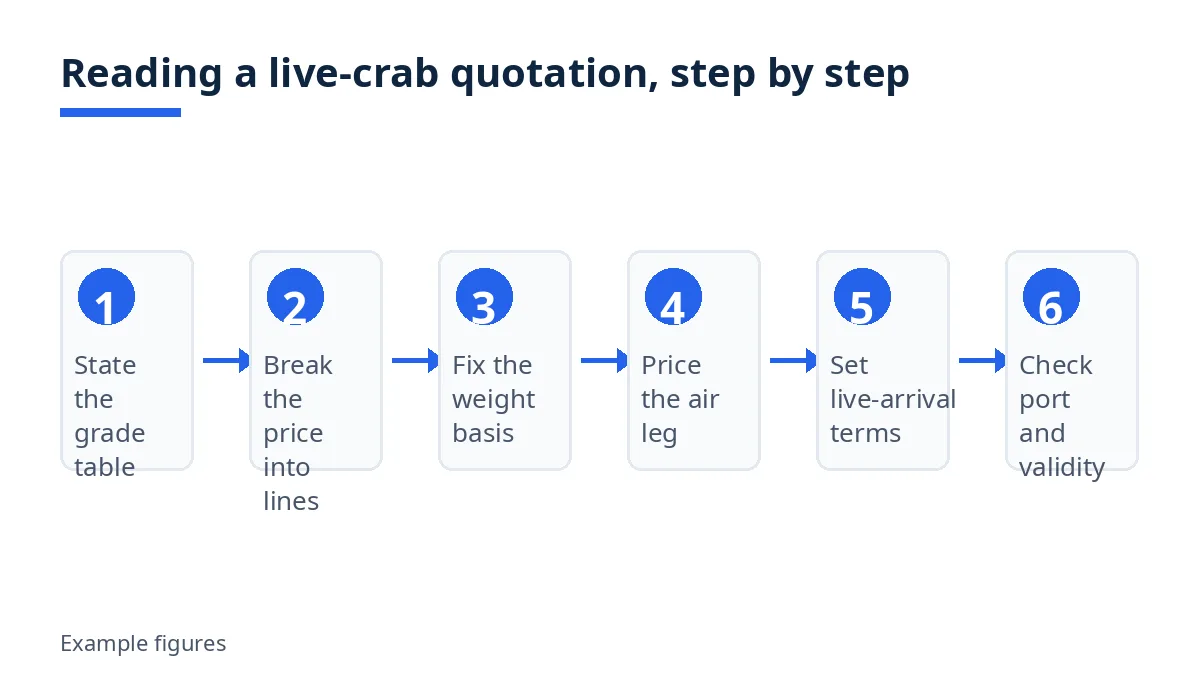
State the shipment in one specification. Give the species and product form, the grade table by size, sex, and shell hardness, the quantity per grade, the packing method, the destination airport or port, the delivery rule for the actual mode of transport, and the latest acceptable arrival date. Ask each supplier to quote against that specification unchanged.
Ask for the price broken into lines. Require separate lines for the crabs by grade, holding, grading and packing, boxes and oxygenated-packing materials, inland transport, export documentation and certification, and any handling charge. A single blended line cannot be checked or renegotiated line by line.
Fix the weight basis in writing. State whether the price is per kilogram of live weight at packing, and state the mortality rule separately: how dead-on-arrival crabs are counted, what evidence is required, the notification window, and whether the remedy is a credit, a replacement, or a refund. Keep that rule in the order document, not in a chat message.
Price the air leg on the same route. Ask for the flight routing, the total door-to-door time, the latest acceptable departure, and what happens if a flight is missed or delayed. Confirm who books and pays the freight under the agreed delivery rule, and who inspects the shipment on arrival, and within how many hours.
Check the documents against the boxes. Ask that the health certificate, the packing list by grade, the commercial invoice, and the airway bill or bill of lading describe the same shipment, grades, and weights. A document mismatch can hold a live shipment at the border while the crabs deteriorate.
Compare on mortality-adjusted weight. Convert each quotation to a cost per live kilogram on arrival before you rank suppliers, using the worked example in the next section.
Costs, timelines and documents
What are the typical costs and timelines?
There are no typical costs or timelines for live crabs that a guide can state as fact, because each supplier prices your grade mix, holding period, packing method, route, and delivery rule. What can be compared is the quotation structure, set out below. The figures are example figures only, showing how a mortality adjustment changes the ranking.
Quotation line | What to check on the line | Example figures |
|---|---|---|
Crabs by grade | Price per kilogram per size, sex, and shell-hardness grade, packed separately | Grade A 10.00, Grade B 7.00 per kilogram at packing |
Holding | Days held, water and aeration management, holding charge | 2 days, separate line |
Grading and packing | Labour, boxes, moist or oxygenated packing, claw tying, labelling | 0.80 per kilogram |
Inland transport | Holding or packing site to airport or port | 0.40 per kilogram |
Export documents and certification | Health certificate, destination-specific certificate, export declaration set | Fixed charge per shipment |
Air freight and insurance | Under the agreed delivery rule, for the stated routing | Per kilogram of chargeable weight |
Live-arrival adjustment | Dead-on-arrival count, evidence, notification window, remedy | Credit per dead crab above threshold |
Example figures: a 500-kilogram trial order at 10.00 per kilogram for one grade gives a goods value of 5,000 before packing, transport, documents, and freight. If 25 kilograms arrive dead and the rule removes dead weight from payable live weight, the buyer has 475 live kilograms, so the same 5,000 equals 10.53 per live kilogram before any other cost. Divide every other cost line by 475, not by 500. A higher headline price with a lower dead-on-arrival count can therefore land cheaper per live kilogram.
Timelines work the same way. Ask for holding days, packing day, departure, and arrival inspection as separate dates, not as a single delivery week. A missed connection or a slow arrival inspection changes the live weight and the evidence for a claim, so agree a fallback flight and a named contact for delays before shipment.
Which documents are needed?
For export clearance in Bangladesh, goods cannot be loaded until a Bill of Export, also called a Shipping Bill, is submitted and approved, and the standard export set includes an export contract or purchase order, the commercial invoice, the packing list, an EXP form certified by an authorized dealer bank, and a certificate of origin issued by the Export Promotion Bureau or a Chamber of Commerce.3 For live aquatic animals, add the health certificate and any destination-specific certificate. The Department of Fisheries e-certification system covers licences, health certificates, destination-specific certificates, sample collection, inspection, test reports, and certificate issuance, and it is connected to customs.4
Destination rules vary, so confirm them for your market before the first order. For edible aquatic animal products bound for China, the Department of Fisheries acts as the competent authority, establishments must appear on the relevant lists before the products are produced or enter the establishments, and the certificate states that the animals were examined clinically by an official veterinarian within 48 hours before export and found healthy and free of signs of infectious or contagious disease.5
On classification, heading 0306 covers crustaceans, whether in shell or not, live, fresh, chilled, frozen, dried, salted, or in brine, and live, fresh, or chilled crabs are cited under subheading 0306.33.6 Confirm the full code for your destination with your customs broker, and keep the code identical on the invoice, the packing list, and the export declaration.
Bangladesh-specific rules and tips
Name the mode and the place, every time. A quotation that says FOB without a named port, or that says FOB for an air shipment, is incomplete. Under FOB, the seller delivers on board the vessel nominated by the buyer at the named port of shipment.1 For air freight, use the rule that fits the mode, name the airport, and keep one named place and one rule on every document.
Tie the certificate to the establishment and the destination. Ask which establishment holds the listing for your destination, which certificate accompanies the shipment, and how long that step took in recent shipments. Approval for one market does not transfer to another.
Ask where holding and packing happen, in writing. Keeping crabs alive depends on the holding tanks and the packing bench, not the sales office. Ask for the holding location, holding period, water and aeration routine, and recent mortality counts.
Do not let the headline price swallow the freight basis. Air freight for live product is commonly charged on chargeable weight, which can differ from live weight at packing once boxes, water, and packing materials are added. Ask whether the freight quotation uses gross, chargeable, or live weight, and ask for the box count, crabs per box, and gross weight per box.
Mistakes and red flags
What are the most common mistakes?
Comparing headline prices without a weight basis. A price per kilogram means nothing until you know whether it prices live weight at packing, weight on arrival, or weight after dead crabs are removed. Convert every quotation to a cost per live kilogram on arrival.
Accepting one price for mixed grades. A mixed box priced as a premium grade is a price increase disguised as a shipment. Require each grade to be priced and packed separately.
Treating FOB as an air-freight term. FOB is a sea and inland waterway rule, with risk transferring on loading on board the vessel.1 2 Using it for air freight leaves the delivery point and the freight obligation unclear. Name the correct rule for the mode, with the named place.
Leaving the mortality rule vague. Without a counting method, an evidence standard, a notification window, and a remedy, each side can blame the other, and the buyer carries the loss while the argument continues. Write the full sequence into the order document.
Comparing quotations with different validity dates. A quotation valid for seven days cannot be compared with one valid for thirty days if holding, freight, or grade availability moves in between. Ask for the validity period, the currency, the weight basis, and the port or airport on every quotation, and re-price any quotation whose validity has lapsed.
Reading a profile badge as a live-arrival guarantee. A badge records a document and photo review, not a holding inspection or a live-arrival guarantee. Use badges as a starting filter, then run the checks in this guide before any bulk order.
Checklist
Every line below should be answered in writing before you confirm.
Specification sent: species and product form, grade table, quantity per grade, packing method, destination, delivery rule, latest arrival date.
Quotation broken into lines: crabs by grade, holding, packing, boxes and packing materials, inland transport, documents and certification, freight.
Weight basis stated: live weight at packing, mortality rule with counting, evidence, notification window, remedy.
Grade table priced and packed separately, no single price for mixed grades.
Flight routing, latest departure, fallback flight, arrival inspection window agreed in writing.
Air freight basis stated: gross, chargeable, or live weight, with box count and gross weight per box.
Validity period, currency, named port or airport, delivery rule on the quotation.
Documents agreed: Bill of Export, invoice, packing list by grade, EXP form, certificate of origin, health certificate, destination-specific certificate.3 4
Quotations converted to cost per live kilogram on arrival, on the same specification and delivery rule, before ranking.
Trial order first, with arrival condition recorded by grade, before any bulk order.
How Exportain helps
On Exportain, browse suppliers and post a request for quotation on the RFQ board with your grade table, quantity per grade, packing method, destination, and delivery rule, so suppliers quote against the same specification. Buyers can search published products by keyword and category, filter by supplier badge, sample availability, and MOQ, and post a request stating quantity, target price, destination, delivery term, and deadline.7 Keep the grade table, the packing specification, and the live-arrival term in the quotation thread.
Read the badges for what they record. Exportain verification is a document and photo review, and supplier badges record the document and photo checks the Exportain team has reviewed and approved.8 That review is a starting filter, not a substitute for the holding, grading, packing, routing, and mortality checks in this guide, and not a guarantee of live arrival. See how supplier verification works on Exportain, and use the live crabs quality control checklist for the packing and arrival checks.
FAQs
What should I know first about live crabs?
Know the weight basis and the grade table before you discuss price: whether the price covers live weight at packing, weight on arrival, or weight after dead crabs are removed, with size, sex, and shell hardness priced and packed separately.
What are the typical costs and timelines?
There are no typical figures for every order. Compare structure instead: crabs by grade, holding, packing, inland transport, documents and certification, freight, and the mortality adjustment, converted to a cost per live kilogram on arrival, with holding, packing, departure, and inspection as separate dates.
Which documents are needed?
The specification, the itemized quotation, and the purchase order, plus the Bill of Export, the commercial invoice, the packing list by grade, the EXP form, a certificate of origin,3 and the health certificate and any destination-specific certificate through the Department of Fisheries e-certification system.4 Confirm the code with your broker: heading 0306 covers crustaceans, and live, fresh, or chilled crabs are cited under 0306.33.6
What are the most common mistakes?
Comparing headline prices without a weight basis, accepting one price for mixed grades, using FOB for air freight when it is a sea and inland waterway rule,1 leaving the mortality rule vague, comparing quotations with different validity dates, and reading a profile badge as a live-arrival guarantee.
Next steps on Exportain
Browse suppliers, then post your grade table, quantity per grade, packing method, and delivery rule on the RFQ board so suppliers quote on the same basis. Before you confirm, read how supplier verification works on Exportain.
Sources
- FOB & FAS Incoterms® 2020 explained: Key differences. ICC Academy (accessed )
- Incoterms 2020 Explained for Exporters. Bilexor (accessed )
- Custom Clearance in Bangladesh: Port Procedures and C and F Agent Guide. Bizmend (accessed )
- Bangladesh: Online certification system rolled out to simplify fish and seafood trade. International Collective in Support of Fishworkers (accessed )
- Edible Aquatic Animal Products Control Guideline. Department of Fisheries, Bangladesh (accessed )
- HS Code for Crabs. FreightAmigo (accessed )
- How to source and buy from Bangladesh. Exportain (accessed )
- Supplier verification: Earn trust badges buyers can see. Exportain (accessed )
About the author
Sourcing from Bangladesh?
Post a request for quotation and suppliers on Exportain can send you their quotes directly.
Post an RFQ