Quality Control Checklist for Leggings From Bangladesh
A numbered QC checklist for leggings from Bangladesh: fabric and opacity checks, waistband recovery, measurements, workmanship, labels and packing, with fixes for common failures.
Short answer
Use this leggings quality control checklist to check fabric opacity, waistband recovery, measurements, seams, labels and packing on leggings from Bangladesh before shipment. Inspect against the approved sample, tech pack and purchase order, agree AQL acceptance numbers in advance, and record actual measurements and defect photos for every failure.
On this page
Key takeaways
Inspect against the approved sample, tech pack and purchase order, and agree the sampling plan and AQL acceptance numbers before the inspection day.
Check opacity while the fabric is stretched and compare every colour, because lighter colours show the problem first.
Stretch-test waistbands, seams and prints on the sample, and confirm laboratory reports cover the bulk fabric and this production lot.
Check fibre and care labels against the destination market wording before cartons are sealed, and recount a sample of cartons against the packing list.
Use this leggings quality control checklist before a shipment leaves Bangladesh. Leggings are judged in wear, not folded on a table: a pair can look correct and still turn sheer when stretched, lose waistband recovery, or crack at the crotch seam. Work through fabric, waistband, measurements, workmanship, labelling and packing in one pass, against the approved sample, the tech pack and the purchase order. Sampling should follow an agreed plan rather than pieces the factory selects. ISO 2859-1 defines AQL-indexed sampling schemes for lot-by-lot inspection, so buyer and supplier can agree sample size and acceptance numbers in advance.1
Why this checklist matters
A general garment inspection will miss the failures that drive returns here. One wrong measurement point can affect an entire size, one unapproved fabric lot can create shade differences, and one faulty waistband setting can repeat across a whole line.
A written checklist creates a shared standard: buyer, factory and any independent inspector judge the same points against the same references, and it catches problems while they can still be corrected. Keep the completed checklist, with measurements and photographs, as a dated record linked to the purchase order.
Before you start
Do not start until the references are in the room.
The purchase order: style, colours, sizes, quantities, destination and packing instructions.
The approved sample, the physical standard for fabric, construction, waistband style, trims and finish.
The tech pack: measurement chart with tolerances, fabric composition and weight, waistband and elastic specification, label requirements, and print or logo artwork where used.
Approved colour references, such as lab dips or a swatch per colour.
Tools: a flexible tape, a ruler, a flat, well-lit table, and a camera for defect photographs.
The agreed inspection plan. Confirm sampling and acceptance criteria before the inspection day, using the AQL approach described above.1 Agree which defects count as critical, major and minor.
Access. Confirm the quantity presented. Goods should be complete, or at the agreed stage, with cartons accessible so samples come from across the order, not only top cartons.
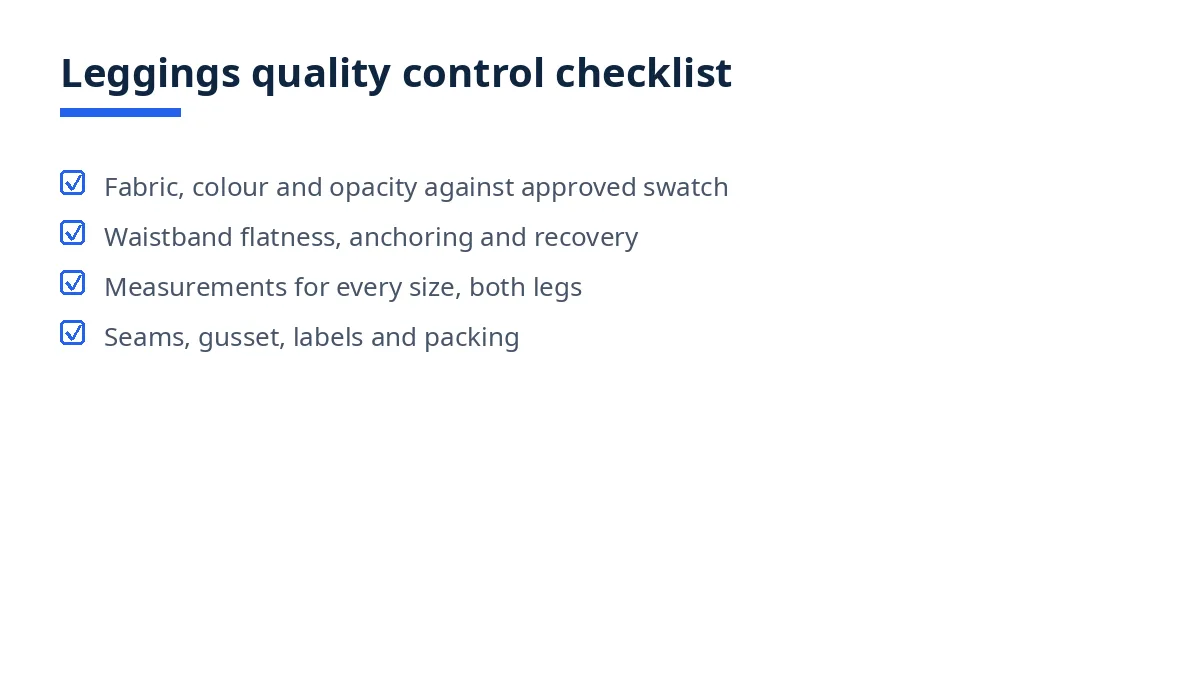
The full checklist
Work through each section in order. Record pass, fail and quantities found, with a photograph for every failure, and compare defect totals with the acceptance limits.
Quantity and style verification
Style number, description and colours match the purchase order.
Total quantity and quantity per size and colour match the order, allowing only buyer-approved variations in writing.
The product matches the approved sample for fabric, construction, waistband style, trims and finish.
Fabric and colour
Fabric composition, weight and appearance match the approved swatch. The knit is consistent, with no holes, snags, runs or knitting faults beyond the approved standard.
Colour matches the approved reference under consistent, neutral light. Check every colour for shade variation within a garment and between garments.
Print or logo, where used, matches approved artwork for design, colours, size and placement. Check that it stretches with the fabric without cracking.
Opacity check: stretch sampled pieces over a contrasting surface and hold them against the light. Fabric that turns clearly see-through beyond the approved sample standard fails. Compare every colour, because lighter colours show the problem first.
Where your contract requires colourfastness testing, confirm the report covers the bulk fabric and this lot. ISO 105-C06 covers colour fastness to domestic and commercial laundering, where colour loss and staining in a single test closely approximate one laundering.2
Waistband and elastic
The waistband sits flat and even, with no twisting, rolling or wavy top edge. Stitching is straight and secure all the way round.
Elastic, where used, is the correct width, evenly inserted and anchored so it cannot twist inside the casing. Any drawstring specified is present and correctly threaded.
Stretch and recovery: stretch the waistband gently and release it several times. It should extend evenly and return close to its original size without staying baggy. Where the contract requires a laboratory figure, ISO 20932-1 sets out strip tests for the elasticity of fabrics, including elongation, permanent deformation and elastic recovery after cycling.3
Measurements
Measure sampled pieces flat and relaxed, without stretching, at every point on the buyer chart: waist, hip, front rise, back rise, thigh, knee, leg opening, inseam and total length.
Record each measurement against its tolerance. Flag any point outside tolerance and measure further pieces in that size.
Check leg symmetry. Compare inseam and total length leg to leg, and confirm consistency across colours in the same size.
Workmanship and defects
Seams are complete, even and secure, with no skipped or broken stitches, open seams or untrimmed threads. Check the crotch and gusset closely, where strain is highest.
Seam stretch check: gently stretch each main seam on sampled pieces. Stitching should extend with the fabric and not crack, pop or open.
Legs are straight and untwisted. Hems or leg openings are even, flat and the same width on both legs.
No stains, oil marks, dirt, holes, snags, runs, needle damage or shiny pressing marks on sampled pieces.
Check body fabric recovery as well as the waistband. Stretched fabric should recover evenly, without local bagging at the knee or seat.
Stack folded pieces of the same size. Obvious length or leg differences should be re-measured, not ignored.
Labelling and trims
Labels are correct and legible: the size label matches the actual size, and the care and fibre content label matches the ordered fabric and the destination requirements.
Fibre content matches the actual fabric. For the European Union, Regulation (EU) No 1007/2011 requires textile products to be labelled with their fibre composition whenever they are made available on the market, in labelling that is durable, easily legible, visible and accessible.4
For the United States, check care wording against the Care Labeling Rule at 16 CFR 423.6: manufacturers and importers must attach care labels that can be seen or easily found, stating the regular care needed, including a washing or drycleaning instruction and warnings where a normal care step would harm the garment.5
Hang tags, price tickets and stickers match the style, size and colour of each garment.
Pressing, folding and packing
Pieces are clean and neatly finished, with no scorch, shine or hard creases that distort the garment.
Individual packing matches the instruction, with correct size identification and any inserts or hangtags attached.
Size and colour ratio in each carton matches the packing list. Carton markings show style, colour, sizes, quantities and carton number.
Cartons are sound, correctly closed and suitable for the agreed transport. Total carton count matches the packing list.
Draw a final sample from packed cartons, not only loose pieces, and recheck style, size, waistband, label and packing before signing.
Common failures and how to fix them
Waistband faults. Twisting, rolling, a wavy top edge or a waistband that stays stretched usually comes from uneven elastic insertion, unanchored elastic, or uneven stitching tension. Isolate affected pieces, re-set or replace waistbands that cannot be corrected, fix the insertion setting, and re-inspect.
Cracked or open seams. Stitching that pops under stretch usually means a stitch type or tension unsuited to stretch fabric, or a skipped stitch at a strain point such as the crotch. Re-sew affected seams completely, correct the machine setting, and repeat the seam stretch check.
See-through fabric. Fabric that turns transparent when stretched is usually lighter than the approved standard, or from the wrong lot. Compare suspect pieces against the approved sample under the same stretch and light. Pieces that fail should be replaced, not shipped.
Uneven and twisted legs. One leg longer than the other, or a leg that twists in wear, usually comes from mismatched cutting or off-grain panels. Isolate the affected size, measure a larger sample leg to leg, and rework or replace failing pieces.
Measurement drift. One size moves outside tolerance because a pattern, cutting or sewing setting has shifted. Isolate that size, measure a larger sample, and rework or replace failing pieces.
Shade variation and fabric faults. Colour differences within a colour, or runs, snags and holes, usually mean fabric lots were mixed or a faulty lot was cut. Sort suspect cartons under consistent light and replace mismatched or faulty pieces.
Wrong labels or packing ratio. A correct garment with a wrong label is still a failed product. Relabel or repack affected cartons completely, then draw a fresh sample to verify.
Summary table
Section | What is checked | Result to record |
|---|---|---|
Quantity and style | Quantities per size and colour against the order | Counts and any variance |
Fabric and colour | Fabric, shade, print and opacity against references | Pass or fail per colour, with photos |
Waistband and elastic | Waistband flatness, elastic anchoring, stretch and recovery | Defects per point, with photos |
Measurements | Every chart point per size, both legs | Measurements against tolerance |
Workmanship | Seams, gusset, hems, stains, labels | Defects as critical, major or minor |
Packing | Folding, ratio, carton marks | Carton sample result, total cartons |
How Exportain helps
Exportain connects buyers with Bangladeshi leggings and knitwear suppliers, so the sample, tolerances and acceptance criteria behind this checklist can be agreed at the enquiry stage. Supplier profiles show what each factory produces and which document and photo checks have been recorded for that supplier. Those checks are reviews of documents and photos, not factory inspections, and they do not replace your own inspection, testing or contract.
FAQs
When should this checklist be used?
Use it at the pre-shipment stage, when production is complete and packing is finished or at the agreed stage, so pieces and packed cartons can both be checked. Waistband, seam stretch and measurement sections can also be used in-process, so faults are corrected before they repeat.
Who should complete it?
An inspector working from the approved sample, tech pack and purchase order: the buyer representative, an independent provider, or a factory quality manager, provided the standard was agreed in advance and findings are recorded with measurements and photographs.
What are the most common failures?
Waistband twisting, rolling or loss of recovery, seams that crack when stretched, fabric that turns see-through in wear, uneven or twisted legs, measurements outside tolerance, shade variation, runs and snags, stains, and packing errors including wrong size ratios and labels.
Can a third party do it?
Yes. A third-party provider can complete this checklist at the factory on the buyer behalf, using the approved references and standard, and report measurements, defect counts and photographs directly to the buyer. Confirm references, sample size and acceptance limits in advance.
Next steps on Exportain
Set your sampling plan with the AQL acceptance quality limit explainer, time the final check with the pre-shipment inspection guide, and compare this list with the knitted underwear quality control checklist for other stretch knit styles.
Sources
- ISO 2859-1:2026 - Sampling procedures for inspection by attributes — Part 1: Sampling schemes indexed by acceptance quality limit (AQL) for lot-by-lot inspection. ISO (accessed )
- ISO 105-C06:2010 Textiles — Tests for colour fastness — Part C06: Colour fastness to domestic and commercial laundering. International Organization for Standardization, (accessed )
- ISO 20932-1:2018/Amd 1:2021 Textiles — Determination of the elasticity of fabrics — Part 1: Strip tests. International Organization for Standardization (accessed )
- Regulation (EU) No 1007/2011 on textile fibre names and related labelling and marking of the fibre composition of textile products. European Union, (accessed )
- 16 CFR Section 423.6 Textile wearing apparel — Care Labeling Rule. Legal Information Institute, Cornell Law School (accessed )
About the author
Sourcing from Bangladesh?
Post a request for quotation and suppliers on Exportain can send you their quotes directly.
Post an RFQ