Leather Jackets Price in Bangladesh: FOB Cost Breakdown for Buyers
Ask what share of the price is the panel, the making, and the finish and packing before you rank any FOB quotation. This guide reads leather jacket prices in Bangladesh as four shares, with tier breaks, the FOB boundary, and the document checks that decide whether a figure holds.
Short answer
A leather jacket FOB price in Bangladesh is read as four shares: panel and leather, construction, finish and packing, and the on-board tail, up to loading on board at the named port. Fix the jacket specification first, require each share itemized on the same counting basis and delivery term, check tier prices on both sides of each break, and have a broker confirm the indicative 4203.10 classification and duty treatment before ranking any quotation.
On this page
Key takeaways
Read an FOB quotation as four shares — panel and leather, construction, finish and packing, and the on-board tail — on the same specification, counting basis, and delivery term, before ranking any headline total.
The panel and leather share cannot be read until the leather type, grain, thickness, color, finish, and tannery are named, with the shade standard and light source agreed.
Tier prices fall in steps as quantity rises, but the order total rises too; check both sides of every break, and requote when the leather lot, split, or validity date changes.
FOB is a sea and inland waterway rule only, ending on board at the named port; for containerized shipments, ask for the quotation restated on FCA as well.
Confirm the indicative 4203.10 classification and duty treatment with the broker, and keep the specification, shares, split, and evidence in one versioned file.
What share of a leather jacket price is the panel? What share is the making, and what share is finish, packing, and the work that gets the jacket on board? Ask those questions before any quotation is ranked, and a single FOB figure becomes a set of lines that can be compared. This guide reads leather jackets price in Bangladesh that way. Every dollar figure is an example figure; no market price, minimum, capacity, or duty rate is stated as fact. It is for buyers ordering leather jackets from Bangladesh for sale in the USA, UK, EU, or UAE.
The price-reading question: four shares in one jacket price
An FOB price is the price of a jacket delivered loaded on board at the named port, with export formalities completed by the seller and the carrier contracted and paid by the buyer.1 2 Freight beyond the port, insurance, and destination charges sit outside it. The first question is which shares the figure contains, and whether every supplier priced the same jacket on the same basis and delivery term.
Read every quotation as four shares: panel and leather; construction; finish and packing; and the on-board tail. Example figures: 400 jackets at an example unit price of $62.50, an FOB total of $25,000. The shares are structure only; no real jacket will match them exactly.
Share | Share of the FOB total | Example dollars, 400 jackets |
|---|---|---|
Panel and leather | 58% | 14,500 |
Construction | 22% | 5,500 |
Finish and packing | 9% | 2,250 |
On-board tail | 11% | 2,750 |
Total | 100% | 25,000 |
Ask every supplier to quote the same four shares, on the same specification, counting basis, and delivery term.
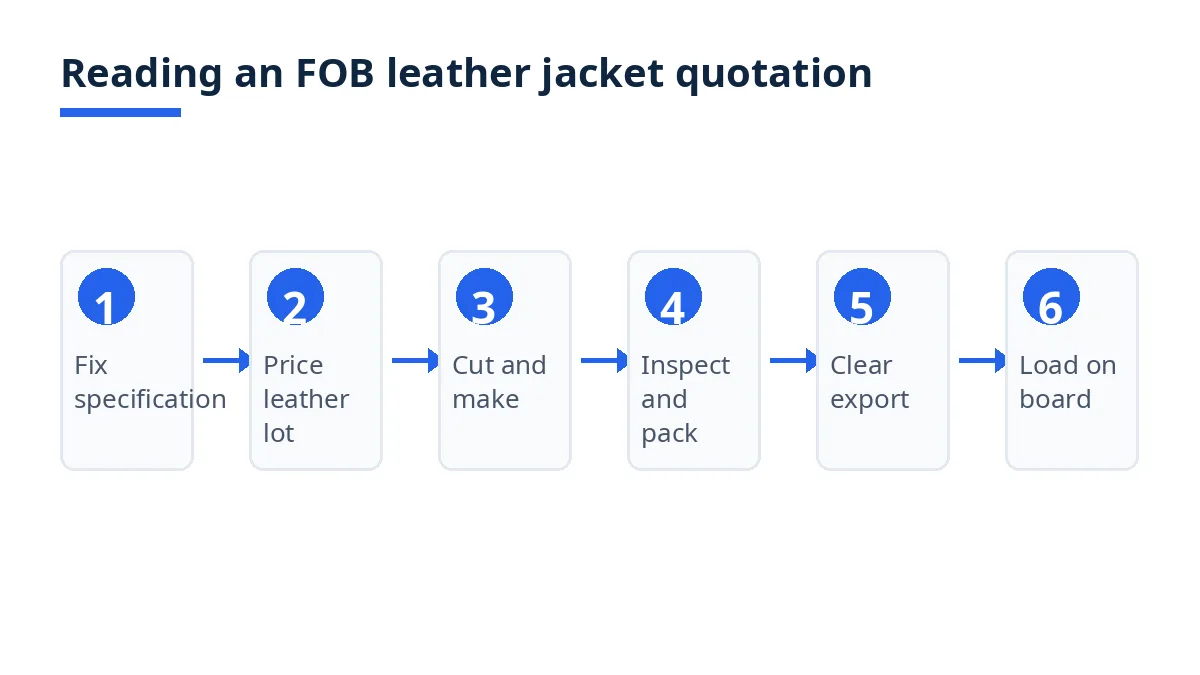
The diagram sets the reading order: specification, leather lot, cut and make, inspect and pack, clear export, load on board.
Panel and leather share: what the hide decides
A leather jacket is panels cut from hides carrying natural marks, so panel layout, leather type and grain, and shade standard decide how much usable leather each jacket takes. Require the quotation to name the leather type and grain, thickness, color, finish, and tannery, with the shade standard and light source agreed before production. Inspection grades natural marks by position and size, not as zero defects.3 Grain and shade must hold across all panels and between jackets in the same color, under the agreed light.3
The word leather alone fixes nothing. In the United States, the unqualified term leather should describe a product only where it is composed in all substantial parts of leather, and imitation, simulated, and bonded leather must be disclosed as the rule requires.4 Require test reports naming your product, leather, and method for each limit your market applies. Leather counts as chrome-free below 1,000 mg/kg of total chromium on a dry weight basis under BS EN 15987, and for Gold and Silver Leather Working Group certification, chromium VI must be below 3 mg/kg, with any level above that an automatic failure.5 In the EU, the REACH restriction bars skin-contact leather articles at or above 3 mg/kg of chromium VI in the total dry weight of the leather.6 Confirm the current rule with your broker or adviser.
Construction share: what the making decides
Construction turns panels into a jacket that holds its shape when worn, and moves with the panel count, collar shape, lining, zip and hardware, and stitching and edge work. Stitching must run straight at a consistent density with reinforced stress points at the shoulders, the armholes, and the pocket corners.3 The front zip must run fully several times, smooth, with no catching or skipped teeth, teeth meeting evenly and tape lying flat.3 The lining must sit flat and secure, with no pulling or bunching, and the sleeve lining free of twist.3 A twisted sleeve lining is found by putting an arm through the jacket, not by laying the jacket flat.
Approve a pre-production sample in writing, keep a sealed counter-sample, and hold bulk production until approval. Where the construction share differs between quotations, ask which element moved: the panel count, the lining, the hardware, or the finishing standard. A cheaper construction share that drops a lining or a reinforcement is a different jacket, not a better price.
Finish, packing and the on-board tail
Finish is judged at first handling: edge finishing smooth and free of cracks, labels correct in content, spelling, and position, and no strong odor or surface marks.3 Lab evidence must name the method and record the result against the specification.3 Packing is hanging packing: hanger, garment bag, tissue, polybag, and carton, hanging and not folded, with no hardware pressing into the leather and no shoulder crease.3
The on-board tail carries the jacket to loading on board, including the export documents. Goods must not be loaded for export unless a Bill of Export is submitted to Customs in the prescribed format and approved, with the export letter of credit or, where there is none, the export contract, purchase order, or export guarantee approved by the negotiating bank, the signed commercial invoice, the packing list, the certified EXP form, the certificate of origin, the VAT registration certificate, and the taxpayer identification number enclosed.7 Ask which documents the handling line includes before the price is fixed. A handling line that omits a document has moved its cost outside the headline.
Tier breaks: the same jacket at three quantities
Quantity changes a jacket price in steps, and the counting basis decides what the quantity means. A minimum order quantity is the smallest quantity a supplier will accept on its normal terms, counted per order, per style, or per color, and can combine with a minimum order value.8 Tiered pricing means the unit price falls in steps as quantity rises.8 Ask for the price at each tier and split, in writing, on the same specification. Example figures only:
Example quantity | Example unit price | Example order total |
|---|---|---|
300 jackets | $68.40 | $20,520 |
400 jackets | $62.50 | $25,000 |
700 jackets | $58.90 | $41,230 |
The unit price falls at each step, but the order total rises, because more jackets are bought. Check both sides of every break: the larger order costs more in total here, and the extra jackets must be sellable. An order below the quoted quantity may carry an upcharge, so ask what the surcharge would be.8 A tier price holds only while the leather lot, split, delivery term, and validity date hold. When any changes, requote it.
The FOB boundary, and the container question
Incoterms 2020 provides eleven rules clarifying costs, transport, insurance in the case of CIP and CIF, formalities, and packing and certification.1 The sea-only group is FAS, FOB, CFR, and CIF.2 9 Under FOB, the seller delivers the goods loaded on board at the named port, transfers the risk to the buyer there, and completes export formalities, while the buyer contracts and pays the carrier.1 2 CFR and CIF share the same risk point, but under both the seller pays the freight to destination, and under CIF the seller must also contract insurance for the buyer.9 Write the rule, the named place or port, and the edition into the contract, for example FOB Chattogram, Incoterms 2020.
The container question decides whether FOB fits the shipment at all. FCA suits any mode of transportation, including multimodal shipments, and is the appropriate rule for container or pallet movement using multiple modes.1 Containers are typically delivered to a container terminal, not on board, and may remain there for days before loading, in which case FCA is more appropriate.2 Late or missing notice of the vessel name or loading point leaves the buyer bearing the risks and costs even before loading.1 For a containerized jacket shipment, ask for the quotation restated on FCA as well, and compare the two on the same specification before choosing.
Costs, timelines and documents in one file
Beyond FOB, budget separately for ocean freight and insurance, destination charges, import clearance, duty and tax, and onward delivery. None belongs inside an FOB comparison, and none is estimated here. No typical lead time can be stated as fact: agree a dated plan. Keep one file: specification, itemized quotation, purchase order, sample approval, inspection plan, and validity date. Quotations on Exportain are versioned, so a change belongs in a new version, not in a message.10
Classification sits in the same file. The Harmonized System comprises more than 5,000 commodity groups, each identified by a six-digit code, and is used by more than 200 countries and economies for their customs tariffs.11 Heading 4203 covers apparel and clothing accessories of leather or composition leather; subheading 4203.10 covers articles of apparel.12 Treat 4203.10 as indicative: confirm the subheading and national extension in the destination tariff for the exact garment on the entry date, and have the broker confirm the duty treatment.11 The outer surface decides whether heading 4203 applies, a quilted lining changes nothing, and a furskin lining beyond mere trimming removes the garment from Chapter 42.11 Keep the description identical across every document.
Bangladesh rules that change a jacket price
Three Bangladesh-side checks change a jacket price. First, the export document set: the Bill of Export must be approved before loading, and product-wise additional documents apply for some categories.7 The product-wise list names an Export Registration Certificate for jute, jute goods, and tea, and states no leather jacket paper, so ask the broker whether any product-wise paper applies to the exact jacket.7 Second, the leather evidence: read any tannery evidence for the leather, tannery, scope, and expiry it names, and confirm it with the issuing body; a tannery audit assesses the tannery, not the finished jacket.5 Third, the supplier record: each badge names the checks behind it, verification is a document and photo review, not a factory visit or a government-database check, and a badge is not a guarantee of capacity, quality, or delivery.13 Exportain is not a party to your trade, does not inspect goods, book freight, or clear customs, and holds money only by agreement to a funds hold.13
Mistakes and red flags
Ranking headline totals that price different jackets is the first mistake. A quotation naming only leather, without type, grain, thickness, color, finish, and tannery, has not fixed the panel share. Comparing a unit price without its counting basis is the second: a minimum counted per color is a different commitment from the same number counted per order.8 Treating a tier price as fixed after the leather lot, split, or validity date changes is the third; a changed condition needs a new version. Reading a tannery certificate as proof about the finished jacket is the fourth: the audit covers the tannery, and the jacket still needs its own test reports and inspection.5 Cutting inspection or testing to reach a target price is the fifth: the fault is then found by the customer. Pay only the company account named in the documents, and treat a late bank-detail change as a reason to pause.
Checklist before you rank a quotation
Specification fixed: leather, panel layout, collar, pockets, zip and hardware, lining, stitching, edge finish, labels, and size run.
Four shares itemized by every supplier, on the same specification, counting basis, and delivery term, with a validity date.
Leather lot locked: lot, tannery, shade standard, light source, and price validity for that lot.
Quantity and split stated, with the price at each tier and split, and the counting basis in writing.
FOB boundary confirmed in the contract, with an FCA restatement asked for containerized shipments.
Documents agreed: the Bill of Export set, the indicative 4203.10 classification, and the broker-confirmed duty treatment.
Evidence agreed: test reports naming the method, leather lot, and jacket, and certificates confirmed with the issuing body.
Inspection plan, written sample approval, sealed counter-sample, payment terms, and the action on a failed lot agreed before production.
What should I know first about leather jacket prices in Bangladesh?
Know the price as four shares, and fix the jacket before reading any share. The panel and leather share cannot be read until the leather type, grain, thickness, color, finish, and tannery are named. An FOB figure excludes freight beyond the port, insurance, and destination charges, and a leather jacket sits indicatively at subheading 4203.10, articles of apparel, under heading 4203.12 11 State the specification, split, and delivery term before asking for a price.
What are the typical costs and timelines for an FOB leather jacket order?
There are no typical costs or timelines a guide can state as fact. Each supplier prices your leather, panel count, construction, finish, packing, split, and delivery term, and timelines follow the leather lot, tooling, and sample approval. Example figures only: 400 jackets at $62.50 give an FOB total of $25,000, with the panel and leather share at 58 percent. Ask for a breakdown by share, a locked leather price, and a validity date, and requote when any condition changes.
Which documents are needed for an FOB leather jacket shipment?
The price set is the specification, the itemized quotation by share, the purchase order, and the sample approval record. The export set enclosed with the Bill of Export is the export letter of credit or contract, purchase order, or bank-approved export guarantee, the signed invoice, packing list, certified EXP form, certificate of origin, VAT certificate, and taxpayer identification number.7 The handling line must state which export documents it includes before the price is fixed. Keep the jacket description identical across every document, and confirm the classification and duty treatment with the broker.
What are the most common mistakes with FOB leather jacket prices?
The most common mistakes are ranking headline totals that price different jackets, accepting one total without the four shares, comparing leather shares naming different leather or thickness, treating a tier unit price as fixed after its conditions change, reading a tannery certificate as proof about the finished jacket, and cutting inspection or testing to reach a target price. Put the specification, shares, split, and evidence in writing first.
Next steps on Exportain
Browse Bangladeshi suppliers against your specification, starting with the supplier verification guide and the MOQ meaning guide. Check the HS code guide for leather jackets and the quality control checklist for leather jackets while writing the specification, and follow the eight steps in the how to buy guide. When the jacket, split, and delivery term are fixed, post a free RFQ stating quantity, target price, destination, Incoterm, certifications, and deadline, asking suppliers to quote each share separately.10 Exportain is not a party to the trade; payment is settled directly with the supplier.10
Sources
- FCA & FOB Incoterms 2020 explained: Key differences. ICC Academy (accessed )
- FOB & FAS Incoterms® 2020 explained: Key differences. ICC Academy (accessed )
- Quality Control Checklist for Leather Jackets. Exportain, (accessed )
- 16 CFR § 24.2 - Deception as to composition. Legal Information Institute, Cornell Law School (accessed )
- Certification - Leather Working Group. Leather Working Group (accessed )
- Commission Regulation (EU) No 301/2014 amending Annex XVII to Regulation (EC) No 1907/2006 (REACH) as regards chromium VI compounds. European Union, (accessed )
- Customs Clearance Procedures for Export. Bangladesh Customs, National Board of Revenue (accessed )
- MOQ Meaning (Minimum Order Quantity). Exportain (accessed )
- CFR & CIF Incoterms 2020 explained: Key differences. ICC Academy (accessed )
- How to source and buy from Bangladesh. Exportain (accessed )
- HS Code for Leather Jackets: Classification Guide for Importers. Exportain, (accessed )
- Classification Detail: HS, 2017, Code 4203. United Nations Statistics Division (accessed )
- How Supplier Verification Works on Exportain. Exportain, (accessed )
About the author
Sourcing from Bangladesh?
Post a request for quotation and suppliers on Exportain can send you their quotes directly.
Post an RFQ