Leather Jackets Exporters in Bangladesh: Supplier Checklist
One file per exporter, four gates in order, and one decision before a deposit: this criteria-only checklist checks identity, producing site, leather evidence, samples, MOQ, terms and inspection for leather jacket exporters in Bangladesh.
Short answer
Check a leather jacket exporter in Bangladesh with one file per exporter and four gates in order: identity and producing site, leather and sample evidence, commercial terms, and market, inspection and shipment file. File the evidence named for each check, mark open items as open and contradictions as holds, and pay no deposit until all four gates are filed. Exportain badges record document and photo reviews only, not inspections or guarantees.
On this page
Key takeaways
Run the checklist at three decision points: shortlisting, sample approval and pre-deposit, closing only the gates that belong to each point before moving on.
Keep one file per exporter, with the same sections, dates and specification version in every file, and three states only: filed, open or hold, with no numeric score.
Read each Exportain badge for the checks its name records: verification is a document and photo review, not a factory inspection or a guarantee.
Example figures: a minimum of 90 pieces per color across 4 colors in 1 style means a smallest order of 360 pieces, not 90; always ask for the counting basis in writing.
Pay no deposit until all four gates are filed, including agreed inspection terms and the export declaration enclosure list.
Two leather jackets exporters in Bangladesh can answer the same request with the same style name, the same leather description and a similar price, and still offer two different orders. One names the tannery, the factory that will cut the jackets and the basis on which its minimum is counted. The other leaves those points unstated, and the buyer finds the difference only when the sample, the invoice or the shipment file does not match the quotation. A checklist used once, at the end of a search, cannot catch that gap. It has to run through the search, with each answer filed as it arrives and compared on identical fields.
This checklist is for buyers in the United States, the United Kingdom, the European Union and the United Arab Emirates before a first order. It names no companies, ranks no exporter and states no price, capacity or certificate as a fact. Every figure in it is labeled as an example figure. Its purpose is narrow: one file per exporter, four gates in order, and one decision — proceed, repair, or walk away — taken before any deposit is paid.
Use the checklist at three decision points, not once
A check that happens only before a deposit arrives too late to change the shortlist, and a check that happens only at shortlisting cannot test the jacket. Run the same file at three points, closing the gates that belong to each point before moving on.
Decision point | What is decided | Gates to close |
|---|---|---|
Shortlist, before quotations are compared | Which exporters answer on the same specification | Gate A: identity and producing site |
Sample approval, before bulk production | Whether the jacket in hand matches the specification | Gate B: leather, sample and specification |
Pre-deposit, before money moves | Whether the commercial and shipment terms are complete | Gates C and D: terms, market and shipment file |
No gate is closed on a verbal assurance. If the evidence is not in the file, the gate stays open and the order waits.
Assemble one file for each exporter before you compare
Open one file per exporter, with the same sections in every file, before the first quotation arrives: identity and site, leather and tannery evidence, sample and specification, commercial terms, market and labelling, and inspection and shipment. Date every entry, name the person who supplied it, and keep the version number of every specification beside it. When a later answer changes an earlier one, keep both versions and note which one the quotation prices.
Give the file one owner: the buyer, or a named member of the buying team, even when a broker, inspector or laboratory completes part of a gate. The owner records three states only: filed, open, or hold. Filed means the evidence named in the checklist is in the file. Open means it has been asked for and has not arrived. Hold means what arrived contradicts another document, names a different product or site, or has expired. This article sets no numeric score and no pass mark. A file with one hold cannot support a deposit until the hold is cleared or the exporter is dropped. Send every exporter the same specification, quantity basis and delivery term, and ask for the same quotation fields: unit price, minimum order quantity, lead time, Incoterm, payment terms and validity.1
The full checklist for leather jackets exporters in Bangladesh
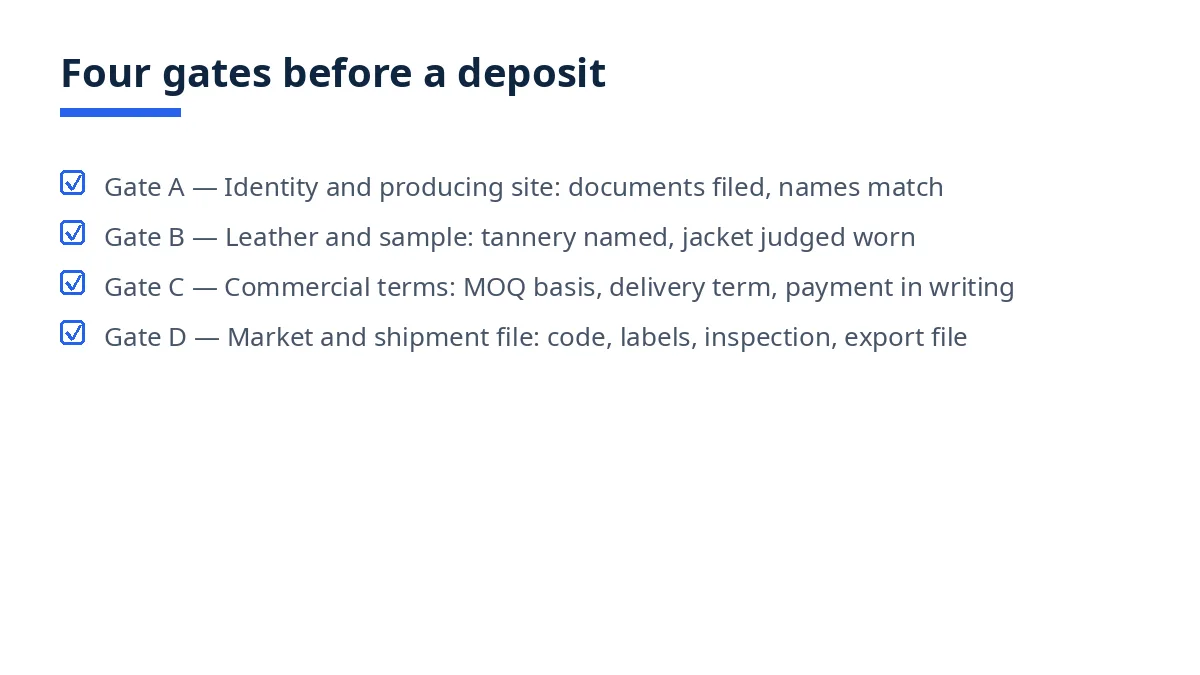
Work the gates in order. Gate A decides whether the exporter is who the profile says it is and where the jackets will be made. Gate B decides whether the jacket and its leather are the ones described. Gate C decides whether the commercial terms are complete and comparable. Gate D decides whether the jacket can enter the destination market and whether the shipment file will match it. Do not start Gate C until Gates A and B are filed, and do not pay a deposit until all four are filed.
Gate A: identity and producing site
Company name and address match across documents. File the trade licence and Export Registration Certificate (ERC) as supplied, and check that the name and address on them match the quotation and the invoice.2 Record any difference as a hold.
Each badge is read for the checks its name records, with its limits. Exportain Verified records identity, phone, email and business registration; Export Verified records the ERC; Factory Verified records reviewed factory photos; Trading Company Verified records reviewed office or warehouse photos; Trusted Trader records completed orders on Exportain with no disputes.2 Verification is a document and photo review by Exportain staff: not a factory inspection, not a check against a government database, and not a guarantee of capacity, quality or delivery.2 A missing badge means a check has not been approved, not that it failed.2
The producing site is named for each style. Record which site cuts, stitches and finishes the jacket, which site supplied the leather, and which stages are bought in. For a trading company, record the producing factory for each style before any deposit, and name it in the order terms. An unnamed site is a hold.
Payment details are checked before they are used. Where the profile checklist shows a payment account line as checked, the business bank account was checked against the company name, with no bank details shown to buyers.2 Treat any late change to bank details as a hold until the exporter confirms it in writing through the same channel as the quotation.
Gate B: leather, sample and specification
The tannery, the leather and its certification are named for the sample. Ask which tannery made the sample leather, what evidence names that tannery and leather, and its scope and expiry. Where a Leather Working Group certificate is relied on, confirm scope, rating and expiry with the issuing body: certification is valid for 24 months for manufacturing facilities and 12 months for part-processed material traders, the audit covers 17 sections, and the final medal is the lowest rating achieved.3 Certification does not guarantee that a final product will pass a restricted substances test, so require a laboratory report naming the product, leather and method for each limit the destination market applies.3
One version-numbered specification fixes the jacket. File a single tech pack, sent identical to every exporter, covering leather type and grain, panel layout, collar and lapel shape, pocket style and placement, zip and hardware, lining, stitching, edge finish, labels, the size run, the shade standard and the packing method. A style name or photograph alone does not fix the jacket.
The sample is judged worn, not flat. Judge the approved sample as a wearer meets it: run the full-length front zip several times, check collar and lapel symmetry while zipped, measure both sleeves by one method, and test each sleeve lining for twist.4 Record the measurement method, the light used for shade, and the condition — zipped or unzipped, flat or on a hanger — and use the same condition for every jacket.4
Natural marks are graded by position and size, in writing. Genuine leather comes from animal hides, so scars, insect holes, blood veins and growth wrinkles are inherent, and inspection grades them by position and size: damage in a corner area may mean only a grade drop, while damage in the main material area may scrap the whole hide.4 State which faults count as critical, major or minor before production, agree the sampling plan in writing, and retest whenever the leather or tannery changes.
Gate C: commercial terms
The minimum is counted on a stated basis. A minimum order quantity is the smallest quantity a supplier will accept on its normal terms, counted per order, per style or per color, sometimes with a minimum order value.1 Ask for the counting basis in writing and whether more than one basis applies at once. Example figures: a minimum of 90 pieces per color, across 4 colors in 1 style, means a smallest order of 360 pieces, not 90.
Price drivers are named, not assumed. Price moves with leather type, grain and thickness, hardware finish, lining, the size and color mix, packing and inspection requirements. Ask which of those the unit price includes, and whether a lower minimum carries a surcharge. The minimum itself is set by the material, the trims and the variety, since custom leather brings the tannery minimum into the maker minimum and every extra color, size or style adds changeovers.1
The delivery term is written in full, with the named place. Write the Incoterms rule, the named place or port and the edition into the contract, and price every quotation on the same term. Incoterms 2020 provides 11 rules with a clear allocation of cost, risk and obligations, and collects all costs for a rule in one article.5 A city name alone is not a named place: record the dock, terminal or gate.
Payment, validity and lead time are dated, in writing. Cash in advance leaves the buyer exposed if the goods are not sent, while a letter of credit protects both sides because payment depends on documents showing the goods were shipped as agreed.2 Record the payment schedule, the documents triggering each payment, the inspection condition to be met first, the quotation validity dates and the production lead time. Exportain is not a party to the trade, and it holds money for a goods order only when both parties agree to a funds hold.2
Gate D: market, inspection and shipment file
Classification is confirmed for the exact jacket. The indicative heading is 4203, articles of apparel and clothing accessories of leather or composition leather, and the indicative subheading for a leather jacket is 4203.10, articles of apparel.6 Confirm the full national code in the destination tariff for the exact garment on the entry date, since only the first six digits are shared internationally.6 State no duty rate from memory: treatment follows the confirmed code, the origin and the measures in force on the entry date.6
Labels are approved proof by proof, per market. Approve every label proof word for word, per destination market, before the label run: main, care and size labels where specified, correct in content, spelling and position.4 A label approved for one market is not approved for another.
Inspection and packing terms are agreed before production. Agree the standard, the sampling plan, the defect classes and the action on a failed lot, name the inspector, and require a report covering the lot, sample size, defects with photographs, measurements and packing.4 A pre-shipment inspection samples finished, mostly packed goods, not every piece, and is not a guarantee. Confirm hanging packing as specified — hanger, garment bag, tissue, polybag and carton, hanging rather than folded, with no hardware pressing into the leather and no shoulder crease.4
The export file is listed before shipment. Goods must not be loaded or stuffed for export unless an export declaration, known as a Bill of Export or Shipping Bill, has been submitted in the prescribed format and approved by the Customs authority.7 File the enclosure list beside the order: the export letter of credit or equivalent contract, the signed invoice, the packing list, the EXP form certified by an Authorized Dealer bank, the certificate of origin, the VAT certificate and the taxpayer identification number.7 Before loading, ask the exporter to confirm the declaration has been approved and that the invoice and packing list describe the jacket in the same terms used for classification.6
When a check fails: repair, substitute, or walk away
Sort a failed check into one of three responses, and record which was chosen and why. Repair means the exporter supplies the missing or corrected evidence and the gate is re-checked. Substitute means different evidence answers the same question, and the file records why. Walk away means the exporter cannot or will not supply the evidence, and the file is closed without a deposit.
Failure | Repair | Walk away when |
|---|---|---|
Names differ across documents | Corrected licence or invoice copy, re-checked | The difference is not explained |
Producing site or tannery unnamed | Named site and tannery per style, in writing | The maker or tannery stays unnamed |
Counting basis unstated | Quotation restated with the basis in writing | Pricing rests on a headline number only |
Inspection agreed late | Terms agreed before production, in writing | Inspection is offered only after packing |
Classification copied from another product | Broker-confirmed code for the exact jacket | The code is copied from a bag, belt or glove line |
Do not repair the same hold twice. If a corrected document contradicts the first version without explanation, or a second sample arrives in different leather without a note, close the file.
Summary table: one row per exporter, one decision per file
Use one row per exporter and one decision per file. Keep each round beside the earlier one, so a change of answer is visible.
Exporter | Gates filed | Open holds | Decision |
|---|---|---|---|
Exporter A | A, B, C, D | None | Proceed to order terms |
Exporter B | A, B | Gate C: counting basis unstated; Gate D: inspection unbooked | Repair or walk away |
Exporter C | A | Gate B: tannery unnamed; Gate C: validity unstated | Walk away |
The table is a decision record, not a ranking. Where two files are both complete, compare them on identical quotation fields — unit price, minimum on its stated basis, lead time, Incoterm, payment terms and validity — and on the sample record, not on the number of badges held. A badge shortens the desk check; it does not replace the sample, the inspection or the payment terms.2
When should this checklist be used?
Use it at the three decision points above: at shortlisting, at sample approval and before a deposit. A single pass at the end leaves no room to change the shortlist, and a single pass at the start cannot test the jacket. Reopen the file whenever the leather, tannery, color, size run or delivery term changes, since each change can reopen a gate that was filed.
Who should complete it?
The buyer owns the file and the decision. A customs broker can complete the classification parts, an inspector the sample and inspection parts, and a laboratory the chemical and physical test parts, each working to the buyer specification. The supplier supplies documents, names sites and tanneries, and produces the sample; it does not complete its own file. Name the person responsible for each gate, so an open hold always has an owner.
What are the most common failures?
The failures that recur are mismatched names across documents, an unnamed producing site or tannery, a minimum stated without its counting basis, a delivery term stated as a city rather than a named place, labels approved for the wrong market, and inspection terms agreed only after packing. Each is a file failure before it is a goods failure: the evidence was missing, contradictory or late, and the order went ahead without it. On the jacket itself, the recurring faults are a zip that catches, a sleeve pair out of step, a collar uneven when zipped, a lining that twists, and shade banding across panels under the agreed light.4
Can a third party do it?
Yes, for parts of it. A third-party inspector can carry out the sample, during-production and pre-shipment checks against the buyer specification and sampling plan, and arrange laboratory testing where the specification requires it.4 A broker can confirm classification and duty treatment, and a laboratory can report on named methods. Require a written report for each part, recording the lot, sample size, defects with photographs, measurements and packing. The decision stays with the buyer: no inspector, broker or laboratory can close a gate on evidence it has not seen, and none can turn a badge into an inspection.
Next steps on Exportain
Browse Bangladeshi suppliers and open each profile trust and verification checklist before shortlisting, then read how supplier verification works on Exportain and the MOQ guide beside the quotation fields in Gate C. When the specification, quantity basis and delivery term are fixed, post a free RFQ stating all three in full, and compare the versioned quotations on the same fields. Exportain is a B2B marketplace where buyers find Bangladeshi suppliers and post requests for quotation. It is not a party to the contract for the goods, and it does not inspect goods, book freight or clear customs.2 8
Sources
- MOQ Meaning (Minimum Order Quantity). Exportain (accessed )
- How Supplier Verification Works on Exportain. Exportain, (accessed )
- Certification - Leather Working Group. Leather Working Group (accessed )
- Quality Control Checklist for Leather Jackets. Exportain, (accessed )
- Incoterms® 2020. International Chamber of Commerce (ICC) (accessed )
- HS Code for Leather Jackets: Classification Guide for Importers. Exportain, (accessed )
- Customs Clearance Procedures for Export. Bangladesh Customs, National Board of Revenue (accessed )
- How to source and buy from Bangladesh. Exportain (accessed )
About the author
Sourcing from Bangladesh?
Post a request for quotation and suppliers on Exportain can send you their quotes directly.
Post an RFQ