

How Much Does Lab Testing Cost in Bangladesh?
Lab testing cost in Bangladesh has no single price. This guide explains what drives a laboratory quote, how sample testing runs from scope to report, and how to read results and handle retests.
Short answer
Lab testing cost in Bangladesh has no single price. The total is built test by test from the test list, the methods and standards, the sample count, the laboratory accreditation scope, courier and handling, express options, and retest terms. Compare itemised written quotes for the same scope, and confirm every figure and turnaround in the laboratory written quote before samples are tested.
On this page
Key takeaways
Lab testing cost in Bangladesh has no single price: the test list, methods, sample count, and accreditation scope drive the quote, and every figure must be confirmed in the laboratory written quote.
Lab testing measures properties of samples against a specification. It is not a shipment inspection, and a report for the wrong sample or the wrong test proves little about the shipment.
ISO/IEC 17025 covers laboratory competence, impartiality, and consistent operation, and accreditation applies to a defined scope, so check the scope test by test before samples are sent.
Compare itemised quotes for the same scope, read the full report rather than only its conclusion, and plan the shipment date around the retest case, not only the pass case.
Lab testing answers a different question from a factory visit or a shipment inspection. It does not ask whether the factory looks capable or whether the cartons look right. It asks whether a sample of the actual product meets the test limits in the specification you agreed with your supplier. That distinction drives the whole cost: you pay for laboratory work on samples, not for days spent walking a factory floor.
This guide is for a buyer sourcing from Bangladesh who needs to budget for laboratory work. It covers what a lab test is, how the job runs from sample to report, what moves the quote, and how to read the result. It does not price any named laboratory, and it states no market rate, because no single Bangladesh lab fee exists. Every money figure here is labelled as an example, and every real figure you rely on should come from the laboratory's own written quote.
Why this matters for buyers and sellers
For the buyer, a test report is the evidence behind a quality claim. A supplier can state that a fabric is colourfast or that a chemical level is within a limit. A laboratory result, measured by a stated method against a stated limit, turns that statement into something you can check, file, and show to your own customer or regulator. Without it, a dispute about quality becomes one party's word against the other's.
For the seller, the same report protects a correct shipment. When a buyer later claims a product failed, the report shows what was tested, by which method, and what the result was. That record matters most when the sample was drawn from the same production lot as the shipment, and when the test scope matches the buyer's specification exactly.
Lab testing is also distinct from inspection, and confusing the two is one of the costliest mistakes in this area. A pre-shipment inspection samples finished, packed goods at the factory and judges them by appearance, measurements, and packing. A laboratory test takes samples away and measures properties that eyes cannot judge: strength, colourfastness, chemical content, and dimensional change after washing. Many buyers need both, and they are quoted and scheduled separately.
Timing matters as well. Laboratory work should happen before shipment if it is to protect the order, so agree the test list in the purchase order, rather than after production finishes.
Step-by-step: how it works
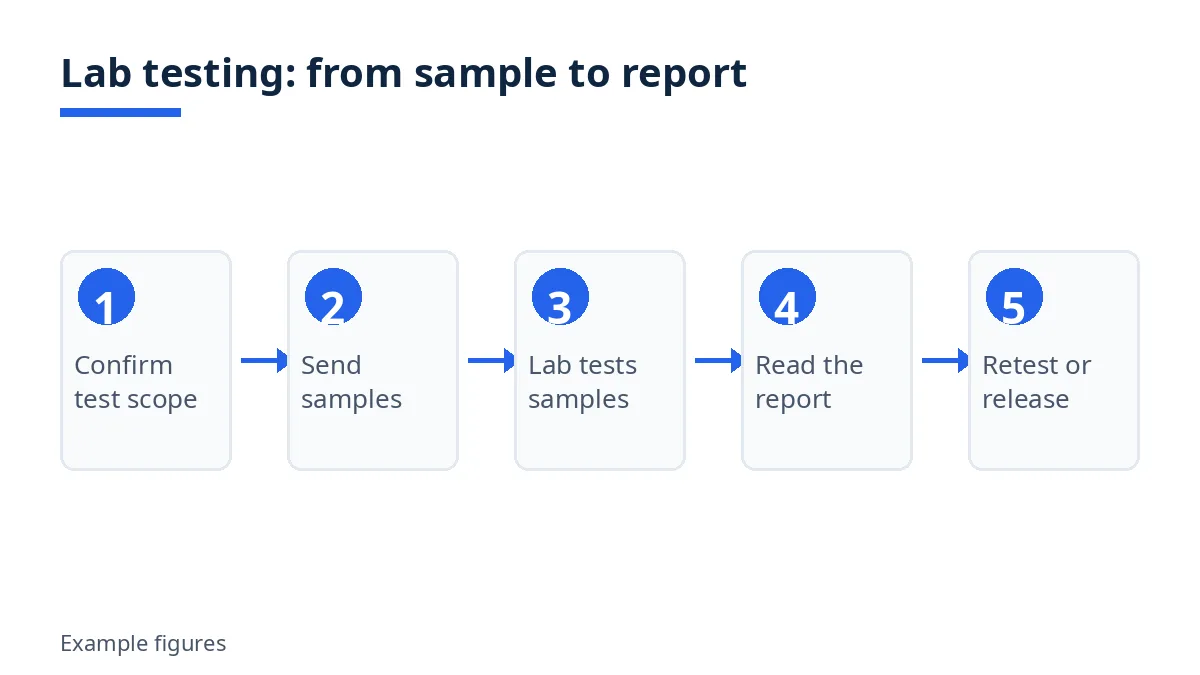
Fix the test scope in writing. List each test, the method or standard it follows, the limit the result must meet, and the number of samples. The scope comes from the buyer's specification or the destination market's requirement, confirmed with the laboratory. Never let the scope be decided by a phrase such as "full testing" with no list attached, because no two laboratories mean the same thing by that phrase.
Choose the laboratory and confirm its scope. Ask whether the laboratory's accreditation scope covers each test you listed. ISO/IEC 17025 is the international standard for testing and calibration laboratories, setting requirements for competence, impartiality, and consistent operation, and accreditation bodies use it as the criteria for assessing laboratories.1 Accreditation for one test does not automatically cover another, so check the scope test by test.
Send samples that represent the shipment. Samples should come from the production lot that will ship, in the quantity the laboratory asks for, with product, colour, size, and batch details recorded. A sample chosen by the factory from a separate, better lot tells you nothing about the shipment.
Receive the written quote and confirm it. The quote should list each test separately, the sample count, the price basis, any courier or handling charge, the expected turnaround, and the retest terms. Confirm it in writing before samples are tested, and ask what happens to the price if an extra test is added later.
Wait for testing, then read the full report. A complete test report normally gives sample details, the methods and standards used, the results with units, and a conclusion about whether the sample met the stated requirements.2 Check that the sample description matches what you sent, that the methods match what you ordered, and that every test you paid for appears.
Decide: pass, fail, or retest. On a pass, file the report with the shipment documents and authorise shipment. On a fail, agree the correction with the supplier, followed by a fresh test on new samples from the corrected lot. On a borderline result, ask the laboratory to explain it, and get that explanation in writing.
Keep the report with the order file. Keep the quote, the sample record, the report, and any retest report together, so the chain from sample to result can be reconstructed if a customer or regulator later asks how quality was checked.
Costs, timelines and documents
What drives the cost
No single lab fee applies across Bangladesh. A laboratory quote is built from the items below, and changing any one of them changes the total. Use this list to compare quotes line by line, rather than comparing only the bottom line.
Cost driver | How it moves the quote | Ask for it as |
|---|---|---|
Test type and count | Each test is priced separately | A line per test, method named |
Standard and method | A named method, a buyer method, and a screening test are different jobs | The exact method reference per test |
Sample count | More samples, colours, or sizes mean more test runs | Price per sample |
Accreditation scope | Tests inside and outside an accredited scope may be priced and reported differently | Whether each test is inside the scope |
Sample handling and courier | Sending, returning, or disposing of samples can be charged separately | Courier shown separately, or confirmed as included |
Express handling | A faster turnaround, where offered, is usually a separate charge | Standard turnaround, plus the express price |
Retesting | A retest is a second job unless the quote says otherwise | Retest price agreed before the first test |
Test categories also shape the scope. For textiles, laboratory work commonly covers physical properties such as tensile strength, tear resistance, pilling, colourfastness, and dimensional stability; chemical properties such as formaldehyde content, pH value, heavy metals, and azo dyes; and safety checks such as flammability and restricted substances.3 Standardised methods from bodies such as ASTM, ISO, and AATCC are commonly used.3 Name the categories that matter for your product and leave out the rest, because every unnecessary test is a cost with no decision value.
Example figures: how a quote adds up
Example figures only. The table below shows the structure of a quote, not a price for any laboratory or order. Replace every figure with the numbers from the laboratory's written quote before you budget.
Quote line | Example figure | Note |
|---|---|---|
Physical test group, 2 samples | 120 | Method and limit named per test |
Chemical test group, 2 samples | 180 | Screening or full panel, as quoted |
Colourfastness tests, 2 samples | 90 | Washing, rubbing, and light, as specified |
Courier and sample handling | 45 | Separate line, or confirmed as included |
Example total, standard turnaround | 435 | Excludes retest |
Example retest, one group | 90 | Agreed before the first test |
Two lessons follow. First, adding one more test group moves the total more than haggling over a small discount on the whole quote. Second, a quote that bundles everything into one figure cannot be compared with another laboratory's quote, because you cannot tell which tests each figure covers. Ask for the itemised version every time.
Timelines
Testing time varies by project, and one testing guide notes that the testing period varies from project to project, from a few days to a few weeks.2 Treat any turnaround as a quote item, not a promise in a brochure. Confirm when the clock starts, and what a retest does to the timeline. Where a shipment date depends on the result, build in the retest case, not only the pass case.
Documents to prepare
Prepare the document set before samples are sent, so the laboratory does not have to guess at the scope.
Purchase order or order reference, with product, quantity, and lot details
Buyer specification, with the test list, methods, and limits
Approved sample details, so the laboratory can check the submitted samples against the approved product
Sample record: product, colour, size, batch or lot number, and who drew the samples
Destination market requirements that set the test list
Contact for questions during testing, and the address for the report
Bangladesh-specific rules and tips
Bangladesh has its own standards and accreditation structure. The Bangladesh Standards and Testing Institution (BSTI) monitors product quality and acceptability, inspects products for conformity with applicable product standards and safety regulations, and issues product certifications.4 The Bangladesh Accreditation Board (BAB) is the government agency tasked with accreditation in Bangladesh, covering conformity assessment bodies including laboratories, and BAB is a member of the International Laboratory Accreditation Cooperation (ILAC).4 International certification and testing bodies also operate in Bangladesh.4 Ask a laboratory which accreditation body accredits it, and check that the scope covers your tests.
Three practical tips follow. First, confirm the destination market's requirement separately from the Bangladesh position: a test that satisfies a local requirement may not satisfy your buyer's market. Second, keep the sample chain clean. Record who drew the samples, from which lot, and when they were sent, because a report is only as strong as the sample behind it. Third, plan courier time into the schedule. Samples travelling to a laboratory, and reports travelling back, take time that does not appear in the laboratory's testing turnaround, so ask for both legs in the timeline. Confirm also that the report will be issued in a language your customer or regulator accepts, with the laboratory's name, report number, sample identification, and methods on the report itself.
Mistakes and red flags
Ordering "full testing" with no test list. Without named tests, methods, and limits, you cannot compare quotes or challenge a result.
Testing a sample from the wrong lot. A pass on an earlier lot or a development sample proves nothing about the shipment.
Accepting a one-line quote. A single total hides which tests are included, whether courier is included, and what a retest costs.
Treating a laboratory report as a shipment inspection. A test report proves properties of the tested samples, not that packed cartons hold the right goods in the right quantities. That is the job of a pre-shipment inspection, and many orders need both.
Reading only the conclusion. A "pass" means little if the sample, method, or limit differs from what you ordered.
Assuming accreditation covers every test. Accreditation applies to a defined scope, so check the scope test by test.1
Shipping before the retest result arrives. A corrected lot is not a passed lot until the new samples are tested and the new report is read.
Red flag: a laboratory that will not name its methods. Methods, standards, and limits should appear in the quote and the report.
Red flag: a report with no sample identification. If you cannot match the report to the samples you sent, you cannot rely on it.
Red flag: a price far below every other quote for the same scope. Check what has been left out: fewer samples, a screening test instead of the named method, or no retest terms.
Checklist
Use this checklist before samples leave the factory.
[ ] Test list agreed in writing, with a method and a limit per test
[ ] Laboratory chosen, accreditation scope checked test by test
[ ] Samples drawn from the shipment lot, sample record completed
[ ] Itemised written quote received: tests, samples, courier, turnaround, retest terms
[ ] Quote confirmed in writing before testing starts
[ ] Shipment date planned around the retest case, not only the pass case
[ ] Full report read on arrival: sample, method, limit, result, and conclusion checked
[ ] Pass, fail, or retest decision recorded, report filed in the order file
How Exportain helps
Exportain connects international buyers with Bangladeshi suppliers, exporters, and trade service providers, and buyers can use the platform to find suppliers and service providers for an order. Exportain itself does not test goods, inspect goods, or act as a party to the contract for goods, so laboratory work is arranged directly between the buyer and the laboratory, on the laboratory's own quote and terms.
Post a free RFQ with the product, the test list, the methods and limits, and the sample plan included. A request that names the tests draws itemised quotes, while a request that only asks for "testing" draws vague ones. Compare the quotes line by line using the cost-driver table in this guide.
FAQs
What should I know first about lab testing in Bangladesh?
Know that lab testing measures properties of samples against a specification, and that its cost is built test by test. Before you ask for a price, fix the test list, methods, and limits in writing, and confirm the laboratory's accreditation scope covers those tests.
What are the typical costs and timelines?
There is no single typical cost or timeline, because both depend on the test list, sample count, methods, and the laboratory's own terms. Compare itemised quotes for the same scope, and confirm when the clock starts, what the standard turnaround covers, and what a retest adds.
Which documents are needed?
Prepare the purchase order, the buyer specification with the test list and limits, the approved sample details, and a sample record naming the product, colour, size, and lot. Add the destination market requirements and a contact for questions during testing. Keep the quote, sample record, and full report together in the order file.
What are the most common mistakes?
The most common mistakes are ordering testing with no test list, testing a sample from the wrong lot, accepting a one-line quote, reading only the report's conclusion, and shipping before a retest result arrives.
Next steps on Exportain
Start with the test list, not the price: write the tests, methods, and limits into your order documents, then ask laboratories to quote against that list. Post a free RFQ with the scope included, and compare the replies line by line. For the shipment check beside laboratory work, read our guide to pre-shipment inspection, and for sampling rules, read our guide to AQL.
Sources
- ISO/IEC 17025:2017 - General requirements for the competence of testing and calibration laboratories. International Organization for Standardization (accessed )
- What information might you find in a textile testing report?. Testex (accessed )
- Textiles & Fabrics Testing - METS Laboratories. METS Laboratories (accessed )
- Bangladesh-Trade-Standards. International Trade Administration, U.S. Department of Commerce (accessed )
About the author
Sourcing from Bangladesh?
Post a request for quotation and suppliers on Exportain can send you their quotes directly.
Post an RFQ


