Top Knit Dresses Manufacturers in Bangladesh: How to Find and Verify Them
Bangladeshi knit dress supply is organised by factory type, not by ranking: seven types matched to silhouette, drape and size curve, with price, MOQ and verification checks for dress buyers.
Short answer
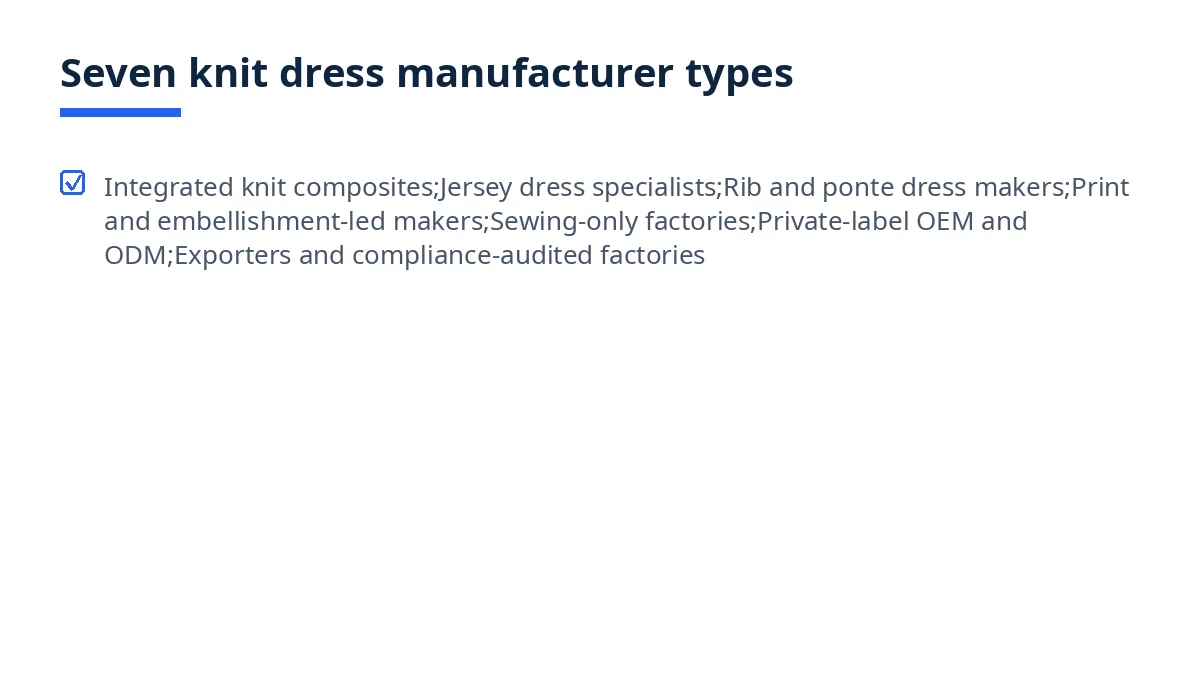
Knit dresses manufacturers in Bangladesh fall into seven types: integrated knit composites, sewing-only factories, jersey dress specialists, rib and ponte dress makers, print and embellishment-led makers, private-label OEM and ODM suppliers, and exporters and compliance-audited factories. Match the type to your silhouette, length and fabric, then verify membership, documents, a washed sample on a form, and inspection terms before paying.
On this page
Key takeaways
Knit dresses are knitted garments, so the supplier pool is the knitwear sector: BKMEA represents approximately 2,540 knitwear member factories.
A dress order starts from silhouette and length: mini, midi and maxi versions of the same design need different grading, fabric weight and hem handling.
Drape, stretch and the size curve decide dress programs: a middle-size sample says little about how a long dress sits at either end of the range.
Verification is a sequence the buyer runs: association membership, document review, a washed sample on a form across sizes, and an agreed AQL inspection before payment.
Exportain badges record document and photo checks reviewed by the Exportain team; they are not factory inspections or quality guarantees.
Start with the dress, not the factory list. A knit dress is judged by how it hangs: the silhouette at the hem, the drape over the hip, and whether the same shape holds from the smallest size to the largest. A supplier that sews a straight jersey tee well can still fail on a midi dress, because a longer skirt shows every grading error, every shade change between dye lots, and every print that drifts as the pattern pieces get longer. This guide sorts Bangladeshi suppliers by what they can do with a dress.
Knitwear exports from Bangladesh earned US$5.963 billion in the first quarter of fiscal 2026-27, up 6.88 per cent year on year, within ready-made garment exports of US$10.578 billion, according to Export Promotion Bureau (EPB) data reported in the press.1 The Bangladesh Knitwear Manufacturers and Exporters Association (BKMEA) states that it represents approximately 2,540 knitwear member factories.2 For classification, knitted or crocheted dresses for women and girls fall under heading 6104, with separate subheadings by fibre, for example cotton under 6104.42 and synthetic fibre under 6104.43.3 The sections below turn that pool into a shortlist matched to silhouette and fabric.
Key points to take away
A knit dress order starts from silhouette and length: mini, midi and maxi versions of the same design need different grading and hem handling.
Drape and stretch are the fabric tests that matter most for dresses: a fabric that looks right flat can pull, flare or cling once cut long.
Size curves decide dress programs: a sample approved in a middle size says little about either end of the range.
Print and embellishment placement must be checked across the full dress length and across sizes.
Price and minimum order quantity (MOQ) are set per style, length and colour, and verification runs through membership, documents, a washed sample, and written inspection terms.
The list: knit dresses manufacturers in Bangladesh by type
Use the seven types to match a supplier to a dress program, not to rank factories. A maker suited to a simple jersey shift can be the wrong partner for a printed maxi or a structured ponte dress, so judge each candidate on dress evidence: graded patterns, washed samples on a form, and fabric at the weight you will sell.
1. Vertically integrated knit composite factories
These groups knit fabric, dye and finish it, and then cut, sew and pack dresses within the same organisation, so a dress order stays under one roof from yarn to carton. The dress advantage is shade control across a whole range: when the bodice, skirt and sleeves of a midi or maxi dress come from the same dye lot, the pieces are more likely to read as one garment rather than as parts dyed on different days. Integrated groups suit repeat dress programs and seasonal colour stories. Before ordering, ask which stages are genuinely in-house for dresses and which go outside, and get the answer in writing, because a group that knits but sends dress dyeing out cannot control the shade match that matters most on a long skirt.
2. Sewing-only knit factories (cut, make and trim)
Sewing-only factories cut and sew dresses from fabric the buyer supplies or bought against the buyer's specification, and their skill is garment construction rather than fabric production. They suit smaller dress runs, buyers who already source their own dress fabric, and buyers testing a new silhouette before committing to a composite factory's volumes. The dress risk is specific: drape is decided by the fabric, so a sewing-only factory cannot fix a jersey that is too stiff for a flowing maxi or too light for a structured shift. Inspect the fabric before cutting, agree drape, shrinkage and shade tolerances in writing, and approve a pre-production sample made from bulk fabric, measured on a form, with the hem checked after hanging.
3. Jersey dress specialists
These factories build their daily production around everyday jersey dresses: T-shirt dresses, A-line shifts, casual midi dresses and relaxed fits in cotton jersey and cotton-blend knits. Their pattern work is dress work, with grading that keeps the armhole, waist and hem in proportion as sizes change, and with hems finished to lie flat rather than ripple after washing. They suit everyday and casual ranges. The check that separates a specialist from a general knit factory is the washed sample across sizes: approve the dress in bulk jersey, wash it, put it on a form in the smallest, middle and largest sizes, and measure length, waist, hip and hem sweep at each size.
4. Rib, ponte and structured knit dress makers
Some dress programs need fabric with body: ribbed bodycon dresses, ponte shift dresses, sweater dresses and office-appropriate knit dresses that must hold a clean line rather than flow. Makers in this type work with heavier, more stable knits and with construction that controls stretch, including shaped waist seams, faced necklines, lined bodices and hems that sit straight. They suit workwear-adjacent ranges and occasion dresses in knit. Approval needs wear as well as measurement: try the sample on, sit in it, and wash it several times, checking whether the waist stays in place, the neckline gaps, or the hem rides up. Ask which rib and ponte weights the factory runs every month, and confirm the exact fabric weight and composition in the order.
5. Print, dye and embellishment-led dress makers
This type exists for dresses where surface design carries the sale: all-over prints, placed prints, tie-dye and garment-dye effects, embroidery at the neckline or hem, and bead or sequin detail on knit. The dress problem is placement across length and size: a motif that sits well on a mini dress can land in the wrong place on a maxi, and a print panel cut for a medium can stretch or compress at the ends of the size curve. These makers suit fashion and resort ranges. Confirm whether printing, dyeing and embellishment are in-house or sent to a separate unit, since that decides who controls shade, placement and lead time. Approve a struck-off sample showing the full print repeat on the finished dress length, wash it, and check for print cracking, colour migration and loose embellishment. Settle who owns the artwork files in writing before production.
6. Private-label OEM and ODM dress suppliers
For private-label work, the supplier's operation is built around the buyer's brand. In an original equipment manufacturing (OEM) setup, the factory produces dresses from your tech pack; in an original design manufacturing (ODM) setup, it presents dress styles and size curves it has already developed, ready for your label. They suit brands and retailers who need their own labels, size sets and packaging. For OEM dresses, the tech pack must cover silhouette and length, fabric and weight, drape and stretch, neckline and hem finish, size chart with hip and hem-sweep measurements, trims, labels and packing, and the counter-sample should be judged against that document line by line on a form. For ODM dresses, confirm the styles on offer are the supplier's own, and agree who owns any pattern files created for your brand.
7. Exporters, trading companies and compliance-audited factories
Two different kinds of supplier close the list, and buyers often confuse them. Exporters and trading companies hold export licences and sell dresses made in partner factories, pooling capacity across several plants and handling documentation for the buyer. They suit mixed orders and buyers who want one contract for several silhouettes. The trade-off is distance from the sewing line: name the producing factory for each dress style before any deposit moves, and arrange inspection at that factory, since a strong export record proves the trader can ship, not that a partner factory can grade a maxi dress. Compliance-audited factories are defined by the audits or certifications they hold under the schemes their buyers require. BGMEA notes that factories in Bangladesh are assessed against frameworks including BSCI, WRAP, SMETA, ICS, the Higg Index, ZDHC, GOTS and OEKO-TEX.4 They suit retail chains and EU or US programs with a code of conduct, chemical restrictions or certified-fibre claims, such as organic cotton dresses. Treat every certificate as a document with a boundary: confirm the number with the issuing body, check that the address matches the site that will cut and sew your dresses, and read the expiry date and product scope.
Summary table
Type | Best for | Main check before ordering |
|---|---|---|
Vertically integrated knit composite | Repeat programs, shade match across lengths | Which dress stages are truly in-house |
Sewing-only (CMT) | Smaller runs, buyer-supplied dress fabric | Fabric drape inspected before cutting |
Jersey dress specialist | Everyday A-line, shift and midi dresses | Washed sample on a form, all sizes |
Rib and ponte dress maker | Structured, bodycon and sweater dresses | Wear and wash test, shape held |
Print and embellishment-led | Printed, dyed and decorated dresses | Full-length placement, washed |
Private-label OEM / ODM | Own-label brands and retailers | Tech pack match, pattern ownership |
Exporter, trading and compliance-audited | Mixed orders, retail codes | Producing factory named; certificate scope checked |
What drives price and MOQ for knit dresses
A quote for a knit dress is built part by part, so compare quotes on the same parts rather than on the final number. Fabric is the largest part, and length makes it larger: a maxi uses materially more fabric than a mini in the same knit, and a heavier ponte costs more than a light jersey. Quantity spreads the fixed costs of pattern grading, dyeing lots and line setup over more pieces, which is why the unit price falls as quantity rises and why each silhouette, length and colour carries its own MOQ. Print placement, embellishment, lining and retail-ready packing each add their own charge.
Example figures: a buyer splitting one jersey design across three lengths might face a separate MOQ for each length and colour, rather than one combined MOQ for the design. Treat any such illustration as a planning aid only, and ask each supplier to quote your exact silhouette, length and fabric. On Exportain, a quotation is versioned and states unit price, MOQ, lead time, Incoterm, payment terms and validity for each version, so two factories can be compared on the same fields instead of on email text.5
How to verify a supplier before you pay
Work through the checks in order, and keep the dress at the centre of each one. First, check association membership: a knitwear exporter should appear in BKMEA or BGMEA member records, and BGMEA runs a member search on its own site.2 4 Membership shows registration only. Second, review the documents: trade licence, Export Registration Certificate (ERC) and factory or office photos are the standard set, and on Exportain, supplier profiles carry badges only for the document and photo checks the Exportain team has reviewed and approved.6 Third, approve a sample in production fabric, washed and measured on a form across the size curve, with hem, neckline and waist checked after hanging. Fourth, agree the inspection standard in the order: set the acceptance quality limit (AQL) and inspection level before production, since ISO 2859-1 specifies sampling schemes indexed by AQL for lot-by-lot inspection.7 Fifth, put payment and shipment conditions in writing before settling, and keep the exchange in the RFQ and message thread so the agreed terms are recorded.5 The guide to knit dresses quality control turns these checks into dress-level items, and the guide to HS codes for knit dresses covers classification.
How Exportain helps
On Exportain, a buyer begins in the product catalogue, narrowing by keyword, category, badge, sample availability, OEM or ODM capability, MOQ and lead time, and then sends a request for quotation (RFQ) that states quantity, target price, destination, Incoterm and deadline.5 Treat any badge as an opening filter rather than a verdict: Exportain verification is a document and photo review, not a factory inspection, and membership alone never earns a badge.6 Apply the dress checks in this guide to every shortlisted supplier, and read how supplier verification works on Exportain before leaning on a badge.
FAQs
What is the biggest mistake?
Choosing a supplier by price before checking whether it can make your dress shape. A sewing-only factory quoted on buyer-supplied jersey, a trading company quoting another factory's capacity, and an integrated factory quoting its own dyed ponte are three different offers, and a low quote often leaves out lining, print placement work, or a longer length's extra fabric. Compare the same silhouette, length and fabric from the same type of supplier.
How can I avoid it?
Write one specification covering silhouette and length, fabric and weight, drape and stretch, neckline and hem finish, size chart with hip and hem-sweep measurements, print placement, labels and packing, and send the identical document to every supplier you quote. Name the producing factory in the order terms, approve a washed sample on a form across the size curve, and set the AQL level in writing before production starts.
Who is responsible?
Both sides, at different points. The factory is responsible for making dresses to the agreed specification and the approved sample. The buyer is responsible for making that specification complete and checkable, including the size curve and the hem and drape tolerances, and for inspecting against it before shipment. In a dispute, the side with the written specification, the sealed sample and the inspection report is the side whose version counts.
Where can I get help?
For registration, turn to the BKMEA and BGMEA member listings; for any audit or fibre claim, contact the issuing body; for the shipment check, engage an independent inspection provider.2 4 Inside Exportain, check what a profile badge covers before you lean on it, and keep questions and answers in the profile thread.6 The steps after shortlisting are covered in how to import knit dresses from Bangladesh.
Next steps on Exportain
Your first move is the supplier catalogue: open Bangladeshi suppliers, narrow the knitwear listings by badge, MOQ and OEM or ODM capability, and read how supplier verification works on Exportain before treating any badge as proof. Then post a free RFQ describing your silhouette, length, fabric and size curve, and weigh the quotations side by side.
Sources
- Merchandise exports rise 6.34pc to $13.09b in Q1 FY27: EPB. The Financial Express, (accessed )
- BKMEA at a Glance. BKMEA (accessed )
- HS Code 6104. Flexport (accessed )
- BGMEA | Home. Bangladesh Garment Manufacturers and Exporters Association (BGMEA) (accessed )
- How to source and buy from Bangladesh. Exportain (accessed )
- Supplier verification: Earn trust badges buyers can see. Exportain (accessed )
- ISO 2859-1:2026 — Sampling for Inspection by AQL. American National Standards Institute (ANSI) (accessed )
About the author
Sourcing from Bangladesh?
Post a request for quotation and suppliers on Exportain can send you their quotes directly.
Post an RFQ