

How Much Does Initial Production Check Cost in Bangladesh?
An IPC is priced on start-of-run workload, not order value. What sets the man-day count for Bangladesh orders, how to compare totals, and how to read the release decision in the report.
Short answer
Initial production check cost in Bangladesh has no single market rate. Firms price by start-of-run workload: a man-day rate multiplied by the man-days the materials check, first-article measurements, and tests need, plus travel, lab tests, and any correction recheck. Compare written totals for identical scope, and read the report as a release decision for the run, not as shipment approval.
On this page
Key takeaways
An IPC checks start-of-run readiness, not a finished lot: materials and components on site, first articles against the approved sample, and the setup that must repeat for the rest of the order.
There is no single Bangladesh market rate; one firm's published 2026 guide puts South Asia at 240 to 320 dollars per man-day, with Bangladesh higher for non-textile products.
The man-day count moves with materials to verify, first articles to measure, sites, tests, and any correction recheck, plus travel and lab tests priced separately.
Compare quotes by total for identical scope, not by day rate: a lower day rate with separate travel can cost more.
Read the report as a release decision: run released, released after a named correction verified on new first articles, or held. An IPC pass is never shipment approval.
An initial production check asks whether a run has started correctly. It does not judge a finished, packed lot, or track a run already half made. It checks whether the materials match the specification, whether the first articles match the approved sample, and whether the factory can repeat them.
An initial production check (IPC) is a quality inspection performed at the very start of manufacturing to verify raw materials, first articles, and production line setup before full-scale production begins.1 One firm's page puts the timing at the first finished samples, typically within the first one to three days of manufacturing.1 Another description puts the window at the very beginning of batch production, up to 20 percent of the cycle, covering materials and parts against the samples offered.2 Pick one trigger and write it into the booking, because a check booked after the first articles have become a large part of the run has lost most of its value.
The cost follows the same logic. An IPC is priced mainly on the workload on the day, not on the value of the order: how many materials, first articles, measurements, tests, and sites. A single-total quote hides those drivers.
Why this matters for buyers and sellers
For the buyer, the IPC is the cheapest point at which to find a material error. A lower-grade component, a chemically different finish, or hardware close to the specified grade will typically not be visible in a final inspection focused on workmanship and appearance.3 That is the risk an IPC catches: substitution and setup error.
For the seller, an early check protects the run as well. When grade, colour reference, and specification version are confirmed on day one, the factory does not spend the run making units that will later need sorting or remaking. The visit also confirms whether the factory is working from the correct specification version, since a factory running several orders can proceed with an earlier revision.3 Catching that on day one costs a correction; catching it at final inspection costs rework across a completed lot.
Step-by-step: how it works
Work through these steps in order, keeping every answer in writing.
Fix the trigger as a date and a first-article count, not only as a percentage. State the visit day, the materials that must be on site, and how many first articles must be ready. One firm's page describes the IPC as conducted at the very beginning of production, with first units off the line, verifying materials and setup rather than finished goods.3 If the factory cannot show first articles on that date, move the visit.
Send the full quote pack before asking for prices. Include the purchase order, the specification with its revision number, the approved sample details, the measurement chart with tolerances, artwork and labelling files, and the on-site test list. One firm's IPC page lists specifications, technical drawings, approved golden samples where available, packaging requirements, and any specific quality standards as the inputs for an effective check.1
Write the checklist around materials, first articles, and setup. A published IPC checklist covers whether the type and quantity of materials and accessories are correct, the quality and specification of raw materials, raw materials against related standards, potential issues in a random sample, whether the production plan is feasible, and machinery, facilities, and tools.2 Add lines for colour reference, component grade, and the approved sample's presence on the line.
Ask for the quote in components, not one total. Require separate lines for man-days, travel per site, tests, lab tests, and any follow-up visit, plus the report turnaround in writing.
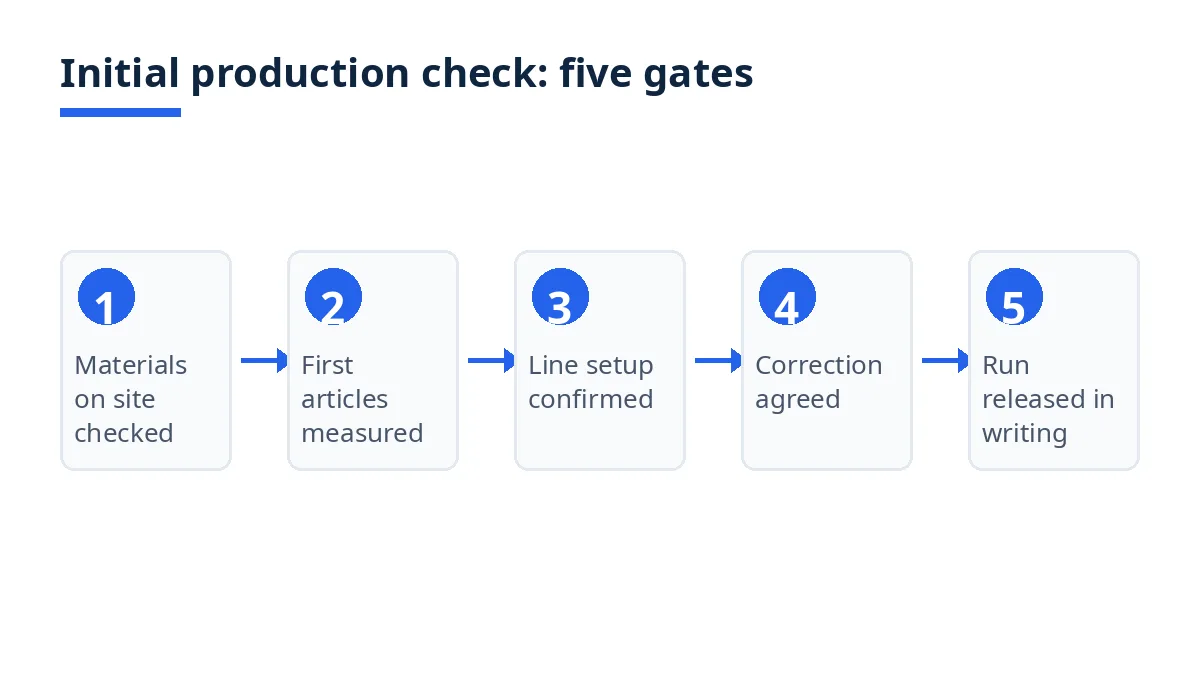
Hold the visit and decide on the day. The inspector checks materials against the specification, measures first articles against the approved sample and chart, and records the setup. The outcome, agreed in advance, is run released, released after a named correction, or held.
Verify the correction before the run builds up. Where the visit found a substitution, a wrong colour reference, or a setup error, verify the correction on new first articles, not on a factory assurance. Record the fix, owner, and deadline with the finding.
Costs, timelines and documents
What drives the man-day count
The man-day count moves on the setup workload, not on the finished quantity. Five inputs set it.
Materials and components. Each item is a separate check: grade, colour reference, quantity on site, and any compliance requirement. Several fabrics, linings, trims, and hardware grades take longer than one fabric and one zipper.
First articles. The count of first articles and the measurements per article set the time on the line. A first article measured on ten dimensions takes longer than one checked visually, and a function test adds more time. State both in the quote pack.
Sites. One factory is one visit. A second component site, or a second factory sharing the order, is a second visit with its own travel line.
Tests. On-site tests sit inside the day rate in some quotes and outside it in others. Lab tests are a separate line in most structures. A grade question needing a lab result cannot be closed on the day, and the quote should say so.
Correction recheck. A correction usually needs a second look at new first articles, priced as a second man-day or at a discounted recheck rate. Agree which applies before the first visit.
Cost component | What moves it on an IPC | Ask for it as |
|---|---|---|
Man-days | Materials, first articles, measurements, tests | Days and inspectors, first-article count stated |
Travel | Distance from inspector base, extra sites | Included or separate, per site |
Tests | Test list, time per test, lab turnaround | Listed tests, priced apart from the day rate |
Correction recheck | Scope of the new first-article check | Full day or focused recheck, and who pays |
Report | Photo record, turnaround | Contents and timing in writing |
What are the typical costs and timelines?
There is no single market rate for an initial production check in Bangladesh, and any guide that states one without naming its source should be treated with care. Pricing follows the same structure across firms: a man-day rate multiplied by the man-days needed, plus separately agreed work. One firm's published 2026 pricing guide puts South Asia at 240 to 320 dollars per man-day, and notes that Bangladesh rates can be higher for non-textile products.4 The same firm's IPC page lists its IPC service starting from 240 dollars per man-day, with 48-hour scheduling.1 Treat both as one firm's published figures, not as a Bangladesh market rate, and ask whether each quote is all-inclusive or inspector time only.
The add-ons are where IPC quotes diverge. In that firm's general pricing guide, travel within the coverage area, the report, sampling, basic on-site testing, and defect photography sit inside an all-inclusive price, while a remote-factory surcharge of 50 to 150 dollars, a weekend or holiday surcharge of 30 to 50 percent, and lab testing priced separately sit outside it.4 A follow-up is a second man-day in most structures, with discounted re-inspection rates of 50 to 70 percent.4 None of those figures is specific to an IPC, so confirm which apply to a start-of-run visit.
Example figures: Quote A offers 1 man-day all-inclusive at 240 dollars. Quote B offers 1 man-day at 200 dollars plus 150 dollars of remote travel, a total of 350 dollars. The lower day rate costs more once travel is added. Example figures only, showing structure, not a typical fee.
For timelines, the binding dates are materials ready, first articles ready, visit, correction, and recheck. One firm's IPC page describes scheduling within 48 hours of booking and a first-visit window in the first one to three days of manufacturing.1 Treat that as one firm's stated service level, not an industry standard.
How to read the report
Read an IPC report as a release decision, not as a score. Start with the setup lines: materials on site matched to the specification, with grade and colour reference for each, and the specification revision in use. Then read the first-article section: measured values against the measurement chart and its tolerances, with photographs showing each deviation. A report stating that materials were checked, without grade, colour reference, and quantity on site, cannot be verified.
Read deviations by cause, not only by count. A wrong grade, a differing colour reference, and a machine setting putting one dimension out of tolerance are three different corrections with three different owners. Where a lab test is pending, name the test, samples, and result date. Close with the release line: released, released after a named correction, or held.
Which documents are needed?
The firm needs the purchase order, the specification with its revision number, the approved sample details, the measurement chart with tolerances, artwork and labelling files, and the on-site test list.1 2 For a multi-material order, include the full materials list with grade and colour reference per item, plus the production schedule, the materials arrival record, and the release rule. Keep the report with the order file.
Bangladesh-specific rules and tips
Bangladesh orders are usually garment orders. First, product type moves the price within the published range: one firm's guide notes that Bangladesh rates can be higher for non-textile products within its South Asia range of 240 to 320 dollars per man-day.4 If your order is not garments, say so early.
Second, colour and fabric variation is a setup risk, not a finishing risk. A shade or dye lot differing from the approved sample will repeat across the run if it is not caught on first articles. Ask the inspector to record the shade and lot reference for the fabric on site, compared with the approved sample. A zipper or button close to, but not, the specified grade is a deviation on day one.
Confirm materials in quantities, not only by presence. If your order splits across two factories, budget two visits. Confirm the specification revision in writing before travel.
Mistakes and red flags
What are the most common mistakes?
Booking the IPC after the run has built up. A visit arriving when a large part of the order is already made is a mid-run visit under another name. It can find faults, but it cannot prevent them from being repeated across units already made. Book on the first-article date.
Sending a specification without a revision number. Without the revision, the factory and the inspector can each work from a different version and both believe they are correct.
Checking materials by appearance only. A component that looks right can still be the wrong grade. Record grade and colour reference per item, and test where grade is a compliance question.
Accepting a pass on first articles as shipment approval. An IPC pass releases the setup, not the shipment. A final inspection of the finished, packed lot remains a separate booking.
Treating a small first-article sample as a lot decision. ISO 2859-1 defines a system of acceptance sampling plans for inspection by attributes, indexed by acceptance quality limit (AQL) for lot-by-lot inspection, and AQL is the maximum average percentage of defective items considered acceptable during random sampling.5 That decision applies to a defined lot. An IPC verdict is release, correction, or hold, not an AQL accept or reject for a lot that does not yet exist.
Leaving the correction without a recheck. A finding without an agreed fix, owner, deadline, and priced recheck will still be open when the run finishes, when it costs more to close.
Comparing day rates instead of totals. A low day rate with separate travel, a paid report, and a full-price recheck can exceed a higher all-inclusive rate. Compare totals for the same first-article count, materials list, sites, and tests.4
Checklist
Before you book, every line should be answered in writing.
Trigger fixed: visit date and first-article count.1
Specification sent with revision number, approved sample, and measurement chart.1 2
Materials list sent: grade, colour reference, quantity on site per item.2
IPC checklist agreed: materials, first articles, setup, specification version.2 3
Quote in components: man-days, travel, tests, lab tests, recheck, report timing.4
Totals compared on the same first-article count and materials list.4
Release rule agreed, with the recheck priced and dated.
Correction record agreed on the day: finding, fix, owner, deadline.
Report checked: materials, measurements, setup, release line.
Final inspection still booked; an IPC pass is never shipment approval.
How Exportain helps
Exportain does not inspect goods itself. Its supplier verification is a document review by staff, not a factory inspection, and a badge is not a guarantee of capacity, quality, or delivery.6 Browse suppliers and post a request for quotation on the RFQ board stating your IPC timing, first-article count, and materials list. When you accept a quotation, Exportain creates one order and issues one proforma invoice from the accepted terms.6
For the inspection itself, contract directly with the inspection firm and read its quote against this guide's component list. Before you set values for a new product, read the pre-shipment inspection guide and the AQL guide, keeping the IPC, any mid-run visit, and the final inspection as separate bookings.
FAQs
What should I know first about initial production check cost in Bangladesh?
Know first that the price is built from setup workload, not order value: a man-day rate multiplied by the man-days needed, plus travel, lab tests, and any correction recheck.4 There is no single Bangladesh market rate; one firm's 2026 guide puts South Asia at 240 to 320 dollars per man-day, with Bangladesh higher for non-textile products.4
What are the typical costs and timelines?
There are no typical figures to rely on, because each firm prices the visit for your materials list, first-article count, sites, and tests. The add-ons are travel per site, weekend surcharges, lab tests, and a correction recheck.4 Agree the materials-ready date, first-article date, report turnaround, and recheck date before the bulk run starts.1
Which documents are needed?
The firm needs the purchase order, the specification with its revision number, the approved sample, the measurement chart, artwork and labelling files, and the test list.1 2 Add the materials list, the production schedule, the arrival record, and the release rule.
What are the most common mistakes?
The most common mistakes are booking after the run has built up, sending a specification without a revision number, checking materials by appearance only, treating an IPC pass as shipment approval, dressing a first-article check in AQL lot numbers it cannot support,5 and leaving a correction without a priced recheck.4
Next steps on Exportain
Browse suppliers, then post your specification revision, materials list, and first-article date on the RFQ board so firms price the same start-of-run job. Before you confirm, read the pre-shipment inspection guide and the AQL guide.
Sources
- Initial Production Check. Tetra Inspection (accessed )
- Initial Production Check (IPC) Services in China - Quality Control Service. IPQC (accessed )
- During Production Inspection in China: What Mid-Order Checks Catch That Final Inspection Cannot. SSTI (accessed )
- How Much Does Product Inspection Cost? 2026 Pricing. Tetra Inspection (accessed )
- ISO 2859-1:2026 - Sampling procedures for inspection by attributes — Part 1: Sampling schemes indexed by acceptance quality limit (AQL) for lot-by-lot inspection. ISO (accessed )
- Trust & Safety Center. Exportain (accessed )
About the author
Sourcing from Bangladesh?
Post a request for quotation and suppliers on Exportain can send you their quotes directly.
Post an RFQ


