Importing Workwear and Uniforms From Bangladesh to UK: Costs, Duties and Suppliers
Importing workwear and uniforms from Bangladesh to the UK: UK duty and DCTS preference, import VAT and postponed VAT accounting, UKCA and PPE rules, supplier verification, samples and landed cost.
Short answer
To import workwear and uniforms from Bangladesh to the UK, classify each garment in the UK tariff, confirm whether it qualifies for 0 percent duty under the Developing Countries Trading Scheme, and check whether it is PPE. Non-protective uniforms need supplier verification, samples and a landed cost. Protective garments also need UKCA or CE marking, a declaration of conformity and the correct EN standard, and VAT-registered buyers can use postponed VAT accounting.
On this page
Key takeaways
UK third-country duty on the Chapter 62 workwear lines opened is 12.00 percent; DCTS Comprehensive Preferences is 0.00 percent, subject to conditions and origin evidence.
Most woven workwear sits in Chapter 62, with industrial and occupational clothing in heading 6211, including 6211.3210.00, 6211.3310.00, 6211.4210.00 and 6211.4310.00.
Protective garments placed on the GB market need UKCA or CE marking, a declaration of conformity and instructions in English under Regulation (EU) 2016/425 as incorporated into UK law.
EN ISO 20471 Classes 1, 2 and 3 require minimum background and retroreflective areas of 0.14/0.10, 0.50/0.13 and 0.80/0.20 square metres respectively.
VAT-registered buyers can declare and recover import VAT on the same VAT return through postponed VAT accounting, using their VAT registration number in Data Element 3/40.
A UK buyer ordering workwear and uniforms from Bangladesh buys garments to a specification, and a customs entry that must stand up in Great Britain. This guide covers both in UK order: duty, import VAT, UKCA and PPE rules, supplier checks, samples, shipping and a landed cost you can rebuild for your own order.
Why source workwear and uniforms from Bangladesh
Bangladesh has a deep woven-garment base, and most workwear is woven. The Bangladesh Garment Manufacturers and Exporters Association (BGMEA) represents the readymade garment industry, and around 60 percent of its member factories are woven garment manufacturers, with BGMEA member factories accounting for 100 percent of woven garment exports.1
The range is wide: coveralls and bib-and-brace overalls, work trousers and jackets, chef jackets and trousers, healthcare tunics and scrubs, corporate shirts and blouses, and high-visibility jackets, vests and trousers. Sort the order into protective and non-protective lines before you ask for a price, because the standards, declaration of conformity and inspection plan follow that split.
The duty position is the commercial reason to look at Bangladesh for the UK market, subject to origin rules. The UK tariff page opened for this guide shows a third-country duty of 12.00 percent on the denim trouser line 6203423100, and a Developing Countries Trading Scheme (DCTS) Comprehensive Preferences rate of 0.00 percent, subject to conditions.2 Never price on 0 percent until your broker confirms the claim.
Find and verify suppliers
Where should you start the search?
Start with the job, not with a factory name. Write down who wears the garment, in what conditions, for how many washes, and to what standard. A hi-vis jacket for motorway work, a flame-resistant coverall for welding and a corporate shirt for office staff each need a different fabric, construction and, for protective items, a different certificate. Shortlist suppliers whose current production already includes that kind of garment.
Send every candidate the same specification and ask for the same reply format: fabric and weight assumed, price inclusions, validity, and minimum per style, per colour and per size curve. Browse suppliers on Exportain and compare your approach with how to import from Bangladesh.
How do you verify a supplier before you pay?
Check company documents first: trade licence, export registration and association membership where applicable, so name, address and bank account name agree across every document. BGMEA or Bangladesh Knitwear Manufacturers and Exporters Association (BKMEA) membership is relevant context, but membership alone does not prove a factory can make your garment to your standard. Check capability next: in-house or bought-in fabric, weights cut regularly, tape application, and whether flame-resistant finishes are inherent or applied. Ask to see a finished garment from current production. Keep payments to the company account named in the documents. On Exportain, supplier profiles carry document and photo review badges: a review of documents and photos, not a factory inspection or a guarantee, and Exportain is not a party to the goods contract.
MOQ, pricing and samples
What is the typical MOQ for workwear and uniforms from Bangladesh?
There is no single typical minimum order quantity. The minimum is set per style and usually per colour, because fabric is woven or dyed in batches, tape is applied in set-ups per garment, and a cutting plan is set up per size curve. Ask how the minimum splits by style, colour and size curve.
How is the price built, and how should you compare quotes?
Fabric is usually the main cost element, followed by cutting and sewing, tape and trims, any protective finish, testing, labelling and packing, and the factory margin. Two quotes can differ because one assumes a lighter fabric, a narrower size curve, no protective finish or simpler tape placement. Compare quotes on the same basis: same garment, sizes, fabric weight, tape and finish, delivery term and packing. Ask what is excluded, for example testing, certification, special packing, or embroidery, which needs its own line because a logo over reflective tape can break the tape pattern.
Which samples do you need, and how do you approve them?
Work in stages. A development sample shows whether the factory can construct the garment, place tape evenly, and hold the size chart. A pre-production sample, made in the actual production fabric, colour, tape, finish and trims, is the sample you approve for bulk. Wear-test the size curve, wash to the care label and re-measure, and check tape after washing where required. Approve in writing and keep one sealed counter-sample of each style.
Quality control and certifications needed
Which quality checks apply to all workwear?
Against the approved sample and size chart, check fabric composition and finished weight, measurements within agreed tolerances, and shade consistency: a set fails when jacket and trouser are visibly different shades of navy. Check construction: seam type, bar tacks at stress points, zip and button function, pocket placement, hem finish, and labelling. Agree inspection method and defect limits before production, inspect inline during sewing, and inspect again on packed goods.
Which garments count as PPE in Great Britain, and what does that change?
Regulation (EU) 2016/425, as incorporated into UK law, sets out the essential health and safety requirements that must be met before PPE products can be placed on the market in Great Britain, and the Personal Protective Equipment (Enforcement) Regulations 2018 are what the Health and Safety Executive uses to enforce that regulation for workplace PPE in Great Britain.3 If you provide PPE, you must supply suitable PPE, including ensuring it has an appropriate conformity assessment mark, and most new PPE placed on the GB market must be UKCA or CE marked, supplied with a declaration of conformity and instructions in English.3
An importer is a person or business based in the UK who places PPE on the GB market from a country outside the UK, and importers must check that manufacturers have carried out the required conformity assessment procedures and include their own name, trade name or mark and a postal address on the equipment or, where this is not possible, on the packaging or in accompanying documentation.4 The manufacturer must draw up a declaration of conformity, UK declaration if UKCA marked and EU declaration if CE marked, and keep it with the technical documentation for 10 years after the PPE has been placed on the GB market, with instructions in clear, legible and easily understandable English.4 Recognition of goods meeting EU requirements, including CE marking, has been extended indefinitely beyond 2024 for many products.4
Which EN standards should you name in the specification?
Name the standard for the hazard. For high-visibility clothing, EN ISO 20471 sets minimum requirements for colour, reflective performance, coverage and material placement.5 It defines three classes by minimum background and retroreflective area: Class 1 requires 0.14 and 0.10 square metres, Class 2 requires 0.50 and 0.13, and Class 3 requires 0.80 and 0.20.5 Class 3 typically needs torso plus arm or leg coverage, or a combination of certified garments meeting the combined area, and performance must hold after cleaning.5
For other hazards, name the standard your customer or sector requires: EN 343 for rain, EN ISO 11612 for heat and flame, and EN 1149-5 for electrostatic dissipative properties. A garment certified to one standard does not automatically meet another: EN ISO 20471 on its own provides no thermal, chemical or arc-flash protection.5 In UK rail, RIS-3279-TOM builds on EN ISO 20471 with a higher concentration of high-visibility orange fabric and a minimum photometric performance for reflective tape.5
Incoterms, shipping and transit time
Which delivery term should a first UK order use?
Incoterms are three-letter codes that decide who arranges and pays for each leg of transport, where risk transfers, and who handles clearance on both sides. They say nothing about price, payment terms, ownership transfer, or defective goods.6 There are eleven Incoterms in the 2020 rules: four sea-and-inland-waterway only, and seven for any transport mode, including containerised ocean freight.6 Under FOB, the seller loads the goods on board and the buyer takes main carriage and import clearance from that point, while under FCA the buyer takes the goods when handed to the nominated carrier.6 For containerised cargo, FCA is the technically correct term.6
For a first UK container order, weigh FCA at the named terminal against FOB at Chattogram, and price both through your forwarder. Under either term, import clearance, duty and import VAT remain yours, except under DDP. Avoid EXW unless you have a capable agent at origin. Name the term, place and edition in the contract, for example FCA Chattogram, Incoterms 2020.
How long does shipping take?
There is no single typical transit time for workwear from Bangladesh to the UK. Sea freight is the standard route for bulk orders and takes weeks rather than days, varying by port, routing, transshipment and season. Plan from your forwarder's current sailing schedule, and add UK clearance and inland delivery.
Import duty, taxes and documents
How are workwear and uniforms classified for UK duty?
Duty follows the classification of each garment in the UK tariff, not the supplier's product name. Most woven workwear sits in Chapter 62, with knitted garments in Chapter 61. The UK tariff page opened for this guide shows the denim trouser line 6203423100 at a third-country duty of 12.00 percent, with DCTS Comprehensive Preferences at 0.00 percent and DCTS Standard Preferences at 9.60 percent, each subject to conditions.2 The heading 6211 page shows the industrial and occupational clothing lines at the same 12.00 percent rate, including 6211.3210.00, 6211.3310.00, 6211.4210.00 and 6211.4310.00.7
Garment type | UK heading to confirm | Third-country duty in the pages opened | DCTS Comprehensive rate in the pages opened |
|---|---|---|---|
Men's woven trousers, including denim work trousers | 6203, for example 6203423100 for denim | 12.00 percent2 | 0.00 percent, subject to conditions2 |
Women's woven trousers and overalls | 6204 | 12.00 percent on the Chapter 62 lines opened7 | 0.00 percent, subject to conditions2 |
Men's woven work shirts | 6205 | 12.00 percent on the Chapter 62 lines opened7 | 0.00 percent, subject to conditions2 |
Industrial and occupational clothing, other garments | 6211, for example 6211.3210.00, 6211.3310.00, 6211.4210.00, 6211.4310.00 | 12.00 percent7 | 0.00 percent, subject to conditions2 |
Confirm the full 10-digit commodity code for each garment before you price or ship, because fibre, gender, construction and use all change the line. Keep styles with different classifications on separate invoice lines matching their codes.
What import duty applies, and what happens after LDC graduation?
Your rate depends on each garment's code, origin, and any preference in force on the entry date. The starting point in the pages opened is 12 percent third-country duty on the Chapter 62 lines above, and 0 percent under DCTS Comprehensive Preferences where the conditions are met.2 7 Agree the proof of origin at order stage; do not claim a preference on a shipment whose origin evidence is incomplete.
Bangladesh's position after graduation from least-developed-country status needs the same broker check. Reporting on the DCTS notes that least-developed countries qualify for Comprehensive Preferences, offering duty-free access with the least restrictive rules of origin, including single-stage transformation for apparel, while Enhanced Preferences provides duty-free access to most products with tighter conditions.8 The same reporting notes that even after graduation, Bangladesh will continue to access the UK apparel market on the same terms, with no safeguard mechanism attached to duty-free apparel access under Enhanced Preferences.8
What about import VAT, and how does postponed VAT accounting work?
Import VAT is separate from duty. The UK tariff page opened for this guide shows a standard import VAT rate of 20.00 percent for the denim trouser line.2 Postponed VAT accounting lets a VAT-registered business declare and recover import VAT on the same VAT return, rather than paying it upfront and recovering it later.9 Your business must be registered for VAT in the UK to use it, and you do not need any approval.9
To use it, include your VAT registration number on your import declaration at header level in Data Element 3/40, and do not use method of payment G in Data Element 4/8.9 You cannot change that choice once the declaration is submitted, so tell your broker or forwarder in writing before filing.9 VAT is recorded against your EORI number, at declaration level only.9 Without postponed VAT accounting, you will need your import VAT certificate (C79) to claim import VAT as input tax.10
Which documents do you need for UK clearance?
The standard import set is the commercial invoice, packing list, bill of lading or air waybill, and proof of origin where a DCTS preference is claimed. The invoice should name each garment plainly, for example men's cotton-polyester hi-vis jacket, Class 2, with composition, sizes, quantities, unit prices and delivery term, on its own line. Quantities, weights and carton counts must agree across every document. For PPE lines, add the declaration of conformity and test reports for the exact garment and standard.
Landed cost example
A landed cost is the full cost of one workwear set, cleared and in your UK warehouse, ready to sell or issue. Every number below is an example figure only, not a quote.
Example figures: 1,500 two-piece hi-vis sets, FCA Chattogram, sea freight to a UK port, inland delivery to a Leeds warehouse, DCTS Comprehensive preference claimed at 0 percent duty, VAT-registered buyer using postponed VAT accounting.
Cost element | Example figures (per set) | How to obtain your figure |
|---|---|---|
Product price, FCA | £18.50 | Confirmed pro forma invoice |
International freight | £1.85 | Forwarder quote per set |
Insurance | £0.22 | Policy or forwarder quote |
Customs value for duty and VAT (FCA plus freight and insurance, example basis) | £20.57 | Broker calculation |
Duty at DCTS Comprehensive rate, 0 percent | £0.00 | Broker calculation |
Port, clearance and broker fees | £0.65 | Broker invoices per set |
Inland delivery to Leeds warehouse | £0.48 | Haulier quote per set |
Inspection and testing allocated | £0.30 | Inspection quote per set |
Total landed cost, excluding import VAT | £22.00 | Sum of all lines above |
Import VAT at 20 percent on customs value plus duty, for reference only | £4.11 | Postponed VAT accounting: declared and recovered on the same return |
Import VAT is shown separately because its treatment depends on your VAT position. Work the calculation twice: at quote stage, set by set, and again after shipment with the actual invoices. See landed cost for imports from Bangladesh for the full method. Without DCTS, duty at 12 percent on the example customs value of £20.57 would be £2.47 per set, taking the landed cost from £22.00 to £24.47 per set before VAT, or £3,705 across 1,500 sets.
Step-by-step import checklist
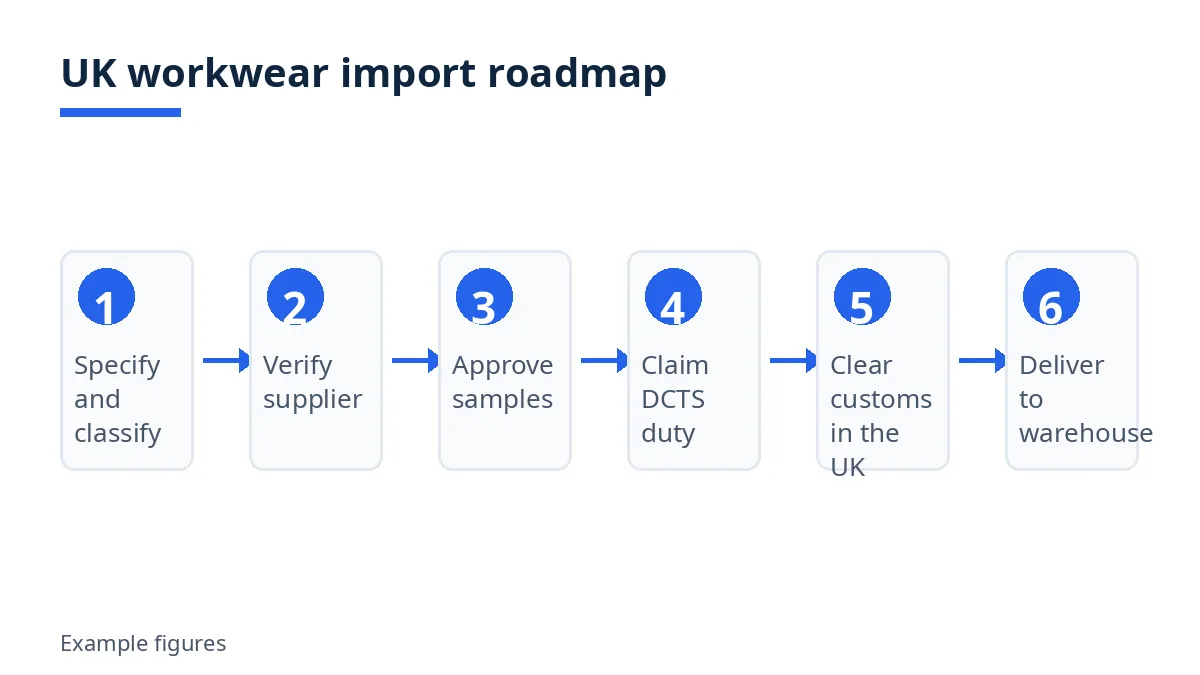
Split the order into protective and non-protective lines, naming the hazard and standard for each protective line.
Write the specification garment by garment: fabric, weight, colour, sizes, tape placement and class, finish, trims, labels and packing.
Classify every garment from Chapters 61 and 62, including the 6211 lines, and confirm each 10-digit code and duty with your broker.
Confirm the DCTS claim, origin rule and origin evidence for each line before pricing on 0 percent duty.
Shortlist suppliers whose current production already includes your kind of workwear, and request comparable quotes on the identical specification and term.
Verify the chosen supplier: documents, capacity, fabric source, tape and finish route, and a factory check for a first order.
Order samples in stages, wash-test them, then approve a pre-production sample of each style in production fabric, tape and finish.
Confirm the order in writing: purchase order, pro forma invoice, delivery and payment terms, inspection plan, labelling, packing and shipment date, plus PPE declarations and test reports for protective lines.
Inspect during production and again on packed goods against the approved samples.
Ship, clear customs with the confirmed code for each garment, using postponed VAT accounting where instructed, and reconcile the actual landed cost.
How Exportain helps
Browse suppliers for Bangladeshi garment exporters and compare their ranges against your garment list, checking whether current production covers woven workwear, hi-vis work or your uniform type. Then post your specification and target quantity as an RFQ and compare replies on the same terms before choosing a factory for sampling. Exportain is a B2B marketplace where buyers post RFQs, receive quotations and message suppliers. It does not inspect goods, book freight or clear customs, and it is not a party to the goods contract.
FAQs
What is the typical MOQ for workwear and uniforms from Bangladesh?
There is no single typical minimum. It is set per style and usually per colour, because fabric is woven or dyed in batches and a cutting plan is set up per size curve. Ask each supplier how its minimum splits by style, colour and size curve.
How long does shipping take?
Production time and transit time are separate, and neither has a single typical figure. Sea transit takes weeks rather than days and varies by port, routing, transshipment and season. Plan from your forwarder's current sailing schedule, and add UK clearance and inland delivery.
What import duty applies?
Duty follows the confirmed classification of each garment, the origin and any preference in force on the entry date. The UK tariff pages opened for this guide show a third-country duty of 12.00 percent on the Chapter 62 workwear lines, including 6203423100 and the 6211 industrial and occupational lines, and a DCTS Comprehensive Preferences rate of 0.00 percent subject to conditions.2 7 Confirm the full code, tier and origin evidence with your broker before you price.
How do I verify a supplier?
Check company documents first, so name, address and bank account agree across the trade licence, export registration and invoices. Then check capability: woven or knitted production as your garment requires, fabric source and weight, tape and finish route, and recent workwear production. Keep payments to the company account named in the documents, and approve a pre-production sample of each style in production fabric, tape and finish before bulk production. For PPE lines, also check the declaration of conformity and test report for the exact garment and standard.
Next steps on Exportain
Read how to import from Bangladesh for the full process, then work through landed cost for imports from Bangladesh with your own quotes. When ready, browse suppliers and post your specification as an RFQ.
Sources
- Bangladesh Garment Manufacturers and Exporters Association (BGMEA). Devex (accessed )
- Commodity code 6203423100: Of denim - UK Integrated Online Tariff. GOV.UK (accessed )
- Using personal protective equipment (PPE) to control risks at work. Health and Safety Executive (accessed )
- Regulation 2016/425 and the Personal Protective Equipment (Enforcement) Regulations 2018: Great Britain. GOV.UK (accessed )
- EN ISO 20471. ProGARM (accessed )
- Incoterms 2020 Guide for Importers. Importivity (accessed )
- Tracksuits, ski suits and swimwear; other garments - UK Integrated Online Tariff. UK Government (accessed )
- UK's trade preference shift offers Bangladesh rare post-LDC relief. The Daily Star (accessed )
- Check when you can account for import VAT on your VAT Return. GOV.UK (accessed )
- How to pay duties and VAT on imports from outside of the UK. GOV.UK (accessed )
About the author
Sourcing from Bangladesh?
Post a request for quotation and suppliers on Exportain can send you their quotes directly.
Post an RFQ