

Workwear and Uniforms From Bangladesh to Germany: A Buyer's Import Checklist
Workwear and uniforms from Bangladesh to Germany: supplier checks, EU PPE and CE rules, EBA duty, German import VAT and Hamburg shipping for buyers.
Short answer
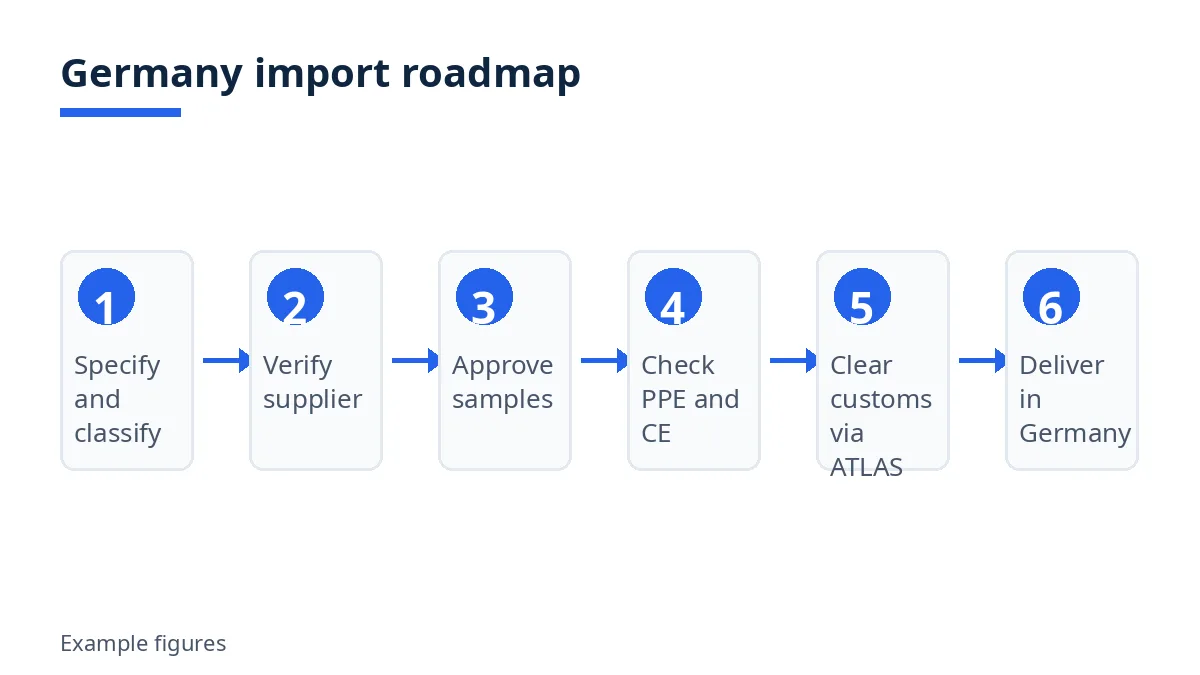
To import workwear and uniforms from Bangladesh to Germany, specify each style by garment, fabric, sizes and protective claim, and verify a supplier making that garment type. Classify styles to their TARIC codes, confirm EBA access with a statement on origin, and hold the PPE file, declaration of conformity and, for Categories II and III, a notified-body certificate, before shipment. Clear customs through ATLAS with an EORI number and pay 19% import VAT on the customs value plus duty.
On this page
Key takeaways
Bangladeshi workwear enters the EU duty-free under Everything But Arms only when the goods meet the GSP origin rules and a valid statement on origin is supplied.
Protective workwear is PPE under Regulation (EU) 2016/425: Category II needs EU type-examination by a notified body, and Category III needs type-examination plus ongoing assessment.
German import VAT is 19% on the customs value plus duty; a VAT-registered buyer can generally deduct it as input tax.
There is no single typical MOQ, price or transit time for workwear: confirm each one in writing for your exact garment, size curve, delivery term and shipment date.
German customs clearance needs a DE EORI number, an ATLAS declaration and, for EBA preference, the exporter's REX-based statement on origin.
A container of workwear bound for Germany raises three questions before any other: what exactly is in each carton, what does each garment claim to protect against, and what proves that the goods qualify as Bangladeshi origin. Answer those three questions in writing before bulk production, and the rest of the order follows a clear order. Leave any one open, and it returns later as a customs query, a rejected PPE claim or a price that no longer holds.
This guide is for German buyers — procurement teams, facility managers, wholesalers and brands buying workwear and uniforms made in Bangladesh for use in Germany — and covers EU preference and duty, EU PPE rules and CE marking, German import VAT and customs clearance, plus supplier, sample and quality steps.
Why source workwear and uniforms from Bangladesh
Textiles dominate EU imports from Bangladesh: they accounted for almost 94% of EU imports from Bangladesh in 2025.1 As a least developed country, Bangladesh benefits from the EU's Everything But Arms (EBA) arrangement, which grants duty-free, quota-free access for all exports except arms and ammunition.1 For a German buyer, that preference is the starting point, not the whole of the duty calculation: the 0% rate applies only when the origin rules are met and the proof of origin is in order.
The range available from Bangladesh covers both sides of the workwear market, and the split matters from the first email. One side is corporate and service uniforms — hotel, catering, cleaning, retail and office — where the buyer judges fabric, fit, colour and finish and no protective claim applies. The other side is protective workwear — hi-vis sets, weatherproof sets, chemical-splash coveralls and flame-resistant garments — where EU PPE rules decide what evidence the buyer must hold. Shortlist by garment type and protective claim, and settle German sizes, labelling and user information in the specification from the start.
Find and verify suppliers
Start with a specification, not with factory names
Write the specification before you contact suppliers. For each style, fix garment type, fabric and weight, colour, size range and size curve. For protective styles, add the risk the garment protects against, the PPE category you expect, and the harmonised standard named in your customer's requirement. Add trims and branding: tape type and placement, buttons, zips, embroidery or print positions, and labelling and packing per size. Then shortlist Bangladeshi suppliers whose current range already includes the same garment type and, for PPE styles, the same protective claim.
Send every candidate the identical specification and ask for the same reply format: fabric, price inclusions, validity, minimums, production time and included tests. Browse suppliers on Exportain and compare replies only on the same terms.
How do you verify a supplier before you pay?
Verification has three layers. The first is company documents: trade licence, export registration and association membership where applicable, checked so that name, address and bank account name agree across every document. The second is capability: cutting and sewing capacity for your garment type, tape application, embroidery or print route, and recent production of the same garment type for video or in-person inspection.
Third, keep payments to the company account named in the documents, never to a personal account, and verify any change of bank details separately. On Exportain, supplier profiles carry document and photo review badges. A badge is a review of documents and photos, not a factory inspection or a guarantee, and Exportain is not a party to the goods contract.
MOQ, pricing and samples
What is the typical MOQ for workwear and uniforms from Bangladesh?
There is no single typical minimum order quantity for workwear and uniforms from Bangladesh. The minimum is set per style and usually per colour, because fabric is woven or dyed in batches, reflective tape is applied by style, and a cutting plan is set up per size range. Ask how the minimum splits by style, colour and size curve, and whether a smaller trial order is possible at a higher unit price.
How is the price built, and how should you compare quotes?
Fabric is usually the main cost element in workwear, followed by cutting and sewing, dyeing or finishing, reflective tape and trims, embroidery or print, testing, packing and the factory margin. Tape area and placement change the price of a hi-vis garment directly, as does the number of sizes in the curve. Taped seams, storm flaps, knee-pad pockets and multi-position branding each add operations and cost.
Compare quotes on the same basis: same garment, fabric, sizes, tape specification, branding, delivery term and packing. Ask each supplier to state what is excluded, for example PPE testing and certification costs, special packing, or freight and insurance where the quote is on a factory-gate term. A quote that excludes the notified-body work for a Category II or III style is not comparable with a quote that includes it.
Which samples do you need, and how do you approve them?
Work in stages: a development sample shows construction, tape application and size-range completion. A pre-production sample, made in the actual production fabric, colour, tape and finish, is the sample you approve for bulk. Fit, shade and tape performance cannot be approved from a sample in substitute fabric, because washing, finishing and tape change dimensions, shade and adhesion.
Test the samples as end users will wear them: check the full size range against your size chart, wash following the care label and re-measure, and check tape adhesion and placement against the certified design. Approve in writing and keep one sealed counter-sample of each style.
Quality control and certifications needed
Start by separating PPE workwear from ordinary uniforms
The first quality decision is classification, not inspection. If a garment claims to protect the wearer against a risk — visibility to traffic, heat, chemicals, cold, cuts or electric arc, for example — it is personal protective equipment (PPE) under Regulation (EU) 2016/425, and the regulation's conformity route applies. A garment with no protective claim is an ordinary uniform: labelling, size accuracy and wash performance still matter, but no CE route applies.
What do the PPE categories mean for your order?
Regulation (EU) 2016/425 divides PPE into three risk categories in its Annex I. Category I covers minimal risks only: superficial mechanical injury, weak cleaning materials, prolonged water contact, hot surfaces up to 50 °C, sunlight eye damage, and non-extreme atmospheric conditions.2 Category II covers risks other than those listed in Categories I and III.2 Category III covers risks that may cause very serious consequences such as death or irreversible damage to health, including hazardous substances, oxygen deficiency, harmful biological agents, ionising radiation, extreme heat or cold, falls from a height, electric shock, drowning, chainsaw cuts, high-pressure jets, bullet or knife wounds, and harmful noise.2
The conformity route follows the category. Category II products require EU type-examination by a notified body, and Category III products require EU type-examination plus ongoing assessment of compliance.3 Importers placing PPE on the EU market must make sure the conformity assessment has been carried out and that the CE marking and technical documentation are available for inspection by the competent national authorities.2 Only PPE bearing the CE mark may be regarded as complying with the basic health and safety requirements.4 For Category III, the CE marking is followed by the identification number of the notified body.5 Ask for these documents by name at order stage and check that the certificate covers your exact garment and size range.
Which hi-vis standard applies, and what do the classes mean?
High-visibility clothing for professional use in the EU is assessed against EN ISO 20471, which sets three classes by the minimum area of fluorescent background material and retroreflective material.6
EN ISO 20471 class | Fluorescent background material | Retroreflective material |
|---|---|---|
Class 1 | 0.14 m² | 0.10 m² |
Class 2 | 0.50 m² | 0.13 m² |
Class 3 | 0.80 m² | 0.20 m² |
Class is a property of the certified garment design, not of the fabric alone, and the smallest size in the range is the hardest to certify because it has the least area. Confirm the class in writing for each style.
Which label rules apply in Germany and the EU?
Fibre labelling follows Regulation (EU) No 1007/2011. For a multi-fibre textile product, the product shall be labelled or marked with the name and percentage by weight of all constituent fibres in descending order.7 Agree the wording at sampling stage and check that the percentages match the fabric you bought. For PPE styles, every importer should indicate on the PPE his name, registered trade name or trade mark and the postal address at which he can be contacted, with exceptions where the size or nature of the PPE does not allow it.2 Supply user information in German for German end users, covering protection, limits of use and care. For ordinary uniforms, agree care, size and origin marking, and check the finished label before bulk sewing.
Which quality checks are specific to workwear?
Against the approved sample and size chart, check fabric, measurements across the size range, seam strength, closures, tape adhesion and alignment, and shade consistency. Agree the inspection method and defect limits before production, inspect inline and finally on packed goods, and check packing by size curve, not only by total pieces.
Incoterms, shipping and transit time
Which delivery term should a first order use?
For containerised workwear, weigh FCA at the named terminal against FOB at the Bangladeshi port. Under Incoterms 2020, FOB risk passes when goods are on board the vessel at the named port, while FCA risk passes when goods are handed to the buyer's carrier; for containers, FCA is typically the better choice.8
DDP puts import formalities on the seller, but confirm in writing who acts as importer of record, whose EORI number is used, and who accounts for German import VAT.
How long does shipping take, and which port should you use?
There is no single typical transit time for workwear from Bangladesh. Sea freight is the standard route for bulk orders and it takes weeks rather than days, varying by port, routing, transshipment and season. Plan from your forwarder's current sailing schedule, and keep production time separate from transit time. Confirm cartons per style, carton dimensions and weight in the specification, because workwear sets are bulky for their weight and carton volume can limit a shipment before weight does.
Hamburg is the natural first choice for many German buyers, and it handled 8.3 million TEU of container throughput in 2025.9 Discuss with your broker whether Hamburg, Bremerhaven or another EU port suits your warehouse. Air freight suits urgent replenishment of a single size or style, not a full seasonal programme.
Import duty, taxes and documents
How are workwear and uniforms classified for duty?
Duty follows the classification of each style in the EU tariff, not the supplier's product name. Most woven workwear falls in Chapter 62 (apparel, not knitted or crocheted). Within that chapter, heading 6203 covers men's or boys' suits, ensembles, jackets, blazers, trousers, bib and brace overalls, breeches and shorts, other than swimwear.10 Confirm the full 10-digit TARIC code for each style with your broker, and keep different styles on separate invoice lines matching their codes.
What import duty applies?
Your rate depends on each style's TARIC code, the origin, and the preference in force on the entry date. Under EBA, Bangladesh receives duty-free, quota-free access for all products except arms and ammunition, so qualifying Bangladeshi workwear enters the EU at 0% duty.1 The preference is not automatic: the goods must meet the EU GSP origin rules, and the proof of origin must be in order. Bangladeshi exporters register in the EU's Registered Exporter (REX) system through the Export Promotion Bureau (EPB) and issue statements on origin under self-certification.11 Agree the statement on origin at order stage and keep it with the customs documents. If the preference cannot be claimed, the third-country rate for the TARIC code applies instead, so price on the non-preferential rate until the preference is confirmed.
What about German import VAT and customs clearance?
German import VAT (Einfuhrumsatzsteuer) applies on top of duty. German customs sets import VAT at 19 percent (7 percent for selected goods) on the customs value plus customs duty.12 Workwear falls under the standard 19% rate. Where a preference exempts the goods from customs duty, only the import VAT and any applicable excise duty must be paid.12 A VAT-registered business can generally deduct import VAT as input tax, so confirm the treatment with your tax adviser.13
Before the first shipment, make sure the customs setup is complete. The EORI number is an operator identification number valid throughout the European Union and a prerequisite for customs clearance in the European Union.14 Applying for an EORI number is free of charge and, from 1 October 2026, use of the Customs Portal is mandatory for applying, cancelling or changing EORI data.14 The entry summary declaration is lodged electronically through ATLAS-EAS at the first customs office of entry.15 Your broker files the import declaration through ATLAS using your EORI number, the TARIC codes, the customs value and the statement on origin.
Which documents do you need for clearance?
The clearance set is the commercial invoice (each style on its own line), the packing list (carton count, pieces per size, weights and dimensions), the bill of lading or air waybill, the statement on origin where EBA preference is claimed, and, for PPE styles, the declaration of conformity, type-examination certificate and test reports, plus fibre and care labels and German user information for PPE.
Quantities, weights and carton counts must agree across every document.
Landed cost example
A landed cost is the full cost of one workwear set, ready for your German warehouse. Every number below is an example figure only, not a quote.
Example figures: 3,000 hi-vis sets (jacket plus trousers), FCA Chattogram, sea freight to Hamburg, EBA duty at 0% with origin proof confirmed.
Cost element | Example figures (per set) | How to obtain your figure |
|---|---|---|
Product price, FCA | $18.50 | Confirmed pro forma invoice |
International freight | $1.60 | Forwarder quote divided by sets shipped |
Insurance | $0.14 | Policy or forwarder quote |
Duty | $0.00 | Broker calculation: EBA 0% with origin proof confirmed |
Port, clearance and broker fees | $0.45 | Broker invoices divided by sets |
Local delivery to warehouse | $0.35 | Local carrier quote divided by sets |
Total landed cost | $21.04 | Sum of all lines above |
German import VAT is shown separately because a VAT-registered buyer generally recovers it as input tax. At 19% on $20.24, example import VAT is $3.85 per set, giving a cash outlay of $24.89 per set before recovery. See landed cost for imports from Bangladesh for the full method. Work the calculation twice: at quote stage, style by style, and again after shipment with the actual invoices.
Step-by-step import checklist
Split the programme into corporate uniforms and PPE workwear, with the protective claim and category fixed for every protective style.
Write the specification style by style: garment, fabric, colour, sizes and size curve, tape specification, branding, labels and packing.
Classify every style to its full TARIC code with your broker and confirm EBA preference and the statement on origin.
Shortlist suppliers already making the same garment type and claim, and request quotes on the identical specification and term.
Verify the supplier: documents, capability, recent production of the same styles, company-account payment only.
Order samples in stages, test fit and washing, and approve a pre-production sample of each style in production fabric and tape.
Confirm the order in writing: purchase order, pro forma invoice, terms, inspection plan, labelling, packing and shipment date.
Collect the PPE file before shipment: declaration of conformity, type-examination certificate where required, and test reports.
Set up the German customs side: EORI, broker instruction, ATLAS data, statement on origin, VAT treatment.
Ship, clear customs through the port of entry, check the size curve on arrival, and reconcile the actual landed cost against the quote.
How Exportain helps
Browse suppliers for Bangladeshi workwear and uniform exporters and compare their ranges against your style list, separating corporate uniform makers from protective workwear makers. Then post your specification and target quantity as an RFQ and compare replies on the same terms before you choose a factory for sampling. Exportain is a B2B marketplace where buyers post RFQs, receive quotations and message suppliers. It does not inspect goods, book freight or clear customs.
FAQs
What is the typical MOQ for workwear and uniforms from Bangladesh?
There is no single typical minimum. It is set per style and usually per colour, because fabric is produced in batches and a cutting plan is set up per size range. Ask how the minimum splits by style, colour and size curve, and whether a smaller trial order is possible at a higher unit price.
How long does shipping take?
Production time and transit time are separate, and neither has a single typical figure. Sea freight to a German port takes weeks rather than days and varies by routing and season, so plan from your forwarder's sailing schedule and add clearance and delivery.
What import duty applies?
Duty follows the confirmed TARIC code of each style, the origin and the preference in force on the entry date. Qualifying Bangladeshi workwear enters the EU duty-free under EBA, subject to the origin rules and a valid statement on origin.1 If the preference cannot be claimed, the third-country rate for the code applies. German import VAT at the standard 19% rate is separate from duty and is assessed on the customs value plus duty.12
How do I verify a supplier?
Check company documents first, so that name, address and bank account agree across the trade licence, export registration and invoices. Then check capability: the same garment type and protective claim in current production, and a video or in-person factory check for a first order. Keep payments to the company account named in the documents, and approve a pre-production sample of each style before bulk production.
Next steps on Exportain
Read how to import from Bangladesh for the full process, then browse suppliers for workwear and uniform exporters. When your specification is ready, use how to buy to post an RFQ and compare quotes on the same terms.
Sources
- EU trade relations with Bangladesh. European Commission, (accessed )
- Regulation (EU) 2016/425 of the European Parliament and of the Council of 9 March 2016 on personal protective equipment. European Union, (accessed )
- Personal Protective Equipment (PPE). SGS (accessed )
- PPE - OSHwiki. European Agency for Safety and Health at Work (accessed )
- Personal protective equipment. Estonian Consumer Protection and Technical Regulatory Authority (accessed )
- High-visibility warning clothing. Finnish Occupational Safety and Health Administration (accessed )
- Regulation (EU) No 1007/2011 on textile fibre names and related labelling and marking of the fibre composition of textile products, Article 9: Multi-fibre textile products. legislation.gov.uk (accessed )
- Place of delivery & risk transfer in trade contracts. ICC Academy (accessed )
- Port of Hamburg: Throughput figures for 2025 at a glance. AJOT, (accessed )
- Bangladesh Customs Tariff, Chapter 62. Bangladesh Trade Portal (accessed )
- Cross-industry eligibility status to be spot-checked. The Financial Express, (accessed )
- Assessment of taxes and duties. German Customs (Zoll) (accessed )
- A Guide to the German Import VAT. Consultinghouse (accessed )
- EORI number. German Customs (Zoll) (accessed )
- Entry summary declaration. German Customs (Zoll) (accessed )
- landed cost
- import duty
- quality control
- Bangladesh sourcing
- CE marking
- Workwear and uniforms
- Germany imports
About the author
Sourcing from Bangladesh?
Post a request for quotation and suppliers on Exportain can send you their quotes directly.
Post an RFQ


