Workwear and Uniforms From Bangladesh to France: A Buyer's Import Checklist
France buyer guide to importing workwear and uniforms from Bangladesh: supplier checks, MOQ, samples, PPE and EN ISO 20471 rules, Le Havre and Fos-sur-Mer shipping, EBA duty, French TVA and landed cost.
Short answer
To import workwear and uniforms from Bangladesh to France, write a garment-by-garment specification that fixes fabric, tape layout, pockets and sizing for each piece, then shortlist factories that already sew woven workwear. Verify the factory, approve a pre-production sample in production fabric, keep ordinary uniforms separate from protective clothing under Regulation (EU) 2016/425, classify each garment for EU duty, confirm the EBA preference and proof of origin, and build the landed cost to Le Havre or Fos-sur-Mer before bulk production.
On this page
Key takeaways
Bangladesh benefits from EU Everything But Arms duty-free, quota-free access for all products except arms and ammunition, so a qualifying France-bound workwear shipment can carry zero duty, subject to meeting the scheme origin rules and holding the proof of origin.
There is no single typical MOQ, price or transit time for workwear and uniforms, so confirm each one in writing for your exact garment set, fabric, color, size curve, route and shipment date.
Workwear is classified garment by garment: woven trousers and overalls start from 6203 and 6204, work shirts from 6205, coated-fabric garments from 6210, and coveralls and other unnamed woven garments from 6211, with the EU using eight-digit codes.
Ordinary uniforms are not protective equipment: a garment designed to protect against a workplace risk falls under Regulation (EU) 2016/425 with conformity assessment and CE marking, and high-visibility garments are specified by EN ISO 20471 class, from Class 1 to Class 3.
France applies the EU tariff at the border and a 20 percent standard TVA rate, and the practical port choice is Le Havre for Paris and northern France or Fos-sur-Mer for the south.
A France-based buyer who imports workwear and uniforms from Bangladesh is buying into a woven-garment supply chain that already serves European buyers at scale, while clearing goods through a French port under EU rules. The order still needs the same discipline as any garment import: a garment-by-garment specification, a factory that already sews that kind of workwear, an approved sample in production fabric, a confirmed tariff line for each piece, and a landed cost built before bulk production. This guide works through each step with France in focus, from the first supplier search to delivery at a warehouse in France.
For a qualifying shipment, the duty starting point is favorable. As a least developed country, Bangladesh benefits from the EU Everything But Arms arrangement, which grants duty-free, quota-free access to the EU for exports of all products except arms and ammunition.1 That preference is why the landed cost example later in this guide shows duty at zero, and why the proof of origin and classification work in the duty section deserve attention before any price is treated as final.
Why source workwear and uniforms from Bangladesh
Bangladesh is a woven-garment producer first, and workwear is a woven product. In fiscal year 2024-25, apparel exports were worth 39.35 billion US dollars, with woven garments accounting for 18.19 billion dollars of that total, according to Export Promotion Bureau data.2 A buyer sourcing jackets, trousers, bib and brace overalls, coveralls, work shirts and uniform sets is therefore shopping where Bangladesh has the deepest factory base.
Buyers in France include logistics operators around Paris and the northern ports, construction firms, municipal services, hospitality groups, food processors and healthcare employers, each with its own uniform or protective range. A single French order can therefore mix ordinary uniforms, worn for identity and durability, with protective garments that must meet a safety standard. Keep those two groups apart from the start, because the compliance path for protective clothing is different, as the quality section explains.
Find and verify suppliers
Send every candidate the identical specification and ask for the same reply format: fabric assumed, price inclusions, validity, minimum per garment and per color, and production capacity per month. Ask each supplier to state what is excluded, for example reflective tape, knee pads, embroidery, testing, or special packing.
Where should a France-based buyer start the search?
Start with the garment set, not with factory names. Write down every piece first: jacket, trouser, bib and brace overall, coverall or work shirt, with its fabric, weight, color, reflective tape layout, pocket plan, closure type, size range and packing rule. State whether each piece is an ordinary uniform or a protective garment, and name the safety standard for every protective piece. Then shortlist factories whose current range already includes woven workwear and uniforms. Browse suppliers on Exportain and read finding suppliers in Bangladesh.
How do you verify a supplier before you pay?
Verification has three layers. The first is company documents: trade license, export registration and association membership where applicable, checked so that name, address and bank account name agree across every document. The second is capability: monthly workwear capacity, fabric sourcing route, dyeing and finishing route, reflective tape application method, and which recent workwear styles the factory can show from current production. A finished set from current production shows more than a catalog photograph: bar tack placement, tape alignment, pocket strength and shade match between jacket and trouser.
The third layer is payment discipline. Keep payments to the company account named in the documents, never to a personal account, and verify any change of bank details separately. Read how supplier verification works on Exportain for what document and photo checks cover. On Exportain, supplier profiles carry document and photo review badges. A badge is a review of documents and photos, not a factory inspection or a guarantee, and Exportain is not a party to the goods contract.
MOQ, pricing and samples
What is the typical MOQ for workwear and uniforms from Bangladesh?
There is no single typical minimum order quantity for workwear and uniforms from Bangladesh. The minimum is set per garment and usually per color, because fabric is woven, dyed or finished in batches and a cutting plan is set up per size range. A plain navy work shirt and a high-visibility coverall with tape, multiple pockets and two colors will not carry the same minimum. Ask each supplier how its minimum splits by garment, color, fabric and size range, and whether a small first order is possible at a higher unit price.
How is the price built, and how should you compare quotes?
Fabric is usually the largest cost element in workwear, followed by cutting and sewing, dyeing or finishing, reflective tape, trims, testing, packing and the factory margin. Heavier fabric, more pockets, bar tacks, knee pad pockets, storm flaps and embroidered logos each add operations. Two quotes can differ because one assumes a lighter fabric, fewer pockets, no tape, or a simpler closure. Ask what each price is based on, in writing, so a lower quote is judged as a different specification rather than accepted as a saving.
Compare quotes on the same basis: same garment set, same sizes, same fabric weight, same tape and pocket plan, same delivery term and same packing. Ask each supplier to state the price validity period and whether testing costs are included. Carry every quote through to the landed cost table before choosing a supplier.
Which samples do you need, and how do you approve them?
Work in stages. A development sample shows whether the factory can construct the garment, apply tape evenly, form pockets cleanly and grade the size range. A pre-production sample, made in the actual production fabric, color, tape and trims, is the sample you approve for bulk. Fit, tape performance and shade match cannot be approved from a sample in substitute fabric, because washing, finishing and tape application change dimensions, shade and reflectivity.
Test the samples as your workers will use them: wear the set, sit and kneel in the trouser, load the pockets, wash the set following your care label, and check tape adhesion and reflectivity after washing. Measure every size against your chart, check that jacket and trouser shades match, and confirm that closures and knee pad pockets work with the pads your workers use. Approve in writing and keep one sealed counter-sample of each garment.
Quality control and certifications needed
Which quality checks are specific to workwear?
Against the approved sample and chart, check fabric composition and finished weight, measurements across the size range, and consistency between jacket and trouser in a set. Then check construction piece by piece: seam strength, bar tacks at pocket corners, flap ends and fly ends, knee pad pocket fit with a pad inserted, zip and button function, tape alignment and adhesion, pocket placement, and hem finish. A set can pass piece by piece and still fail as a set if the jacket is from a different shade batch than the trouser or the tape sits at a different height on each piece.
Agree the inspection method and defect limits before production. ISO 2859-1:2026 defines a system of acceptance sampling plans for inspection by attributes, and its summary states that AQL stands for acceptance quality limit, the maximum average percentage of defective items considered acceptable during random sampling, used to determine sample sizes and acceptance and rejection thresholds.3 ### Which certifications apply, and where does protective clothing differ?
Ordinary uniforms bought for identity and durability are not protective equipment. A garment designed to protect against a workplace risk falls under Regulation (EU) 2016/425, which lays down requirements for the design and manufacture of personal protective equipment that aim to ensure the health and safety of users and to allow the equipment to be sold and used throughout the EU.4 Under that regulation, manufacturers must subject each item to the relevant conformity assessment procedure, keep technical documentation and the EU conformity declaration for 10 years, and mark compliant equipment with the CE marking.4 Importers and distributors also carry obligations to ensure the equipment satisfies EU standards.4
For high-visibility garments, the standard most French buyers will name is EN ISO 20471. That standard covers high-visibility clothing, sets minimum requirements for the color and reflective performance of materials, how much of the garment must be covered, and how the materials must be positioned on the body, and it defines three classes based on the total minimum surface area of background and retroreflective material.5 Class 1 requires at least 0.14 square metres of background material and 0.10 square metres of retroreflective material, Class 2 requires 0.50 and 0.13 square metres, and Class 3 requires 0.80 and 0.20 square metres.5 Name the class in the specification, ask for the matching test report or certificate, and check its scope, garment covered, issuing body and date. A report for a different fabric, color or tape layout does not cover your garment.
Which label rules apply in France?
Fiber labeling applies to workwear as it does to other textile garments. Article 9 of Regulation (EU) No 1007/2011 states that a textile product shall be labeled or marked with the name and percentage by weight of all constituent fibers in descending order.6 Agree the wording at sampling stage and check that the percentages match the fabric you bought, because the labeled composition is also the composition your classification is built on. Confirm with your broker whether French-language information is required for your sales channel before bulk label sewing begins, and check that no logo is printed over reflective tape.
Incoterms, shipping and transit time
For a first container order, weigh FOB at the Bangladeshi port against FCA at the named terminal, and confirm who books freight, who arranges insurance, and who carries risk at each handover point, in writing, before the purchase order is signed.
Which delivery term should a first order use?
Incoterms rules are a set of eleven three-letter trade terms reflecting business-to-business practice in contracts for the sale and purchase of goods, and the Incoterms 2020 version entered into force on 1 January 2020.7 ### Which French port should the shipment use?
Le Havre, on the north coast of France, is the natural first choice for buyers serving Paris and northern France, since it keeps onward road delivery short for the Paris region. France's largest container port, Le Havre, reported strong growth in traffic in 2026 as shipping lines sought to avoid congestion at rival European hubs, with containers handled up 8.6 percent year on year in the first half of 2026.8 For buyers serving the south of France, Fos-sur-Mer, at Marseille-Fos on the Mediterranean coast, can shorten the inland leg instead. Ask your forwarder to quote both routes and compare total transit plus inland delivery, not the sea leg alone.
How long does shipping take?
There is no single typical transit time for workwear from Bangladesh. Sea freight is the standard route for bulk orders and it takes weeks rather than days, varying by port, routing, transshipment and season. Plan from your forwarder's current sailing schedule, and add clearance and delivery. Keep production time separate: an order is ready only when every garment has finished sewing, finishing, inspection and set packing. Confirm sets per carton, carton dimensions and weight in the specification, because workwear is heavier than fashion apparel and carton weight limits can bind before volume does.
Import duty, taxes and documents
How are workwear garments classified for duty?
Duty follows the classification of each garment in the EU tariff, not the supplier's product name. The Harmonised System is an international commodity classification of approximately 5,000 six-digit product categories, organized by chapters, headings and sub-headings, and the EU Combined Nomenclature uses eight-digit codes built on that system.9 That structure decides the duty line before any price is final.
For woven workwear, the Access2Markets textile guidance is the practical starting point. Trousers, dungarees and shorts are classified under headings 6103, 6104, 6203 or 6204 as appropriate, and woven working trousers can be regarded as industrial and occupational clothing where they meet the appropriate criteria.10 Shirts for men or boys are classified under 6205 where they are not knitted or crocheted, and garments made from woven fabric with a visible non-cellular coating on one surface are classified under 6210.10 Coveralls and other unnamed woven garments sit in the other-garments heading 6211.10 A jacket, trouser, bib and brace overall and coverall in one order can therefore sit on four different lines. Confirm the full eight-digit code for each garment with your broker before you price or ship.
What import duty applies in France?
France applies the EU Common Customs Tariff, so the duty question for a France-bound shipment is an EU question, answered garment by garment. For a qualifying shipment from Bangladesh, the Everything But Arms arrangement grants duty-free, quota-free access to the EU for all products except arms and ammunition.1 Claim the preference only when your broker confirms that the goods meet the scheme origin rules and that the proof of origin is in order for the entry date. If a garment cannot meet the origin rules, or the proof of origin is missing, the broker must confirm the applicable tariff rate from the EU TARIC schedule for that garment's eight-digit code before you commit to a selling price. Do not carry a duty rate from another destination, another garment, or another entry date into a French landed cost.
What taxes and documents apply on arrival in France?
Import TVA is separate from duty. The standard TVA rate in France is 20 percent under the Code Général des Impôts framework implementing the EU VAT Directive.11 The standard import set is the commercial invoice, packing list, bill of lading or air waybill, and proof of origin where a preference is claimed. The invoice should name each garment plainly, for example woven cotton work trouser with knee pad pockets, with composition, quantities, unit prices and the delivery term, on its own line. Keep jackets, trousers, overalls and coveralls on separate lines matching their classifications. Quantities, weights and carton counts must agree across every document.
Landed cost example (table)
A landed cost is the full cost of one workwear set, ready to sell in France. Every number below is an example figure only, not a quote.
Example figures: 1,200 two-piece workwear sets (jacket plus trouser), FOB Chattogram, sea freight to Le Havre, EBA preference claimed, duty at zero on that basis.
Cost element | Example figures (per set) | How to obtain your figure |
|---|---|---|
Product price, FOB | €16.80 | Confirmed pro forma invoice |
International freight | €1.40 | Forwarder quote divided by sets shipped |
Insurance | €0.12 | Policy or forwarder quote |
Duty | €0.00 | Broker calculation from confirmed codes and EBA claim |
Port, clearance and broker fees | €0.55 | Broker invoices divided by sets shipped |
Local delivery to warehouse | €0.45 | Local carrier quote divided by sets shipped |
Total landed cost | €19.32 | Sum of all lines above |
Import TVA is not included in that total, because its treatment depends on your tax position. At the 20 percent standard rate, import TVA on the customs value plus duty in this example would be €3.66 per set, since the customs value of €18.32 (product plus freight plus insurance) carries no duty under the EBA claim. Work the calculation twice: at quote stage, garment by garment, and again after shipment with the actual invoices. See landed cost for imports from Bangladesh for the full method.
Step-by-step import checklist
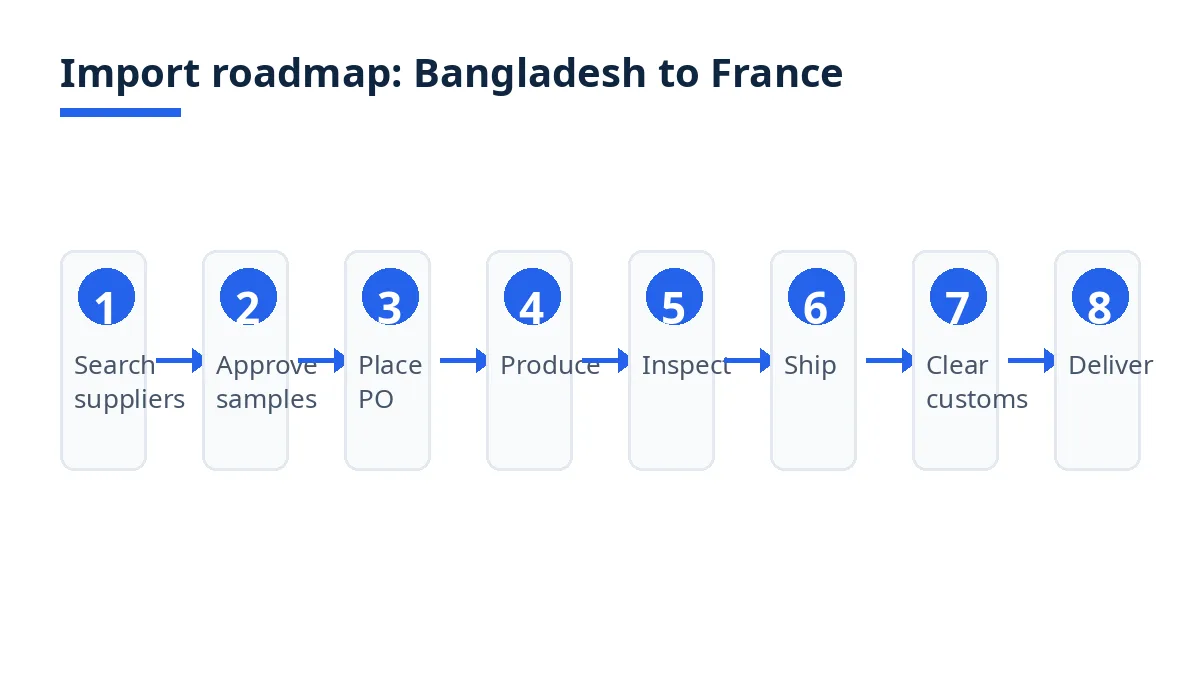
Write the specification garment by garment: fabric, weight, color, tape layout, pocket plan, closures, size range, and packing as complete sets, with protective garments and their standards named separately.
Classify every garment, starting from headings 6203 and 6204 for trousers and overalls, 6205 for work shirts, 6210 for coated garments and 6211 for other garments, and confirm each full eight-digit code and duty treatment with your broker.
Shortlist factories whose range already includes woven workwear, and request comparable quotes on the identical specification and delivery term.
Verify the chosen supplier: company documents, workwear capacity, fabric and tape route, and a video or in-person factory check for a first order.
Order samples in stages, wear and wash them, test tape performance after washing, then approve a pre-production sample of each garment in production fabric, color and tape.
Confirm the order in writing: purchase order, pro forma invoice, delivery and payment terms, inspection plan with AQL and defect limits, labeling, set packing and shipment date.
Inspect during production and again on packed goods against the approved samples, checking shade match across each set, tape alignment and closure function.
Ship to Le Havre or Fos-sur-Mer as the delivery address dictates, clear French customs with the confirmed code for each garment and the proof of origin, and reconcile the actual landed cost.
How Exportain helps
Browse suppliers for Bangladeshi workwear exporters and compare their ranges against your garment list. Then post your specification and target quantity as an RFQ and compare replies on the same terms before you choose a factory for sampling. Exportain is a B2B marketplace where buyers post RFQs, receive quotations and message suppliers. It does not inspect goods, book freight or clear customs.
FAQs
What is the typical MOQ for workwear and uniforms from Bangladesh?
There is no single typical minimum. It is set per garment and usually per color, because fabric is woven, dyed or finished in batches and a cutting plan is set up per size range. Ask each supplier how its minimum splits by garment, color, fabric and size curve.
How long does shipping take?
Production time and transit time are separate, and neither has a single typical figure. Sea transit takes weeks rather than days and varies by port, routing, transshipment and season. Confirm the sailing schedule and the inland leg to your French warehouse before promising a delivery date.
What import duty applies?
Duty follows the confirmed classification of each garment, the origin and the preference in force on the entry date. For a qualifying shipment from Bangladesh, the Everything But Arms arrangement grants duty-free, quota-free access to the EU for all products except arms and ammunition.1 If the preference cannot be claimed, your broker must confirm the applicable rate from the EU TARIC schedule for each eight-digit code.
How do I verify a supplier?
Check company documents first, so that name, address and bank account agree across the trade license, export registration and invoices. Then check capability: workwear capacity, fabric and tape route, and recent workwear production. Keep payments to the company account named in the documents, and approve a pre-production sample of each garment before bulk production.
Next steps on Exportain
Read how to import from Bangladesh for the full process, then use how to buy to set out your garment list. When ready, browse suppliers on Exportain and compare quotes on the same terms.
Sources
- EU trade relations with Bangladesh. European Commission, (accessed )
- Apparel exports hit $39.35bn, 8.84% higher in 2024-25 despite political crisis. RMG Bangladesh (accessed )
- ISO 2859-1:2026 - Sampling procedures for inspection by attributes — Part 1: Sampling schemes indexed by acceptance quality limit (AQL) for lot-by-lot inspection. International Organization for Standardization (accessed )
- Regulation (EU) 2016/425 of the European Parliament and of the Council of 9 March 2016 on personal protective equipment - summary. European Union (accessed )
- EN ISO 20471. ProGARM (accessed )
- Regulation (EU) No 1007/2011 on textile fibre names and related labelling and marking of the fibre composition of textile products, Article 9: Multi-fibre textile products. legislation.gov.uk (accessed )
- Incoterms® rules. International Chamber of Commerce (ICC) (accessed )
- Shipping lines turn to Le Havre as European port logjams worsen. Baird Maritime (accessed )
- Harmonised System. European Commission (accessed )
- Classifying textiles. European Commission, Access2Markets (accessed )
- France TVA Guide 2026. TaxDo (accessed )
About the author
Sourcing from Bangladesh?
Post a request for quotation and suppliers on Exportain can send you their quotes directly.
Post an RFQ