

How to Import Sportswear and Activewear to USA From Bangladesh
How to import sportswear and activewear from Bangladesh to the USA: USA tariff lines for cotton and synthetic track suits, CPSIA flammability and labelling rules, ISF filing, shipping and a landed-cost example for buyers.
Short answer
To import sportswear and activewear from Bangladesh to the USA, write a tech pack for each style, classify it in heading 6112 or 6114, and confirm the duty with your broker before pricing. Verify the factory, approve a pre-production sample in production fabric, agree the flammability position and labels, file the Importer Security Filing before loading, and build the landed cost style by style.
On this page
Key takeaways
Knitted track suits sit in heading 6112: the 2026 schedule opened for this guide gives 14.9 percent for cotton and 28.2 percent for synthetic fibres.
A synthetic blend does not get the cotton rate: confirm the full code before you price it.
Adult wearing apparel must meet the flammability standard in 16 CFR part 1610; children's sportswear carries a separate testing and certification regime.
For ocean cargo, most Importer Security Filing elements are due no later than 24 hours before loading at the foreign port.
There is no single typical minimum order quantity, price or transit time for sportswear from Bangladesh: confirm each one in writing for your exact style and route.
This guide is for buyers in the United States who want to import sportswear and activewear from Bangladesh: track suits, training tops, leggings, shorts and swimwear. It follows one order from specification to delivery at a United States warehouse, with the United States rules that change the answer: tariff lines that split by fibre, flammability and labelling rules that apply before the goods ship, and the ocean-filing deadline that falls before loading.
Bangladesh supplies both knitted and woven sportswear, and the two constructions do not share a tariff chapter. That is why this guide starts with classification, not with a supplier list: get the line wrong and the duty, the label and the inspection plan are all built on the wrong garment.
Why source sportswear and activewear from Bangladesh
Bangladesh has a deep knitting base, and most sportswear and activewear is knitted: jersey, interlock, fleece, rib and stretch knits with elastane for recovery. The factory skills that matter are circular knitting, dyeing of synthetics and blends, cut-and-sew of stretch fabric, sublimation or screen printing, and heat-transfer labelling.
Buy for the end use, not for the fabric name. A running tight, a gym training top and a sideline fleece jacket face different wear, wash and stretch demands. Write the end use into the specification: activity, wash frequency and fit.
Find and verify suppliers
Where should you start the search?
Start with a tech pack, not with a supplier name. A usable tech pack for one style contains the garment sketch, the fabric specification (knit type, fibre composition, weight, stretch and recovery), the graded size chart with tolerances, seam and stitch types, trims, print artwork, colour standards, packing and the label text. Send the identical pack to every candidate and ask for the same reply format: fabric assumed, price inclusions, validity, minimum per style and per colour, and lead time from approved pre-production sample.
Shortlist factories whose current range already includes your construction, and ask how they handle elastane. Browse suppliers on Exportain and read how to import from Bangladesh for the wider process.
How do you verify a supplier before you pay?
Verification has three layers. The first is company documents: trade licence, export registration and association membership where applicable, checked so that name, address and bank account name agree across every document and invoice. The second is capability: current styles in production in your construction, capacity, fabric source, dyeing and print route, and inspection setup. Ask to see a finished garment from current production in a comparable fabric, not a catalogue photograph, and check seam stretch, waistband recovery, print adhesion and colour consistency.
MOQ, pricing and samples
What is the typical MOQ for sportswear and activewear from Bangladesh?
There is no single typical minimum order quantity for sportswear and activewear from Bangladesh. The minimum is usually set per style and per colour, because fabric is knitted and dyed in batches and a cutting plan is set up per size range. A solid-colour training top and a sublimated all-over-print legging will not carry the same minimum. Ask each supplier how its minimum splits by style, colour, print method and size range, and whether a small first order is possible at a higher unit price.
How is the price built, and how should you compare quotes?
Fabric is usually the main cost element in activewear, followed by cutting and sewing, dyeing or printing, trims, testing, packing and the factory margin. Stretch fabric costs more to handle than a stable jersey: cutting must control relaxation, and waistbands and cuffs need elastics that hold recovery. Print adds operations, and an all-over print uses more print capacity than a chest logo.
Compare quotes only on the same basis: same tech pack, fabric, size range, print method, trims, packing and delivery term. Ask each supplier to state what is excluded. A lower quote that assumes a lighter fabric or a simpler print is a different garment, not a saving.
Which samples do you need, and how do you approve them?
Work in stages. A development sample shows whether the factory can construct the garment and place the print. A fit sample shows whether the graded measurements work on a body and whether stretch and recovery behave as specified. A pre-production sample, made in the actual production fabric, colour, print and trims, is the sample you approve for bulk. Test samples as your customers will use them: wear and wash them, stretch the waistband and cuffs, and check print cracking after washing.
Approve in writing and keep one sealed counter-sample of each style. Agree what happens if a bulk lot fails a test the sample passed, and who pays for the retest.
Quality control and certifications needed
Which quality checks are specific to sportswear and activewear?
Against the approved sample and size chart, check fibre composition and fabric weight, finished measurements within your agreed tolerances, and consistency across the size range. Then check construction: seam stretch at armholes, crotch and waistband joins, waistband and cuff recovery, zipper function, print placement and adhesion, and colour consistency between pieces and lots. For leggings, check that the garment recovers after stretching rather than bagging at the knee and waist.
Set the performance tests in the specification: dimensional stability after washing, colourfastness to washing and perspiration, pilling resistance, seam strength and stretch recovery. Name the test, the required result and the laboratory for each one, and require the report to name the fabric and style it covers. Agree the inspection method and defect limits before production, with an inline check during sewing and a final inspection on packed goods.
Which United States flammability rules apply?
Adult wearing apparel is covered by the clothing-textile flammability standard in 16 CFR part 1610. The United States Consumer Product Safety Commission (CPSC) guidance states that the standard classifies fabrics into three classes of flammability, and that Class 3 textiles are unsuitable and prohibited for use in clothing.1 Adult wearing apparel requires a General Certificate of Conformity (GCC) based on testing or a reasonable testing program, except for apparel that is exempt from testing.1
Exemptions matter for activewear because most of it is synthetic. The CPSC guidance states that plain surface fabrics weighing 2.6 ounces per square yard or more are exempt from testing, as are plain and raised surface fabrics made of acrylic, modacrylic, nylon, olefin, polyester, wool or any combination of those fibres.1 A polyester training top therefore often falls inside an exemption, while a cotton-rich fleece with a raised surface may not. Confirm it fabric by fabric, and remember that exposed linings and reversible garments are tested on the exposed parts.1
Children's sportswear is a different regime. The CPSC guidance states that testing for children's wearing apparel must be performed at a third-party, CPSC-accepted laboratory, and that importers must issue a Children's Product Certificate (CPC) after receiving passing results.1 Children's products must also carry a permanent tracking label giving the manufacturer, importer or private labeller, the date and location of production and batch or cohort information.1 If your range includes children's sizes, build the testing time and the CPC into the schedule before you confirm a delivery date.
Which labelling rules apply in the United States?
Two labelling systems apply at once, from two different agencies. Most textile products sold in the United States must carry a label disclosing fibre content, country of origin and the identity of the manufacturer or marketer, under the Textile Fiber Products Identification Act, with fibre content listed by generic name and percentage by weight in descending order, and the responsible company identified by its full name or by an FTC-issued Registered Identification Number (RN).2 The FTC Care Labeling Rule requires a care instruction on most wearing apparel.2
Country-of-origin marking is a customs requirement distinct from the FTC label: under 19 U.S.C. section 1304 every imported article must be marked conspicuously, legibly and permanently with the English name of its country of origin, and textile-specific origin rules sit in 19 CFR 102.21.2 Agree the full label text at sampling stage, including fibre percentages that match the fabric actually bought. A label that names the wrong fibre percentages is also a classification problem, because the duty line follows the fibre composition.
Incoterms, shipping and transit time
Which delivery term should a first United States order use?
The Incoterms 2020 rules set out, for each rule, where delivery takes place, and risk passes from seller to buyer at the same point and time as delivery.3 Under FOB, CFR and CIF the seller must place the goods on board the vessel, and the four sea rules are only intended for port-to-port bulk or break-bulk shipments and are not suitable for container shipments, because a container is handed to the carrier before it is on board.3 In all rules but EXW the seller must carry out export formalities, and in all rules but DDP the buyer must carry out import formalities.3 Put the named place and the version, Incoterms 2020, in the purchase order.
For a first containerised order from Bangladesh, weigh FOB at Chattogram against FCA at the named terminal. Under FOB, the factory delivers the goods on board and your forwarder handles the sea leg. Under FCA, delivery happens when the goods are handed to your carrier, which matches how containerised cargo actually moves. CPT or CIP keep the same delivery point as FCA while the seller pays freight to the destination, and only CIP and CIF oblige the seller to provide insurance for the buyer's risk.3
How long does shipping take, and which United States port should you choose?
There is no single typical transit time for sportswear from Bangladesh. Sea freight is the standard route for bulk orders and it takes weeks rather than days, varying by port, routing and season. Plan from your forwarder's sailing schedule, and keep production time separate: an order is ready only when every style has finished sewing, printing, inspection and packing. Confirm pieces per carton, carton dimensions and weight in the specification, because activewear is light for its volume.
Choose the United States gateway by where the goods will be warehoused, not by the shortest ocean leg alone. East Coast, Gulf Coast and West Coast gateways all receive Bangladesh cargo through transshipment, and the inland leg to your warehouse can erase an ocean saving. Ask your forwarder to quote the same shipment to two gateways, door to door, and compare the full landed cost.
What is the Importer Security Filing, and when is it due?
For cargo arriving by vessel, the Importer Security Filing (ISF), known as 10+2, must be submitted through a CBP-approved system. The rule requires the seller, buyer, importer of record number, consignee number, manufacturer or supplier, ship-to party, country of origin and commodity HTSUS number no later than 24 hours before the cargo is laden aboard the vessel at the foreign port, while the container stuffing location and consolidator are due no later than 24 hours before arrival in a United States port.4 The filing is therefore a pre-loading task: give your broker the manufacturer name and address, the HTSUS number and the ship-to party as soon as the purchase order is confirmed, and update the filing if any element changes.4
Import duty, taxes and documents
How are sportswear and activewear classified for United States duty?
Duty follows the classification of each style, not the supplier's product name. Knitted track suits, ski-suits and swimwear sit in heading 6112. Other knitted garments not covered by a more specific heading, including many training tops and leggings, sit in heading 6114. Woven track suits sit in heading 6211, which this guide does not price, because the schedule page opened for this guide was Chapter 61: confirm any woven style's line and rate with your broker.
Inside heading 6112, the split is by fibre. In the United States schedule opened for this guide, Revision 18 (2026), knitted track suits of cotton, 6112.11.00, carry a general rate of 14.9 percent, knitted track suits of synthetic fibres, 6112.12.00, carry 28.2 percent, knitted track suits of artificial fibres, 6112.19.10, carry 28.2 percent, and other knitted track suits in 6112.19.80 carry 21.6 percent.5 Swimwear splits the same way: men's or boys' swimwear of synthetic fibres, 6112.31.00, carries 25.9 percent, women's or girls' swimwear of synthetic fibres, 6112.41.00, carries 24.9 percent, and swimwear of other textile materials, 6112.39.00 and 6112.49.00, carries 13.2 percent.5 A blended fabric must be classified by its fibre composition, not by its marketing name.
Inside heading 6114, the lines buyers most often meet are 6114.30.10 for tops of man-made fibres at 28.2 percent, 6114.30.20 for bodysuits and bodyshirts at 32 percent, and 6114.30.30 for other garments at 14.9 percent, all general rates in the same 2026 schedule.5 A training top and a legging are not automatically on the same line, so classify each style on its own construction.
What import duty applies?
Your rate depends on each style's subheading, the origin and any preference or additional duty in force on the entry date, so there is no single rate for a whole sportswear order. The figures above are general rates from Revision 18 (2026) of the United States schedule. Ask your broker to confirm the current rate for each style's full 10-digit code, whether any additional duties in Chapter 99 apply, and whether any merchandise processing or harbor maintenance fees apply.
Which documents do you need for clearance?
The standard import set is the commercial invoice, packing list, bill of lading or air waybill, and proof of origin where a preference is claimed. The invoice should name each style plainly, with fibre composition, quantities, unit prices and the delivery term on its own line. Keep cotton, synthetic and artificial-fibre styles on separate lines. Quantities, weights and carton counts must agree across every document.
Landed cost example
A landed cost is the full cost of one unit, ready to sell. Every number below is an example figure only, not a quote.
Example figures: 5,000 synthetic-fibre knitted track suits, FOB Chattogram, sea freight to a United States East Coast gateway, duty at the schedule general rate for 6112.12.00 only.
Cost element | Example figures (per set) | How to obtain your figure |
|---|---|---|
Product price, FOB | $9.80 | Confirmed pro forma invoice |
International freight | $1.15 | Forwarder quote divided by sets shipped |
Insurance | $0.08 | Policy or forwarder quote |
Duty at 28.2 percent of FOB value | $2.76 | Broker calculation from confirmed codes and rates |
Port, clearance and broker fees | $0.42 | Broker invoices divided by sets |
Local delivery to warehouse | $0.35 | Local carrier quote divided by sets |
Total landed cost | $14.56 | Sum of all lines above |
Merchandise processing and harbor maintenance fees, any additional duties in force on the entry date, and United States sales tax are not included. Work the calculation twice: at quote stage, style by style, and again after shipment with the actual invoices. See landed cost for imports from Bangladesh for the full method, and how to buy on Exportain for how buyer orders work on the platform.
Step-by-step import checklist
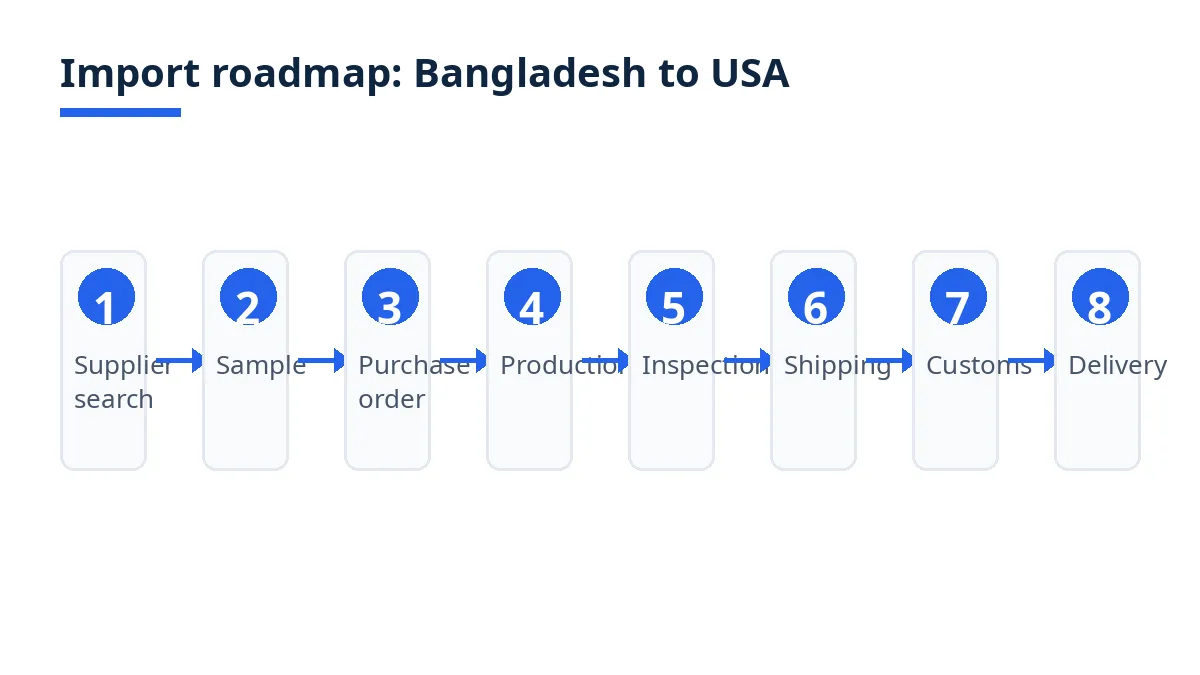
Write the tech pack style by style: end use, fabric, knit type, size chart, seams, trims, print method and packing.
Classify every style from heading 6112 or 6114, and confirm each full code and duty with your broker.
Shortlist factories whose current production already includes your construction, and request comparable quotes on the identical tech pack.
Verify the chosen supplier: company documents, knitting and dyeing route, print route, and a finished garment from current production.
Order samples in stages, wear and wash them, then approve a pre-production sample in production fabric.
Confirm the order in writing: purchase order, pro forma invoice, delivery and payment terms, inspection plan, labelling, packing and shipment date.
Agree the United States compliance pack before production: flammability position per fabric, FTC and CBP labels, and a CPC with third-party testing for children's sizes.
Give your broker the ISF data at purchase-order stage, inspect during production and on packed goods, and file the ISF no later than 24 hours before loading.
Ship, clear customs with the confirmed code for each style, and reconcile the actual landed cost.
How Exportain helps
Browse suppliers for Bangladeshi sportswear and activewear exporters and compare their ranges against your style list. Then post your tech pack and target quantity as an RFQ and compare replies on the same terms before you choose a factory for sampling. Exportain is a B2B marketplace where buyers post RFQs, receive quotations and message suppliers. It does not inspect goods, book freight or clear customs.
FAQs
What is the typical MOQ for sportswear and activewear from Bangladesh?
There is no single typical minimum. It is usually set per style and per colour, because fabric is knitted and dyed in batches. Ask each supplier how its minimum splits by style, colour and print method.
How long does shipping take?
Production time and transit time are separate, and neither has a single typical figure. Sea transit takes weeks rather than days and varies by port, routing and season. Plan from your forwarder's sailing schedule, and add clearance and delivery.
What import duty applies?
Duty follows the confirmed classification of each style. In the 2026 schedule opened for this guide, knitted track suits of cotton, 6112.11.00, carry 14.9 percent, knitted track suits of synthetic fibres, 6112.12.00, carry 28.2 percent, and other knitted track suits in 6112.19.80 carry 21.6 percent.5 Tops of man-made fibres in 6114.30.10 carry 28.2 percent and other garments in 6114.30.30 carry 14.9 percent.5 Confirm the current rate for each style's full code with your broker before you price it.
How do I verify a supplier?
Check company documents first, so that name, address and bank account agree across the documents and invoices. Then check capability: knitting and dyeing route, print route and current production in your construction. Keep payments to the company account named in the documents, and approve a pre-production sample before bulk production.
Next steps on Exportain
Read how to import from Bangladesh for the full process, then use how to buy on Exportain to plan your order. When ready, browse suppliers and compare quotes on the same tech pack.
Sources
- Clothing Business Guidance. U.S. Consumer Product Safety Commission (accessed )
- How to Import Textiles into the U.S.. Reidel Law Firm (accessed )
- Insider thoughts: Bob Ronai on Incoterms 2020 Rules; What are they about?. International Chamber of Commerce (accessed )
- Part 149 - Importer Security Filing. United States Customs and Border Protection (accessed )
- Harmonized Tariff Schedule of the United States Revision 18 (2026), Chapter 61. U.S. International Trade Commission (accessed )
About the author
Sourcing from Bangladesh?
Post a request for quotation and suppliers on Exportain can send you their quotes directly.
Post an RFQ


