

UAE Sportswear Imports From Bangladesh: Jebel Ali Entry, 5% VAT and Duty Guide
UAE sportswear imports from Bangladesh: Jebel Ali entry, 5% duty, 5% VAT on the duty-inclusive value, Arabic labelling, designated-zone rules and a worked landed-cost example for buyers.
Short answer
To import sportswear and activewear from Bangladesh to the UAE, write one specification per style, shortlist factories that already make that style, and approve a pre-production sample in production fabric. Classify each style for the GCC tariff, plan for 5% duty on CIF value and 5% VAT on the duty-inclusive value, label in Arabic or Arabic and English, and clear the goods through Jebel Ali with a UAE trade licence and customs code.
On this page
Key takeaways
Plan on the general UAE customs duty rate of 5 percent of the cost, insurance and freight value for sportswear, but confirm the full UAE tariff line for each style with your broker before you price or ship, and mark any unopened duty line as confirm with broker.
For mainland entry, UAE VAT at 5 percent is charged on the duty-inclusive value, so calculate duty first, add it to the cost, insurance and freight value, and only then apply VAT; a VAT-registered importer should confirm the cash-flow timing with a tax adviser.
Labels must be in Arabic, or in both Arabic and English, stating fibre composition, country of origin and care instructions using ISO symbols, and conformity often requires an Emirates Conformity Assessment Scheme certificate, so agree the label and conformity route at sampling stage.
Jebel Ali Free Zone is a designated zone for VAT purposes: goods stored and re-exported under customs control have duty and VAT suspended, while goods entering the mainland are treated as an import and the mainland recipient accounts for VAT at 5 percent.
There is no single typical minimum order quantity, price or transit time for sportswear from Bangladesh: confirm the minimum per style and colour, the price on one identical specification, and the sailing schedule for your exact shipment date.
If you buy sportswear and activewear for the UAE market, the order that matters is not the cheapest quote. It is the order where style, fabric, size range, tariff line, Arabic label and Jebel Ali clearance all agree before bulk production starts. This guide walks through that order: shortlisting Bangladeshi factories that already make your style, agreeing a minimum and a price on one identical specification, clearing the goods through Jebel Ali, and building a landed cost that includes UAE customs duty and VAT. The UAE differs from a European route in three ways: no EU-style preferential zero duty, VAT timing that changes between mainland entry and a designated zone, and Arabic labelling. Plan for those three differences from the first sample.
Why source sportswear and activewear from Bangladesh
Bangladesh makes its living from apparel in volume, and sportswear and activewear sit inside that strength: knitted tops, leggings, shorts, tracksuits, training sets and swimwear. The advantage for a UAE buyer is range within one order: one factory group can often cover a training set, a matching top and a short in the same fabric family. A colour that drifts between a top and a legging reads as a defect even when each piece measures correctly on its own.
Source by style, not by country brochure. A factory that sews woven shirts well is not automatically a good activewear factory: activewear needs flatlock or coverstitch capacity for stretch seams, pattern work that accounts for stretch and recovery, and print or sublimation routes that survive washing without cracking. Check a finished piece from a recent run for seam stretch, print placement across a seam, and waistband or cuff recovery, and put the wash test and number of wash cycles in the specification, since Gulf garments are washed often and worn in warm conditions.
Find and verify suppliers
Where should you start the search?
Start with a written specification, not with factory names: garment type, fabric composition and weight, stretch behaviour, construction, print or sublimation method, colours, size chart, label wording in Arabic or in Arabic and English, and packing. Then shortlist factories whose current range already includes that style. Browse suppliers on Exportain, read the general route in how to import from Bangladesh, and send every candidate the identical specification with the same reply format: fabric assumed, price inclusions, validity period, minimum per style and per colour, and delivery term.
How do you check a supplier before you pay?
Check documents so that company name, factory address and bank account name agree, and keep payments to the company account named in the documents. Check capability against your exact style from current production, and ask which machines, print routes and quality staff handled a comparable recent order. Ask what went wrong on that order and how it was fixed: a supplier that cannot describe a problem it fixed is a supplier you have not yet tested.
Profile badges describe what was reviewed, and they do not replace your own sample approval and inspection.
MOQ, pricing and samples
What is a realistic minimum order?
There is no single minimum for sportswear and activewear from Bangladesh. The minimum is set per style and usually per colour, because fabric is knitted, dyed or printed in batches and cutting is planned per size range. A factory may accept a lower total quantity on one fabric and one colour, and refuse the same total split across six colours and four print designs. Ask how the minimum splits by style, colour, print method and size range, and confirm the answer in writing before approving a sample.
How should you compare prices?
Compare prices on one identical specification, on the same delivery term, with the same inclusions. A price quoted free on board at a Bangladeshi port is not comparable with a price quoted delivered to your UAE warehouse, and a price that excludes trims, labels or packing is not comparable with a price that includes them. Ask every candidate to break the price into fabric, trims, printing or sublimation, sewing, packing and any testing charge, and to state the validity period. If one quote is far below the others, ask which fabric weight, print route and packing it assumes before treating it as a saving.
Samples follow two stages, and both matter. Approve a development sample first to settle fit, construction and print placement, then a pre-production sample in production fabric, colour, print and trims, with the production label sewn in. The pre-production sample is the standard bulk production is judged against, so check it against the size chart, wash it, stretch it, and check the Arabic label wording before you approve it. Do not approve a pre-production sample from a photograph alone when the print, stretch or label is new.
Quality control and certifications needed
Which quality checks matter most for activewear?
Activewear fails in predictable places: seams that split under stretch, prints that crack or peel after washing, waistbands and cuffs that lose recovery, colours that drift between styles, and sizes that run small after the first wash. Build the inspection around those points, name the tests in the purchase order, and agree the inspection stages before bulk production: an inline check, a final inspection on finished and packed goods, and a clear rule for a failed lot.
Agree defect limits in writing, by defect type: a broken seam and a loose thread are not the same class of defect. Add label and packing checks to the final inspection: Arabic wording, fibre composition, country of origin, care symbols, size marking, carton marking and carton count.
Which certifications do you actually need?
No single certificate covers every sportswear order. What you need follows your customer and market: a retailer or brand may name a specific test, a restricted-substance list or a scheme in its own supplier manual. Name any such requirement in the specification, ask for the matching report or certificate, and check its scope, product covered, issuing body and date.
For the UAE, the conformity question is separate from any buyer scheme. Textile and garment products must meet labelling and conformity requirements enforced through the Emirates Authority for Standardization and Metrology, and demonstrating conformity often requires an Emirates Conformity Assessment Scheme certificate.1 Labels must be in Arabic, or in both Arabic and English, and must state fibre composition, country of origin and care instructions using ISO symbols.1 Conformity covers colourfastness, flammability and the absence of harmful chemicals such as azo dyes and formaldehyde.1
Incoterms, shipping and transit time
Which delivery term should you choose?
The delivery term decides where risk passes, who books the main carriage and who handles export and import formalities, so agree it before bulk production. For containerised sportswear, weigh free on board at the Bangladeshi port against free carrier at the named terminal, and both against delivered at place to your UAE warehouse. Under free on board, the factory delivers the goods on board and your forwarder handles the sea leg. Under delivered at place, the seller bears transport risk to the named place while you still handle import clearance and pay duty and VAT. Under delivered duty paid, the seller also handles import formalities and pays duty and VAT, which is convenient only if the seller is set up to clear in the UAE and account for UAE VAT correctly.
How does the Jebel Ali entry work?
Jebel Ali, in Dubai, is the natural first entry for most UAE sportswear imports from Bangladesh, Jebel Ali sits inside the Jebel Ali Free Zone, which is also a designated zone for VAT purposes, so the same port can serve two routes: mainland clearance for UAE-wide sale, or designated-zone entry for storage and regional distribution. Decide which route your shipment takes before it sails, because the declaration, VAT treatment and onward movement all follow from that choice.
Sea freight is the standard route for bulk sportswear. Air freight suits samples and urgent top-ups, but it does not change the duty, VAT or labelling rules. Confirm the sailing schedule, the port pair and the free time at Jebel Ali with your forwarder for your exact shipment date, since a clearance delay past free time adds demurrage cost.
How long does shipping take?
There is no single transit figure for every order on this lane, and you should distrust any guide that gives one. A current lane listing for Chittagong to Jebel Ali shows an average transit of 10 days 9 hours for full container load, with an indicative freight range of USD 4,592.698 to USD 4,784.06 for a 20-foot standard container on the schedules shown.2 Treat that listing as a planning input, not as a quote: the schedule, carrier and rate change, and your own forwarder quote for your shipment date is the figure that matters. Plan from that schedule, add Jebel Ali clearance and inland delivery, and keep production time separate: an order is ready only when every piece has finished sewing, printing, inspection and packing.
Import duty, taxes and documents
What duty applies to sportswear from Bangladesh?
Duty follows the classification of each style in the tariff, not the supplier's product name. Tracksuits, ski suits and swimwear that are not knitted or crocheted sit in heading 6211, which splits by garment type and fibre, including tracksuits of cotton and of man-made fibres.3 Knitted tracksuits sit in heading 6112, and other knitted activewear tops, leggings and shorts are classified by their own construction and fibre, so one order can sit on several tariff lines. The UAE uses a longer national tariff code built on the international six-digit heading, so confirm the full UAE tariff line for each style with your broker before you price or ship, and mark any duty line you have not opened in a tariff schedule "confirm with broker" in your costing file.
The general UAE customs duty rate is 5 percent of the cost, insurance and freight value of imports, with other rates and exemptions applying to certain goods.4 Textiles and garments are subject to the standard 5 percent GCC Common Customs Tariff on the cost, insurance and freight value.1 That general rate is the planning rate for sportswear, but it is not a substitute for a line-by-line check: confirm each style's line and any exemption or relief with your broker in writing. Bangladesh origin does not, on its own, remove UAE duty, so do not price a UAE order on a zero-duty assumption borrowed from a European guide.
What UAE VAT applies, and how does the free-zone choice change it?
The general UAE VAT rate is 5 percent and applies to most goods and services, with some goods and services subject to a zero rate or an exemption where specific conditions are met.4 For a mainland import, VAT at 5 percent applies to the sum of the cost, insurance and freight value and the customs duty payable.5 Calculate duty first, add it to that value, and only then apply the 5 percent VAT rate.5 A VAT-registered importer generally accounts for import VAT through the VAT return, but the cash-flow timing depends on registration status and on whether postponed accounting applies, so ask your tax adviser to confirm the timing before you fund the shipment. A non-registered importer should expect to fund the VAT at clearance.
The free-zone choice changes the timing, not the existence, of the tax. A designated zone is a fenced, FTA-approved area treated as outside the UAE for VAT purposes, but only for specific goods transactions and only where customs controls and documentation requirements are met.6 Goods traded within or between qualifying designated zones can be treated as outside the scope of VAT where the conditions are met, and services remain subject to standard VAT rules regardless of zone status.6 Jebel Ali Free Zone is listed among the approved designated zones.6 When goods leave a designated zone and enter the mainland, the mainland recipient is treated as the importer of record and accounts for VAT, typically at 5 percent.6 A standard free zone that is not a designated zone does not give the same treatment, so check your zone's status against the current FTA list before structuring a transaction around it. In short: store and re-export from a designated zone and mainland duty and VAT are suspended while goods stay under customs control; sell into the mainland and duty and VAT fall due at mainland entry.
Which documents does the Jebel Ali clearance need?
Prepare one consistent document set: commercial invoice, packing list, bill of lading, certificate of origin, and the import declaration data. The invoice, packing list and bill of lading must agree on parties, quantities, values, tariff lines, delivery term and route. The commercial invoice must state the harmonised system code for each item, the country of origin, a full description, and the unit and total value, and the certificate of origin must be authenticated by the chamber of commerce in the exporting country.1 The packing list must detail weight, dimensions and packing method for each package.1 Any discrepancy between the declaration and the physical goods or documents can trigger a full physical inspection, with delays and demurrage charges.1
You also need a UAE trade licence and a customs code. A valid trade licence is required to register with Dubai Customs, and declarations are filed through the Mirsal 2 system against that code, so confirm before the shipment sails that your licence is current and your customs code is active. If you clear through a broker, agree in writing whether the broker acts in your name or in its own name, because that choice decides who bears the customs debt and who accounts for VAT. Keep the shipment file together: declaration, invoice, packing list, bill of lading, certificate of origin, test reports, label artwork and inspection report.
Landed cost example (table)
All figures in this section are Example figures. They illustrate one Jebel Ali mainland shipment; they are not a quote, and your own figures will differ by style, fabric, quantity, route and broker terms.
Cost element | Example figures |
|---|---|
Goods value, Example figures | USD 20,000 |
International freight and insurance to Jebel Ali, Example figures | USD 4,600 |
Customs value at Jebel Ali (goods plus freight and insurance), Example figures | USD 24,600 |
Customs duty at the general 5 percent rate on the customs value, Example figures | USD 1,230 |
Import VAT base (customs value plus duty), Example figures | USD 25,830 |
UAE import VAT at 5 percent on the duty-inclusive base, Example figures | USD 1,291.50 |
Customs broker and clearance charges, Example figures | USD 600 |
Total landed cost in these Example figures, before inland delivery to your warehouse | USD 27,721.50 |
The table shows why the order of calculation matters: on these Example figures, border VAT alone is USD 1,291.50, charged on the duty-inclusive base, so any duty increase from a reclassification would also increase the VAT. Add inland delivery, inspection, warehousing and any relabelling to reach a full landed cost, and compare that total with your selling price before confirming the order. See the landed cost imports from Bangladesh guide for the full build-up, and read how to buy for the buying route on Exportain. If your route is a designated-zone entry rather than a mainland entry, build a separate table in which duty and VAT are suspended while the goods stay in the zone, and fall due only on mainland entry.
Step-by-step import checklist
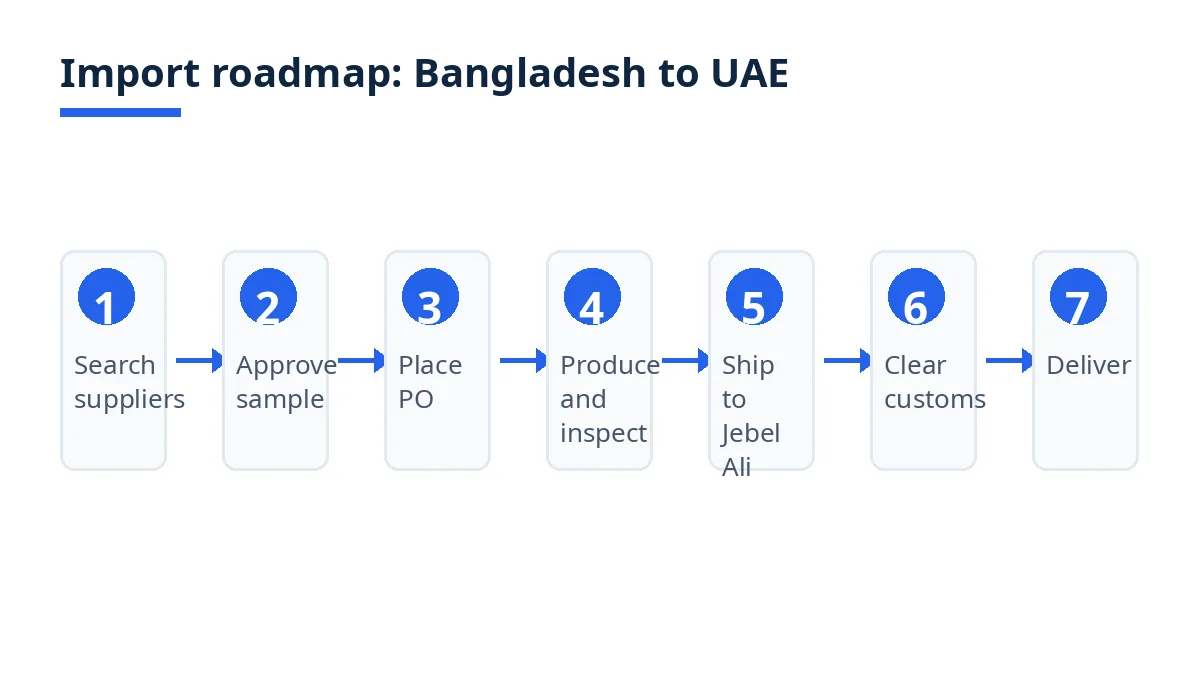
Write one specification per style: garment type, fabric, stretch, construction, print method, colours, size chart and Arabic label wording.
Decide the destination route before pricing: mainland, designated-zone, or both.
Shortlist factories already making that style, and send each the identical specification.
Check documents, capability and bank details; confirm the minimum per style and colour in writing.
Approve a development sample, then a pre-production sample in production fabric, colour, print and trims, with the production label sewn in.
Agree delivery term, tariff lines, label wording and route before bulk production; mark any unopened duty line "confirm with broker".
Name the tests in the purchase order, agree inspection stages and defect limits, and confirm any ECAS certificate need.
Confirm the sailing, Jebel Ali entry, free time and onward delivery; build a buffer before any launch date.
File the Jebel Ali declaration with matching invoice, packing list, bill of lading and certificate of origin; fund 5 percent duty and 5 percent VAT at mainland clearance.
Check delivered goods against the sealed sample and size chart, keep the shipment file, and review the first order before repeating it.
How Exportain helps
Exportain connects UAE buyers with Bangladeshi suppliers, and the platform carries supplier profiles, product listings and a request-for-quote route for buyers who want comparable quotes. Use the platform to shortlist, send the identical specification to several factories, and compare replies on the same basis. Profile badges describe what was reviewed, and they do not replace your own sample approval and inspection. When your specification is ready, post a free request for quote through request for quote and compare replies line by line on fabric, print, minimum, delivery term and label wording.
FAQs
What is the typical MOQ for sportswear and activewear from Bangladesh?
There is no single typical minimum. It is set per style and usually per colour, because fabric is knitted, dyed or printed in batches. Ask how it splits by style, colour, print method and size range, and confirm the answer in writing before approving a sample.
How long does shipping take?
There is no single transit figure for every order. A current lane listing for Chittagong to Jebel Ali shows an average transit of 10 days 9 hours for full container load.2 Confirm the sailing schedule and clearance steps with your forwarder for your exact shipment date, and build a buffer before any launch date.
What import duty applies?
Plan on the general UAE duty rate of 5 percent of the cost, insurance and freight value, and confirm each style's full UAE tariff line with your broker before you price or ship.4 Textiles and garments are subject to the standard 5 percent GCC Common Customs Tariff on that value.1 Mark any unopened duty line "confirm with broker". UAE import VAT at 5 percent is charged on the duty-inclusive base for mainland entry.5
How do I verify a supplier?
Check company documents so that name, address and bank account name agree, check capability against your exact style from current production, and keep payments to the company account named in the documents. Approve a development sample and then a pre-production sample in production fabric, agree inspection stages before bulk production, and check the Arabic label wording and any ECAS certificate need at the same stage.1
Next steps on Exportain
Start with how to import from Bangladesh, shortlist through suppliers, compare costs in the landed cost imports from Bangladesh guide, then read how to buy.
Sources
- UAE Textile and Garment Import Regulations. Nour Attorneys (accessed )
- Chittagong to Jebel Ali FCL Shipping Rates | Schedules & Transit Time. Cogoport (accessed )
- Classification Detail — HS Code 6211. United Nations Statistics Division (accessed )
- United Arab Emirates - Corporate - Other taxes. PwC (accessed )
- VAT on Customs Duty in the UAE: Documents and Payment Process. Global Trade Plaza (accessed )
- UAE VAT in Designated Free Zones - Guide 2026. ProAct Chartered Accountants (accessed )
About the author
Sourcing from Bangladesh?
Post a request for quotation and suppliers on Exportain can send you their quotes directly.
Post an RFQ


