

Spain Sportswear Imports From Bangladesh: Valencia Entry, IVA and EBA Duty Guide
Spain sportswear imports from Bangladesh: Valencia entry, EBA duty, 21% IVA, Spanish labelling and a worked landed-cost example for buyers.
Short answer
To import sportswear and activewear from Bangladesh to Spain, write one specification per style, shortlist factories that already make that style, and approve a pre-production sample in production fabric and print. Classify each style in the EU tariff, prove Everything But Arms origin for a zero duty rate, label fibre content in Spanish, clear the goods through Valencia with an ES EORI number, and fund 21 percent import IVA at clearance.
On this page
Key takeaways
Bangladesh currently enjoys duty-free and quota-free access to the EU market for all products except arms and ammunition under Everything But Arms, but the zero rate applies only where the goods meet the origin rules and the origin evidence is in order, so confirm each tariff line with your customs broker before the shipment sails.
Spain charges import VAT, known as IVA, at the standard rate of 21 percent on the duty-inclusive customs value, and a VAT-registered importer can generally reclaim input VAT used for taxable sales, so fund the border IVA at clearance even though it is normally recoverable.
Article 16 of Regulation (EU) No 1007/2011 requires textile labelling to be provided in the official language of the Member State where the products are made available to the consumer, so goods sold in Spain need Spanish-language fibre labelling agreed at sampling stage.
Valencia is the natural first entry for buyers serving Madrid, Valencia and Catalonia: in the first seven months of 2021 it handled 40 percent of Spain's import and export containers, ahead of Barcelona at 29.05 percent, so price Barcelona and Algeciras alongside Valencia rather than assuming one port.
There is no single typical minimum order quantity, price or transit time for sportswear and activewear from Bangladesh: confirm the minimum per style and colour, the price on one identical specification, and the sailing schedule for your exact shipment date.
If you buy sportswear and activewear for the Spanish market, the decision that matters is not the cheapest quote. It is the order where style, fabric, size range, tariff line, origin file and Spanish label all agree before bulk production starts. This guide walks through that order for Spain: shortlisting Bangladeshi factories that already make your style, agreeing a minimum and a price on one identical specification, clearing the goods through Valencia, and building a landed cost that includes Spanish import IVA at 21 percent.
Bangladesh, as a least developed country, benefits from the most favourable regime available under the EU Generalised Scheme of Preferences, namely the Everything But Arms arrangement, which grants duty-free, quota-free access to the EU for exports of all products except arms and ammunition.1 That preference is why the origin file deserves as much attention as the sample. If the goods qualify and the origin evidence is in order, the customs duty in the example below is zero. If the claim fails, duty is charged line by line at the applicable third-country rate, so confirm every 10-digit TARIC line with your customs broker before the shipment sails. Every figure in the landed-cost section is an example, not a quote, and any duty line you cannot confirm from an opened schedule is marked confirm with broker.
Why source sportswear and activewear from Bangladesh
Bangladesh makes its living from apparel in volume, and sportswear and activewear sit inside that strength: knitted tops, leggings, shorts, tracksuits, training sets and swimwear. The practical advantage for a Spanish buyer is range within one order: a single factory group can often cover a training set, a matching top and a short in the same fabric family.
Source by style, not by country brochure. A factory that sews woven shirts well is not automatically a good activewear factory. Activewear needs flatlock or coverstitch capacity for stretch seams, pattern work that accounts for stretch and recovery, and print or sublimation routes that survive washing without cracking. Ask for current production in your exact style family, and check a finished piece for seam stretch, print placement across a seam, and waistband or cuff recovery.
For Spain, put the inland leg in the first quote comparison.
Find and verify suppliers
Where should you start the search?
Start with a written specification, not with factory names: garment type, fabric composition and weight, stretch behaviour, construction, print or sublimation method, colours, size chart, label wording in Spanish, and packing. Then shortlist factories whose current range already includes that style. Browse suppliers on Exportain, read the general route in how to import from Bangladesh, and send every candidate the identical specification with the same reply format: fabric assumed, price inclusions, validity period, minimum per style and per colour, and delivery term. Quotes on different specifications cannot be compared, and the cheapest is usually the one that assumed the lightest fabric or the simplest print.
Ask each candidate the same capability questions: which styles in your range it makes now, whether knitting, dyeing and printing are in-house or bought in, and whether it holds fabric stock or knits to order.
How do you verify a supplier before you pay?
Verification has three layers. The first is documents: trade licence, export registration and association membership where applicable, checked so that company name, address and bank account name agree across every document. The second is capability: current production in your style, seam and print quality on a finished piece, and a sample that matches your specification. The third is payment discipline: pay only to the company account named in the documents, never to a personal account, and check any change of bank details through a separate channel.
On Exportain, supplier profiles carry document and photo review badges. A badge records that documents and photos were reviewed. It is not a factory inspection, a guarantee of quality or delivery, or a substitute for your own sample approval and inspection.
MOQ, pricing and samples
What is the typical MOQ for sportswear and activewear from Bangladesh?
There is no single typical minimum for sportswear and activewear from Bangladesh. The minimum is set per style and usually per colour, because fabric is knitted, dyed or printed in batches and cutting is planned per size range. A plain training top in one colour, a sublimated set in four colours and a swimwear line with several prints will not carry the same minimum. Ask each supplier how its minimum splits by style, colour, print method and size range, and confirm the answer in writing before you approve a sample. If a supplier will run a smaller first order, ask what changes: a higher unit price, a fabric surcharge, fewer colours, or a longer lead time.
How is the price built, and how should you compare quotes?
Fabric is usually the largest cost element in activewear, followed by cutting and sewing, dyeing or printing, trims, testing, packing and the factory margin. Stretch fabric costs more to handle than a stable knit, and sublimation adds a print step and transfer paper cost that a solid colour does not carry. A quote that looks low often assumes a lighter fabric, a simpler print, fewer sizes, or a delivery term that leaves freight and insurance to you.
Compare quotes on the same basis only: same style, fabric, colours, print method, size range, packing, delivery term and validity period. Ask each supplier to state what is excluded, for example testing, special packing, hang tags, or carton marking in Spanish.
Which samples do you need, and how do you approve them?
Work in stages, and approve each stage in writing. A development sample shows whether the factory can construct the garment, form stretch seams cleanly, place a print evenly and hold the size chart. A pre-production sample, made in the actual production fabric, colour, print and trims, is the sample you approve for bulk. Fit, colour, print durability and seam recovery cannot be approved from a sample in substitute fabric.
Test the samples the way your customers will use them: stretch every seam, wash the garment following your care label and measure it again, and check that a sublimated print has not cracked and that a waistband or cuff still recovers. Keep one sealed counter-sample of each style and colour.
Quality control and certifications needed
Which quality checks are specific to sportswear?
Against the approved sample and size chart, check fabric composition and finished weight, finished measurements across the full size range within your agreed tolerances, and consistency from the smallest to the largest size. Then check construction piece by piece: stretch seam formation, stitch density, skipped stitches at curves, print placement across seams, colour consistency between pieces in one set, waistband and cuff recovery, and zip and drawcord function where fitted. Check sets together, since a top and a legging from different shade batches can fail as a set.
Agree the inspection method and defect limits before production, and inspect in stages: an inline check during cutting, sewing and printing catches a drift while correction is still possible, and a final random inspection on packed goods checks quantity, workmanship, measurements, labels and packing. Name the test method in the purchase order. A test result for a different fabric or an unprinted version does not cover your printed set.
Which label rules apply in Spain?
Fibre labelling is an EU rule, and Spain is where it bites for this order. Regulation (EU) No 1007/2011 requires the labelling or marking to be provided in the official language or languages of the Member State on the territory of which the textile products are made available to the consumer, unless that Member State provides otherwise.2 For goods sold in Spain, that means Spanish-language fibre labelling: agree the Spanish wording at sampling stage, check that the percentages match the fabric you bought, and check the finished label before bulk label sewing begins. Do not assume that an English label accepted for another market will pass in Spain, since the regulation uses harmonised fibre names.
Which certifications do you actually need?
No single certificate covers every sportswear order. What you need follows your customer and market: a retailer or brand may name a specific test, a restricted-substance list or a scheme in its supplier manual. Name any such requirement in the specification, ask for the matching report or certificate, and check its scope, product, issuing body and date.
Incoterms, shipping and transit time
Which delivery term should you choose?
The delivery term decides where risk passes, who books the main carriage and who handles export and import formalities, so agree it before bulk production. For containerised sportswear, weigh FOB at the Bangladeshi port against FCA at the named terminal, and weigh both against DAP to your Spanish warehouse. Under FOB, the factory delivers the goods on board and your forwarder handles the sea leg. Under FCA, delivery happens when the goods are handed to your carrier, which matches how containerised cargo moves. Under DAP, the seller bears the transport risk to the named place while you still handle import clearance and pay import IVA and any duty; under DDP the seller also handles import formalities and pays the duty and IVA.
How does the Valencia entry work?
Valencia is the natural first entry for this lane. In the first seven months of 2021, Valenciaport handled 1,434,840 import and export containers, representing 40 percent of the import and export containers that entered or left the Spanish port system in that period, followed by Barcelona at 29.05 percent and Algeciras at 10.89 percent.3 For a buyer serving Madrid, Valencia or Catalonia, Valencia keeps the inland leg short. Also price Barcelona if your distribution sits in Catalonia and the north-east, and Algeciras if your onward route runs south, since the cheapest sea leg is not always the cheapest landed cost.
How long does shipping take?
There is no single transit figure for every order on this lane. Sea freight is the standard route for bulk sportswear, and it takes weeks rather than days, varying by sailing schedule, port pair and season. Plan from your forwarder's current sailing schedule for your exact shipment date, add Valencia clearance and inland delivery, and keep production time separate.
Import duty, taxes and documents
What duty applies to sportswear from Bangladesh?
Duty follows the classification of each style in the EU tariff, not the supplier's product name. Tracksuits, ski suits and swimwear, knitted or crocheted, sit in heading 6112, which splits by garment type and fibre.4 Other knitted activewear tops, leggings and shorts are classified by their own construction and fibre, so a single order can sit on several tariff lines. Confirm the full 10-digit TARIC code for each style before you price or ship.
The preferential rate is where the money is. Bangladesh benefits from duty-free, quota-free access to the EU for exports of all products except arms and ammunition under Everything But Arms.1 The preference is not automatic: the goods must meet the origin rules, and the origin evidence must be in order at clearance. Ask your broker, before the shipment sails, which origin evidence your consignment needs.
Plan for the preference to change over time. After a three-year transition following LDC graduation, Bangladesh will lose the duty-free, quota-free access it currently enjoys under Everything But Arms around the end of 2029, unless the transition is extended, and the replacement arrangement will turn on origin rules including double transformation for apparel.5 Do not price a long-term programme as if the current preference lasts forever.
For scale, the TARIC mirror consulted for this guide shows a third-country duty of 12 percent for ski suits under 6112.20, alongside a general GSP rate of 9.6 percent for the same line.4 That figure is for that line only, not a rate for your whole order, and every other line in your order is confirm with broker until your broker confirms its own rate. If origin is not proven on a line, that line pays its own third-country rate, and import IVA is then charged on the duty-inclusive base.
What Spanish import VAT applies?
Spain applies IVA to imports, and the standard Spanish rate is 21 percent, with reduced rates of 10 percent and 4 percent for other goods.6 Sportswear for general sale falls under the standard rate, but confirm the rate for your exact goods with your broker. For a commercial import, the IVA base is normally the customs value plus any duty payable, and VAT incurred on expenditure can generally be reclaimed where it is used in connection with taxable sales, subject to the usual limits.6 That recovery makes border IVA a cash-flow item for a registered business, but it does not remove the need to fund it at clearance.
One Spain-specific trap needs a direct check: the Canary Islands and the autonomous cities of Ceuta and Melilla are not part of the Spanish VAT territory, so they have special regulations.6 If any part of your delivery goes to those territories, agree the tax treatment with your broker before you ship.
Which documents does the Valencia clearance need?
Prepare one consistent document set: commercial invoice, packing list, bill of lading, origin evidence for the Everything But Arms claim, and the import declaration data. The invoice, packing list and bill of lading must agree on parties, quantities, values, tariff lines, delivery term and route.
You also need an EORI number: an identification number, unique within the customs territory of the Union, assigned by a customs authority to an economic operator for registration for customs purposes.7 For operators established in Spain with a Tax Identification Number issued by the Agencia Estatal de Administración Tributaria, the EORI number consists of the two-digit ISO code for Spain, ES, followed by that tax identification number.7 Check that it is registered and valid before the shipment sails. If you are not established in the EU, you will normally clear through a customs representative in Spain, and you should agree in writing whether that representative acts in your name or in its own name, because that choice decides who bears the customs debt.
Landed cost example (table)
All figures in this section are Example figures. They illustrate one Valencia shipment under an Everything But Arms claim; they are not a quote, and your own figures will differ by style, fabric, quantity, route and broker terms.
Cost element | Example figures |
|---|---|
Goods value, Example figures | EUR 20,000 |
International freight and insurance to Valencia, Example figures | EUR 2,500 |
Customs value at Valencia (goods plus freight and insurance), Example figures | EUR 22,500 |
Customs duty at the 0 percent Everything But Arms rate where origin is proven, Example figures | EUR 0 |
Import VAT base (customs value plus duty), Example figures | EUR 22,500 |
Spanish import IVA at 21 percent, Example figures | EUR 4,725 |
Customs broker and clearance charges, Example figures | EUR 600 |
Total landed cost in these Example figures, before inland delivery to your warehouse | EUR 27,825 |
The table shows why the origin file matters: on these Example figures, border IVA alone is EUR 4,725, charged on the duty-inclusive base, so any duty payable because origin was not proven would also increase the IVA. Add inland delivery from Valencia, inspection and warehousing to reach a full landed cost, and compare that total with your selling price before confirming the order. See the landed cost imports from Bangladesh guide for the full build-up, and read how to buy for the buying route on Exportain.
Step-by-step import checklist
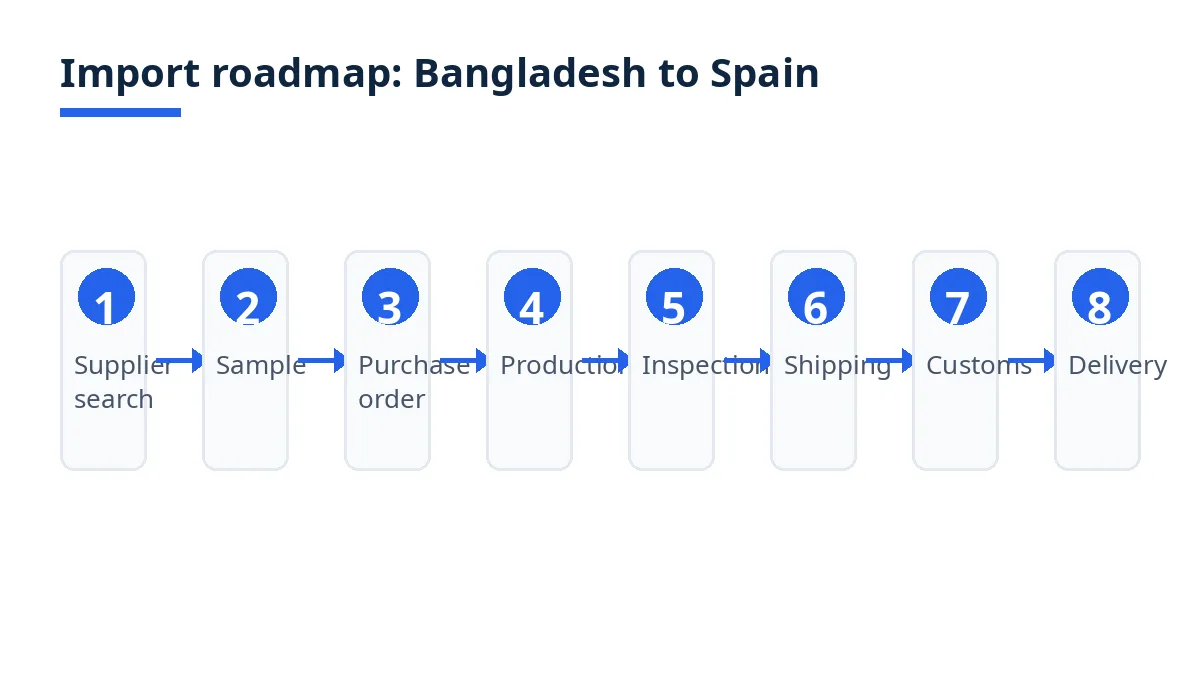
Write one specification per style: garment type, fabric, stretch, construction, print method, colours, size chart and Spanish label wording.
Shortlist factories whose current production already includes that style, and send every candidate the identical specification.
Check documents, capability and bank details, and confirm the minimum per style and per colour in writing.
Approve a development sample, then a pre-production sample in production fabric, colour, print and trims.
Agree the delivery term, tariff lines, Everything But Arms origin evidence and Valencia customs roles before bulk production.
Name the tests in the purchase order, and agree inspection stages and defect limits.
Confirm the sailing, the Valencia entry and the onward delivery, and build a buffer before any launch date.
File the Valencia declaration with matching invoice, packing list, bill of lading and origin evidence, and fund the 21 percent import IVA at clearance.
Check the delivered goods against the sealed sample and size chart, and keep the shipment file.
Review the first order before repeating it: which styles sold, which sizes ran out, and what changes next time.
How Exportain helps
Exportain connects Spanish buyers with Bangladeshi suppliers, and the platform carries supplier profiles, product listings and a request-for-quote route for buyers who want comparable quotes. Use the platform to shortlist, to send the identical specification to several factories, and to compare replies on the same basis. Document and photo review badges describe what was reviewed, and they do not replace your own sample approval and inspection. When your specification is ready, post a free request for quote through request for quote.
FAQs
What is the typical MOQ for sportswear and activewear from Bangladesh?
There is no single typical minimum. The minimum is set per style and usually per colour, because fabric is knitted, dyed or printed in batches and cutting is planned per size range. Ask each supplier how its minimum splits by style, colour and print method, and confirm the answer in writing before approving a sample.
How long does shipping take?
There is no single transit figure for every order. Confirm the sailing schedule, port pair and Valencia clearance steps with your forwarder for your exact shipment date, and build a buffer before any launch date.
What import duty applies?
Where the goods meet the Everything But Arms origin rules and the origin evidence is in order, the preferential duty is zero.1 If origin is not proven, each line pays its own third-country rate, which your broker must confirm per 10-digit TARIC line before the shipment sails, and every unconfirmed line in this guide is confirm with broker. Spanish import IVA at 21 percent is charged on the duty-inclusive base.6
How do I verify a supplier?
Check company documents so that name, address and bank account name agree, check capability against your exact style from current production, and keep payments to the company account named in the documents. Approve a development sample and then a pre-production sample in production fabric.
Next steps on Exportain
Start with the general import route in how to import from Bangladesh, then shortlist factories through suppliers and compare your landed cost with the landed cost imports from Bangladesh guide. When your specification is ready, read how to buy and post a free request for quote.
Sources
- EU trade relations with Bangladesh. European Commission, (accessed )
- Regulation (EU) No 1007/2011 on textile fibre names and related labelling and marking of the fibre composition of textile products. European Union, (accessed )
- Valenciaport already handles 40% of Spain's imports and exports by sea. Hellenic Shipping News (accessed )
- HS Code 61122000. Tariffnumber (accessed )
- EU GSP rules and Bangladesh's RMG. The Daily Star, (accessed )
- Spain VAT guide. Kreston Global (accessed )
- Registration and identification of economic operators (EORI) or EORI-NIF association. Agencia Tributaria (accessed )
About the author
Sourcing from Bangladesh?
Post a request for quotation and suppliers on Exportain can send you their quotes directly.
Post an RFQ


