

Saudi Arabia Sportswear Imports From Bangladesh: Jeddah Entry, VAT and SABER Guide
Saudi Arabia sportswear imports from Bangladesh: Jeddah and Dammam entry, SABER conformity, Arabic labelling, 15% VAT and a worked landed-cost example for buyers.
Short answer
To import sportswear and activewear from Bangladesh to Saudi Arabia, write one specification per style, shortlist factories that already make that style, and approve a pre-production sample in production fabric and print. Register the product in SABER, obtain a shipment certificate for each shipment, label fibre content and care in Arabic, clear the goods through Jeddah or Dammam, confirm every duty line with your broker, and fund 15 percent import VAT at clearance.
On this page
Key takeaways
Saudi Arabia applies import VAT at 15 percent, collected by ZATCA at the point of importation before goods are released, and calculated on the customs value inclusive of any applicable customs duty, so duty and VAT must be confirmed together.
Textile products placed on the Saudi market fall under a SASO technical regulation handled through SABER: a Product Certificate of Conformity registers a product for one year for regulated products, and a Shipment Certificate of Conformity is mandatory for each shipment.
Labels for the Saudi market must carry fabric composition, washing instructions and country of origin in Arabic, so agree the Arabic wording at sampling stage and check the finished label before bulk label sewing begins.
Choose the port by distribution: Jeddah Islamic Port serves the western region, while King Abdulaziz Port in Dammam is the eastern gateway with daily rail connections to Riyadh Dry Port for central distribution.
No duty rate is stated for any individual line in this guide because no Saudi tariff schedule was opened for it: confirm every duty line with your customs broker against the current ZATCA tariff before the shipment sails.
If you buy sportswear and activewear for the Saudi market, the order that matters is not the cheapest quote. It is the order where style, fabric, size range, tariff line, SABER file and Arabic label all agree before bulk production starts. This guide walks through that order: shortlisting Bangladeshi factories that already make your style, agreeing a minimum and a price on one identical specification, clearing the goods through Jeddah or Dammam, and building a landed cost that funds 15 percent import VAT at clearance.
Two Saudi requirements set this lane apart from other lanes, and both need attention before the goods sail. The first is conformity: textile products placed on the Saudi market fall under a SASO technical regulation, handled through the SABER portal with a product certificate and a shipment certificate in the chain. The second is tax: Saudi import VAT is charged at 15 percent on the duty-inclusive customs value. Treat every figure in the landed-cost section as an example, not a quote, and confirm every duty line with your customs broker before the shipment sails.
Why source sportswear and activewear from Bangladesh
Bangladesh makes its living from apparel in volume, and sportswear and activewear sit inside that strength: knitted tops, leggings, shorts, tracksuits, training sets and swimwear. The practical advantage for a Saudi buyer is range within one order: a single factory group can often cover a training set, a matching top and a short in the same fabric family.
Source by style, not by country brochure. A factory that sews woven shirts well is not automatically a good activewear factory. Activewear needs flatlock or coverstitch capacity for stretch seams, pattern work that accounts for stretch and recovery, and print or sublimation routes that survive washing without cracking.
For the Saudi market, add one more sourcing filter at the start: the factory must be able to supply the product information your SABER file needs, including fabric composition, a care method that can be stated in Arabic, and conformity information tied to the actual product.
Find and verify suppliers
Where should you start the search?
Start with a written specification, not with factory names: garment type, fabric composition and weight, stretch behaviour, construction, print or sublimation method, colours, size chart, Arabic label wording, and packing. Then shortlist factories whose current range already includes that style. Browse suppliers on Exportain, read the general route in how to import from Bangladesh, and send every candidate the identical specification with the same reply format: fabric assumed, price inclusions, validity period, minimum per style and per colour, and delivery term.
Ask each candidate the same capability questions: which styles in your range it makes now, with knitting, dyeing and printing in-house or bought in; whether it can run your print method at your size range; and whether it holds fabric stock or knits to order. Also ask whether it has supplied Saudi-bound orders before and what SABER documentation it provided for them.
How do you verify a supplier before you pay?
Verification has three layers. The first is documents: trade licence, export registration and association membership where applicable, checked so that company name, address and bank account name agree across every document. The second is capability: current production in your style, seam and print quality on a finished piece, and a sample that matches your specification rather than a near substitute. The third is payment discipline: pay only to the company account named in the documents, never to a personal account.
On Exportain, supplier profiles carry document and photo review badges. A badge records that documents and photos were reviewed. It is not a factory inspection, not a guarantee of quality or delivery, and not a substitute for your own sample approval and inspection. This point is repeated in the Exportain section below because it decides how much weight a badge should carry in your decision.
MOQ, pricing and samples
What is the typical MOQ for sportswear and activewear from Bangladesh?
There is no single typical minimum for sportswear and activewear from Bangladesh. The minimum is set per style and usually per colour, because fabric is knitted, dyed or printed in batches and cutting is planned per size range. A plain training top in one colour, a sublimated set in four colours and a swimwear line with several prints will not carry the same minimum. Ask each supplier how its minimum splits by style, colour, print method and size range, and confirm the answer in writing before you approve a sample.
How is the price built, and how should you compare quotes?
Fabric is usually the largest cost element in activewear, followed by cutting and sewing, dyeing or printing, trims, testing, packing and the factory margin. Stretch fabric costs more to handle than a stable knit, and sublimation adds a print step and transfer paper cost that a solid colour does not carry.
Compare quotes on the same basis only: same style, fabric, colours, print method, size range, packing, delivery term and validity period. Ask each supplier to state what is excluded, for example testing, special packing, hang tags, polybags per piece, or carton marking in Arabic. Then add the Saudi-side costs separately: freight to Jeddah or Dammam, duty per tariff line as confirmed by your broker, 15 percent import VAT on the duty-inclusive value, and broker and clearance charges.
Which samples do you need, and how do you approve them?
Work in stages, and approve each stage in writing. A development sample shows whether the factory can construct the garment, form stretch seams cleanly, place a print evenly and hold the size chart. A pre-production sample, made in the actual production fabric, colour, print and trims, is the sample you approve for bulk. Fit, colour, print durability and seam recovery cannot be approved from a sample in substitute fabric.
Test the samples the way your customers will use them: stretch every seam, wash the garment following your care label and measure it again, and check that a sublimated print has not cracked and that a waistband or cuff still recovers. Keep one sealed counter-sample of each style and colour, and approve the Arabic label text at the same stage as the pre-production sample.
Quality control and certifications needed
Which quality checks are specific to sportswear?
Against the approved sample and size chart, check fabric composition and finished weight, finished measurements across the full size range within your agreed tolerances, and consistency from the smallest to the largest size. Then check construction piece by piece: stretch seam formation, stitch density, skipped stitches at curves, print placement across seams, colour consistency between pieces in one set, waistband and cuff recovery, and zip and drawcord function where fitted.
Agree the inspection method and defect limits before production, and inspect in stages: an inline check during cutting, sewing and printing catches a drift while correction is still possible, and a final random inspection on packed goods checks quantity, workmanship, measurements, labels and packing.
Which SABER and SASO rules apply to textiles?
Textiles are a regulated area in Saudi Arabia. The Saudi Standards, Metrology and Quality Organization, SASO, published a technical regulation for textile products, and textile and apparel products were implemented in the SABER portal from 1 December 2019.1 The regulation applies to textile products available in the Kingdom, including products containing at least 80 percent by weight of textile fibres, which covers clothing.1
SABER is the online portal where importers, notified bodies and Saudi Customs take part in certificate issuance for product and shipment certificates, and the certificates are used to clear consignments from customs.1 The chain has two certificates. A Product Certificate of Conformity, PCoC, is issued to register a product, is valid for one year, and is mandatory for regulated products.1 A Shipment Certificate of Conformity, SCoC, is mandatory for each shipment of regulated and non-regulated products and is valid for one shipment only.1 The importer registers in SABER, adds the product, and for a regulated product selects a notified certification body to issue the product certificate; the shipment certificate is then requested for each shipment.1
Start the SABER work before bulk production, not after packing. The product registration needs product information and photos, and the certification body may need test work or a factory audit: factory auditing applies to type 3 products, which include children's products and underwear.1
Which label rules apply in Saudi Arabia?
Labels for the Saudi market must carry fabric composition, washing instructions and country of origin in Arabic.2 Agree the Arabic wording, the care symbols and the origin statement at sampling stage, check that the percentages match the fabric you bought, and check the finished label before bulk label sewing begins.
Which certifications do you actually need?
No single certificate covers every sportswear order. Beyond the SABER certificates for Saudi clearance, name any test, restricted-substance list or scheme your retailer or brand requires in the specification, and check the scope and date of each report.
Incoterms, shipping and transit time
Which delivery term should you choose?
The delivery term decides where risk passes, who books the main carriage and who handles export and import formalities, so agree it before bulk production, not when the goods are already packed. For containerised sportswear, weigh FOB at the Bangladeshi port against FCA at the named terminal, and weigh both against DAP to your Saudi warehouse. Under FOB, the factory delivers the goods on board and your forwarder handles the sea leg. Under FCA, delivery happens when the goods are handed to your carrier. Under DAP, the seller bears the transport risk to the named place while you still handle import clearance and pay import VAT and any duty.
Whichever term you choose, write the named port, the named place and the SABER responsibilities into the purchase order.
How does the Jeddah and Dammam entry work?
Choose the port by where the goods will sell, not by which port looks cheaper on the sea leg alone. Jeddah Islamic Port serves the western region, including the Makkah and Madinah areas. King Abdulaziz Port in Dammam is the eastern gateway: Saudi Global Ports operates two container terminals there, forming the largest container gateway on the eastern coast of Saudi Arabia, with daily rail connections to Riyadh Dry Port.3 For Riyadh and the central region, Dammam with its rail link to the Riyadh dry port is the route to price first.
Price both ports when your distribution spans regions: the cheaper sea leg is not always the cheaper landed cost once inland haulage is added, and a split shipment doubles the clearance work.
How long does shipping take?
There is no single transit figure for every order on this lane. Sea freight is the standard route for bulk sportswear, and it takes weeks rather than days, varying by sailing schedule, port pair and season. Plan from your forwarder's current sailing schedule for your exact shipment date, add Jeddah or Dammam clearance and inland delivery, and keep production time separate.
Build the SABER timeline into the same plan. The product certificate is valid for one year, so a repeat order inside that year reuses the product registration, but every shipment still needs its own shipment certificate.1
Import duty, taxes and documents
What duty applies to sportswear from Bangladesh?
Duty follows the classification of each style in the Saudi and GCC customs tariff, not the supplier's product name. Knitted or crocheted garments fall in chapters 6101 to 6117, and the guide consulted for this article places T-shirts and pullovers in 6109 to 6110, children's garments and sportswear lines in 6111 to 6112, and workwear and uniforms in 6211.2 Other activewear tops, leggings and shorts are classified by their own construction and fibre, so a single order can sit on several tariff lines. Confirm the full tariff code for each style before you price or ship, and check the code on the SABER platform, since products are classified as regulated or non-regulated by HS code.1
No duty rate is stated in this guide for any individual line, because no Saudi tariff schedule was opened for this article. Every duty line in your order must be confirmed with your customs broker against the current ZATCA tariff before the shipment sails, and the landed-cost table below therefore shows duty as a broker-confirmed item excluded from its total, rather than as a figure.
Plan on duty being payable unless your broker confirms otherwise for a specific line. A certificate of origin is still part of the file: Saudi Customs requires authenticated certificates of origin for textile imports, to guard against misdeclared goods.2
What Saudi import VAT applies?
Saudi Arabia applies import VAT at the standard rate of 15 percent, and ZATCA collects import VAT at the point of importation before goods are released into free circulation.4 Import VAT is calculated on the customs value inclusive of any applicable customs duty: the customs value is the CIF value, duty is calculated on that value under the Saudi customs tariff, and import VAT is 15 percent of the customs value plus duty.4 For a VAT-registered business, import VAT is recoverable as input tax where the goods are used for taxable business activity; for a non-registered importer it is a final cost.4
Import VAT must be paid before customs releases goods, and payment runs through the FASAH system, by bank transfer to the ZATCA customs account, or through a licensed customs broker paying on the importer's behalf.4 VAT-registered importers may also be able to use deferred payment through a bank guarantee arrangement.4 Agree the payment route with your broker before the vessel berths, so a payment delay does not become a storage bill.
Which documents does the Saudi clearance need?
Prepare one consistent document set: commercial invoice, packing list, bill of lading, certificate of origin, the SABER product and shipment certificates, and the customs declaration data filed electronically through FASAH.4 The invoice, packing list and bill of lading must agree on parties, quantities, values, tariff lines, delivery term and route, and the SABER shipment certificate must match the same shipment. FASAH is Saudi Arabia's single-window electronic customs system: all declarations are filed electronically and pre-arrival declarations speed clearance.4
Landed cost example (table)
All figures in this section are Example figures. They illustrate one Dammam shipment; they are not a quote, and your own figures will differ by style, fabric, quantity, route and broker terms. Duty is excluded from the total below because no Saudi tariff schedule was opened for this article: confirm each duty line with your broker, then add the duty to the customs value and recalculate VAT at 15 percent on the duty-inclusive value.
Cost element | Example figures |
|---|---|
Goods value, Example figures | SAR 75,000 |
International freight and insurance to Dammam, Example figures | SAR 9,000 |
Customs value at Dammam (goods plus freight and insurance), Example figures | SAR 84,000 |
Customs duty, Example figures | Confirm with broker — excluded from this total |
Import VAT at 15 percent on the customs value before duty, Example figures | SAR 12,600 |
Customs broker and clearance charges, Example figures | SAR 2,000 |
Total landed cost in these Example figures, before duty and before inland delivery to your warehouse | SAR 98,600 |
The table shows why the duty line matters twice over: duty itself is a cost, and because import VAT is charged on the duty-inclusive value, every riyal of duty also adds 15 percent in VAT.4 On these Example figures, border VAT alone is SAR 12,600 before any duty is added. Add the broker-confirmed duty, the extra VAT on that duty, and inland delivery from Dammam to reach a full landed cost. See the landed cost imports from Bangladesh guide for the full build-up, and read how to buy for the buying route on Exportain.
Step-by-step import checklist
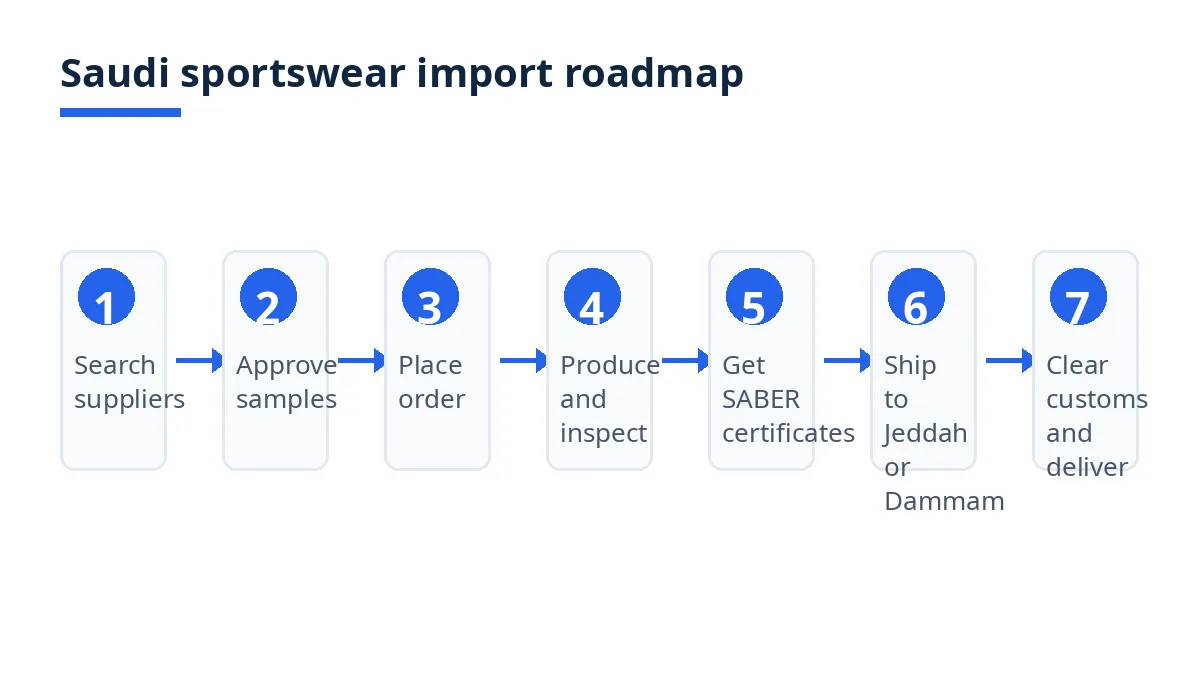
Write one specification per style: garment type, fabric, stretch, construction, print method, colours, size chart and Arabic label wording.
Shortlist factories whose current production already includes that style, and send every candidate the identical specification.
Check documents, capability and bank details, and confirm the minimum per style and per colour in writing.
Approve a development sample, then a pre-production sample in production fabric, colour, print and trims, with the Arabic label approved at the same stage.
Register the product in SABER, obtain the product certificate for regulated products, and confirm who supplies each item of the shipment file.
Agree the delivery term, tariff lines, duty confirmation from your broker, and Jeddah or Dammam customs roles before bulk production.
Name the tests in the purchase order, and agree inspection stages and defect limits.
Request the SABER shipment certificate for the packed shipment, and confirm the sailing, the port entry and the onward delivery.
File the FASAH declaration with matching invoice, packing list, bill of lading, certificate of origin and SABER certificates, and fund the 15 percent import VAT.
Check the delivered goods against the sealed sample and size chart, and keep the shipment file.
Review the first order before repeating it: which styles sold, which sizes ran out, and what changes next time.
How Exportain helps
Exportain connects Saudi buyers with Bangladeshi suppliers, and the platform carries supplier profiles, product listings and a request-for-quote route for buyers who want comparable quotes. Use the platform to shortlist, to send the identical specification to several factories, and to compare replies on the same basis.
FAQs
What is the typical MOQ for sportswear and activewear from Bangladesh?
There is no single typical minimum. It is set per style and usually per colour, because fabric is knitted, dyed or printed in batches. Ask each supplier how its minimum splits by style, colour, print method and size range, and confirm the answer in writing before approving a sample.
How long does shipping take?
There is no single transit figure for every order. Confirm the sailing schedule, port pair and Jeddah or Dammam clearance steps with your forwarder for your exact shipment date.
What import duty applies?
No duty rate is stated in this guide, because no Saudi tariff schedule was opened for it. Confirm every duty line with your customs broker against the current ZATCA tariff before the shipment sails. Saudi import VAT at 15 percent is charged on the duty-inclusive customs value.4
How do I verify a supplier?
Check documents so that name, address and bank account name agree, check capability against your exact style from current production, and keep payments to the company account named in the documents. Approve a development sample and then a pre-production sample in production fabric.
Next steps on Exportain
Start with the general import route in how to import from Bangladesh, then shortlist factories through suppliers and compare your landed cost with the landed cost imports from Bangladesh guide. When your specification is ready, read how to buy and post a free request for quote.
Sources
- SASO Certificate of Conformity | SALEEM | SABER. TÜV SÜD (accessed )
- Apparel and Textiles HS Codes in Saudi Arabia. Palm Horizons (accessed )
- SGP Container Terminals - Dammam. Saudi Global Ports (accessed )
- Guide to Import VAT in Saudi Arabia for Foreign Companies. Commenda (accessed )
About the author
Sourcing from Bangladesh?
Post a request for quotation and suppliers on Exportain can send you their quotes directly.
Post an RFQ


