

Canada Sportswear Imports From Bangladesh: CBSA, LDCT and Buyer Checklist
Canada sportswear imports from Bangladesh: CBSA entry, LDCT duty-free rules, bilingual fibre labelling, GST/HST and a worked landed-cost example for buyers.
Short answer
To import sportswear and activewear from Bangladesh to Canada, write one specification per style, shortlist factories that already make that style, and approve a pre-production sample in production fabric and print. Prove origin with Form B255 for a Least Developed Country Tariff claim, label fibre content in English and French, clear the goods through a Canadian port with a business number and RM account, and fund border sales tax at release.
On this page
Key takeaways
Canada's Least Developed Country Tariff gives duty-free treatment for virtually all goods from least developed countries, and Bangladesh is listed among its beneficiaries, but the zero rate applies only where the goods meet the origin rules and the Form B255 proof of origin is in order.
Bangladesh is identified by Canada among beneficiaries for prospective United Nations graduation in 2026, with an intended three-year transition retaining full tariff benefits, so confirm the tariff treatment in force on the arrival date for each tariff line with your broker.
Canadian textile labels must show the generic name of each fibre present at 5 percent or more of total mass, with its percentage, plus dealer identity by name and place of business or CA number, agreed in English and French at sampling stage.
Track suits under heading 6112 carry an 18 percent Most-Favoured-Nation rate for cotton lines in the Canadian schedule, which is the fallback if an LDCT claim fails, while every other line must be confirmed by your broker in the schedule.
Importers need a nine-digit business number before registering for a CBSA import-export (RM) program account, and border sales tax at 5 percent GST, or Harmonized Sales Tax in participating provinces, must be funded at release.
If you buy sportswear and activewear for the Canadian market, the order that matters is not the lowest unit price. It is the order where style, fabric, size range, tariff line, origin file and bilingual label all agree before bulk production starts, and where the Canadian entry route is settled before the container sails. This guide walks through that order for Canada: shortlisting factories that already make your style, proving origin for the Least Developed Country Tariff claim, labelling in English and French, clearing through the port that serves your distribution, and building a landed cost that includes Canadian sales tax at the border.
Why source sportswear and activewear from Bangladesh
Bangladesh makes its living from apparel in volume, and sportswear and activewear sit inside that strength: knitted tops, leggings, shorts, tracksuits, training sets and swimwear. The practical advantage for a Canadian buyer is range within one order: a single factory group can often cover a training set, a matching top and a short in the same fabric family.
For Canada, there is a second reason to get the paperwork right from the start. Canada gives duty-free treatment under the Least Developed Country Tariff to virtually all goods from least developed countries, and Bangladesh is listed among its beneficiaries.1 That treatment is why the duty line in the landed-cost table later in this guide can be zero, but it applies only where the goods qualify under the origin rules and the proof of origin is in order.
There is also a timing point Canadian buyers must not miss. Canada identifies Bangladesh among the beneficiaries identified for prospective United Nations graduation in 2026, and states its intent to apply a three-year transition period retaining full tariff benefits after a formal change in status.1 That intent is reassuring, but it is not a substitute for checking the treatment in force on the date your goods arrive. Ask your broker to confirm it for each tariff line before the shipment sails.
Find and verify suppliers
Where should you start the search?
Start with the style, not with a supplier list. Write one specification per style: garment type, fabric and stretch, construction, print method, colours, size chart and label wording. Then shortlist factories whose current production already includes that style.
Send every candidate the identical specification and ask for replies on the same basis: unit price, minimum per style and colour, sample cost and timing, lead time, fabric source, and delivery term.
How do you verify a supplier before you pay?
Check documents so name, address and bank account name agree, and keep payments to the company account named in those documents. Check capability against your exact style from current production, not a catalogue photo.
Agree commercial terms in writing before approving a sample: minimum per style and colour, price validity, payment terms, inspection stages, defect limits, and who bears the cost of a failed inspection or late shipment.
MOQ, pricing and samples
What is the typical MOQ for sportswear and activewear from Bangladesh?
There is no single typical minimum. It is set per style and usually per colour, because fabric is knitted, dyed or printed in batches and cutting is planned per size range. A plain top in one colour, a sublimated set in four colours and a swimwear line with several prints will not carry the same minimum. Ask each supplier how its minimum splits by style, colour, print method and size range, confirm it in writing before approving a sample, and if a smaller first order is offered, ask what changes: price, surcharge, colours, or lead time.
How is the price built, and how should you compare quotes?
A sportswear price is built from fabric, trims, print or sublimation, sewing, packing and factory margin, plus testing or inspection. When quotes differ, the difference usually sits in one element: a lighter fabric, a cheaper waistband elastic, a print method with lower colour fastness, or a size range that stops short of your largest sizes. Ask each supplier to break the price down on the same specification, and keep freight, insurance, duty and sales tax out of the factory comparison.
Which samples do you need, and how do you approve them?
Approve a development sample first, to check fit, construction and fabric hand, then a pre-production sample in production fabric, colour, print and trims. Check it against the size chart, wash it the way your customer will wash it, and check colour between the pieces of a set under the same light. For a tracksuit, approve the top and bottom together.
Seal one approved sample as the inspection reference. Photographs alone do not settle colour or hand-feel disputes.
Quality control and certifications needed
Which quality checks are specific to sportswear?
Sportswear fails in ways ordinary knitwear does not. Stretch recovery, seam strength under movement, colour fastness to washing and perspiration, print adhesion after washing, and waistband and cuff recovery all need checking on the production fabric, not a development fabric. Name the tests, method and pass limit for each in the purchase order.
Agree inspection stages before bulk production: inline inspection, final random inspection before packing, or both. State defect limits and what happens when a lot fails, and inspect a set as a set, so pieces that pass separately but do not match in colour are still caught.
Which label rules apply in Canada?
Canada is where this guide differs most sharply from the European and American versions of the same topic. Under the Textile Labelling Act, a prescribed consumer textile article sold in Canada must carry a label stating its fibre content, showing the generic name of each fibre present at 5 percent or more of the total mass, with its percentage, plus the dealer identity: dealer name and place of business, or a CA identification number.2 The Competition Bureau guidance gives bilingual examples, such as body and sleeve sections in English and French.2
Agree the label at sampling stage. The factory needs fibre percentages by section, the dealer identity, and the language layout. A label correct in English only, or using a trade name instead of the generic fibre name, is a relabelling problem on arrival. The Bureau notes a dealer may import incompletely labelled goods and label them in Canada only after notifying an inspector at importation and giving the inspector an opportunity to inspect the relabelled goods before sale.2 That route is slower and more expensive than getting the label right at the factory.
Two further points deserve a line in your specification. Size is not prescribed by the Textile Labelling Act, but any size dimension you state must be accurate and not misleading.2 Country of origin marking is separate from fibre labelling: the law does not require origin on the label unless the dealer chooses to identify the item as imported, in which case origin must appear on the disclosure label or a separate label in English or French.2
Which certifications do you actually need?
No single certificate covers every sportswear order. What you need follows your customer: a retailer or brand may name a specific test, restricted-substance list or scheme in its supplier manual. Name any such requirement in the specification, ask for the matching report or certificate, and check its scope, product covered, issuing body and date. A certificate for a different fabric, factory or expired period does not cover your order.
If your customer sells to children, ask separately about Canadian product safety rules for that age group, and do not assume a test passed for adult activewear covers a children's line. Children's sleepwear carries strict Canadian flammability requirements, and products not meeting the necessary standards cannot be sold, advertised or imported into Canada.2
Incoterms, shipping and transit time
Which delivery term should you choose?
The delivery term decides where risk passes, who books the main carriage and who handles export and import formalities, so agree it before bulk production, not when the goods are already packed. For containerised sportswear, weigh FOB at the Bangladeshi port against FCA at the named terminal, and weigh both against DAP to your Canadian warehouse. Under FOB, the factory delivers the goods on board and your forwarder handles the sea leg. Under FCA, delivery happens when the goods are handed to your carrier. Under DAP, the seller bears transport risk to the named place while you handle clearance and pay duty and sales tax; under DDP the seller also handles import formalities and pays duty and tax.
The term also decides who controls the Canadian entry. If you want your own broker to file the declaration and hold the origin file, keep import formalities on your side of the term and say so in the purchase order.
How does the Canadian entry work?
Choose the port by your distribution, not by the cheapest sea leg alone. Vancouver serves western Canada, Montreal serves Ontario and Quebec through the St. Lawrence route, and Halifax serves Atlantic Canada. Price the sea leg, port handling, clearance and inland leg together for each candidate port, because a cheaper ocean rate can be erased by a longer inland haul.
Before the shipment sails, settle the importer side of the entry. Importers need a nine-digit business number before registering for an import-export (RM) program account with the Canada Border Services Agency, and registration business names must match customs documents, or goods may be delayed.3 Register early, and agree with your broker who files the declaration, holds the origin file, and funds duty and sales tax at release.
How long does shipping take?
There is no single transit figure for every order on this lane. Sea freight is the standard route for bulk sportswear, and it takes weeks rather than days, varying by sailing schedule, port pair and season. Plan from your forwarder's current sailing schedule, add clearance and inland delivery, and keep production time separate: an order is ready only when every piece has finished sewing, printing, inspection and packing.
Build a buffer before any launch date. A sailing missed because inspection ran late, or a document that did not match the cargo, can move delivery by a sailing cycle.
Import duty, taxes and documents
What duty applies to sportswear from Bangladesh?
Start with classification. Track suits, ski suits and swimwear, knitted or crocheted, fall under heading 6112, and the schedule shows a Most-Favoured-Nation rate of 18 percent for cotton track suits under 6112.11, with the Least Developed Country Tariff listed among the applicable preferential treatments.4 Other styles fall under their own headings, and each line must be classified on its own construction, fabric and wearer. Any duty line you have not opened in the schedule for your exact style is "confirm with broker" until your broker confirms it.
Canada's Least Developed Country Tariff gives duty-free treatment for virtually all goods from least developed countries, except over-access, supply-managed dairy, poultry and egg products, and Bangladesh is listed among its beneficiaries.1 The General Preferential Tariff program notes that most apparel and textile products are excluded from GPT preferences, which is why the LDCT claim, not a GPT claim, is the route that matters for Bangladeshi apparel.1
Origin is where the claim is won or lost. For textile and apparel goods of Harmonized System Chapters 50 to 63, the proof of origin is the Certificate of Origin for Textile and Apparel Goods Originating in a Least Developed Country, Form B255, completed and signed by the exporter where the goods were finished, and submitted to the Canada Border Services Agency upon request.5 The importer declares possession of the proof when claiming the treatment, and failure to produce it on request leads to the fallback treatment and can attract a penalty. Keep the proof and related import documents for six years.5
The origin rules behind the form also matter for how the garment is made. Apparel goods under the LDCT rules must generally be cut, or knit to shape, and sewn or otherwise assembled in the least developed country, and one route requires at least 20 percent of the ex-factory price, as packed for shipment to Canada, to originate in one or more least developed countries or Canada.6 Ask the exporter which origin criterion the B255 will cite, and what production steps in Bangladesh support it, before the goods are sewn.
What Canadian sales tax applies at the border?
Canada does not charge import VAT in the European sense. It charges Goods and Services Tax, and Harmonized Sales Tax in participating provinces, at the border. The Canada Border Services Agency notes that imports are generally subject to the 5 percent Goods and Services Tax, and that in provinces with an agreement to collect Harmonized Sales Tax, that tax applies instead, at 13 percent for participating provinces.7 A GST-registered importer can generally claim input tax credits for business inputs, so border tax is a cash-flow cost at clearance even where later recoverable. Fund it at release, and ask your broker to confirm the rate for the province of importation.
Which documents does the Canadian clearance need?
Prepare one consistent document set: commercial invoice, packing list, bill of lading, Form B255 origin evidence for the LDCT claim, and the import declaration data. The invoice, packing list and bill of lading must agree on parties, quantities, values, tariff lines, delivery term and route. The invoice must list preference-claimed goods separately from other goods, and the proof of origin must cross-reference the invoice numbers.6
Add your business number and RM account details, the broker authority, and the label artwork to the same file. If the label artwork, invoice description and tariff classification describe three different garments, clearance will stop while the broker reconciles them.
Landed cost example (table)
All figures in this section are Example figures. They illustrate one Canadian shipment under an LDCT claim through a west-coast entry; they are not a quote, and your own figures will differ by style, fabric, quantity, route and broker terms.
Cost element | Example figures |
|---|---|
Goods value, Example figures | CAD 20,000 |
International freight and insurance to Canada, Example figures | CAD 2,500 |
Customs duty at the LDCT rate where origin is proven, Example figures | CAD 0 |
Goods and Services Tax at 5 percent on the CAD 20,000 duty-paid goods value in these Example figures | CAD 1,000 |
Customs broker and clearance charges, Example figures | CAD 600 |
Total landed cost in these Example figures, before inland delivery to your warehouse | CAD 24,100 |
The table shows why the origin file matters more than any other single document. If the LDCT claim failed, the fallback for a 6112 cotton track suit line at the 18 percent Most-Favoured-Nation rate in the schedule would be CAD 3,600 of duty on these Example figures, with sales tax then charged on the higher duty-paid value.4 That fallback total would be CAD 27,880 before inland delivery, against CAD 24,100 with the LDCT claim. Other tariff lines are "confirm with broker" until your broker confirms them, and a Harmonized Sales Tax province rate will differ from the 5 percent used here. Add inland delivery, inspection, warehousing and any relabelling for a full landed cost, and compare it with your selling price before confirming the order. See the landed cost imports from Bangladesh guide for the full build-up, and read how to buy for the buying route on Exportain.
Step-by-step import checklist
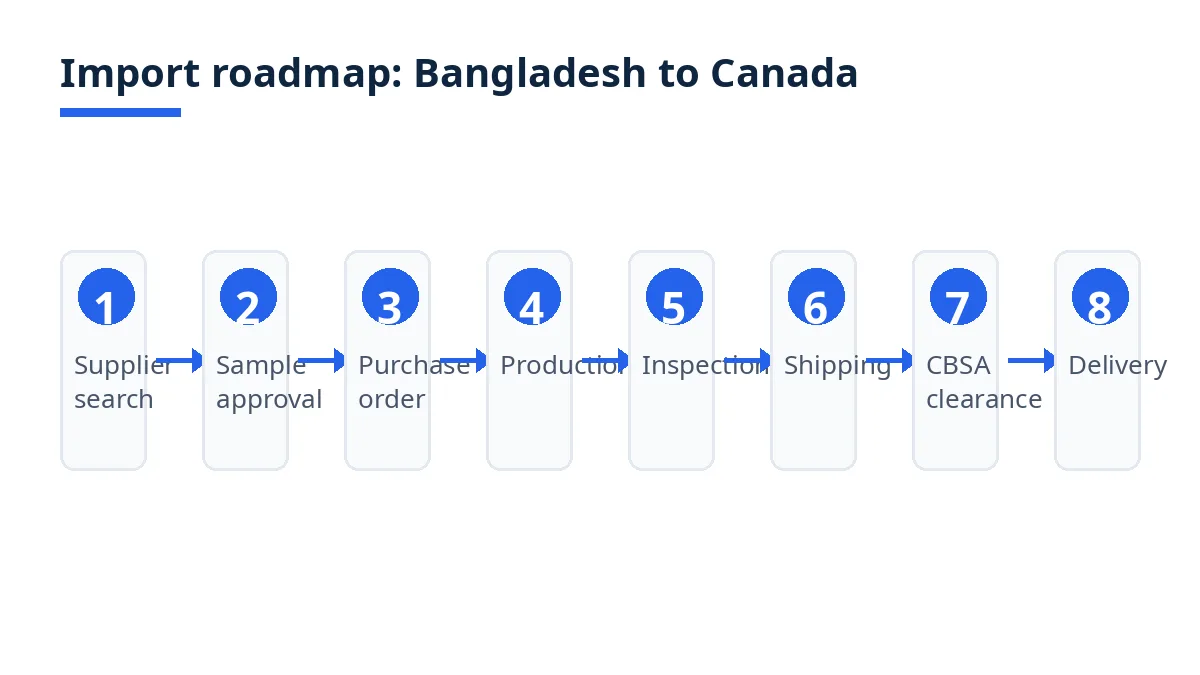
Write one specification per style: garment type, fabric, stretch, construction, print method, colours, size chart and bilingual label wording.
Shortlist factories whose current production already includes that style, and send every candidate the identical specification.
Check documents, capability and bank details, and confirm the minimum per style and per colour in writing.
Approve a development sample, then a pre-production sample in production fabric, colour, print and trims, and seal the approved sample.
Agree the delivery term, tariff lines, LDCT origin criterion and Form B255 evidence, and the Canadian port of entry, before bulk production.
Name the tests in the purchase order, and agree inspection stages and defect limits.
Register your business number and RM account, appoint your broker, and confirm who funds duty and sales tax at release.
Confirm the sailing, the Canadian entry and the onward delivery, and build a buffer before any launch date.
File the Canadian declaration with matching invoice, packing list, bill of lading and Form B255, and fund the border sales tax at clearance.
Check the delivered goods against the sealed sample and size chart, and keep the shipment file for six years.
Review the first order before repeating it: which styles sold, which sizes ran out, and what changes next time.
How Exportain helps
Exportain connects Canadian buyers with Bangladeshi suppliers, and the platform carries supplier profiles, product listings and a request-for-quote route for comparable quotes. Use it to shortlist, send the identical specification to several factories, and compare replies on the same basis. Profile review badges describe what was reviewed; they do not replace your own sample approval and inspection.
When your specification is ready, post a free request for quote through rfqs. Ask each reply to confirm the minimum per style and colour, the price basis, the LDCT origin criterion for the B255, and the bilingual label wording.
FAQs
What is the typical MOQ for sportswear and activewear from Bangladesh?
There is no single typical minimum. It is set per style and usually per colour, because fabric is knitted, dyed or printed in batches. Ask each supplier how its minimum splits by style, colour, print method and size range, and confirm it in writing before approving a sample.
How long does shipping take?
There is no single transit figure for every order. Confirm the sailing schedule, port pair and clearance steps with your forwarder for your exact shipment date, and build a buffer before any launch date.
What import duty applies?
Where the goods meet the LDCT origin rules and the Form B255 proof is in order, LDCT duty is duty-free for virtually all goods.1 If origin is not proven, each line pays its own fallback rate: the schedule shows 18 percent Most-Favoured-Nation for cotton track suits under 6112.11, and every other line is "confirm with broker".4 Border sales tax is charged in addition to duty.
How do I verify a supplier?
Check documents so name, address and bank account name agree, check capability against your exact style from current production, and keep payments to the company account named in the documents. Approve a development sample and then a pre-production sample in production fabric, agree inspection stages before bulk production, and ask which LDCT origin criterion the Form B255 will cite.
Next steps on Exportain
Start with the general import route in how to import from Bangladesh, then shortlist factories through suppliers and compare your landed cost with the landed cost imports from Bangladesh guide. When your specification is ready, read how to buy and post a free request for quote.
Sources
- Canada's unilateral tariff preference programs for imports from developing countries. Department of Finance Canada (accessed )
- Textile labelling requirements. Competition Bureau Canada (accessed )
- Getting or making changes to a nine-digit business number for importing and exporting. Canada Revenue Agency (accessed )
- Customs Tariff, Chapter 61: Articles of apparel and clothing accessories, knitted or crocheted (2024). Canada Border Services Agency (accessed )
- Memorandum D11-4-2 - Proof of Origin of Imported Goods. Canada Border Services Agency (accessed )
- Memorandum D11-4-4: Rules of Origin Respecting the General Preferential Tariff and Least Developed Country Tariff. Canada Border Services Agency (accessed )
- Importing by mail or courier - Paying duty and/or taxes on imported goods. Canada Border Services Agency (accessed )
About the author
Sourcing from Bangladesh?
Post a request for quotation and suppliers on Exportain can send you their quotes directly.
Post an RFQ


