

Australia Sportswear Imports From Bangladesh: Sydney Entry, GST and DFQF Guide
Australia sportswear imports from Bangladesh: Port Botany entry, DFQF duty, 10% GST, care labelling and a worked landed-cost example for buyers.
Short answer
To import sportswear and activewear from Bangladesh to Australia, write one specification per style, shortlist factories that already make that style, and approve a pre-production sample in production fabric and print. Classify each style in the Australian tariff, prove duty-free origin under the Generalized System of Preferences for least developed countries, apply Australian care labelling, clear the goods through Port Botany with an N10 declaration, and fund 10 percent GST on the value of the taxable importation at clearance.
On this page
Key takeaways
Bangladesh has enjoyed duty-free and quota-free access to the Australian market under the Generalized System of Preferences for least developed countries since 1 July 2003, but the zero rate applies only where the goods meet the origin rules and the origin evidence is in order, so confirm each tariff line with your broker before the shipment sails.
Australia charges GST on taxable importations at 10 percent of the value of the taxable importation, which is the customs value plus any duty payable plus international transport and insurance to Australia, so fund the border GST at clearance even though a GST-registered business can generally claim it as an input tax credit.
The Consumer Goods (Care Labelling) Information Standard 2023 covers clothing and apparel, and after the transitional period ended on 5 March 2025 a label complies if it follows AS/NZS 1957:1998 with the standard's variations or ISO 3758:2012, so agree care symbols at sampling stage.
Port Botany in Sydney's south is one of Australia's largest container ports, and for a buyer whose customers sit in New South Wales it keeps the inland leg short, with Melbourne and Brisbane worth pricing when distribution sits in Victoria or Queensland.
There is no single typical minimum order quantity, price or transit time for sportswear and activewear from Bangladesh: confirm the minimum per style and colour, the price on one identical specification, and the sailing schedule for your exact shipment date.
If you buy sportswear and activewear for the Australian market, the order that matters is not the cheapest quote. It is the order where style, fabric, size range, tariff line, origin evidence, care label and Sydney clearance all agree before bulk production starts. This guide walks through that order for Australia: shortlisting Bangladeshi factories that already make your style, agreeing a minimum and a price on one identical specification, clearing the goods through Port Botany, and building a landed cost that includes 10 percent GST.
Bangladesh has enjoyed duty-free and quota-free access to the Australian market under the Generalized System of Preferences for least developed countries since 1 July 2003, and that arrangement allows almost all Bangladeshi products, including garments, to enter without paying duty, provided they meet the rules of origin and compliance requirements.1 That preference is why the origin file deserves as much attention as the sample. If the claim holds, the duty in the example below is zero. If it fails, duty is charged line by line at the general rate for that line, so confirm every tariff line with your broker before the shipment sails, and treat every figure in the landed-cost section as an example, not a quote.
Why source sportswear and activewear from Bangladesh
Bangladesh makes its living from apparel in volume, and sportswear and activewear sit inside that strength: knitted tops, leggings, shorts, tracksuits, training sets and swimwear. The practical advantage for an Australian buyer is range within one order: a single factory group can often cover a training set, a matching top and a short in the same fabric family.
Australia is also a market where order size needs honest discussion. Reporting on the trade notes that buyers in Australia typically place small orders, which does not suit a volume-based apparel industry, while many Bangladeshi factories now offer small minimum order quantity capabilities for mid-sized and boutique retailers.1 Settle early whether your first Australian order fits the factory's normal run, or needs a smaller-run arrangement.
Source by style, not by country brochure. A factory that sews woven shirts well is not automatically a good activewear factory. Activewear needs flatlock or coverstitch capacity for stretch seams, pattern work that accounts for stretch and recovery, and print or sublimation routes that survive washing without cracking. Ask for current production in your exact style family.
Australia sits in the southern hemisphere, so its seasons run opposite to the northern hemisphere production calendar. Agree your delivery window against the Australian selling season, not a generic production calendar, and build a buffer before any launch date.
Find and verify suppliers
Where should you start the search?
Start with a written specification, not with factory names: garment type, fabric composition and weight, stretch behaviour, construction, print or sublimation method, colours, size chart, care label wording, and packing. Then shortlist factories whose current range already includes that style. Browse suppliers on Exportain, read the general route in how to import from Bangladesh, and send every candidate the identical specification with the same reply format: fabric assumed, price inclusions, validity period, minimum per style and per colour, and delivery term. Quotes on different specifications cannot be compared.
Ask each candidate the same capability questions: which styles in your range it makes now, whether knitting, dyeing and printing are in-house or bought in, and whether it holds fabric stock or knits to order.
How do you verify a supplier before you pay?
Verification has three layers. The first is documents: trade licence, export registration and association membership where applicable, checked so that company name, address and bank account name agree across every document. The second is capability: current production in your style, and a sample that matches your specification rather than a near substitute. The third is payment discipline: pay only to the company account named in the documents, never to a personal account, and check any change of bank details through a separate channel before you act on it.
On Exportain, supplier profiles carry document and photo review badges. A badge records that documents and photos were reviewed. It is not a factory inspection, not a guarantee of quality or delivery, and not a substitute for your own sample approval.
MOQ, pricing and samples
What is the typical MOQ for sportswear and activewear from Bangladesh?
There is no single typical minimum for sportswear and activewear from Bangladesh. The minimum is set per style and usually per colour, because fabric is knitted, dyed or printed in batches and cutting is planned per size range. A plain training top in one colour, a sublimated set in four colours and a swimwear line with several prints will not carry the same minimum. Ask each supplier how its minimum splits by style, colour, print method and size range, and confirm the answer in writing before you approve a sample.
How is the price built, and how should you compare quotes?
Fabric is usually the largest cost element in activewear, followed by cutting and sewing, dyeing or printing, trims, testing, packing and the factory margin. Stretch fabric costs more to handle than a stable knit, and sublimation adds a print step and transfer paper cost that a solid colour does not carry.
Compare quotes on the same basis only: same style, fabric, colours, print method, size range, packing, delivery term and validity period. Ask each supplier to state what is excluded.
Which samples do you need, and how do you approve them?
Work in stages, and approve each stage in writing. A development sample shows whether the factory can construct the garment, form stretch seams cleanly, place a print evenly and hold the size chart. A pre-production sample, made in the actual production fabric, colour, print and trims, is the sample you approve for bulk. Fit, colour, print durability and seam recovery cannot be approved from a sample in substitute fabric.
Test the samples the way your customers will use them: stretch every seam, wash the garment following your care label and measure it again, and check that a sublimated print has not cracked and that a waistband or cuff still recovers.
Quality control and certifications needed
Which quality checks are specific to sportswear?
Against the approved sample and size chart, check fabric composition and finished weight, finished measurements across the full size range within your agreed tolerances, and consistency from the smallest to the largest size. Then check construction piece by piece: stretch seam formation, stitch density, skipped stitches at curves, print placement across seams, colour consistency between pieces in one set, waistband and cuff recovery, and zip and drawcord function where fitted. Check sets together, since a set can fail if the top and the legging come from different shade batches.
Agree the inspection method and defect limits before production, and inspect in stages: an inline check during cutting, sewing and printing catches a drift while correction is still possible, and a final random inspection on packed goods checks quantity, workmanship, measurements, labels and packing. Name the test method in the purchase order. A test result for a different fabric or an unprinted version does not cover your printed set.
Which label rules apply in Australia?
Care labelling is the Australian rule to get right first. The Consumer Goods (Care Labelling) Information Standard 2023 covers clothing and apparel, and after the second transitional period, which ended on 5 March 2025, a label complies if it follows the Australian and New Zealand Standard AS/NZS 1957:1998 with the variations in the standard, or the international standard ISO 3758:2012.2 Agree the care symbols at sampling stage, check them against the fabric you bought, and check the finished label before bulk label sewing begins.
Fibre content needs a different approach in Australia than in Europe. Do not copy a European label pack onto an Australian order without checking it: agree the fibre wording with your buyer and your broker, print only fibre claims you can support from the fabric specification, and keep the fabric test result in the shipment file.
Which certifications do you actually need?
No single certificate covers every sportswear order. What you need follows your customer: a retailer or brand may name a specific test, a restricted-substance list or a scheme in its own supplier manual. Name any such requirement in the specification, and check the scope, product covered, issuing body and date of any report or certificate supplied.
What about biosecurity and quarantine?
Australia applies strict biosecurity laws to goods entering the country, and the Department of Agriculture, Fisheries and Forestry operates the Biosecurity Import Conditions system, known as BICON, which states whether a commodity needs an import permit or treatment, or carries other biosecurity conditions.3 Before the goods leave Bangladesh, ask your broker to check the BICON conditions for your exact goods and packing. Keep cartons clean and new, keep packing free of soil, seeds, plant debris and animal matter, and avoid straw or other organic packing material. If a consignment is referred for inspection on arrival, treatment, delay or export at your expense are the outcomes to plan for, so settle this question before loading.
Incoterms, shipping and transit time
Which delivery term should you choose?
The delivery term decides where risk passes, who books the main carriage and who handles export and import formalities, so agree it before bulk production. For containerised sportswear, weigh FOB at the Bangladeshi port against FCA at the named terminal, and weigh both against DAP to your Australian warehouse. Under FOB, the factory delivers the goods on board and your forwarder handles the sea leg. Under FCA, delivery happens when the goods are handed to your carrier. Under DAP, the seller bears the transport risk to the named place while you still handle import clearance and pay duty and GST; under DDP the seller also handles import formalities and pays the duty and GST.
How does the Port Botany entry work?
Port Botany is the natural first entry for this lane when your customers sit in New South Wales. Port Botany in Sydney's south is one of Australia's largest container ports, a deep-water seaport in Botany Bay through which around 1,600 ships carrying over 2.5 million containers pass each year to support the largest population centre in the country.4 For a Sydney buyer, Port Botany keeps the inland leg short. Also price Melbourne for Victoria and Brisbane for Queensland, since the cheaper sea leg is not always the cheaper landed cost once inland delivery is added.
How long does shipping take?
Sea freight is the standard route for bulk sportswear. Plan from your forwarder's current sailing schedule for your exact shipment date, plus Port Botany clearance and inland delivery, and keep production time separate from transit time.
Import duty, taxes and documents
What duty applies to sportswear from Bangladesh?
Duty follows the classification of each style in the Australian tariff, not the supplier's product name. Tracksuits, ski suits and swimwear, knitted or crocheted, sit in heading 6112, and other knitted garments sit in heading 6114.5 The Australian Border Force schedule consulted for this guide gives these general rates: tracksuits of cotton under 6112.11.00 at 5 percent, tracksuits of synthetic fibres under 6112.12.00 at Free, tracksuits of other textile materials under 6112.19.00 at 5 percent, ski suits under 6112.20.00 at 5 percent, and other garments of man-made fibres under 6114.30.00 at 5 percent.5 Every other line in your order must be confirmed with your broker, since this guide does not state a rate for any line it did not open in the schedule.
The preferential rate is where the money is. Bangladesh has enjoyed duty-free and quota-free access to the Australian market under the Generalized System of Preferences for least developed countries since 1 July 2003, covering almost all products including garments, subject to the rules of origin and compliance requirements.1 The same reporting notes that the facility is expected to continue for five more years after Bangladesh graduates from least developed country status in 2026.1 The preference is not automatic: the goods must meet the origin rules, and the origin evidence must be in order at clearance. Ask your broker, before the shipment sails, which origin evidence your consignment needs and how the supplier's origin declaration must read.
For scale, if the preference claim failed on a cotton tracksuit line, the general rate in the schedule is 5 percent, and GST would then be charged on a base that includes that duty.
What Australian GST applies?
Australia charges GST on taxable importations at 10 percent of the value of the taxable importation. The Australian Border Force states that the value of the taxable importation is the sum of the customs value, any duty payable, the amount paid or payable for international transport to Australia and insurance for that transport, to the extent not already included in the customs value, and any wine tax payable where applicable.6 GST is payable at clearance unless the importer is approved for GST deferral, in which case the deferred amount is handled through the Business Activity Statement.6 A GST-registered business can generally claim import GST as an input tax credit, so border GST is normally a cash-flow item for a registered business, but it still has to be funded at clearance.
Which documents does the Port Botany clearance need?
A commercial shipment valued over AUD 1,000 needs a full Import Declaration, known as form N10, and all applicable duties, taxes and charges must be paid before the goods can be released.7 The declaration states the goods, the importer, how the goods are transported, and the tariff classification and customs value, and it may be lodged through the Integrated Cargo System or by a licensed customs broker acting for the importer.7 The importer remains responsible for the declaration even when a broker lodges it, and after clearance, all relevant documents must be kept for five years.7
Prepare one consistent document set: commercial invoice, packing list, bill of lading, origin evidence for the duty-free claim, and the import declaration data. The invoice, packing list and bill of lading must agree on parties, quantities, values, tariff lines, delivery term and route. If you need an Australian Business Number for the declaration, arrange it before the shipment sails.
Landed cost example (table)
All figures in this section are Example figures. They illustrate one Port Botany shipment under a duty-free claim where origin is proven; they are not a quote, and your own figures will differ by style, fabric, quantity and route.
Cost element | Example figures |
|---|---|
Goods value, Example figures | AUD 30,000 |
International freight and insurance to Port Botany, Example figures | AUD 3,500 |
Value of the taxable importation, Example figures | AUD 33,500 |
Customs duty at the zero preferential rate where origin is proven, Example figures | AUD 0 |
Australian GST at 10 percent of the value of the taxable importation, Example figures | AUD 3,350 |
Customs broker and clearance charges, Example figures | AUD 800 |
Total landed cost in these Example figures, before inland delivery to your warehouse | AUD 37,650 |
The table shows why the origin file matters: on these Example figures, border GST alone is AUD 3,350, charged on a base that includes any duty payable, so any duty payable because origin was not proven would also increase the GST. Add inland delivery from Port Botany, inspection, warehousing and any relabelling to reach a full landed cost, and compare that total with your selling price before confirming the order. See the landed cost imports from Bangladesh guide for the full build-up.
Step-by-step import checklist
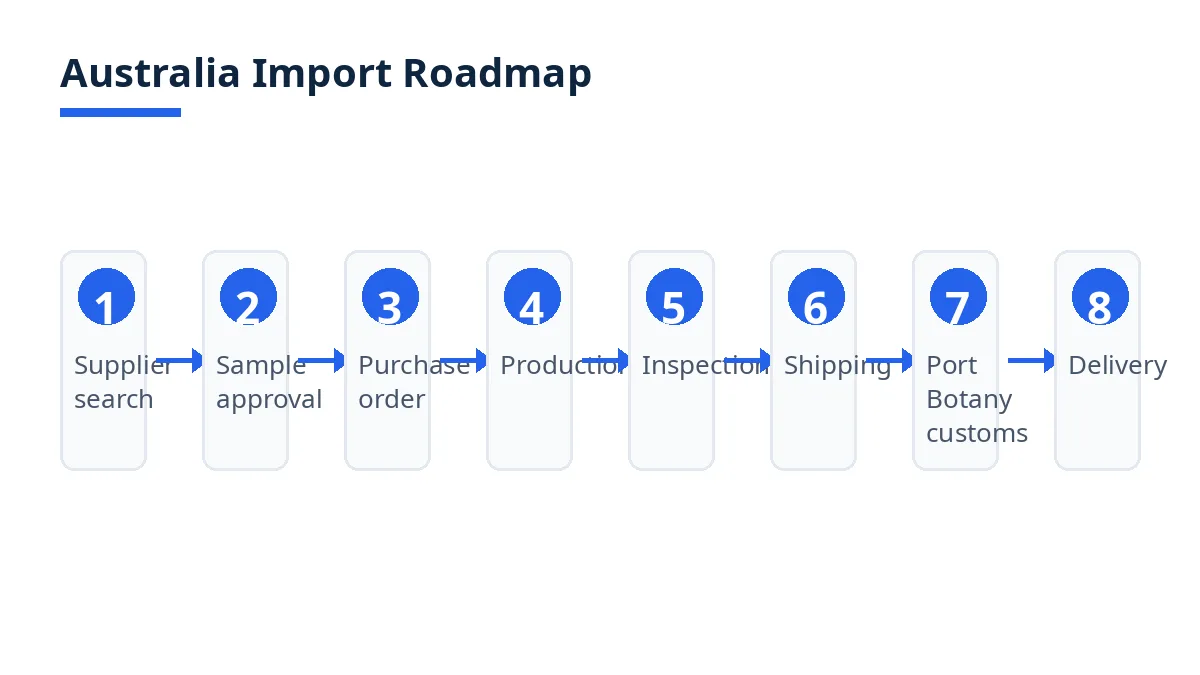
Write one specification per style: garment type, fabric, stretch, construction, print method, colours, size chart and care label wording.
Shortlist factories whose current production already includes that style, and send every candidate the identical specification.
Check documents, capability and bank details, and confirm the minimum per style and per colour in writing.
Approve a development sample, then a pre-production sample in production fabric, colour, print and trims.
Agree the delivery term, tariff lines, duty-free origin evidence and Port Botany customs roles before bulk production.
Check the BICON conditions for your goods and packing, and agree care labelling before bulk label sewing.
Name the tests in the purchase order, and agree inspection stages and defect limits.
Confirm the sailing, the Port Botany entry and the onward delivery, and build a buffer before any launch date.
File the N10 declaration with matching invoice, packing list, bill of lading and origin evidence, and fund the 10 percent GST at clearance.
Check the delivered goods against the sealed sample and size chart, and keep the shipment file for five years.
How Exportain helps
Exportain connects Australian buyers with Bangladeshi suppliers, and the platform carries supplier profiles, product listings and a request-for-quote route for buyers who want comparable quotes. Use the platform to shortlist, to send the identical specification to several factories, and to compare replies on the same basis. The document and photo review badges on a profile describe what was reviewed, and they do not replace your own sample approval and inspection.
FAQs
What is the typical MOQ for sportswear and activewear from Bangladesh?
There is no single typical minimum. The minimum is set per style and usually per colour, because fabric is knitted, dyed or printed in batches and cutting is planned per size range. Ask each supplier how its minimum splits by style, colour, print method and size range, and confirm the answer in writing before approving a sample.
How long does shipping take?
There is no single transit figure for every order. Confirm the sailing schedule, port pair and Port Botany clearance steps with your forwarder for your exact shipment date.
What import duty applies?
Where the goods meet the duty-free origin rules and the origin evidence is in order, the preferential duty is zero.1 If origin is not proven, each line pays its own general rate, which your broker must confirm per tariff line before the shipment sails: in the schedule consulted here, cotton tracksuits sit at 5 percent and synthetic-fibre tracksuits at Free, while every other line is confirm with broker.5 Australian GST at 10 percent is charged on the value of the taxable importation, which includes any duty payable.6
How do I verify a supplier?
Check company documents so that name, address and bank account name agree, check capability against your exact style from current production, and keep payments to the company account named in the documents. Approve a development sample and then a pre-production sample in production fabric.
Next steps on Exportain
Start with the general import route in how to import from Bangladesh, then shortlist factories through suppliers and compare your landed cost with the landed cost imports from Bangladesh guide. When your specification is ready, read how to buy and post a free request for quote.
Sources
- Growth of garment exports to Australia stagnate. tob.news, (accessed )
- Australia Textile Care Labelling Requirements. TÜV SÜD (accessed )
- Biosecurity questions and answers. Department of Agriculture, Fisheries and Forestry (accessed )
- Port Botany overview. Port Authority of New South Wales (accessed )
- Chapter 61 - Articles of apparel and clothing accessories, knitted or crocheted. Australian Border Force (accessed )
- GST and other taxes when importing. Australian Border Force (accessed )
- Import declarations. Australian Border Force (accessed )
About the author
Sourcing from Bangladesh?
Post a request for quotation and suppliers on Exportain can send you their quotes directly.
Post an RFQ


