

How to Import Socks From Bangladesh to USA: Step-by-Step Guide
How to import socks from Bangladesh to USA: specification, supplier checks, samples, FTC labels, HTS 6115 duty, ISF filing, shipping, and landed cost for United States buyers.
Short answer
To import socks from Bangladesh to USA, write a style-by-style specification covering fiber mix, sizes, and heel and toe construction, then shortlist hosiery suppliers, approve a pre-production sample in production yarn, agree the AQL inspection plan, confirm each style's heading 6115 subheading and current duty with your broker, approve FTC fiber and care labels, and file the Importer Security Filing before loading.
On this page
Key takeaways
Socks fall in heading 6115, split by fiber into 6115.94, 6115.95, 6115.96, and 6115.99; confirm the full code and current general rate for each style with your broker, as the schedule lines in this guide are indicative.
FTC labels must show generic fiber names and percentages for fibers at 5 percent or more, in order of predominance, plus the responsible party's name or Registered Identification Number and the country of processing or manufacture.
There is no single typical MOQ, price, or transit time for socks; confirm each in writing for your exact style, fiber mix, color count, size run, and route.
For ocean cargo, ISF data must reach CBP no later than 24 hours before lading at the foreign port; give your broker the manufacturer, origin, and HTSUS number in time to file.
Approve a pre-production sample in production yarn, agree AQL defect limits before production, and inspect during production and again on packed goods.
To import socks from Bangladesh to USA, start with one style at a time and fix its specification before you ask for a price. A sock order can combine crew socks, ankle socks, dress socks, and athletic socks in cotton, synthetic fibers, wool, or blends, each with its own size range, fiber mix, heel and toe construction, and tariff line. This guide is for buyers in the United States who buy socks for retail, private label, or wholesale, and it follows the import steps in order: specification, supplier checks, samples, quality control, shipping, duty, and delivery.
A sock is a small product with many points of failure. Length, heel placement, toe seam comfort, welt grip, and pairing all show up the first time a customer wears the sock, not in a photograph. Write the style down in measurable terms, approve a production-method sample, agree inspection before production, and confirm classification, labels, and entry documents before sailing.
Before you import socks from Bangladesh to USA: settle these points first
Settle style, fiber, size curve, and packing before comparing prices: each changes price and duty. Confirm each style's subheading and current rate with your broker, including any additional duty or fee on your entry date. Approve label wording at sample stage from the production yarn percentages, and give your broker the ISF data before loading.
Why source socks from Bangladesh
Socks are knitted hosiery, and the buying decision turns on knitting and finishing details. A supplier suited to socks should already make the type of sock you want to buy: the same length, gauge, and construction, in the same fiber family. Ask what the factory knits now, in which gauges, and with what toe-closing method, and ask to see current production in your style family. A factory that knits only dress socks will not prove it can make a cushioned athletic sock.
Build the specification around the parts of a sock that a wearer notices. State the style and length, the fiber content by weight, the gauge as you define it, the size range in United States shoe sizes, and the pairs per retail unit and per carton. State the heel and toe construction, including heel shape and toe closing, and state how the welt should grip without leaving a mark. Add colors, pattern placement, cushioning or grip dots, and the packing format.
Fiber choice drives feel, wash behavior, and classification at the same time. Cotton, synthetics, wool, and elastane each change feel and wash behavior, and a small share of elastane or spandex holds the sock in place. Name the fiber mix for each style as a buyer choice, and require the supplier to quote and label on that mix. A blend that changes during production changes the label, the tariff subheading, and the wash result, so any substitution needs your written approval before bulk knitting. Give the supplier your size chart and tolerances, and check the sample on a foot form.
Find and verify suppliers
Where should you start the search?
Start with the specification, not with factory names. Write one sheet per style with the fiber mix, sizes, colors, heel and toe construction, welt type, logo, labels, and packing. Send every candidate the same sheet and ask for the same reply format: yarn assumed, price inclusions, validity, and the minimum per style, color, and size run. Browse suppliers on Exportain, and read how to import from Bangladesh before you shortlist.
Shortlist suppliers whose current range already includes your sock type. Ask for the gauge range they knit and recent production in the same fiber family and length, and ask whether dyeing and finishing are done in-house or bought in. Ask to see a finished pair from current production.
How do you verify a supplier before you pay?
Verification has three layers. The first is company documents: trade license, export registration, and association membership where applicable, checked so that name, address, and bank account name agree. The second is capability: knitting capacity for your gauge and construction, yarn sourcing, dyeing route, toe-closing capacity, and packing capacity. The third is payment discipline: pay only the company account named in the documents, and verify any change of bank details separately.
On Exportain, supplier profiles may carry document and photo review badges. A badge is a review of documents and photos, not a factory inspection or a guarantee, and Exportain is not a party to the goods contract. For a first order, add a video walkthrough or visit.
MOQ, pricing and samples
What is the typical MOQ for socks from Bangladesh?
There is no single typical minimum order quantity for socks from Bangladesh. The minimum is set per style and usually per color and size run, because yarn is dyed in batches and machines are set up per construction. Ask each supplier how its minimum splits by style, color, size, and construction.
How is the price built, and how should you compare quotes?
Yarn is often the main cost element, followed by knitting, dyeing, toe closing, boarding, pairing, labeling, and packing. Fiber mix changes the yarn cost, gauge changes knitting time, and detail adds operations: a hand-linked toe, a shaped heel, cushioning, a jacquard pattern, or grip dots each cost more than a plain tube. Compare quotes only on the same basis: the same style, fiber mix, size curve, color count, construction, pairs per retail unit, delivery term, and packing. Confirm the per-dozen-pairs unit and what is excluded, such as testing, special packing, labels, or freight.
Which samples do you need, and how do you approve them?
Work in stages: a development sample tests construction, toe closing, heel shape, and size holding. A pre-production sample, made in production yarn, colors, and finish, is the sample you approve for bulk. Do not approve fit or color from substitute yarn, because dyeing, finishing, and boarding change dimensions, shade, and stretch.
Test the samples as a customer will use them. Wear a pair from each size, check heel hold and toe seam comfort, and wash the pair following your care label to check shrinkage, color loss, and welt grip. Measure finished length and leg length against your chart, check pair matching, and approve. Keep one sealed counter-sample of each style and color.
Quality control and certifications needed
Which quality checks are specific to socks?
Check each style against the approved sample and your size chart: finished length, leg length, foot length, and width within your agreed tolerances, and consistency across the size curve. Then check construction pair by pair: heel shape and position, toe seam comfort, welt tension and recovery, pattern alignment, and any cushioning or logo detail. Check pairing, packing, and finish: matching pairs, ordered size mix, even dyeing, and no dropped stitches.
Agree the inspection method and defect limits before production. ISO 2859-1 provides sampling schemes indexed by acceptance quality limit (AQL) for lot-by-lot inspection by attributes.1 Agree the lot size, inspection level, AQL, and defect classes, and let the tables set the sample size and the accept and reject numbers. Set separate limits for critical, major, and minor defects, and name the sock defects in each class. Inspect during knitting and finishing, and again on packed goods.
Which label rules apply to socks sold in the United States?
Federal law requires most textile and wool products to carry a label listing fiber content, country of origin, and the identity of the manufacturer or marketer, plus care instructions under the Care Labeling Rule.2 The label rule requires generic names and percentages by weight for fibers at 5 percent or more, in order of predominance, with other fiber last, plus the name or Registered Identification Number and the country of processing or manufacture.3
The label must reflect the production yarn. A sock labeled 80 percent cotton, 17 percent polyester, and 3 percent spandex must be made to that mix, and a small functional fiber such as spandex may be named even below 5 percent. Use generic names, equal-size type, and check the finished label before bulk labeling.3 Care labeling also needs a reasonable basis: the Care Labeling Rule covers textile wearing apparel, and its definition expressly includes hosiery.4 It requires regular care instructions, a warning where cleaning would harm the product, and a reasonable basis held before sale.4 Wash-test the production construction by the labeled method before you fix the wording.
Which certifications do you actually need?
No single certificate covers every sock order. What you need follows your customer: a retailer may name a test, restricted-substance list, or scheme in its supplier manual, and a children's sock may bring additional United States rules to confirm with counsel or your broker. Name any requirement in the specification, ask for the matching report, and check its scope, product, issuing body, and date. A report for a different yarn or color does not cover your sock.
Incoterms, shipping and transit time
Which delivery term should a first order use?
The Incoterms 2020 rules set out, for each rule, where delivery takes place and where risk passes from seller to buyer. Delivery and risk transfer generally coincide, except in the C-family, where the seller pays for transport to the destination but risk passes earlier.5 Weigh FOB at the Bangladeshi port against FCA at the named terminal. Under FOB, delivery and risk transfer occur when the goods are on board the vessel nominated by the buyer, and the ICC Academy notes that for goods in containers FCA is typically a better choice, even for maritime transport.5
Under FCA, the seller delivers the goods and risk passes when the goods are loaded on the transport arranged by the buyer at the seller's premises, or when they reach another named place ready for unloading and at the disposal of the carrier or person nominated by the buyer.5 Under CFR and CIF, risk passes when the goods are on board the vessel contracted by the seller; CIF adds seller insurance against the buyer's risk.5 Under DAP, risk transfers at the named destination; under DDP the seller must also clear the goods for import, which the ICC Academy warns may pose problems for the seller.5 State the rule, the named place, and the Incoterms 2020 version in the contract, and state who handles United States import clearance.
How long does shipping take, and what must be filed before loading?
There is no single typical transit time for socks from Bangladesh to the United States. Sea freight is the standard bulk route and takes weeks, varying by port pair, routing, and season. Plan from your forwarder's current sailing schedule, and add clearance and delivery.
For ocean cargo, the Importer Security Filing has hard timing. The ISF Importer or authorized agent must submit the seller, buyer, importer of record number, consignee numbers, manufacturer, ship-to party, origin, and HTSUS number no later than 24 hours before lading at the foreign port, and the stuffing location and consolidator no later than 24 hours before arrival at a United States port.6 Give your broker that data in time to file, and update it if it changes before entry.6
Import duty, taxes and documents
How are socks classified for duty?
Duty follows the classification of each style in the Harmonized Tariff Schedule of the United States, not the supplier's product name. Heading 6115 covers panty hose, tights, stockings, socks and other hosiery, knitted or crocheted.7 Ordinary socks fall in the "Other" group, split by fiber: wool or fine animal hair, cotton, synthetic fibers, and other textile materials, with further splits for lace or net and silk content.7 Classify graduated compression hosiery separately. Confirm the code for each style before you price or ship.
What import duty applies?
Your rate depends on each style's subheading, origin, and any additional duty or fee on the entry date. The table below gives the general rates from the schedule edition opened for this guide. Treat them as indicative schedule lines and confirm the current rate with your broker before you price.
Subheading | Description | General rate |
|---|---|---|
6115.94.00 | Wool or fine animal hair | 11.3% |
6115.95.60 | Cotton, lace or net | 10% |
6115.95.90 | Cotton, other | 13.5% |
6115.96.60 | Synthetic fibers, lace or net | 18.8% |
6115.96.90 | Synthetic fibers, other | 14.6% |
6115.99.14 | Artificial fibers, lace or net | 18.8% |
6115.99.19 | Artificial fibers, other | 14.6% |
6115.99.40 | 70% or more silk or silk waste | 1.6% |
6115.99.90 | Other textile materials | 9.9% |
The schedule opened is the 2015 annotated Chapter 61 edition; verify the rates on the current tariff.7 Ask your broker to confirm the current rate, any additional duty or fee for Bangladeshi origin on your entry date, and how duty is calculated. Confirm the entry type and duty position before you set a selling price.
Which documents do you need for clearance?
The entry documentation required to secure release consists of the entry on CBP Form 3461 or its electronic equivalent, evidence of the right to make entry, a commercial invoice, a packing list where appropriate, other required documents, and the name, street address, and identification number of the United States buyer or delivery premises.8 The documents must agree: quantities, weights, carton counts, values, fiber content, and origin must match across the invoice, packing list, and bill of lading.
The commercial invoice should name each style plainly, for example cotton crew sock with shaped heel, with fiber content by weight, sizes, quantities in dozen pairs, unit prices, and the delivery term, on its own line. State the country where each style was processed or manufactured. The invoice fiber content must match the label, because the label, invoice, and classification are all built on the same fiber mix. Keep the full document set with the entry number.
Landed cost example (table)
A landed cost is the full cost of one dozen pairs of socks, ready for your warehouse. Every number below is an example figure only, not a quote, and the duty line uses an example rate only.
Example figures: 5,000 dozen pairs of cotton crew socks, FOB Chattogram, sea freight to a United States port, duty at an example rate of 13.5 percent.
Cost element | Example figures (per dozen pairs) | How to obtain your figure |
|---|---|---|
Product price, FOB | $18.00 | Confirmed pro forma invoice |
International freight | $1.80 | Forwarder quote per dozen pairs |
Insurance | $0.15 | Policy or forwarder quote |
Duty | $2.43 | Broker calculation |
Port, clearance and broker fees | $0.60 | Broker invoices per dozen pairs |
Local delivery to warehouse | $0.45 | Local carrier quote per dozen pairs |
Total landed cost | $23.43 | Sum of all lines above |
State sales tax and any additional duty or fee confirmed by your broker are not included. Work the calculation twice: at quote stage and after shipment with the actual invoices. See landed cost for imports from Bangladesh for the full method.
Step-by-step import checklist
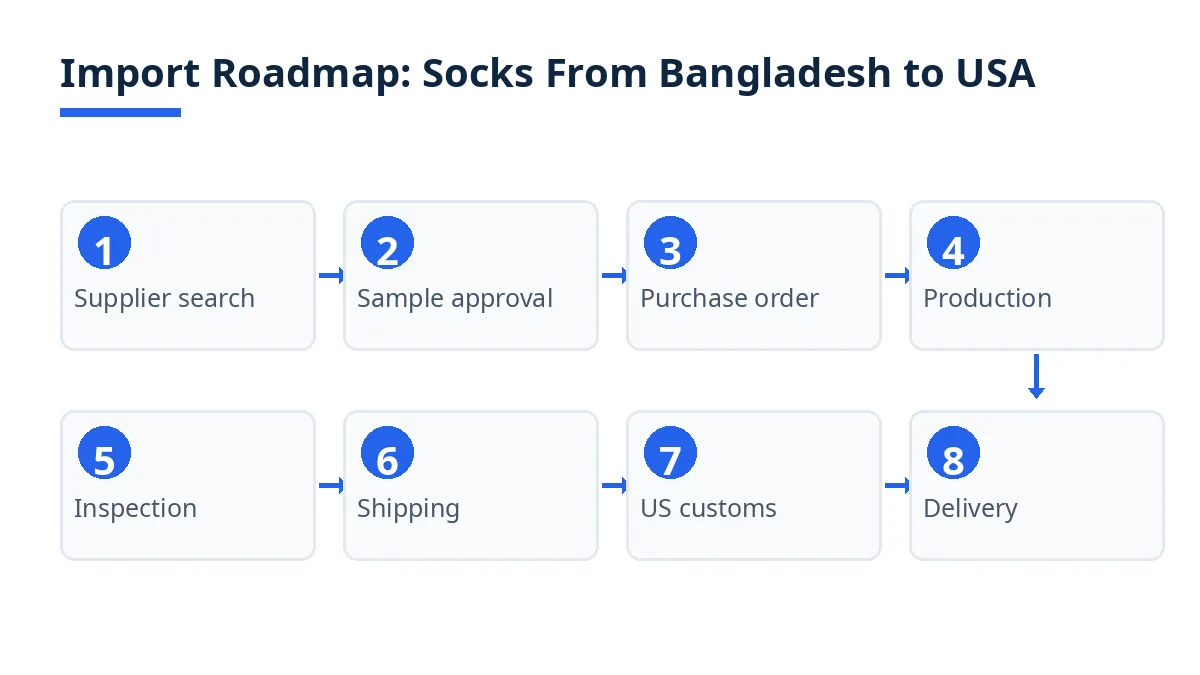
Write the specification style by style: length, fiber mix, gauge, sizes, heel and toe construction, welt type, colors, labels, and packing.
Classify every style, starting from heading 6115, then 6115.94, 6115.95, 6115.96, and 6115.99 by fiber, and confirm each code and current rate with your broker.7
Shortlist suppliers whose current range includes your sock type, and request comparable quotes on the identical specification, per dozen pairs, on the same delivery term.
Verify the chosen supplier: company documents, capacity for your construction, yarn and dyeing route, and a video or in-person check for a first order.
Approve samples in stages, then approve a pre-production sample of each style and color in production yarn.
Approve the fiber label and care label wording from the production fiber mix, and confirm the label check against 16 CFR 303.16 and the Care Labeling Rule before bulk labeling.3 4
Confirm the order in writing: purchase order, pro forma invoice, delivery and payment terms, inspection plan, labeling, packing, and shipment date.
Inspect during production and again on packed goods, checking size, heel and toe, welt, shade, and pair matching.
Give your broker the ISF data before loading: seller, buyer, manufacturer, ship-to party, origin, and HTSUS number for each style, with the stuffing location and consolidator to follow.6
Ship, clear customs with the confirmed code for each style and the matching invoice, packing list, and bill of lading, and reconcile the actual landed cost.8
How Exportain helps
Browse suppliers for exporters whose ranges include hosiery, and compare them with your style list. Then post your specification and target quantity as an RFQ and compare replies on the same terms before you choose a factory for sampling. Exportain is a B2B marketplace for RFQs, quotations, and supplier messages. It does not inspect goods, book freight, or clear customs, and it is not a party to the goods contract. Read how to buy to see the buyer steps on the platform.
FAQs
What is the typical MOQ for socks from Bangladesh?
There is no single typical minimum. It is set per style and usually per color and size run, because yarn is dyed in batches and machines are set up per construction. Ask each supplier how its minimum splits by style, color, size, and construction.
How long does shipping take?
Production time and transit time are separate, and neither has a single typical figure. Sea transit takes weeks rather than days and varies by port pair, routing, transshipment, and season. Plan from your forwarder's current sailing schedule, and give your broker the ISF data no later than 24 hours before loading.6
What import duty applies?
Duty follows the confirmed classification of each style, the origin, and any additional duty or fee in force on the entry date. Ordinary socks sit in heading 6115, split by fiber into 6115.94, 6115.95, 6115.96, and 6115.99.7 In the schedule edition opened for this guide, general rates range from 1.6 percent for silk-rich socks to 18.8 percent for synthetic and artificial-fiber socks containing lace or net.7 Confirm the current rate with your broker before you price.
How do I verify a supplier?
Check company documents first, so that name, address, and bank account agree across the trade license, export registration, and invoices. Then check capability: gauge and construction for your sock type, yarn and dyeing route, toe-closing and finishing capacity, and recent production in the same fiber family. Keep payments to the company account named in the documents, and approve a pre-production sample of each style and color before bulk production.
Next steps on Exportain
Read how to import from Bangladesh for the full process, then check how to buy for the platform steps. When your specification is ready, post an RFQ on Exportain and compare quotes on the same style, fiber mix, size curve, and delivery term.
Sources
- SIST ISO 2859-1:2003 - Sampling procedures for inspection by attributes, Part 1: Sampling schemes indexed by acceptance quality limit (AQL). International Organization for Standardization, (accessed )
- Textile, Wool, Fur, Apparel and Leather Matters. Federal Trade Commission (accessed )
- 16 CFR 303.16 - Arrangement and disclosure of information on labels. Cornell Law Institute (accessed )
- Care Labeling of Textile Wearing Apparel and Certain Piece Goods. Federal Trade Commission (accessed )
- Place of delivery & risk transfer in trade contracts. ICC Academy (accessed )
- 19 CFR 149.2 - Importer security filing, requirement, time of transmission. Cornell Law Institute (accessed )
- Harmonized Tariff Schedule of the United States (2015), Chapter 61: Articles of apparel and clothing accessories, knitted or crocheted. United States International Trade Commission (accessed )
- 19 CFR 142.3 - Entry documentation required. Legal Information Institute, Cornell Law School (accessed )
About the author
Sourcing from Bangladesh?
Post a request for quotation and suppliers on Exportain can send you their quotes directly.
Post an RFQ


