Importing Socks From Bangladesh to UAE: Costs, Duties and Suppliers
Import socks from Bangladesh to UAE through Jebel Ali: pair specification, supplier checks, MOQ and samples, HS 6115 duty and VAT, JAFZA entry, shipping and a landed cost example per pair.
Short answer
To import socks from Bangladesh to UAE, first choose the entry route: mainland sale through Jebel Ali, storage and distribution from JAFZA, or re-export without mainland entry. Then write a pair-level specification, verify the supplier and approve samples, confirm the indicative HS heading 6115 line, duty and VAT with a broker, and build the landed cost per pair before bulk production starts.
On this page
Key takeaways
Choose the UAE entry route before booking: mainland import through Jebel Ali, JAFZA storage and distribution, or re-export each change when duty and VAT fall due and which declaration the broker files.
Socks are specified, quoted, classified and counted in pairs. Fix style, fiber percentages, size range, colors, labels and packing per style before comparing any quotation.
There is no single typical MOQ for socks. Ask for the minimum in pairs per style, per color and per size, and record the price validity, lead time basis and payment terms in writing.
Heading 6115 is indicative until a broker confirms the full UAE or GCC code and the duty line for the exact subheading. The Dubai general tariff is 5 percent of CIF value, and UAE standard VAT is 5 percent, including on the duty-inclusive value for imports.
OEKO-TEX STANDARD 100 Product Class II covers socks as direct skin-contact textiles, is awarded only when all components meet the criteria, and is valid for 12 months. Check that the certified articles match the socks ordered.
If you plan to import socks from Bangladesh to UAE, the first decision is not the pair price. It is the entry route: sale on the UAE mainland through Jebel Ali, storage and distribution from the Jebel Ali Free Zone (JAFZA), or re-export without the goods entering the mainland. Each route changes when duty and value added tax (VAT) fall due, which declaration your broker files, and what goes on the carton and label. Socks are bought, counted and cleared in pairs, and each style has its own fiber mix, size range, color range and packing.
Why source socks from Bangladesh for the UAE market
Bangladesh makes socks inside a knitwear sector that has become the larger part of the country's garment exports. Knitwear accounted for 53.3 percent of apparel exports in fiscal year 2025-26, at USD 20.62 billion, and industry leaders attribute much of that position to domestic spinning, knitting and dyeing capacity close to the factories.1 That capacity can shorten the time between a confirmed color and a production sample, and make repeat orders easier to place. It does not remove the need to check an individual supplier.
Find and verify suppliers
Write the pair specification before you contact suppliers
Fix the decisions a supplier would otherwise guess: style and wearer, construction, fiber composition by percentage, size range and pairs per size, color range, cuff and heel and toe construction, label and hang tag, inner pack and export carton, and the tests or certificates you require. Send the same specification to every candidate, with the same delivery term and named place, such as FOB Chittagong or CIF Jebel Ali, Incoterms 2020.
Shortlist suppliers without a ranked list
Do not buy from a ranked list of company names. A name on a list does not prove that the company still makes your style, still holds the certificates it claims, or still has capacity in your delivery window. Shortlist by fit: suppliers whose current range already includes your construction and fiber mix, who already ship to the Gulf or warm-climate retail markets, and who can show recent production in your quantity band. Three to five candidates is enough for a first order, including one backup. Search through suppliers on Exportain and trade association listings.
What checks come before the first payment?
Ask for core business documents and check that names, addresses and validity dates match across them: legal name and registered address, trade licence, taxpayer identification number and VAT registration where applicable, and the Export Registration Certificate (ERC), the registration an exporter needs in order to export from Bangladesh. A badge is a document and photo review, not a factory audit, inspection of your goods, or guarantee of capacity, quality or delivery. Never send a large deposit where the bank account name differs from the name on the quotation without a clear, documented explanation.
MOQ, pricing and samples
What is the typical MOQ for socks from Bangladesh?
There is no single typical minimum order quantity (MOQ) for socks from Bangladesh. The minimum is set per style, per color and often per size, because yarn dyeing is done in lots, knitting machines are set per style and size, and packing is done per color and size breakdown. Ask every supplier to state its MOQ in pairs per style, per color and per size, and whether a surcharge applies below that level.
How is the price per pair built, and how should you compare quotes?
The unit price is built from yarn, knitting, dyeing and finishing, trims and labels, packing, testing where required, and margin, plus the delivery term in the quotation. Fiber mix is usually the main variable: cotton, wool, bamboo-derived fiber, polyester, nylon and elastane each price differently, and a small change in elastane content or heel and toe reinforcement changes both cost and wear. Compare quotes only on the same specification, size breakdown, packing and Incoterm with a named place, and convert every offer to the same basis, ideally an estimated landed cost per pair in your warehouse. Ask for the price validity date, the lead time counted from a named event, the payment terms, and what is excluded, such as testing, special labels, barcodes or freight beyond the named place.
Which samples do you need, and how do you approve them?
Treat samples as part of the contract, since the approved sample is the physical standard for judging bulk production. First, a development sample confirms the supplier understood the specification; expect corrections and often a second round, and comment precisely, with measurements, materials, colors and construction points. Second, a pre-production sample uses the actual yarn, trims, labels and packing for bulk production. Approve it in writing before bulk production. Third, a shipment sample is taken from finished bulk production for comparison with the approved sample before the goods leave, or during inspection.
Quality control and certifications needed
Which quality checks are specific to socks?
Sock failures are small and easy for a customer to notice: one sock longer than the other, a heel in the wrong place, a toe seam that rubs, a cuff that loses stretch, color that fades after a few washes, or a pack that mixes sizes. Build inspection around the pair: each pack must hold matched pairs in the stated size, left and right socks must match in length and pattern, heel and toe reinforcement must sit where the specification places them, and stitching must be even with no skipped stitches or loose threads at the toe seam. Do not adopt a universal sampling figure from this guide; name any sampling standard and acceptance numbers in the purchase order.
What label rules apply to socks sold in the UAE?
Do not assume a label approved for another market meets UAE requirements. Before bulk production, ask your UAE customs broker and retail customer which language, fiber composition, care, size and origin details the sale requires, and whether Arabic text is required for your sales channel. Put the approved label artwork into the purchase order as an attachment, and check the production label against it at the pre-production sample stage. The percentages on the label must match the yarn actually used, including elastane and reinforcement fiber, and must match the composition declared to customs.
Which certifications do you actually need?
No sock-specific mandatory certification for the UAE was found in the sources opened for this guide. Do not treat a certificate as mandatory until your broker or retail customer names it. The certificate most often relevant to socks is OEKO-TEX STANDARD 100, which tests textiles for harmful substances. Socks fall in Product Class II, the class for textiles whose surface comes into direct contact with the skin, alongside underwear, bed linen, towels, shirts and blouses.2 Requirements are stricter the more direct the skin contact, and the certificate is only awarded if all components meet the criteria, including sewing threads, dyes, finishes and prints.2 A STANDARD 100 certificate is valid for 12 months and can be renewed annually.2 A certificate for yarn alone does not certify the finished sock.
Incoterms, shipping and transit time (Chittagong to Jebel Ali)
Which delivery term should a first order use?
Incoterms 2020 rules set the contractual obligations of seller and buyer: where delivery takes place, where risk passes, who arranges carriage and insurance, and who handles export and import formalities.3 Risk passes from seller to buyer at the same point and time as delivery, and in only two rules, CIP and CIF, must the seller provide the buyer with insurance for its risk.3 In all but EXW the seller must carry out export formalities, and in all but DDP the buyer must carry out import formalities.3 For containerized socks, prefer FCA, CPT or CIP over the sea-only rules. Four rules, FAS, FOB, CFR and CIF, are only intended for port-to-port shipments, meaning bulk or break-bulk, and are not suitable for container shipments in their current form, because a container is handed over before it is on board.3
How long does shipping take?
Port-to-port sailing time is only part of the timeline, which runs from sample approval to production, booking, loading at Chittagong, sailing, arrival at Jebel Ali, clearance, and delivery at your warehouse. For the sea leg, schedules listed for the Chittagong to Jebel Ali lane in October 2026 showed an average transit of 10 days 9 hours for full container load sailings, across several departure windows.4 Treat that as a schedule snapshot, not a promise: final vessel rotation depends on the selected schedule and carrier allocation, and transshipment can add time.4
Mainland, JAFZA or re-export: choose the entry before you book
Fix the entry choice before the goods sail, because it decides the declaration type and the tax point. Goods inside JAFZA sit outside the UAE customs territory, so a company can import, store and re-export without paying customs duty, and pays the 5 percent import duty only when goods cross into the mainland.5 JAFZA is also a Designated Zone for VAT, so the supply of goods that stay within the zone can fall outside the scope of UAE VAT, subject to strict customs documentation, while a sale from JAFZA to a mainland buyer is an import and the mainland buyer accounts for the VAT.5 Tell your broker before booking whether the destination is mainland, JAFZA storage, or re-export.
Import duty, taxes and documents (UAE)
How are socks classified for duty in the UAE?
Socks are classified in HS heading 6115, counted in pairs. The heading covers pantyhose, tights, stockings, socks and other hosiery, including graduated compression hosiery and footwear without applied soles, knitted or crocheted.6 The subheading is set by hosiery type and fiber: graduated compression hosiery sits at 6115.10, and the other lines split by fiber.6 The tariff page opened for this guide shows the supplementary unit for the sock lines as pairs, marked "pa (Number of pairs)".6 That page is a Northern Ireland tariff page, used only for heading wording. Treat every heading here as indicative, and verify the full UAE or GCC code for your exact sock with your broker before you price or declare.
What import duty applies?
Use the official line for the general rate, and a broker confirmation for the sock line. The UAE Government platform states that government tariffs range from 0 to 5 percent, and that in Dubai the customs tariff is 5 percent of the CIF (cost, insurance and freight) value except for alcohol and cigarettes.7 On that general line, a mainland import through Dubai at Jebel Ali is worked in the example below at 5 percent of CIF value. The landed cost example is labeled Example figures throughout, and its duty line must be replaced with the broker-confirmed line. Ask your broker to confirm the GCC tariff line for your exact 6115 subheading.
What about VAT, and how is it accounted for?
The UAE standard VAT rate is 5 percent. The Federal Tax Authority VAT returns guide states that standard rated supplies are those subject to VAT at 5 percent, and that the output tax amount on imported goods is auto-populated by applying 5 percent VAT to the net value amount, which includes any customs duties and excise tax paid on the goods imported.8 If you are VAT-registered and can recover import VAT, it is a cash-flow item, accounted for through the return and recovered subject to the conditions in the guide.8 Confirm the treatment with your accountant, and whether your Tax Registration Number is linked to your customs registration.
Which documents do you need for clearance?
Give your broker the complete set before the vessel sails, and check that every document names the same legal entities, quantities in pairs, fiber composition and values. The core set for a Dubai sea import is the commercial invoice, packing list, bill of lading or airway bill, certificate of origin, customs declaration filed through the Dubai system, and the importer's trade licence and customs code, with authority permits for regulated goods where they apply. The commercial invoice must be the final invoice, not a proforma invoice, and must match the packing list and the bill of lading.
Landed cost example
The table below is a worked example only. Example figures are used throughout the text and the table. Every figure is illustrative, not a quotation for any supplier, route or shipment. Replace each line with your own quotation, forwarder quote, broker-confirmed duty line and bank charges before you price. The example uses a mainland import through Jebel Ali, on an FOB Chittagong basis, for 12,000 pairs. Duty is worked at the general 5 percent Dubai CIF rate from the official page opened for this guide, and must be replaced with the broker-confirmed line for heading 6115.
Line | Example figures (USD) | Basis |
|---|---|---|
Product cost: 12,000 pairs at USD 0.85 per pair, FOB Chittagong | 10,200.00 | Example figures: supplier quotation |
Ocean freight Chittagong to Jebel Ali, not in the FOB price | 1,150.00 | Example figures: forwarder quote |
Cargo insurance | 95.00 | Example figures: insurer or forwarder quote |
CIF value (product cost plus freight plus insurance) | 11,445.00 | Calculated |
Import duty at 5 percent of CIF value | 572.25 | Example figures: general Dubai CIF rate, broker to confirm the 6115 line |
Subtotal including duty | 12,017.25 | Calculated |
Import VAT at 5 percent of the subtotal including duty, recoverable if VAT-registered | 600.86 | Example figures: shown separately, excluded from the total below |
Customs broker fee | 220.00 | Example figures: broker fee schedule |
Destination port and terminal charges | 310.00 | Example figures: forwarder or carrier quote |
Inland delivery to a Dubai warehouse | 260.00 | Example figures: haulier quote |
Inspection and testing | 340.00 | Example figures: inspection company quote |
Bank and currency costs | 110.00 | Example figures: bank charges |
Total landed cost excluding recoverable VAT | 13,257.25 | Calculated |
Landed cost per pair excluding recoverable VAT | 1.10 | Calculated: USD 13,257.25 divided by 12,000 pairs |
Total landed cost if VAT cannot be recovered | 13,858.11 | Calculated: USD 13,257.25 plus USD 600.86 |
Landed cost per pair if VAT cannot be recovered | 1.15 | Calculated: USD 13,858.11 divided by 12,000 pairs |
The quoted price is USD 0.85 per pair, and the landed cost is USD 1.10 per pair excluding recoverable VAT. Recalculate the table for every order, from current quotations and the current tariff, and price from the landed cost per good pair received. The full method is set out in the landed cost guide.
Step-by-step import checklist: import socks from Bangladesh to UAE
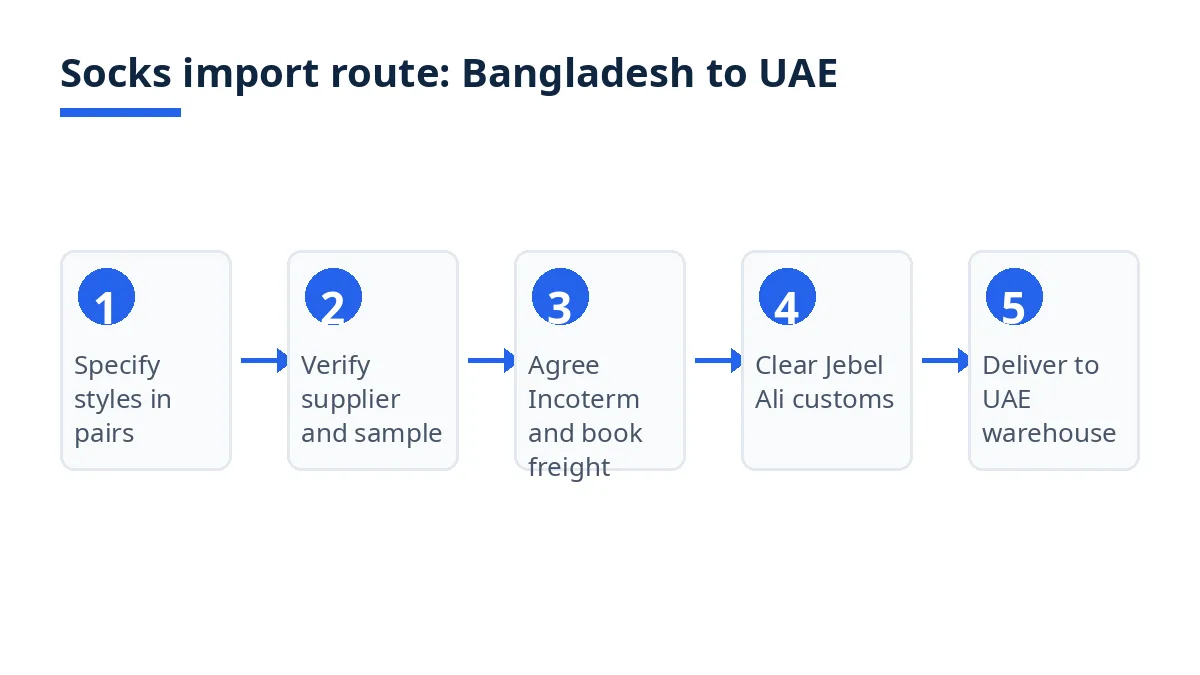
Fix the entry route: mainland sale, JAFZA storage, or re-export, and tell your broker before booking.
Write the pair specification: style, construction, fiber percentages, size range, colors, labels, packs and cartons, all in pairs.
Shortlist three to five suppliers whose current range includes your construction and fiber mix, and send the same specification and delivery term to each.
Check business documents for consistency, including trade licence, taxpayer identification, VAT registration where applicable, and the ERC.
Agree the MOQ in pairs per style, per color and per size, price validity, lead time basis and payment terms, in writing.
Approve a development sample, then a pre-production sample in production yarn, trims, labels and packing, in writing, and keep a sealed pair.
Name the inspection point, inspector, sampling standard and acceptance numbers in the purchase order, and agree what happens if inspection fails.
Confirm the UAE label artwork, fiber composition, care details and origin marking with your broker and retail customer before bulk production.
Ask your broker to confirm the full UAE or GCC code for heading 6115, the duty line, the customs value definition, and the VAT treatment.
Agree the Incoterm with a named place and the 2020 edition in the contract, and book freight on the same basis as the supplier quotation.
Give your broker the final invoice, packing list, bill of lading, certificate of origin, trade licence and customs code before the vessel sails, with pair quantities matching across every document.
Track the sailing, confirm arrival and free days at Jebel Ali, clear customs, check the shipment sample, and divide the final cost by the good pairs received.
How Exportain helps
Exportain is a business-to-business marketplace where buyers find suppliers on Exportain, post requests for quotation, receive quotations, message suppliers and place orders. You can search suppliers on Exportain, filter by product and category, and review supplier profiles, including trust badges that record which document and photo checks have been reviewed. The how to buy guide sets out the eight steps from search to shipment, including sending an order request, posting a request for quotation, comparing versioned quotations, and arranging freight and inspection through listed providers. Exportain is not a party to the contract for goods. It does not inspect goods, book freight or clear customs, and a trust badge is not a factory inspection or a guarantee.
FAQs
What is the typical MOQ for socks from Bangladesh?
There is no single typical MOQ. The minimum is set per style, per color and often per size, because yarn dyeing, machine setup and packing run at that level. Ask each supplier to state its minimum in pairs per style, per color and per size, and whether a surcharge applies below it.
How long does shipping take?
For the sea leg, schedules listed for the Chittagong to Jebel Ali full container load lane in October 2026 showed an average transit of 10 days 9 hours.4 That is a schedule snapshot, not a promise, and transshipment can add time.
What import duty applies?
Socks fall in indicative HS heading 6115, counted in pairs, with the subheading set by hosiery type and fiber.6 The UAE Government platform states that government tariffs range from 0 to 5 percent and that the Dubai tariff is 5 percent of the CIF value except for alcohol and cigarettes.7 The example here works duty at that general 5 percent CIF rate and labels it Example figures. Before you price, ask your broker to confirm the GCC tariff line for your exact 6115 subheading and the customs value definition, and replace the example line.
How do I verify a supplier?
Start with the pair specification, shortlist suppliers whose current range already includes your sock construction, and check business documents for consistency: legal name and address, trade licence, taxpayer identification and VAT registration where applicable, and the ERC. Approve development and pre-production samples in writing, and set inspection, sampling and acceptance terms in the purchase order before the first large payment.
Next steps on Exportain
Decide your entry route, write the pair specification, and shortlist suppliers on Exportain against the same brief. Compare quotations on the same Incoterm and size breakdown, approve samples in writing, and ask your broker to confirm the heading 6115 line, duty and VAT before the goods sail. Start with the guide to how to import from Bangladesh, search suppliers on Exportain, and work through the how to buy guide to post a request for quotation on the same specification every supplier quotes against.
Sources
- Knitwear dominance faces fresh pressure. TIMES of Bangladesh (accessed )
- OEKO-TEX STANDARD 100 for textiles tested for harmful substances. Hohenstein (accessed )
- Insider thoughts: Bob Ronai on Incoterms 2020 Rules; What are they about?. International Chamber of Commerce (accessed )
- Chittagong to Jebel Ali FCL Shipping Rates | Schedules & Transit Time. Cogoport (accessed )
- JAFZA: A Legal Guide for Companies in Jebel Ali Free Zone (2026). Kayrouz & Associates, (accessed )
- HS heading 6115: hosiery, knitted or crocheted. GOV.UK (accessed )
- Customs duty and tariff. UAE Government (accessed )
- Value Added Tax (VAT) Returns User Guide. Federal Tax Authority (accessed )
About the author
Sourcing from Bangladesh?
Post a request for quotation and suppliers on Exportain can send you their quotes directly.
Post an RFQ