Socks From Bangladesh to Saudi Arabia: A Buyer's Import Checklist
How to import socks from Bangladesh to Saudi Arabia: pair specification, supplier checks, samples, SABER and SASO labels, Jeddah clearance, duty and VAT checks, and a per-pair landed cost example.
Short answer
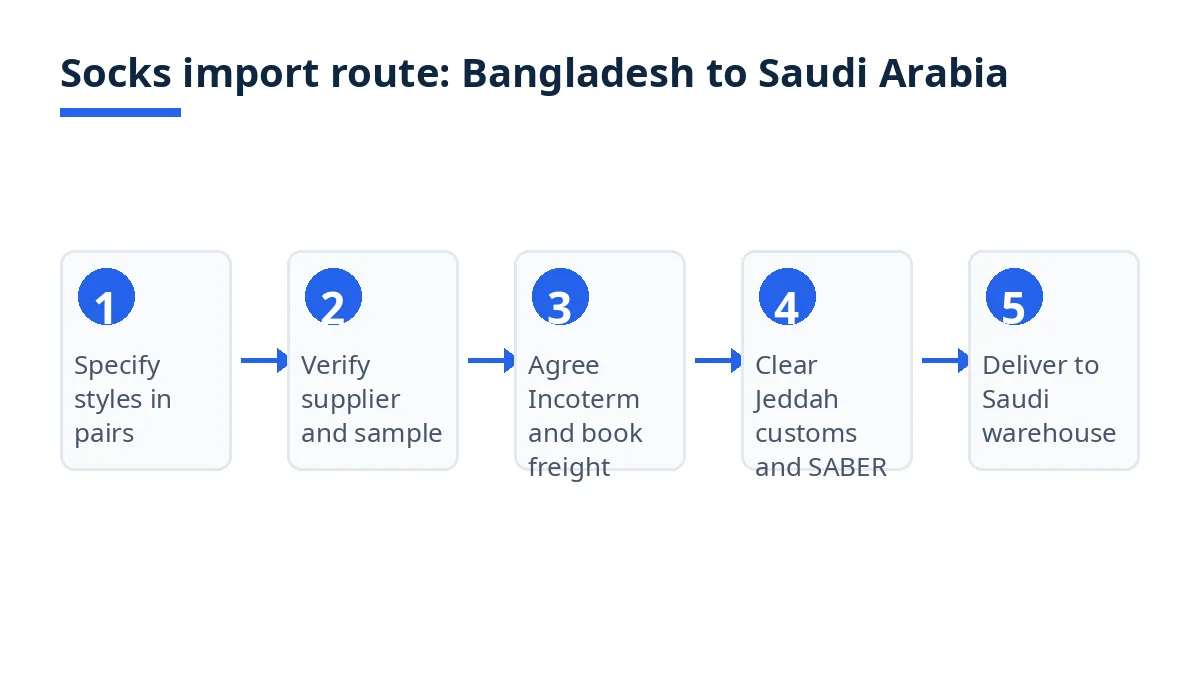
To import socks from Bangladesh to Saudi Arabia, specify each style by fiber mix, size range, and packing, verify a sock knitter, and approve a pre-production sample in production yarn. Confirm each style's Saudi tariff code and duty with your broker, complete the SABER conformity step that applies, use Arabic label wording under the SASO textile regulation, and ship to Jeddah. Compare quotes only as landed cost per pair.
On this page
Key takeaways
Socks fall in heading 6115, split by fiber into 6115.94, 6115.95, 6115.96, and 6115.99, counted in pairs. Every heading is indicative - verify on the official Saudi tariff, and confirm the duty for each style with your broker on every order.
SABER conformity runs through Product and Shipment Certificates for goods under a SASO Technical Regulation, or a Self Declaration and Shipment Certificate otherwise. Register products in SABER before a Product Certificate can be issued, and confirm the route before production.
Saudi textile labels must be in Arabic, or Arabic and English, and state fiber names with mass percentages, weight, size, the supplier name and commercial register on the external packaging, the country of origin, and care instructions.
ZATCA states the standard VAT rate is 15 percent on the import of goods and the supply of most goods and services in the Kingdom. Confirm how VAT applies to your shipment and whether you can recover it; confirm duty with your broker.
There is no single typical MOQ, price, or transit time for socks. Confirm each one in writing for your exact style, fiber mix, color count, size run, and route, and approve a pre-production sample in production yarn before bulk production.
To import socks from Bangladesh to Saudi Arabia, fix the pair first: style, fiber mix, size range, and packing, then confirm the Saudi entry steps before you ask for a price. A sock order that reaches Jeddah with wrong label wording or an unfinished conformity step can wait at the port while the selling season passes. This guide is for buyers in Saudi Arabia who buy socks for retail, wholesale, or private label, in decision order: specification, supplier checks, samples, quality control, shipping, and Saudi duty and tax.
Socks in this guide means knitted ankle, crew, knee-high, sports, work, and dress socks, usually in cotton, polyester, nylon, or wool blends with elastane. Each style needs its own line, since fiber mix, size range, and construction change the price, label, and tariff line.
Why source socks from Bangladesh
Bangladesh sells socks from inside a large knitwear base. In the July to September quarter of fiscal year 2026-27, knitwear exports were $5.963 billion, up 6.88 percent on the same quarter a year earlier, within total ready-made garment exports of $10.578 billion.1 Those figures describe knitwear as a whole, not socks alone. They show a base that knits, dyes, finishes, and packs at scale. Match each sock to a factory that already knits that type.
That base covers white crew socks in retail packs, black dress socks, cushioned sports socks, and heavier work socks. Buy styles together from one supplier only when it knits each type routinely; otherwise split them across suppliers. Settle Arabic labels, fiber percentages, and conformity documents while the styles are still on paper.
Find and verify suppliers
Where should you start the search?
Start with one specification sheet per style, not with factory names. Write down the style and length, fiber mix by weight, gauge, size range in the shoe sizes your customers use, heel and toe construction, cuff type and width, cushioning or grip detail, colors and pattern placement, pairs per retail unit, and pairs per export carton. Add the Saudi label wording, conformity step, and delivery term. Send every candidate the identical sheet and ask for the same reply format. Browse suppliers on Exportain and the general socks guide, and read how to import from Bangladesh for the full process.
Shortlist only suppliers whose current range already includes your sock type. Ask what gauges they knit, how they close toes, whether dyeing, linking, boarding, and packing run in-house, and ask to see a finished pair from recent production in the same fiber family and length. Record any subcontracted step in writing.
How do you verify a supplier before you pay?
Verification has three layers. The first is company documents: trade license, export registration, and association membership where it applies, checked so that the legal name, address, and bank account name agree across every document. A mismatch without a written explanation is a reason to pause. The second is capability: gauges, monthly capacity in pairs, yarn sources, dyeing route, and toe-closing, boarding, and packing capacity. The third is payment discipline. Keep payments to the company account named in the documents, never to a personal account, and verify any change of bank details through a separate route before you use it.
On Exportain, supplier profiles may carry document and photo review badges, which record a review of documents and photos, not a factory inspection or a guarantee. Exportain is not a party to the contract for the goods. For a first order, add a live video walk-through or an independent factory check.
MOQ, pricing and samples
What is the typical MOQ for socks from Bangladesh?
There is no single typical minimum order quantity for socks from Bangladesh. The minimum is set per style and usually per color and size run, because yarn is dyed in batches and machines are set up per style and gauge. Stock yarn in standard colors usually allows a lower start. Custom-dyed yarn, jacquard logos, a wide size range, and private-label packing raise it. Ask each supplier how its minimum splits by style, color, and size, and at what quantity the price per pair or per dozen pairs changes. Record the split in writing.
How is the price built, and how should you compare quotes?
Yarn is usually the main cost element, followed by knitting, linking, dyeing, boarding, trims, testing, packing, and margin. Heavier socks, higher cotton content, and terry cushioning cost more, and detail adds operations: a hand-linked toe, shaped heel, cushioning, jacquard pattern, or grip dots. Ask for a breakdown and which yarn each price assumes; a lower quote on thinner yarn is a different product, not a saving.
Compare quotes only on the same basis: style, fiber mix, size curve, color count, construction, pairs per retail unit, delivery term, and packing. Confirm the unit in every quote, since socks are quoted per pair by some and per dozen pairs by others, and confirm what is excluded, such as testing, labels, or freight. Convert every offer to an estimated landed cost per pair before you decide.
Which samples do you need, and how do you approve them?
Work in stages: a development sample tests construction, heel, toe, and size holding. A pre-production sample, made in the actual production yarn, colors, and finish, is the sample you approve for bulk. A shipment sample, taken from finished bulk production, shows what is actually being sent. Confirm in writing whether any sample charge is credited against a bulk order.
Test samples as customers will wear them: wear a pair from each size, check heel hold and toe seam comfort, and wash a pair following your care label for shrinkage, color loss, and cuff grip. Measure finished length, leg length, and cuff width against your chart, check pair matching in length, shade, and pattern, and approve the pre-production sample in writing. Keep one sealed counter-sample of each style and color. Lead time runs from final sample approval and deposit, not from your first inquiry.
Quality control and certifications needed
Which quality checks are specific to socks?
Name the defects specific to socks in your inspection standard: mismatched pairs, uneven dyeing, holes and dropped stitches, twisted legs, loose or tight cuffs, poor heel formation, and prominent toe seams. Agree the size chart with tolerances for every size, and state the pairing and packing standard in the same document. Check heel shape, toe seam, cuff recovery, pattern alignment, and cushioning or logo detail pair by pair.
Agree the inspection method and defect limits before production, and leave the acceptance numbers to the purchase order. ISO 2859-1:2026 defines acceptance sampling plans for inspection by attributes, and its summary states that AQL stands for acceptance quality limit, the maximum average percentage of defective items considered acceptable during random sampling, used to determine sample sizes and acceptance and rejection thresholds.2 Inspect in stages: an inline check during knitting and finishing, and a final random inspection on packed goods against the approved sample. Agree any remedy in writing before the goods leave.
What do SABER and the SASO textile regulation require?
Saudi conformity assessment runs through SABER, the electronic platform SASO put in place under the Saudi Product Safety Program, SALEEM. For goods under a SASO Technical Regulation, traders obtain a Product Certificate and a Shipment Certificate through the platform; for goods not covered by any Technical Regulation, they obtain a Self Declaration and a Shipment Certificate.3 Products must be registered in SABER before a Product Certificate can be issued.3 SASO states the Saber e-platform facilitates certificates before entry and is being linked to customs clearance to reduce clearance time.4 Ask your broker and the certification body before production which route your style takes and what test reports are needed. A certificate for a different yarn, color, or construction does not cover your sock.
The SASO Technical Regulation for Textile Products applies to products displayed in the Saudi market that contain at least 80 percent by weight of textile fibers, and its annexes include chemical limits and fiber names.5 Name any test or restricted-substance requirement your customer imposes in the specification, ask for the matching report, and check its scope, product, issuing body, and date.
Which label rules apply to socks sold in Saudi Arabia?
Label wording is a Saudi design decision, not a packing afterthought. Labels must be written in Arabic, or in Arabic and English, indelibly, in clear uniform letters the consumer can read before purchase, including online.5 The label must state fiber types with names and mass percentages, weight, size and dimensions, the supplier name and commercial register on the external packaging, the country of origin, and washing instructions in clear phrases or symbols.5 Labels must be fixed firmly and all information must be correct and proven.5 The regulation also bars verses of the Quran, the word Allah, and images or wording contrary to public order, morals, and Islamic values prevailing in Saudi Arabia on labels and packaging.5
Agree the wording at sampling, from the production fiber percentages, and check the finished label before bulk labeling. The percentages must match the approved yarn, because a change of blend changes the label and the tariff line. Keep one approved label with your sealed counter-sample.
A retailer may name a test or scheme in its supplier manual; name any requirement in the specification and check the certificate holder, scope, product, and expiry date. Keep the SABER certificates, test reports, and label approvals in one file per style for your broker.
Incoterms, shipping and transit time (Chittagong to Jeddah)
Which delivery term should a first order use?
Under Incoterms 2020, delivery place and risk transfer coincide for each rule.6 Under FOB, CFR, and CIF the seller places the goods on board; under FCA, CPT, and CIP the seller delivers to the carrier.6 In all rules but EXW the seller handles export formalities, and in all rules but DDP the buyer handles import formalities.6 The four sea rules are only for port-to-port bulk or break-bulk shipments, not container shipments.6
For a first container order, weigh FOB at Chittagong against FCA at the named terminal. Under FOB the factory delivers on board and your forwarder handles the sea leg; under FCA delivery happens when the goods reach your carrier. Under CIF the seller arranges freight and minimum insurance to Jeddah while you clear the goods. Under DAP the seller delivers to the named place and you clear the goods; under DDP the seller also clears them. State the rule, named place, and Incoterms 2020 edition in the contract, and who handles Saudi clearance.
How long does shipping take from Chittagong to Jeddah?
There is no single typical transit time. Sea freight is the standard bulk route and takes weeks rather than days, varying by routing, transshipment, and season. Plan from your forwarder's current sailing schedule, add clearance and delivery, and keep production time separate. Air freight suits samples and small, urgent orders. Confirm carton dimensions and gross weight, since retail packs add volume.
Jeddah Islamic Port is the entry point this guide plans around. DP World and the Saudi Ports Authority (Mawani) opened an expanded South Container Terminal there in March 2025, more than doubling capacity from 1.8 million to 4 million twenty-foot equivalent units, with a 2,150-metre quay that can take up to five ultra-large container vessels at once.7 Book the sailing, broker, and conformity documents early.
Import duty, taxes and documents (Saudi)
How are socks classified for duty?
Duty follows the classification of each style in the Saudi tariff, not the supplier's product name. Heading 6115 covers pantyhose, tights, stockings, socks and other hosiery, including graduated compression hosiery, and footwear without applied soles, knitted or crocheted.8 The "Other" group splits by fiber: wool or fine animal hair under 6115.94, cotton under 6115.95, synthetic fibers under 6115.96, and other textile materials under 6115.99, with further splits for lace, net, and silk content in some lines.8 The supplementary unit is the number of pairs.8 One order can therefore span three lines. Every heading here is indicative only, marked "indicative - verify" until verified on the official Saudi tariff; confirm the full Saudi code for each style with your broker before you price or ship.
What import duty applies?
Confirm the duty for each style with your broker on every order, since no Saudi duty rate is stated in this guide. Your rate depends on the confirmed subheading, customs value, origin, and any preference or charge in force on the entry date, so there is no single rate for a whole order. Do not copy a rate from another country guide, a previous shipment, or a supplier quotation. Ask your broker to confirm the rate, the customs value basis, and any preference, in writing, before you set a selling price. Every duty line in this guide carries the same marking: confirm with broker.
Import VAT is separate from duty. ZATCA states that the import of goods and the supply of most goods and services in the Kingdom are subject to VAT at the standard rate of 15 percent, while a zero percent rate applies to certain specifically defined supplies.9 Confirm how it applies, what value it is charged on, and whether you can recover it; recoverable VAT is a cash cost at clearance, otherwise add it in full.
Which documents do you need for clearance?
The standard import set is the commercial invoice, packing list, bill of lading or air waybill, and certificate of origin, plus the SABER certificates that apply.3 Name each style plainly on the invoice, with fiber mix, sizes, quantities in pairs, unit prices, and the delivery term. State pairs, dozens, and cartons on the packing list, with weights and counts that agree with the invoice and bill of lading. Keep styles on separate lines and counts identical across every document.
Give your broker the full set early so the declaration is ready before sailing. Where a preference is claimed, the proof of origin must match the goods. Keep the broker's written confirmation with the shipment file and reconcile actual charges against it after clearance.
Landed cost example
A landed cost is the full cost of one pair, cleared and delivered to your warehouse. Every number below is an example figure only, not a quote. The duty line is left for your broker: confirm with broker.
Example figures: 20,000 pairs of cotton crew socks, FOB Chittagong, sea freight to Jeddah, VAT at the standard rate on the example subtotal, duty to be confirmed by the broker.
Cost element | Example figures (per pair) | How to obtain your figure |
|---|---|---|
Product price, FOB | $0.42 | Pro forma invoice |
International freight | $0.06 | Forwarder quote / pairs |
Insurance | $0.01 | Insurer quote |
Duty | Confirm with broker | Broker calculation |
VAT at 15 percent on the example subtotal before duty | $0.07 | Broker confirmation |
Port, clearance and broker fees | $0.04 | Broker invoice / pairs |
Local delivery to warehouse | $0.03 | Carrier quote / pairs |
Inspection and testing | $0.02 | Inspector quote / pairs |
Total landed cost before duty | $0.65 | Sum above, duty excluded |
VAT is shown as an example figure on the example subtotal before duty; confirm the VAT base with your broker. Add the broker-confirmed duty per pair to the $0.65 example total for the final landed cost per pair. Work the calculation twice: at quote stage and after shipment with actual invoices. See the landed cost guide for the full method.
Step-by-step checklist: import socks from Bangladesh to Saudi Arabia
Write the specification per style: length, fiber mix, gauge, size range, heel and toe, cuff, colors, and pairs per retail unit and carton.
Classify every style from heading 6115, then 6115.94, 6115.95, 6115.96, and 6115.99, and confirm each Saudi code and duty with your broker. Every heading is indicative - verify; confirm with broker.
Agree the Saudi label wording and SABER route for each style before production, including Arabic text, fiber percentages, and required certificates.
Shortlist sock knitters whose range includes your styles, and request comparable quotes on the identical specification, unit, and delivery term.
Verify the supplier: documents, capacity, dyeing and boarding route, and a video walk-through for a first order.
Order samples in stages, wear and wash them, and approve a pre-production sample in production yarn and colors.
Confirm the order in writing: purchase order, pro forma invoice, delivery and payment terms, inspection plan with acceptance numbers, labeling, packing, and shipment date.
Inspect during production and on packed goods against the approved samples: pair matching, heel and toe work, cuff recovery, shade, and carton size mix.
Ship to Jeddah, clear customs with the confirmed code and SABER certificates for each style, and reconcile actual landed cost against the quote-stage calculation.
How Exportain helps
Browse suppliers on Exportain for sock knitters whose current production matches your styles. Then post your specification as an RFQ and compare replies on the same terms, unit, and delivery term. Exportain is a B2B marketplace where buyers post RFQs, receive quotations, and message suppliers. It does not inspect goods, book freight, or clear customs, and it is not a party to the contract for the goods. Keep your own document checks, samples, and inspection decisions in place.
FAQs
What is the typical MOQ for socks from Bangladesh?
There is no single typical minimum; it is set per style, color, and size run, since yarn is dyed in batches and machines are set per style and gauge. Ask how the minimum splits and where the price changes, in writing.
How long does shipping take?
Neither has a single typical figure. Sea transit from Chittagong to Jeddah takes weeks, varying by routing, transshipment, and season. Plan from your forwarder's sailing schedule, plus clearance and delivery.
What import duty applies?
Duty follows the confirmed classification, customs value, and origin of each style. Socks sit in heading 6115, split by fiber into 6115.94, 6115.95, 6115.96, and 6115.99, counted in pairs.8 Every heading is indicative - verify on the official Saudi tariff, and confirm with broker on every order; no Saudi duty rate is stated in this guide. Import VAT is separate: ZATCA states the standard rate is 15 percent.9 Confirm its application with your broker or accountant.
How do I verify a supplier?
Check documents first so name, address, and bank account agree across the trade license, export registration, and invoices. Then check capability: gauges, toe-closing and boarding capacity, dyeing route, and recent production in your type and fiber family. Pay only the company account named in the documents, add a video check for a first order, and approve a pre-production sample before bulk production.
Next steps on Exportain
Read how to import from Bangladesh for the full process, then work your per-pair figures with the landed cost guide. When ready, browse suppliers on Exportain and post your sock styles as an RFQ.
Sources
- Merchandise exports rise 6.34pc to $13.09b in Q1 FY27: EPB. The Financial Express, (accessed )
- ISO 2859-1:2026 - Sampling procedures for inspection by attributes — Part 1: Sampling schemes indexed by acceptance quality limit (AQL) for lot-by-lot inspection. International Organization for Standardization (accessed )
- Saudi Arabia - SASO Certificate of Conformity. SGS (accessed )
- "SASO": More than 5000 Commercial Facilities Registered their Products in Saber Platform. Saudi Standards, Metrology and Quality Organization (accessed )
- Technical Regulation for Textile Products. Saudi Standards, Metrology and Quality Organization (accessed )
- Insider thoughts: Bob Ronai on Incoterms 2020 Rules; What are they about?. International Chamber of Commerce (accessed )
- DP WORLD AND MAWANI INAUGURATE $800 MILLION STATE-OF-THE-ART TERMINAL IN JEDDAH. DP World, (accessed )
- Pantyhose, tights, stockings, socks and other hosiery, including graduated compression hosiery and footwear without applied soles, knitted or crocheted - UK Integrated Online Tariff. UK Government (accessed )
- SEZ Tax and Customs Procedures. Zakat, Tax and Customs Authority (ZATCA) (accessed )
About the author
Sourcing from Bangladesh?
Post a request for quotation and suppliers on Exportain can send you their quotes directly.
Post an RFQ