Canada Socks Imports From Bangladesh: Buyer Entry Checklist
How to import socks from Bangladesh to Canada: CARM setup, HS 6115 duty and LDCT, GST, bilingual labels, Vancouver routing, MOQ, samples and landed cost per pair.
Short answer
To import socks from Bangladesh to Canada, settle the Canadian entry first: register in the CARM Client Portal, confirm the HS 6115 line and LDCT treatment for your entry date, and specify each style pair by pair. Then verify a sock knitter, approve pre-production samples with bilingual labels, agree FCA or FOB, and build the landed cost per pair at the confirmed MFN or preference rate plus 5 percent GST.
On this page
Key takeaways
Socks are classified in heading 6115, measured in pairs: graduated compression hosiery in 6115.10, other panty hose and tights in 6115.21 to 6115.29, women's hosiery in 6115.30, and other hosiery by fiber in 6115.94 to 6115.99.
There is no single typical MOQ, price or transit time for socks: confirm each in writing for your exact style, color, size range, gateway and shipment date.
Register in the CARM Client Portal yourself, arrange your RM account, delegate authority to your broker, and settle Release Prior to Payment and financial security before the vessel sails.
In the 2024 schedule edition opened for this guide, MFN duty is 18 percent on panty hose and tights lines and 16 percent on other 6115 lines; confirm the current line, rate and any LDCT treatment for your entry date.
Canadian labels must show fiber content in percentages by mass and dealer identity, in English and French, and GST at 5 percent applies on the duty-paid value of imported goods.
To import socks from Bangladesh to Canada, settle the Canadian entry before you ask for a price. A sock order is bought, classified, checked and sold in pairs, and the Canadian tariff schedule measures heading 6115 in pairs.1
Settle two Canadian questions before the factory: the tariff treatment on your entry date, and your CARM account. Canada's Least Developed Country Tariff (LDCT) provides duty-free treatment for virtually all goods from least developed countries, Bangladesh is listed as an LDCT beneficiary, and Bangladesh is identified for prospective graduation from the United Nations list in 2026, with a stated intent to retain full benefits for a further three years after a formal status change.2 The Canada Border Services Agency (CBSA) Assessment and Revenue Management (CARM) system is the official system of record for duties and taxes on commercial goods imported into Canada, and importers register their own business in the CARM Client Portal.3 That transition is why the landed cost example below uses the standard tariff rate.
This guide is for Canadian buyers of retail, private label, wholesale, workwear, sport or baby socks clearing goods at Vancouver, Montreal or Halifax.
Why source socks from Bangladesh
Socks are a small product with a long specification. Length, size range, fiber mix, heel and toe construction, cuff tension, cushioning, grip, color range and packing each change the price, the tariff line and the way the sock is checked. Bangladesh suits a buyer who wants that specification made in volume, because the order is built around knitting, toe closing, boarding and pairing rather than cut-and-sew assembly. Judge a supplier on sock operations: hosiery knitting, toe closing, boarding, and pairing that keeps two socks together to the carton.
The range is wide: crew, ankle, quarter, knee-high and dress lengths; cotton, wool, synthetic fiber and blended yarns; cushioned soles, arch support, grip dots and compression styles. Each variant needs its own specification line, because a cushioned cotton crew sock and a fine synthetic dress sock do not share a price, a minimum or a tariff line. Graduated compression hosiery sits in its own subheading, 6115.10, so a compression claim changes classification as well as testing.1 Price per pair from the first quotation.1
Find and verify suppliers
Where should you start the search?
Start with the pair specification, not with supplier names: length, fiber mix by percentage, size range, heel and toe construction, cuff type, cushioning or grip, color range, labelling and packing. Then shortlist knitting factories and exporters whose current range already includes socks in your lengths and fiber mixes. Send every candidate the identical specification and ask for the same reply format: yarn, pairs per carton, price inclusions, validity and minimum per style, color and size range. Browse suppliers on Exportain, and compare candidates on the same specification and delivery term before narrowing the list for sampling.
How do you verify a supplier before you pay?
Check three layers. First, company documents: trade licence, export registration and association membership, with name, address and bank account name agreeing across every document. Second, capability: monthly pair capacity in your lengths, whether knitting is in-house, toe closing, boarding and pairing, and recent sock styles from current production. Third, payment discipline. Keep payments to the company account named in the documents, never to a personal account, and verify any change of bank details through a separate channel. On Exportain, supplier profiles may carry document and photo review badges. A badge is a review of documents and photos, not a factory inspection or a guarantee, and Exportain is not a party to the goods contract. For a first order, arrange a video or in-person factory check.
MOQ, pricing and samples
What is the typical MOQ for socks from Bangladesh?
There is no single typical minimum order quantity for socks from Bangladesh. The minimum is set per style and usually per color, because yarn is dyed in batches, machines are set up per style and size range, and a run is planned around the colors and sizes in that setup. Ask each supplier how its minimum splits by style, color, size range and pair composition, and get the split in writing before comparing quotations.
How is the price built, and how should you compare quotes?
Yarn is usually the largest cost element, followed by knitting, toe closing, boarding, dyeing, finishing, labelling and packing, and the factory margin. Yarn use depends on length, fiber mix, cushioning and size, and detail adds operations: a linked toe, a cushioned sole, a grip application and pattern work each cost more. Two quotes can differ because one assumes a lighter yarn, a shorter length, less cushioning, a simpler cuff or a different fiber mix. Ask what each price is based on, in writing.
Compare quotes on the same basis: same pair composition, sizes, fiber mix, length, cuff and packing, and the same delivery term. Ask what is excluded, for example labelling, hang tags, polybagging, testing or special packing.
Which samples do you need, and how do you approve them?
Work in stages. A development sample shows whether the factory can knit the style, close the toe cleanly, form the cuff evenly and pair socks to the size chart. A pre-production sample, in the actual production yarn, colors and finish, is the sample you approve for bulk. Length, cuff tension and shade cannot be approved from substitute yarn.
Wear a pair from each size, wash them per your care instructions, measure length and cuff recovery, and check shade, size and pattern match within the pair, plus toe comfort and heel shape. Approve in writing and keep one sealed counter-sample of each style.
Quality control and certifications needed
Which quality checks are specific to socks?
Against the approved sample and size chart, check fiber mix, length, cuff width and tension, heel and toe construction, and consistency across the size range. Then check pair by pair: shade, size, pattern position, cuff tension and toe seam finish on both socks. A shipment can pass style by style and still fail as pairs if one sock comes from a different shade batch.
Agree the inspection method and defect limits before production, and put the acceptance numbers in the purchase order. ISO 2859-1:2026 defines acceptance sampling plans indexed by acceptance quality limit (AQL), the maximum average percentage of defective items considered acceptable during random sampling.4 Inspect in stages: an inline check during knitting and boarding, and a final random inspection on packed goods. Do not treat any single AQL figure as a universal rule: the figure, sample size and defect classes are choices you agree for your order.
Which Canadian label rules apply to socks?
Canadian textile labelling turns on fiber content and dealer identity. The Competition Bureau guide states that the disclosure label must bear fiber content in percentages by mass and dealer identity, that each fiber present at 5 percent or more must be named as a percentage of total fiber mass, generally in order of predominance, and that required fiber content information must be bilingual except where only one official language is used in consumer transactions.5 Dealer identity may be shown by name and postal address, or by a CA identification number from the Competition Bureau.5 Agree label wording at sampling stage, in English and French, and check percentages against the yarn bought.
If you sell in Quebec, get a separate French-language check before bulk label printing, since Quebec applies additional French-language requirements.5 Ask your broker whether country-of-origin marking applies to your socks. The guide allows relabelling in Canada for incompletely labelled imports if a Competition Bureau officer is notified and may inspect the goods before resale, but that is a fallback, not a plan.5
Which certifications do you actually need?
No single certificate covers every sock order. A retailer may name a test or scheme in its supplier manual. OEKO-TEX STANDARD 100 is a label for textiles tested for harmful substances, with every component tested against a list of over 1,000 harmful substances, and stricter requirements the more intensive the skin contact.6 Its classes put products for babies and children up to 3 years in Product Class 1, with the strictest requirements, and products with direct skin contact in Product Class 2.6 Name the class you require in the specification, check the certificate's scope, product, issuing body and date, and verify the certificate number through the scheme's own label check. A certificate for a different yarn or style does not cover your order.
Incoterms, shipping and transit time
Which delivery term should a first order use?
The Incoterms 2020 rules define, for each rule, delivery and risk transfer, costs, who contracts for transport, and who completes export and import formalities.7 Under FCA, the seller delivers to the carrier nominated by the buyer, and FCA suits any mode of transport, including multimodal shipments.7 Under FOB, the seller delivers once goods are loaded on board at the named port, and FOB is only for maritime or inland waterway transport.7 For containerised socks, FCA at the named terminal usually matches how cargo moves: name the rule, edition and place in the contract, for example FCA Chattogram container terminal, Incoterms 2020.
Which gateway should the socks enter through?
Choose the gateway by where the socks will be sold. Vancouver serves British Columbia, Alberta and the Prairies, with rail onward, while Montreal and Halifax serve Ontario, Quebec and Atlantic Canada. The Port of Vancouver is described by its port authority as Canada's largest port, connecting Canada to more than 170 international markets, and its four container terminals handled 3.8 million TEUs in 2025, 9 percent higher than 2024.8 Book the gateway that shortens the inland leg, confirm sailing and inland booking together, and leave a buffer for examination and winter weather.
How long does shipping take, and what must be ready before the vessel sails?
There is no single typical transit time for socks from Bangladesh to Canada. Sea freight is the standard route for bulk orders and takes weeks rather than days, varying by gateway, routing, transshipment and season. Plan from your forwarder's current sailing schedule, and add clearance, CARM accounting and warehouse delivery. Keep production time separate: an order is ready only when every pair has finished knitting, toe closing, boarding, inspection and packing.
Your CARM registration, broker delegation and financial security decision must be ready before goods leave Bangladesh. The CBSA states that importers must register their own business in the CARM portal, that brokers cannot register a client's business, and that importers should consider enrolling in the Release Prior to Payment program and reviewing its financial security component.3 Registration needs a 9-digit business number from the Canada Revenue Agency and an import-export program (RM) account.3 Ask your broker to confirm in writing that your CARM account, delegation and security are in place, and treat any gap as a reason to hold the sailing.
Import duty, taxes and documents
How are socks classified for duty?
Duty follows the classification of each style, not the supplier's product name. Heading 6115 covers panty hose, tights, stockings, socks and other hosiery, knitted or crocheted: graduated compression hosiery in 6115.10, other panty hose and tights in 6115.21 to 6115.29, women's hosiery in 6115.30, and other hosiery by fiber in 6115.94 to 6115.99.1 Confirm the full 10-digit code for each style before pricing or shipping, and keep different fibers on separate invoice lines.
What import duty applies?
Your rate depends on the confirmed classification of each style, the origin of the goods and the tariff treatment in force on the entry date, so there is no single rate for a whole order. In the schedule edition opened for this guide, issued January 1, 2024, the Most-Favoured-Nation (MFN) rate is 18 percent on the panty hose and tights lines 6115.10.10, 6115.21.00, 6115.22.00 and 6115.29.00, and 16 percent on the other lines, including graduated compression hosiery other than panty hose and tights at 6115.10.91 and 6115.10.99, women's hosiery at 6115.30.00, and other hosiery at 6115.94.00, 6115.95.00, 6115.96.00 and 6115.99.00, with LDCT listed among the applicable preferential tariffs on each line.1 Confirm the current line and rate for your entry date with your broker before committing to a selling price: the schedule is revised, and the edition opened here is not current.
The preference question is separate. LDCT provides duty-free treatment for virtually all goods from least developed countries, except over-access, supply-managed dairy, poultry and egg products, and Bangladesh is listed among LDCT beneficiaries, with a stated intent to retain full benefits for a further three years after a formal change in United Nations status.2 Qualification on your entry date depends on the origin rules being met and the treatment in force then, including the transition following Bangladesh's prospective 2026 graduation.2 Do not price a zero-duty outcome until your broker confirms in writing that LDCT applies to your styles, origin evidence and entry date.
What tax applies on top of duty?
GST is charged on imported goods on top of duty. The Canada Revenue Agency states that the GST or the federal part of the HST is payable at 5 percent on the value of imported goods, and that GST/HST is calculated on the value for duty including duties and excise tax, collected at the border at the same time as duties and taxes.9 For commercial goods destined for a participating province, the provincial part of the HST may need to be self-assessed rather than collected at the border: ask your accountant.9 A GST/HST registrant can generally claim an input tax credit for tax paid on imported goods if the requirements are met.9
Which documents do you need for clearance?
The standard import set is the commercial invoice, packing list, bill of lading or air waybill, and proof of origin where a preference is claimed. The invoice should name each style plainly, with fiber percentages, length, sizes, quantities in pairs, unit prices per pair and the delivery term, on its own line, with different fibers and compression styles on separate lines. Quantities, weights and carton counts must agree across every document: a mismatch is the most common avoidable cause of a clearance delay.
Landed cost example
A landed cost is the full cost of one pair, ready to sell from your warehouse. Every number below is an example figure only, costed at the MFN rate.
Example figures: 20,000 pairs of cotton crew socks, FCA Chattogram container terminal, sea freight to Vancouver, onward rail to a Toronto warehouse, duty at 16 percent, GST at 5 percent.
Cost element | Example figures (per pair, CAD) | How to obtain your figure |
|---|---|---|
Product price, FCA | 0.85 | Pro forma invoice, per pair |
International freight and insurance | 0.20 | Forwarder quote divided by pairs shipped |
Duty at 16 percent MFN | 0.14 | Broker calculation from confirmed codes and rates |
GST at 5 percent on the duty-paid value | 0.05 | Broker calculation |
Port, clearance and broker fees | 0.06 | Broker invoices divided by pairs |
Rail and delivery to Toronto | 0.12 | Carrier quote divided by pairs |
Total landed cost | 1.42 | Sum of all lines above |
If LDCT duty-free treatment is confirmed, remove the duty line for 1.27 per pair on these example figures. See landed cost for imports from Bangladesh for the full method.
Step-by-step import checklist: how to import socks from Bangladesh to Canada
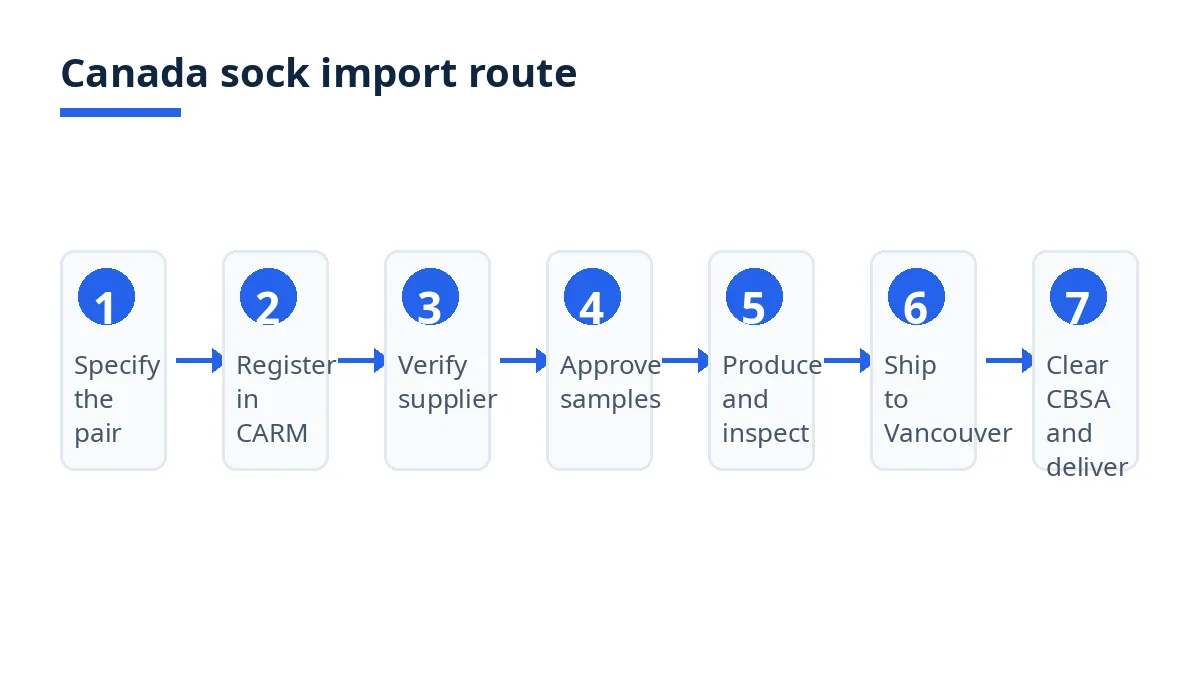
Write the specification pair by pair: length, fiber mix, size range, heel and toe, cuff, cushioning or grip, colors, bilingual labelling, and packing.
Classify every style from heading 6115 and confirm each code and tariff treatment with your broker.
Register in the CARM Client Portal, arrange your RM account, delegate authority to your broker, and settle Release Prior to Payment and financial security before you order.
Shortlist sock knitters whose range includes your lengths and fiber mixes, and request comparable quotes on the identical specification and delivery term, priced per pair.
Verify the chosen supplier: documents, knitting and pairing capacity, toe closing and boarding, and a factory check for a first order.
Order samples in stages, wear and wash them, then approve a pre-production sample of each style, with the bilingual label approved at the same time.
Confirm the order in writing: purchase order, pro forma invoice, delivery and payment terms, inspection plan, labelling, packing and shipment date.
Inspect during production and again on packed goods against the approved samples.
Ship through the gateway that suits your warehouse, clear customs with the confirmed code and tariff treatment, pay duty and GST, and reconcile the actual landed cost.
How Exportain helps
Browse suppliers for Bangladeshi exporters whose ranges include socks, compare them against your style list, then post your specification as an RFQ and compare replies on the same terms, priced per pair. Read how to buy to see how RFQs, quotations and messaging work on Exportain. Exportain is a B2B marketplace for RFQs, quotations and supplier messages. It does not inspect goods, book freight or clear customs.
FAQs
What is the typical MOQ for socks from Bangladesh?
There is no single typical minimum: it is set per style and usually per color, because yarn is dyed in batches and machines are set up per style and size range. Ask how each supplier's minimum splits by style, color and size range.
How long does shipping take?
Sea transit takes weeks rather than days and varies by gateway, routing, transshipment and season: plan from your forwarder's current sailing schedule and add clearance and inland delivery.
What import duty applies?
Duty follows the confirmed classification of each style, the origin of the goods and the tariff treatment in force on the entry date. Socks sit in heading 6115: graduated compression hosiery in 6115.10, other panty hose and tights in 6115.21 to 6115.29, women's hosiery in 6115.30, and other hosiery by fiber in 6115.94 to 6115.99.1 In the schedule edition opened for this guide, the MFN rate is 18 percent on the panty hose and tights lines and 16 percent on the other lines, with LDCT listed among the applicable preferential tariffs, subject to the origin rules and the treatment in force on the entry date.1 2 Confirm the current line, rate and preference with your broker before you price.
How do I verify a supplier?
Check company documents first, so name, address and bank account agree across the trade licence, export registration and invoices. Then check capability: knitting capacity, toe closing, boarding, pairing, and recent sock production in your lengths and fiber mixes. Keep payments to the company account named in the documents, and approve a pre-production sample before bulk production.
Next steps on Exportain
Read how to import from Bangladesh for the full process, then work through the landed cost for imports from Bangladesh method with your quotations. When your specification and CARM setup are ready, post a free RFQ and compare quotes on the same specification, priced per pair.
Sources
- Customs Tariff, Chapter 61: Articles of apparel and clothing accessories, knitted or crocheted (2024). Canada Border Services Agency (accessed )
- Canada's unilateral tariff preference programs for imports from developing countries. Department of Finance Canada (accessed )
- Get started with CARM. Canada Border Services Agency (accessed )
- ISO 2859-1:2026 - Sampling procedures for inspection by attributes — Part 1: Sampling schemes indexed by acceptance quality limit (AQL) for lot-by-lot inspection. International Organization for Standardization (accessed )
- Guide to the Textile Labelling and Advertising Regulations. Competition Bureau Canada (accessed )
- OEKO-TEX Standard 100. OEKO-TEX (accessed )
- FCA & FOB Incoterms 2020 explained: Key differences. ICC Academy (accessed )
- Port of Vancouver moves record cargo in 2025, delivering more of what Canadians make, mine, harvest and grow to key overseas markets. Port of Vancouver (accessed )
- General Information for GST/HST Registrants. Canada Revenue Agency (accessed )
About the author
Sourcing from Bangladesh?
Post a request for quotation and suppliers on Exportain can send you their quotes directly.
Post an RFQ