

Polo Shirts From Bangladesh to USA: Step-by-Step Guide
Import polo shirts from Bangladesh to USA: collar and placket specification, supplier verification, samples, polo quality checks, 6105.10 and 6106.10 duty, USA labeling, Incoterms and a worked landed-cost example for one order.
Short answer
To import polo shirts from Bangladesh to the USA, specify the piqué fabric, collar, placket and cuffs, verify the supplier's documents and polo production, and approve a pre-production sample in production fabric. Classify cotton men's shirts under 6105.10.00 and women's under 6106.10.00, confirm the 19.7 percent general rate and any additional duties with your broker, settle USA fiber, origin and care labeling, choose FCA or FOB, file the ocean Importer Security Filing, and build landed cost before bulk production.
On this page
Key takeaways
Cotton polo shirts, knitted, sit under 6105.10.00 for men's or boys' shirts and 6106.10.00 for women's or girls' blouses and shirts, and the General rate in Revision 17 (2026) of the United States schedule is 19.7 percent for each line, with a Column 2 rate of 45 percent; confirm the line, the rate and any additional duties with your broker for your exact shirt on your entry date.
A polo specification must settle piqué fabric, collar and cuff construction, placket and button details, and shade across body, collar and cuffs, and bulk production should not start before the pre-production sample in actual bulk fabric and trims is approved in writing.
There is no single typical MOQ or transit time for this route: the minimum is set per style and per color, and transit time must be planned from your forwarder's current sailing schedule for your actual shipment date and USA port.
The USA label must show true fiber content, country of origin as made in Bangladesh, and the responsible business identity, plus a care instruction with a reasonable basis; the label must match the actual bulk fabric, including any fiber in the collar or cuffs.
Example figures only: 7,500 cotton polo shirts at a 48,000 dollar customs value, FOB Chattogram to the Port of Savannah, give a rounded landed cost of 8.29 dollars per shirt, using duty at the 19.7 percent general rate plus freight, insurance, broker, port, inland delivery and inspection lines.
A polo shirt is not a T-shirt with a collar added at the end. The collar, the button placket, the cuffs, and the piqué knit each change how the shirt is specified, inspected, classified, and priced. A buyer who orders polos with a T-shirt specification will receive shirts that look close to the request and fail on the details that matter in wear: a collar that curls after washing, a placket that gaps, buttons that loosen, or a collar shade that does not match the body. This guide works through a USA polo order in the order those decisions arise, from the polo specification to the landed cost at a USA warehouse.
Why source polo shirts from Bangladesh
Bangladesh has a deep knitwear base, and polos sit inside that base rather than at its edge. The work a polo needs, circular knitting of piqué fabric, dyeing, cutting, collar and cuff knitting, placket setting, button attachment, and finishing, is work that knitwear factories in Bangladesh perform as part of their regular production. That matters for a USA buyer because the supporting steps, fabric supply, dyeing, trims, and packing, are available in the same production chain, and a factory that runs polos regularly will already have answers for collar construction and placket setting that a factory trying the style for the first time will not.
Find and verify suppliers
Start with a shortlist of three to five suppliers that make knitted polo shirts as part of their current production. Ask each supplier for the same information, so replies can be compared directly: current polo production, piqué fabrics knitted or sourced, collar and cuff constructions run, size range produced regularly, and recent USA shipments if they are willing to describe them.
Verification has three layers. The first is company identity. Ask for the trade licence, export registration, and tax documents, and check that the legal company name, address, and bank account name agree across every document, quotation, and invoice. A mismatch between the name on the quotation and the name on the bank account is a reason to pause, not a detail to resolve after payment.
The second layer is capability. Ask how the factory makes the collar: whether collars and cuffs are knitted in the factory or bought in, how plackets are set and reinforced, and how buttons are attached and tested. Ask to see a finished polo from current production, in a fabric close to the one you plan to order, and check the collar shape, the placket line, and the cuff finish with your own eyes before you discuss price in detail.
The third layer is payment discipline. Pay only to the company account named in the verified documents, never to a personal account, and verify any change of bank details through a separate channel, by a phone call or a message to a contact you already know, before you send money. On Exportain, supplier profiles carry document and photo review badges. A badge records a review of documents and photos. It is not a factory inspection, not a guarantee of quality or delivery, and Exportain is not a party to the goods contract.
MOQ, pricing and samples
There is no single market MOQ for polo shirts from Bangladesh, and this guide states none. A supplier sets the minimum by style, by color, and sometimes by size breakdown, because dyeing, collar knitting, and button supply each have their own batch limits. A polo in one color may carry a lower minimum than the same polo in four colors, because each color needs its own dye lot and its own collar run. Ask each supplier to state, in writing, whether the minimum applies per order, per style, per color, or per size, and what happens to the price when you fall below it.
Compare quotations only when they share the same specification, quantity breakdown, Incoterm with named place, and inclusions. A price that excludes buttons, labels, or packing is incomplete, not lower. Ask each supplier to list what the unit price covers, then convert every quotation to the same basis, ideally to an estimated landed cost.
Samples are part of the contract, not a courtesy. Work through three stages. The development sample confirms that the supplier understood the specification. Comment on it precisely, by measurement, fabric, color, collar shape, and placket, rather than in general terms. The pre-production sample is made with the actual fabric, collars, buttons, labels, and packing intended for bulk production. Approve it in writing, keep one sealed piece yourself, and ask the factory to retain a matching piece. Bulk production should not start before that approval. The shipment sample, taken from finished bulk production, lets you compare bulk output with the approved pre-production sample before the goods leave, or lets your inspector do so on your behalf.
Quality control and certifications needed
Polo quality control starts where a T-shirt check ends. A T-shirt check covers fabric, measurements, seams, and print. A polo check adds the parts that give the shirt its shape and its failure points. Check the piqué knit for holes, dropped stitches, and uneven dyeing, and check shade across the body, collar, and cuffs together, because a collar knitted in a separate run can drift from the body shade even when both pass on their own.
Then check the collar and placket piece by piece. The collar should sit flat, hold its shape, and match the body in shade and fabric weight. Collar points should be even, the collar seam should be clean, and the collar should recover after folding rather than holding a crease. The placket should run straight, with even stitching, a reinforced base, and buttonholes that are cleanly cut and finished. Buttons should be securely attached, evenly spaced, and matched in color and size, with no cracked or chipped buttons in the shipment. Cuffs should match each other in width and rib recovery, and sleeve and body hems should be even.
USA labeling is part of quality control, not an afterthought at packing. Federal law requires that most textile and wool products have a label that lists the fiber content, the country of origin, and the identity of the manufacturer or another business responsible for marketing or handling the product, and under the Care Labeling Rule, manufacturers and importers must provide instructions so consumers know how to clean the products they buy.1 For a polo, that means the fiber label must match the actual bulk fabric, including any elastane or other fiber in the collar or cuffs, the origin must read as made in Bangladesh where that is the origin, and the care instruction must have a reasonable basis in how the shirt actually washes. A label copied from a previous order, in a different fabric, is a mislabel, even when the shirt itself is sound.
Incoterms, shipping and transit time
The Incoterms 2020 rules allocate transport, costs, and risk between seller and buyer through eleven clauses, and they do not govern ownership, payment, or choice of law.2 The eleven clauses fall into two groups: clauses for any mode of transport, and clauses for sea and inland-waterway transport only, and under every clause, risk passes from seller to buyer at the place of delivery.2 Write the clause in full in the contract, with the named place or port and the words Incoterms 2020, so that neither side has to guess where delivery, cost, or risk changes hands.
For a first containerized polo order to the United States, weigh FCA against FOB. Under FOB, the seller delivers the goods on board the vessel at the named port of shipment, and risk passes at that point. Under FCA, the seller delivers the goods to the carrier at the named place, and risk passes on handover to the carrier there. The ICC Academy notes that for goods in containers, the Incoterms 2020 rule FCA is typically a better choice, even for maritime transport, because a container is usually handed to the carrier at a terminal well before it is loaded onto the vessel.3 That timing difference is the reason to choose deliberately, rather than by habit. A container delivered to a terminal under an FOB term leaves a gap between handover and loading that the contract does not describe well.
There is no single typical transit time for polo shirts from Bangladesh to the United States, and this guide gives no figure for it. Sea freight is the standard route for bulk orders, and the time from factory gate to your warehouse is the sum of production time, inland movement to the port, ocean transit, USA clearance, and inland delivery. Each leg varies by port, routing, transshipment, season, and clearance. Plan from your forwarder's current sailing schedule for your actual shipment date, for your actual USA port, and for the container size you will actually use. A transit figure borrowed from another route, another season, or another product will mislead your delivery promise.
Import duty, taxes and documents
Polo shirts are knitted shirts, and the USA schedule treats knitted shirts under headings 6105 and 6106, not under the T-shirt heading 6109. The schedule note for those headings states that shirts are garments designed to cover the upper part of the body, having long or short sleeves and a full or partial opening starting at the neckline, and that shirts may also have a collar.4 A polo, with its partial neckline opening and its collar, fits that description. The same note excludes garments with pockets below the waist, with a ribbed waistband or other means of tightening at the bottom, or with fewer than ten stitches per linear centimeter in each direction over the measured area.4 If your polo design adds a ribbed waistband, a pocket below the waist, or a similar feature, tell your broker before you price, because the classification may change.
For cotton polo shirts, the schedule lines are as follows. Men's or boys' knitted shirts of cotton fall under subheading 6105.10.00, and women's or girls' knitted blouses and shirts of cotton fall under subheading 6106.10.00.4 In Revision 17 (2026) of the schedule, each of those national lines shows a General rate of 19.7 percent and a Column 2 rate of 45 percent.4 That 19.7 percent figure is the national line from that revision, for that line, and it is not a universal rate for all polo shirts. A polo in a different fiber, a polo with a different construction, or a polo entered on a different date may fall under a different line or a different rate, and additional duties may apply on the entry date. Have your customs broker confirm the line, the rate, and any additional duties in force on your entry date, for your exact shirt, before you price or commit.
The entry document set for a USA ocean shipment starts with the entry documentation required to secure release: the entry on CBP Form 3461 or its electronic equivalent, evidence of the right to make entry, a commercial invoice, and a packing list where appropriate.5 The entry summary, on CBP Form 7501 or its electronic equivalent, follows with the duty calculation, and the commercial invoice must describe the goods in plain, specific terms, by style, fiber, and quantity, so that classification, valuation, and origin can all be checked against it. Keep the importer number consistent across every form. It is normally your employer identification number, and a mismatch across forms will slow release.
For ocean cargo, the Importer Security Filing is a separate transmission from the entry filing. Importers must electronically submit ten specific data elements at least 24 hours before the cargo is loaded onto a vessel at the foreign port, and the filing applies to most containerized ocean shipments.6 Confirm at order stage who files it, what data they need from the supplier, and who holds the ISF bond, because a late or inaccurate filing can draw penalties, cargo holds, and closer scrutiny of later shipments.6 The ISF does not replace the entry, and the entry does not replace the ISF. Both must be filed, on their own timetables, for the same shipment.
Landed cost example (table)
Example figures only. The figures below are not a real price, freight rate, or charge for any product, route, or supplier. They show the method, using a different order size, port, and set of figures from the earlier USA cotton T-shirt guide. Replace every line with your own quotation, your own broker schedule, and your broker-confirmed duty line before you price.
Example order: 7,500 cotton polo shirts, FOB Chattogram, Incoterms 2020, ocean freight to the Port of Savannah, inland delivery to a warehouse in Georgia, customs value 48,000 dollars.
Cost element | Example figure | How to obtain your figure |
|---|---|---|
Product cost: 7,500 shirts at 6.40 dollars FOB | 48,000.00 dollars | Supplier quotation, FOB Chattogram, Incoterms 2020 |
Ocean freight, Chattogram to Savannah | 2,850.00 dollars | Forwarder quote for your sailing date and container size |
Cargo insurance | 210.00 dollars | Insurer or forwarder quote for your shipment value |
Import duty: 19.7 percent of 48,000 dollars, line 6105.10.00, Revision 17 (2026) | 9,456.00 dollars | Broker-confirmed national line and rate for your entry date |
Customs broker and clearance | 320.00 dollars | Broker fee schedule for one entry |
Destination port and terminal charges | 410.00 dollars | Forwarder or carrier quote for Savannah |
Inland delivery to warehouse in Georgia | 580.00 dollars | Haulier quote for your warehouse address |
Pre-shipment inspection | 350.00 dollars | Inspection company quote for your inspection plan |
Total landed cost | 62,176.00 dollars | Sum of the lines above |
Landed cost per shirt: 62,176.00 dollars divided by 7,500 shirts | 8.29 dollars | Total divided by shirts received in good condition |
State sales tax treatment is separate from federal entry costs and depends on your business and resale position, so confirm it with your own tax adviser. For the full method, see the landed cost for imports from Bangladesh guide.
Step-by-step import checklist
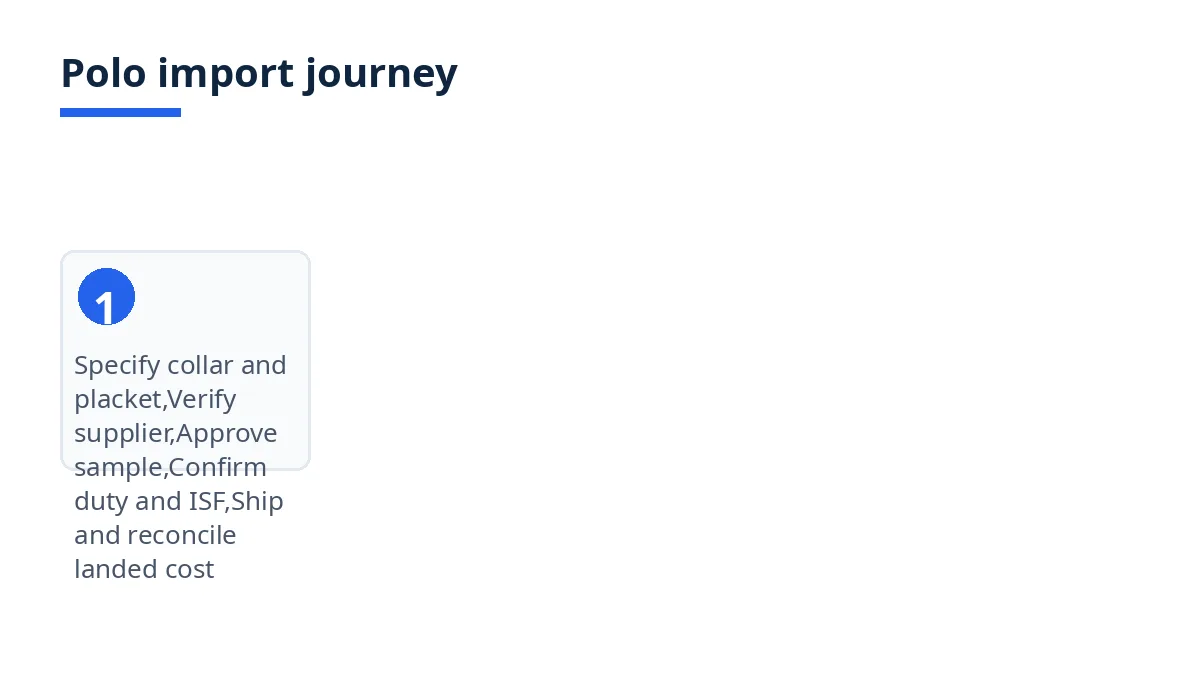
Write the polo specification in full: piqué fabric and weight, fiber content, collar and cuff construction, placket and button details, measurements and tolerances, colors and shade standard, labels, and packing.
Shortlist three to five suppliers with current polo production, and verify company identity, capability, and bank account details before discussing price in detail.
Send every shortlisted supplier the same RFQ, with the same quantity breakdown, the same Incoterm and named place, and the same sample and inspection requirements.
Compare quotations on the same basis, convert each to an estimated landed cost, and confirm the duty line with your broker before you choose.
Approve the development sample, then approve the pre-production sample in writing, in the actual bulk fabric and trims, before bulk production starts.
Agree the inspection plan, defect limits, and shipment sample in writing, and confirm who inspects and at which stage.
Confirm who files the ocean Importer Security Filing, who arranges cargo insurance, and who holds the customs bond, before goods leave the factory.
Check the USA labels against the bulk fabric and the approved care instruction, and check collar, placket, and cuff quality on the shipment sample.
File the entry documents with consistent importer numbers, descriptions, and quantities, and reconcile the landed cost against the actual invoices on arrival.
Record what worked and what did not, by supplier and by style, so the next polo order starts from evidence rather than from memory.
How Exportain helps
Browse suppliers for Bangladeshi polo-shirt exporters and compare their ranges against your style list, then post your specification and target quantity as an RFQ and compare replies on the same terms before you choose a factory for sampling. Exportain is a B2B marketplace where buyers post RFQs, receive quotations, and message suppliers. It does not inspect goods, book freight, or clear customs, and a document and photo review badge is not a factory inspection or a guarantee.
FAQs
What is the typical MOQ for polo shirts from Bangladesh?
There is no typical MOQ to quote. Suppliers set the minimum by style, by color, and sometimes by size breakdown, because dyeing, collar knitting, and button supply each have batch limits. Ask each supplier to state its minimum in writing, per style and per color, and to state the price change if you order below it.
How long does shipping take?
Shipping time has no single figure for this route. It is the sum of production time, inland movement to the port, ocean transit, USA clearance, and inland delivery, and each leg varies by port, routing, transshipment, season, and clearance. Plan from your forwarder's current sailing schedule for your actual shipment date and your actual USA port.
What import duty applies?
For cotton polo shirts, the national lines in Revision 17 (2026) of the USA schedule are 6105.10.00 for men's or boys' shirts and 6106.10.00 for women's or girls' blouses and shirts, each showing a General rate of 19.7 percent and a Column 2 rate of 45 percent.4 That is a national line from that revision, not a universal rate. Have your broker confirm the line, the rate, and any additional duties in force on your entry date, for your exact shirt, before you price.
How do I verify a supplier?
Check company identity first, so that the legal name, address, and bank account agree across the trade licence, export registration, quotations, and invoices. Then check capability: current polo production, collar and cuff construction, and a finished polo from current production. Keep payments to the company account named in the documents, approve a pre-production sample before bulk production, and add a factory visit, an independent audit, or a trial order for larger programmes.
Next steps on Exportain
Read the how to import from Bangladesh guide for the full import process, then work through the landed cost for imports from Bangladesh guide to build your own per-shirt calculation. When your specification is ready, Post a free RFQ on Exportain with the polo fabric, collar, placket, quantity breakdown, and destination port attached, so replies can be compared on the same terms. You can also review the how to buy steps before you post, so the quotation, sampling, and payment steps are clear from the start.
Sources
- Textile, Wool, Fur, Apparel and Leather Matters. Federal Trade Commission (accessed )
- Incoterms 2020: all 11 clauses, risk, and costs. INN.LAW (accessed )
- Place of delivery & risk transfer in trade contracts. ICC Academy (accessed )
- Harmonized Tariff Schedule of the United States, Chapter 61: Articles of apparel and clothing accessories, knitted or crocheted (Revision 17, 2026). United States International Trade Commission (accessed )
- 19 CFR 142.3 - Entry documentation required. Legal Information Institute, Cornell Law School (accessed )
- Importer Security Filing (ISF). DP World (accessed )
About the author
Sourcing from Bangladesh?
Post a request for quotation and suppliers on Exportain can send you their quotes directly.
Post an RFQ


