Importing Polo Shirts From Bangladesh to UAE: Costs, Duties and Suppliers
UAE polo shirt import guide: Jebel Ali routing, Dubai duty and VAT on CIF value, Arabic labeling, and an AED landed-cost example for 3,600 shirts.
Short answer
To import polo shirts from Bangladesh to the UAE, specify the collar, placket, embroidery, and size range, shortlist knitted polo suppliers, and approve a pre-production sample with an Arabic or bilingual label. Treat 6105.10 for men and 6106.10 for women as indicative lines, ask your broker to confirm the UAE line on the entry date, settle the Dubai duty and VAT treatment on the CIF value, and clear the shipment through Jebel Ali under a Mirsal 2 declaration.

On this page
Key takeaways
Dubai customs duty is 5 per cent of the CIF value in general terms, but that is not a tariff-line confirmation for 6105.10 or 6106.10: the broker must confirm the current UAE line for each exact style on the entry date, and a Bangladesh-made shirt gains no GCC-origin treatment.
Import VAT is 5 per cent on the Federal Tax Authority base of CIF value plus customs duty for a shipment with no excise tax, and whether it is a final cost or recoverable input tax depends on the buyer's VAT registration and use of the goods for taxable supplies.
UAE textile labels must be in Arabic or in both Arabic and English, stating fiber composition, country of origin, and ISO care symbols, with ESMA conformity and an Emirates Conformity Assessment Scheme certificate where required, and the artwork must be checked in Arabic by a reader of Arabic.
Commercial import through Dubai requires a valid trade license, an active customs business code, a Mirsal 2 declaration, and a delivery order, and every document must match the others in name, quantity, value, wearer split, and code.
Example figures only: a 3,600-shirt Jebel Ali order lands at AED 17.26 per shirt excluding VAT and AED 18.08 including example VAT, and a separate 900-shirt inspection example at Level II gives code J, a sample of 80, accept 5 for major defects at AQL 2.5 and accept 7 for minor defects at AQL 4.0.
A buyer in Abu Dhabi who orders polo shirts for a staff uniform program, a corporate client, or a retail range faces the UAE entry questions before the price can be settled: what duty applies on the CIF value at Jebel Ali, how import VAT is worked out on the duty-paid value, and what the sewn-in label must say when the shirts are sold or issued in the UAE. Answer those three points with your broker before the goods sail.
The duty starting point for Dubai is stated on the official portal of the UAE Government: the customs tariff in Dubai is 5 per cent of the CIF value, except for alcohol and cigarettes, and government tariffs range from 0 to 5 per cent.1 That is a general treatment, not a tariff-line confirmation for any single polo shirt, so the broker must still confirm the current line for the exact style on the entry date. Import VAT is a separate charge. The Federal Tax Authority guide states that VAT at the point of import is imposed on the value of the import, comprising the customs value including insurance, freight and customs fees, and any excise tax paid, and that import VAT is imposed on top of the customs duties and excise tax inclusive value.2 Duty is therefore worked out first, and VAT is then worked out on a base that already includes that duty.2
Why source polo shirts from Bangladesh
Bangladesh suits a polo shirt program because knitwear production, dyeing, finishing, embroidery, and packaging trades are built around garment production, so several factories can usually quote the same polo shirt. Exportain's pillar guide to importing from Bangladesh frames the buyer sequence as specification first, supplier verification second, and price comparison on a common basis third.3
The UAE angle in this guide is an entry-first angle. The goods arrive at Jebel Ali, clear through a Dubai declaration, and then either enter the UAE mainland for sale or issue, move under a free-zone arrangement, or move onward as a re-export to a neighboring Gulf market. Each route carries a different clearance and tax outcome, and the route must be fixed before filing, not after arrival. DP World describes Jebel Ali as connected through its inland logistics network to Jafza and to end markets in the UAE and beyond.4 Fix the selling or issuing market before approving artwork: UAE retail and uniform issue need an Arabic or bilingual label, while a re-export polo shirt may follow its destination market instead.
Find and verify suppliers
Start with a specification before contacting suppliers. A usable polo specification states fabric construction and weight in grams per square meter, fiber composition, pique or jersey knit, fit and size range with a measurement chart, collar construction and rib recovery, placket length and button type, sleeve cuff finish, embroidery or print method and placement, color standards, packaging per carton, and label artwork in Arabic or in both Arabic and English, plus quantity per style, color, and size, and the split between men's and women's styles where both are ordered.
Shortlist three to five suppliers who make knitted polo shirts themselves or who can show a direct production relationship with the factory that will make them. Ask each candidate for the same documents: the legal company name and registered address, the trade license, the taxpayer identification number, the VAT registration where applicable, and the Export Registration Certificate. Check that the same legal name appears on the quotation, the proforma invoice, the bank details, and the shipping documents. Exportain's pillar guide sets out the same document sequence and warns that a badge or profile note is a record of checks reviewed, not a guarantee of capacity or quality.3
MOQ, pricing and samples
No single minimum order quantity figure applies to every polo shirt factory in Bangladesh, so this guide states no figure as a market fact. A minimum depends on the fabric, the color count, the size range, the embroidery setup, and whether the factory must dye fabric to order or can cut from stock fabric. Treat any minimum a supplier states as that supplier's figure for that specification, and ask whether it applies per order, per style, per color, or per size. Embroidery setup is charged per design and per placement, so a small run with several chest logos can carry a higher per-shirt setup cost than a larger run with one logo.
Pricing follows the same logic. The unit price moves with fabric weight, fiber mix, collar and placket construction, button quality, embroidery coverage, label and packaging complexity, and quantity, and it moves again with the delivery term: FOB Chattogram excludes main freight and insurance, while CIF Jebel Ali includes them to the named destination port, subject to the insurance level in the contract. Samples are the contract in physical form. The development sample confirms that the factory understood the specification, including the collar shape and placket sit. The pre-production sample, made with the actual fabric, trims, buttons, embroidery, labels, and packaging for the bulk order, is the piece to approve in writing, including the label artwork and embroidery thread colors. Keep one sealed pre-production sample with the buyer and one matching piece at the factory, and do not authorize bulk production before that approval. Wash-test the pre-production sample before approval so collar curling and shrinkage are found before bulk, not after delivery.
Quality control and certifications needed
Quality control starts with the fabric and ends with the carton. Before production, confirm fabric weight, shrinkage allowance, color fastness, and measurement tolerances, plus collar rib recovery and button pull strength. During production, check knitting and dyeing, cutting, collar and placket sewing, embroidery placement, label attachment, and measurement against the approved sample. At final inspection, check the finished shirts, embroidery quality, packaging, carton marks, and label artwork against the approved artwork.
Labeling is where UAE rules enter the factory specification directly. Labels for textile and garment products in the UAE must be in Arabic, or in both Arabic and English, and must clearly state the fiber composition, the country of origin, and internationally recognized care instructions using ISO symbols.5 Products must also conform to the standards of the Emirates Authority for Standardization and Metrology, covering color fastness, flammability, and the absence of harmful chemicals such as azo dyes and formaldehyde, and demonstrating conformity often requires a certificate under the Emirates Conformity Assessment Scheme.5 For certain textiles, such as children's sleepwear or fabrics making specific health claims, additional certifications and laboratory test reports may be required.5 If a retailer or customer requires a particular standard, name it in the purchase order, state which test report or certificate must accompany the shipment and who pays for testing, and ask for the certificate before production.
For the final inspection, agree a sampling plan in advance and record it in the purchase order. The AQL system under ISO 2859-1 sets the sample size from the lot size and inspection level, and the accept and reject numbers for each defect class.6 As an example only, a 900-shirt inspection lot at General Inspection Level II gives code letter J, a sample of 80 shirts, accept 5 and reject 6 for major defects at AQL 2.5, and accept 7 and reject 8 for minor defects at AQL 4.0.6 Define major defects for a polo shirt in the purchase order before inspection: a twisted collar, a misaligned placket, a missing button, and a wrong embroidery placement are major defects in most uniform programs.
Incoterms, shipping and transit time
The delivery term decides who arranges the main carriage, who bears transit risk, and which costs are already inside the price. For a first Jebel Ali order, FOB Chattogram, CIF Jebel Ali, and DAP Dubai are the three rules most buyers compare. Under FOB, the seller delivers the goods on board the buyer's nominated vessel at Chattogram, and the buyer arranges and pays for main freight and insurance from that point. Under CIF, the seller contracts for carriage and at least minimum insurance to Jebel Ali, while the buyer still handles import clearance, duty, VAT, and onward delivery. Under DAP, the seller delivers ready for unloading at a named place in Dubai, but the buyer still clears the goods for import. Incoterms do not transfer ownership or set price or payment terms.7
Containerized cargo needs one extra check. FOB, CFR, and CIF are sea and inland waterway rules written for goods loaded on a vessel, while FCA is the rule designed for containers handed to a carrier before loading, and using a sea-only rule for a container shipment leaves a gap in risk cover between handover and loading.7 Under CIF, cost and risk also separate: the seller pays freight and insurance to the destination port, but risk passes to the buyer when the goods are loaded at origin.7 A buyer who wants the seller to carry risk to Dubai should look at a delivered rule, and a buyer who accepts CIF should confirm the insurance level, since CIF requires only minimum cover unless the parties agree more.7
No transit time is stated here as a standard figure, because the time from Chattogram to Jebel Ali depends on the sailing schedule, transshipment port, carrier, season, and congestion at both ports. Ask the forwarder for a dated estimate naming the vessel, any transshipment point, and the expected Jebel Ali arrival date. Sea freight to Jebel Ali is the normal bulk route; air freight is for samples or urgent replenishment only.
Import duty, taxes and documents
Classification comes first, and for polo shirts it splits by wearer before it splits by fiber. The nomenclature description for the men's cotton line is men's or boys' shirts of cotton, knitted or crocheted, excluding nightshirts, T-shirts, singlets and other vests.8 The women's cotton line is described as women's or girls' blouses, shirts and shirt-blouses of cotton, knitted or crocheted, excluding T-shirts and vests.9 Those descriptions are nomenclature descriptions only, not UAE duty rates, and no duty figure for 6105.10 or 6106.10 should be copied from a nomenclature page. The broker must confirm the full UAE line for each exact style on the entry date, and a mixed men's and women's order needs a separate line for each wearer group.
The duty treatment for a mainland UAE import is then assessed on the CIF value. The official portal of the UAE Government states that the Dubai customs tariff is 5 per cent of the CIF value, except for alcohol and cigarettes, and that government tariffs in the country range from 0 to 5 per cent.1 The same portal notes that goods originating from GCC countries are treated as UAE local goods where the GCC origin condition is met.1 A shirt manufactured in Bangladesh is not a GCC-origin good, so it gains no GCC-origin treatment on that basis. If the broker confirms a different current line figure on the entry date, that figure governs and the example below must be recalculated.
VAT is calculated after duty. The Federal Tax Authority guide states that import VAT is imposed on the value of the import, comprising the customs value including insurance, freight, and customs fees, plus any excise tax, and that import VAT is imposed on top of the customs duties and excise tax inclusive value, with the standard rate applied at 5 per cent.2 For a polo shirt shipment with no excise tax, the VAT base in the example is therefore the CIF value plus the customs duty. Whether that VAT is a final cost or a recoverable input tax depends on the buyer's VAT registration and use of the goods for taxable supplies, so the accountant should confirm recoverability before pricing.
Before the vessel sails, assemble the broker documents and check that every document tells the same story. The core set is the commercial invoice, the packing list, the bill of lading, the certificate of origin where required, and the customs declaration itself.10 To import commercially in Dubai, a business must hold a valid UAE trade license and an active customs business code registered through the Dubai Trade Portal, and without a valid customs code no import declaration can be filed.10 The declaration is submitted through the Mirsal 2 platform and must state the importer customs business code, the code for each product line, the declared CIF value, the country of origin, references to the invoice and transport document, and the duty and VAT calculation.10 The delivery order is a parallel step: it is issued by the shipping line or forwarder once the bill of lading has been surrendered or original copies presented and freight charges settled, and without it cargo cannot be collected from the port even after customs approval.10 A mismatch between invoice, packing list, bill of lading, and declaration, even a small difference in quantity, wearer split, or consignee name, is enough to hold the declaration for manual review, so run the consistency check before submission.10
Landed cost example (table)
The table below follows the Exportain landed-cost method11 and is an example only: every figure is an example figure for a Jebel Ali-bound order, not a quoted price, freight rate, or charge for any real shipment. The duty line uses the standard Dubai CIF treatment as an example figure, and the broker must confirm the current line for 6105.10 and 6106.10 on the entry date before this table is used for pricing. VAT uses the Federal Tax Authority formula, 5 per cent of the CIF value plus duty, shown separately so a buyer who can recover it can exclude it.
Line | Example item | Example figure (AED) |
|---|---|---|
Quantity | Polo shirts, FOB Chattogram to Jebel Ali | 3,600 shirts |
Product cost | 3,600 shirts at AED 14.50 per shirt | 52,200.00 |
Ocean freight | Chattogram to Jebel Ali, example | 3,850.00 |
Cargo insurance | Voyage insurance, example | 360.00 |
CIF value | Product cost plus freight plus insurance | 56,410.00 |
Import duty, example | 5 per cent of CIF value, broker to confirm line | 2,820.50 |
VAT base | CIF value plus import duty | 59,230.50 |
Customs broker fee | Example broker fee for the entry | 590.00 |
Destination port and terminal charges | Jebel Ali arrival charges | 690.00 |
Inland delivery | Jebel Ali to an Abu Dhabi warehouse, example | 720.00 |
Pre-shipment inspection | Example inspection fee | 640.00 |
Bank and currency costs | Transfer and margin costs | 260.00 |
Total landed cost excluding VAT | Sum of the lines above excluding VAT | 62,130.50 |
Landed cost per shirt excluding VAT | Total excluding VAT / 3,600 shirts | 17.26 |
VAT, example | 5 per cent of AED 59,230.50 under the Federal Tax Authority formula | 2,961.53 |
Total including example VAT | Total excluding VAT plus example VAT | 65,092.03 |
Landed cost per shirt including example VAT | Total including VAT / 3,600 shirts | 18.08 |
Step-by-step import checklist
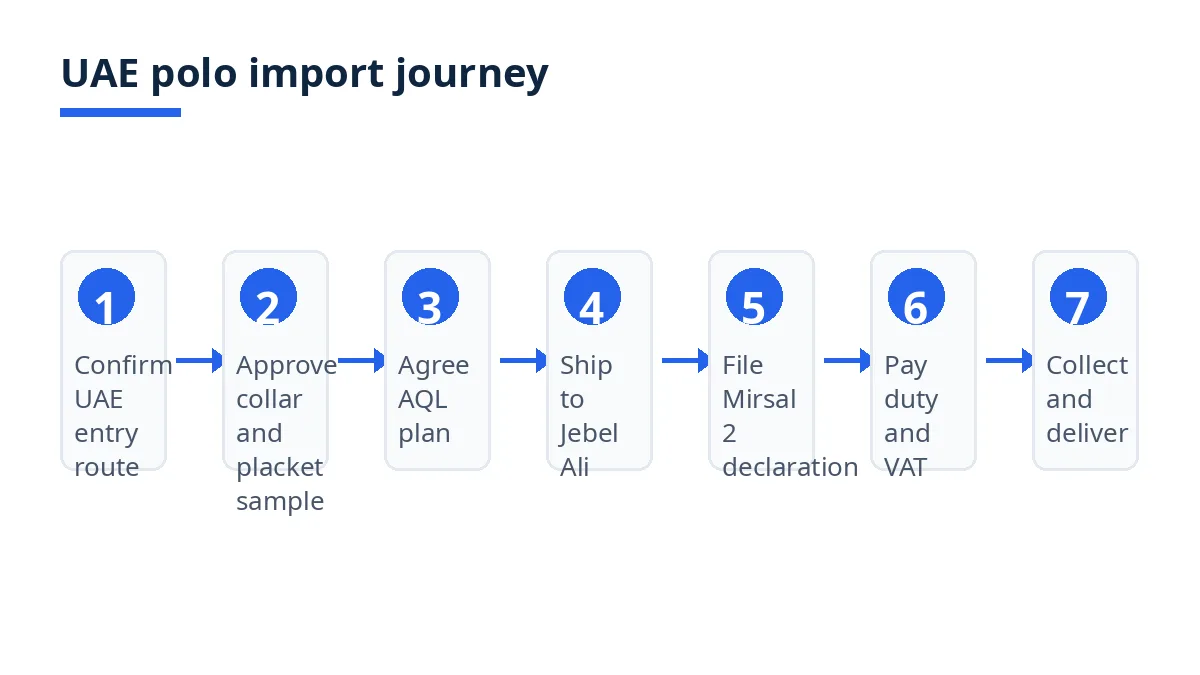
Confirm the UAE entry route first: mainland sale or issue, free-zone storage, or re-export, and the matching declaration type.
Confirm classification with the broker for each wearer group, the current UAE line figure, the duty treatment, and the VAT base, before shipment.
Write the full polo specification: fabric weight, fiber mix, collar and placket construction, embroidery placement, size range, packaging, and label artwork.
Shortlist three to five knitted polo suppliers, request the same documents from each, and check the legal name matches across all documents.
Compare quotations on the same delivery term, converted to estimated landed cost, with embroidery setup shown separately.
Approve the development sample, then the pre-production sample in writing, including a wash test, keeping one sealed piece.
Record the AQL sampling plan, the polo defect list, and required certificates in the purchase order.
Assemble the invoice, packing list, bill of lading, origin document, and Mirsal 2 declaration, and check figures and names match.
Obtain the delivery order, pay duty and VAT, collect the goods from Jebel Ali, and deliver onward.
Reconcile landed cost against actual invoices, keep the shipment file, and record any claim.
How Exportain helps
Exportain can shorten the supplier-search stage without replacing the checks in this guide. Buyers can search the supplier directory by product and category, review supplier profiles, and read which document and profile checks have been reviewed for each supplier. The how-to-buy guide sets out the eight steps from first search to shipment, including posting an RFQ, comparing versioned quotations, and arranging freight and inspection.
FAQs
What is the typical MOQ for polo shirts from Bangladesh?
There is no single figure that holds for every factory, so no figure is stated here as a market fact. A minimum depends on fabric, color count, size range, embroidery setup, and whether fabric must be dyed to order. Ask each supplier whether its minimum applies per order, per style, per color, or per size, and get the answer in writing.
How long does shipping take?
No standard transit time is stated as a fact in this guide, because the time from Chattogram to Jebel Ali depends on the sailing schedule, transshipment port, carrier, season, and congestion at both ports. Ask the forwarder for a dated estimate naming the vessel, any transshipment point, and the expected Jebel Ali arrival date.
What import duty applies?
For a mainland import, the Dubai customs tariff is 5 per cent of the CIF value in general terms, as stated on the official portal of the UAE Government.1 That is not a tariff-line confirmation for 6105.10 or 6106.10. The broker must confirm the current UAE line for each exact style on the entry date, and if that figure differs from the standard treatment, it governs and the landed-cost example must be recalculated. A shirt manufactured in Bangladesh does not gain GCC-origin treatment.1
How do I verify a supplier?
Request the same documents from every candidate: legal company name and registered address, trade license, taxpayer identification number, VAT registration where applicable, and Export Registration Certificate, and check that the same legal name appears on the quotation, invoice, bank details, and shipping documents.3 Add reference buyers the supplier is willing to name, a clear statement of who will make the goods and where, and written pre-production sample approval, including the collar, placket, and embroidery, before bulk production.
Next steps on Exportain
Start with the specification, not with a price request. Write the fabric, collar, placket, embroidery, size range, packaging, and Arabic or bilingual label artwork into one document, then post a free RFQ on Exportain so suppliers in the category can quote against the same brief. Compare the replies on the same delivery term, convert each one to an estimated landed cost, and confirm the classification, duty line, and VAT base with your broker before approving bulk production. For the wider steps, read the pillar guide to importing from Bangladesh and browse the supplier directory.
Sources
- Customs duty and tariff. UAE Government (accessed )
- Value Added Tax (VAT) Returns User Guide. Federal Tax Authority (accessed )
- How to Import from Bangladesh. Exportain (accessed )
- DP World to expand UAE gateway network with new Fujairah terminals. DP World (accessed )
- UAE Textile and Garment Import Regulations. Nour Attorneys (accessed )
- AQL Calculator | Sample Size and ISO 2859-1 Tool. AQMBD (accessed )
- Incoterms 2020 Explained: All 11 Rules. Blue Ocean Academy (accessed )
- HS Code 61051000 - Men's or boys' shirts of cotton, knitted or crocheted. Tariffnumber (accessed )
- HS Code 61061000 - Women's or girls' blouses, shirts and shirt-blouses of cotton, knitted or crocheted. Tariffnumber (accessed )
- Documents Required for Customs Clearance in Dubai. TTL (accessed )
- Landed Cost for Imports from Bangladesh. Exportain (accessed )
About the author
Sourcing from Bangladesh?
Post a request for quotation and suppliers on Exportain can send you their quotes directly.
Post an RFQ