

Polo Shirts From Bangladesh to Saudi Arabia: A Buyer's Import Checklist
Saudi polo shirt import checklist: ZATCA duty and VAT at Jeddah, Arabic labeling, supplier checks, and a SAR landed-cost example for 2,750 shirts.
Short answer
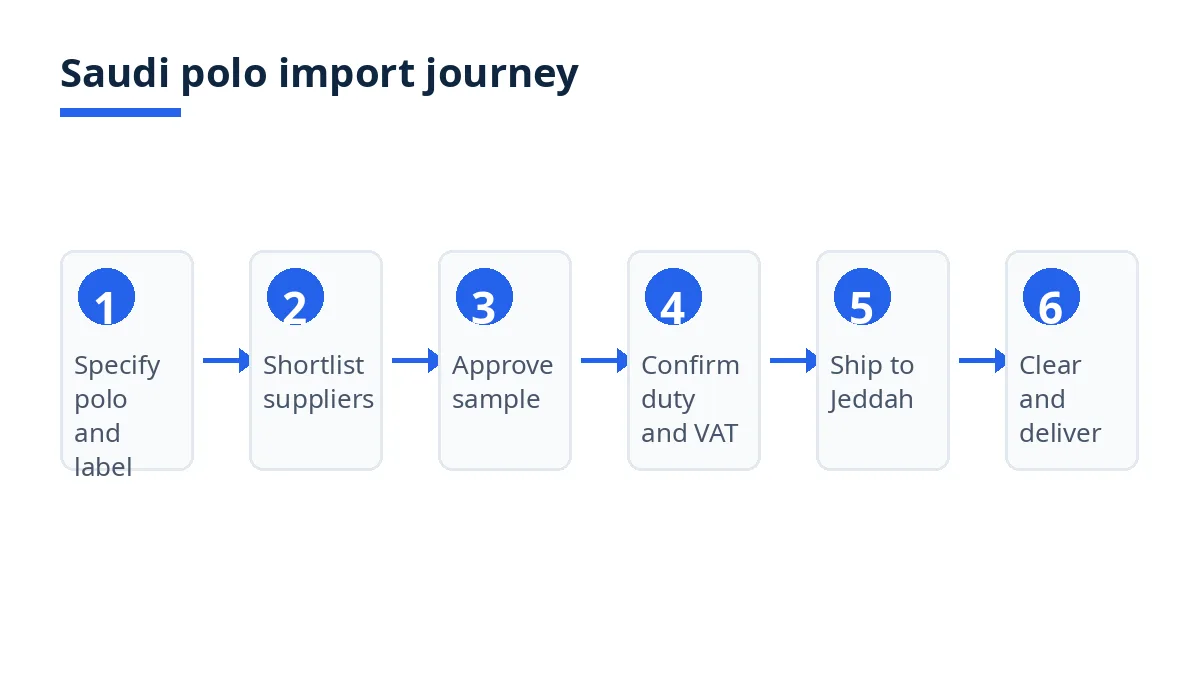
To import polo shirts from Bangladesh to Saudi Arabia, specify the polo in full, shortlist knit suppliers, and approve a pre-production sample carrying an Arabic or bilingual Arabic and English label. Classify each style under 6105 or 6106, ask your broker to confirm the current Saudi line on the entry date, settle ZATCA duty and 15 percent import VAT treatment on the customs value plus duty before pricing, and clear the shipment through Jeddah under a FASAH declaration.
On this page
Key takeaways
No percentage duty rate for 6105 or 6106 is asserted as fact: no opened Saudi tariff page rendered a line-specific rate for those headings in text, so the broker must confirm the current Saudi line on the entry date, and a Bangladesh-made polo gains no GCC-origin duty-free treatment.
Saudi import VAT is 15 percent on the customs value plus customs duty for a standard-rated shipment, and whether it is a final cost or a recoverable input tax depends on the buyer's VAT registration and use of the goods for taxable supplies.
Saudi textile labels must be in Arabic or Arabic and English, stating fiber composition, size, supplier name and commercial registration on external packaging, country of origin, and care instructions; confirm the SABER pathway for the exact polo before shipment.
Commercial import requires FASAH registration and an Advance Cargo Declaration at least 24 hours before departure, plus a shipping instruction carrying the full registered consignee detail, cargo description, quantity, package, weight, and HS code to at least six digits, inside the carrier cut-off time.
Example figures only: a 2,750-shirt Jeddah order lands at SAR 14.91 per shirt excluding VAT and SAR 16.95 including example VAT, using an illustrative duty placeholder that is not a tariff rate, and a 2,750-shirt inspection lot at Level II gives code K, a sample of 125, accept 7 for major defects at AQL 2.5 and accept 10 for minor defects at AQL 4.0.
A polo shirt order for Saudi Arabia is decided at Saudi entry, not at the factory gate. The collar shape, the placket, and the fabric weight are settled in Bangladesh, but the order only becomes saleable stock when it clears a Saudi port, carries a label that meets Saudi textile rules, and arrives with documents that match each other line by line. Settling those Saudi questions after production has started costs far more than getting each point right in the purchase order.
Saudi import VAT is charged at a standard rate of 15 percent, and the ZATCA guideline for the retail sector describes 15 percent as the standard rate.1 For imports, the VAT base is the customs value plus any customs duty, and import VAT is 15 percent of that sum, so duty and VAT cannot be priced separately.2 No opened Saudi tariff page rendered a line-specific duty rate for polo shirts under headings 6105 or 6106 in text, so this guide asserts no percentage duty rate for those headings as fact. The broker must confirm the current Saudi line for the exact polo on the entry date, and the landed-cost table below uses an illustrative duty placeholder only, labeled as such. Whether the VAT in that table is a final cost or a recoverable input tax depends on the buyer's VAT registration and on whether the goods are used for taxable supplies.2
Why source polo shirts from Bangladesh
Bangladesh suits a polo program because knitwear production sits at the center of its garment sector, with spinning, knitting, dyeing, finishing, trims, and packaging trades built around garment output. A polo is a knit product with a collar, a placket, and buttons or a zip, and those details reward a supplier base that makes knit tops every day. Several factories can usually quote the same polo, so price, lead time, and quality comparisons are real comparisons. The Exportain pillar guide to importing from Bangladesh frames the buyer sequence as specification first, supplier verification second, and price comparison on a common basis third.3
The Saudi angle changes what belongs in the factory brief from the start. The goods arrive at a Saudi Red Sea gateway, clear through a Saudi declaration, and then move to a Saudi warehouse for sale in the Kingdom. That chain brings three Saudi-specific checks into the brief before any sample is cut: the Arabic label, the SASO textile requirements, and the broker documents for ZATCA clearance.
Find and verify suppliers
Start with a specification before contacting suppliers. A usable polo specification states fiber composition and fabric weight in grams per square meter, knit structure for the body, collar, and cuffs, collar construction and placket type, button type and count, fit and size range with a measurement chart, stitching and seam type, print or embroidery method and placement, color standards, packaging per carton, and label artwork in Arabic or in both Arabic and English, plus quantity per style, color, and size. A factory that receives only a photo and a target price will fill every gap with its own assumptions, and those assumptions become disputes later.
Ask each candidate for the same documents: the legal company name and registered address, the trade license, the taxpayer identification number, the VAT registration where applicable, and the Export Registration Certificate. Check that the same legal name appears on the quotation, the proforma invoice, the bank details, and the shipping documents. The Exportain pillar guide sets out the same document sequence and warns that a badge or profile note is a record of checks reviewed, not a guarantee of capacity or quality.3 Search the supplier directory by product and category, and shortlist three to five knit suppliers for a first order.
MOQ, pricing and samples
No single minimum order quantity figure applies to every polo factory in Bangladesh, so this guide states no figure as a market fact. A minimum depends on the fabric, the color count, the size range, the collar and placket construction, the print or embroidery method, and whether the factory must knit or dye fabric to order or can cut from stock fabric. Treat any minimum a supplier states as that supplier's figure for that specification, and ask whether it applies per order, per style, per color, or per size, because the answer changes the total quantity the buyer must commit to.
Pricing follows the same logic. The unit price moves with fabric weight, fiber quality, stitch density, collar and placket construction, embroidery stitch count or print coverage, label and packaging complexity, and quantity, and it moves again with the delivery term: an FOB Chattogram price excludes main freight and insurance, while a CIF Jeddah price includes them to the named destination port. Compare every offer on the same delivery term, or convert each offer to an estimated landed cost before deciding.
Samples are the contract in physical form. The development sample confirms that the factory understood the specification, including collar shape, placket length, button placement, and color. The pre-production sample, made with the actual fabric, trims, labels, and packaging for the bulk order, is the piece to approve in writing, including the Arabic label artwork. Keep one sealed sample with the buyer and one matching piece at the factory, and do not authorize bulk production before that approval.
Quality control and certifications needed
Quality control starts with the fabric and ends with the carton. Before production, confirm fabric weight, shrinkage allowance, color fastness, and measurement tolerances, including collar point length and placket alignment. During production, check knitting, cutting, sewing, collar and placket construction, button attachment, print or embroidery placement, and label attachment against the approved sample. At final inspection, check the finished polos, packaging, carton marks, and label artwork against the approved artwork.
Labeling is where Saudi rules enter the factory specification directly. Under the SASO technical regulation for textile products, label information must be legible, visible, and clear, written in Arabic or in Arabic and English, indelible, and easy to read before purchase, including for electronic purchases.4 The labeling must include fiber composition by name and mass percentage in descending order, product weight, size or dimension, supplier name and commercial registration on the external packaging, country of origin, and care instructions.4 Labels must not include Quranic verses or the word of majesty, and images and words on packaging must not violate public order, public morality, or the Islamic values prevailing in Saudi Arabia.4
The same regulation sets safety requirements for textiles in direct contact with skin or close to it, covering color fastness, physical properties, and chemicals including formaldehyde, phenols, heavy metals, hazardous dyes, and phthalates.4 The supplier responsible for putting the product on the market, usually the importer, must obtain a certificate of conformity from a notified body, with Type 3 for children's products and underwear and Type A1 for other textile products, supported by a supplier conformity declaration and a product safety test report.4 This guide does not assert a SABER shipment-certificate procedure, fee, or timeline for polo shirts, because no opened source stated one for this exact product. Ask your broker, before shipment, which conformity pathway applies to your exact polo, and name that requirement in the purchase order.
For the final inspection, agree a sampling plan in advance and record it in the purchase order. The AQL system under ISO 2859-1 sets the sample size from the lot size and inspection level, and the accept and reject numbers for each defect class.5 As an example only, a 2,750-shirt inspection lot at General Inspection Level II gives code letter K, a sample of 125 shirts, accept 7 and reject 8 for major defects at AQL 2.5, and accept 10 and reject 11 for minor defects at AQL 4.0.5 Critical defects, such as a wrong label or a misdeclared fiber content, should carry zero tolerance in the purchase order.
Incoterms, shipping and transit time
The delivery term decides who arranges the main carriage, who bears transit risk, and which costs are already inside the price. Under FOB, the seller delivers the goods on board the buyer's nominated vessel at Chattogram, and the buyer arranges main freight and insurance from that point. Under CIF, the seller contracts for carriage and at least minimum insurance to Jeddah, while the buyer still handles import clearance, duty, VAT, and onward delivery. Under DAP, the seller delivers ready for unloading at a named place in Jeddah, but the buyer still clears the goods for import.
Containers are often handed to a carrier before loading, so ask the forwarder which rule fits your actual handover point, and confirm the insurance level under CIF, since CIF requires only minimum cover unless the parties agree more, plus who pays destination handling at Jeddah.
No transit time is stated here as a standard figure, because the time from Chattogram to Jeddah depends on the sailing schedule, transhipment port, carrier, season, and congestion at both ports. Ask the forwarder for a dated estimate naming the vessel, any transhipment point, and the expected Jeddah arrival date. Jeddah Islamic Port is a Red Sea gateway with 62 multi-purpose berths, a total handling capacity of 130 million tons, specialized container terminals, a dedicated logistics area for bonded and re-export goods, and a direct trucking system for cargo movement.6
Import duty, taxes and documents
Classification comes first, and polo classification turns on garment type, not on the word polo alone. Saudi Arabia applies HS codes under the GCC Unified Customs Tariff, with additional SASO requirements integrated into the apparel process.7 The nomenclature descriptions distinguish men's or boys' shirts, knitted or crocheted, under heading 6105, with 6105.10 for cotton, from women's or girls' blouses, shirts, and shirt-blouses, knitted or crocheted, under heading 6106, with 6106.10 for cotton.8 Those descriptions are nomenclature descriptions only, not Saudi duty rates, and no duty figure for 6105.10 or 6106.10 should be copied from a nomenclature page. The chapter notes also exclude from headings 6105 and 6106 garments with pockets below the waist or a ribbed waistband tightening at the bottom, so a polo with an unusual hem or pocket treatment needs broker confirmation of its heading.8
A Bangladesh-made polo gains no GCC-origin duty-free treatment, because GCC duty-free entry applies to GCC-origin goods, not to goods made outside the GCC and shipped from Bangladesh. The duty line in the table below is an illustrative placeholder amount, not a tariff rate, and if the broker confirms a different figure on the entry date, that figure governs and the table must be recalculated before pricing.
VAT is calculated after duty: the VAT base is the customs value plus customs duty, and import VAT is 15 percent of that sum for a standard-rated shipment.2 For a polo shipment with no excise tax, no other Saudi import tax line is added in the example. Whether that VAT is a final cost or a recoverable input tax depends on the buyer's VAT registration and use of the goods for taxable supplies.2
Before the vessel sails, assemble the broker documents and check that every document tells the same story. All businesses importing into Saudi Arabia must register on ZATCA's FASAH platform, submitting company documents including commercial registration and VAT certificate, and obtaining an importer or exporter code.9 Since 2024, Saudi customs requires an Advance Cargo Declaration for all shipments before arrival, submitted at least 24 hours before shipment departure for sea and air, including HS code, invoice value, and consignee details.9 The core document set is the commercial invoice, the packing list, the bill of lading, the certificate of origin where required, and the customs declaration itself, with SASO or SABER certificates where the broker confirms they apply.9 Invoices exceeding SAR 10,000 must be attested by the Saudi Chamber of Commerce or a Saudi embassy or consulate under the 2025 update described in the same clearance guide, so confirm the current attestation rule for your invoice value before submission.9
Saudi manifest rules reach back to the origin port, so the shipping instruction deserves the same care as the declaration. For shipments to Saudi Arabia, the local consignee's full registered company name, address, email address, and telephone number must appear on the bill of lading consignee or notify party address field, cargo description, quantity, package, and weight must be clearly provided, and the HS code must be stated to at least six digits.10 The shipping instruction should be submitted at least 24 hours before the vessel arrives at the port of loading, or by the local shipping-instruction cut-off time, whichever is earlier, and an incomplete or late instruction can lead to manifest rejection, retain-on-board treatment, penalties, and administration charges on the cargo owner's account.10
Landed cost example (table)
The table below follows the Exportain landed-cost method, in which landed cost is the supplier price plus every charge it does not cover, divided by good units received.11 The duty line is an illustrative placeholder amount only, not a Saudi tariff rate for 6105 or 6106, and the broker must confirm the current line on the entry date before this table is used for pricing. VAT uses the formula stated in opened sources, 15 percent of the customs value plus duty, shown separately.
Line | Example item | Example figure (SAR) |
|---|---|---|
Quantity | Polo shirts, FOB Chattogram to Jeddah | 2,750 shirts |
Product cost | 2,750 shirts at SAR 11.60 per shirt | 31,900.00 |
Ocean freight and insurance | Chattogram to Jeddah, example | 3,100.00 |
Customs value (CIF) | Product cost plus freight and insurance | 35,000.00 |
Import duty | Illustrative placeholder only, not a tariff rate | 2,400.00 |
VAT base | Customs value plus illustrative duty | 37,400.00 |
Import VAT | 15 percent of VAT base, example | 5,610.00 |
Customs broker fee | Declaration and clearance, example | 750.00 |
Jeddah port and terminal charges | Handling and release, example | 950.00 |
Inland delivery | Jeddah port to Jeddah warehouse, example | 550.00 |
Pre-shipment inspection | Inspection fee, example | 900.00 |
Bank and currency costs | Transfer and exchange margin, example | 450.00 |
Total landed cost excluding VAT | Sum of all lines except import VAT | 41,000.00 |
Landed cost per shirt excluding VAT | 41,000.00 divided by 2,750 shirts | 14.91 |
Total landed cost including example VAT | 41,000.00 plus 5,610.00 | 46,610.00 |
Landed cost per shirt including example VAT | 46,610.00 divided by 2,750 shirts | 16.95 |
Step-by-step import checklist
Ask your broker the Saudi entry questions first: the tariff line for your exact polo, the VAT treatment, the conformity pathway, and the invoice attestation rule.
Write the full specification: fiber, weight, knit structure, collar and placket construction, buttons, fit, size range, print or embroidery, packaging, and Arabic label artwork.
Shortlist three to five knit suppliers, request the same documents from each, and check the legal name on every document.
Send every supplier the same request for quotation: quantity by style, color, and size, Jeddah destination, delivery term and named place, and required certificates.
Compare quotations line by line on the same delivery term, and convert each offer to an estimated landed cost.
Approve the development sample, then the pre-production sample in writing, including the Arabic label, and keep a sealed sample.
Agree the purchase order terms in writing: price, delivery term, payment terms, AQL plan with zero tolerance for critical defects, conformity documents, and who pays for testing.
Confirm the shipping instruction in writing with the carrier: full registered consignee detail on the bill of lading, cargo description, quantity, package, weight, and HS code to at least six digits, inside the cut-off time.
File the Advance Cargo Declaration through FASAH at least 24 hours before departure, and check invoice, packing list, bill of lading, and declaration for consistency.
Inspect finished goods against the approved sample, confirm collar, placket, label, and carton marks, and release shipment only after recording the result.
Book freight on a dated forwarder estimate naming the vessel, transhipment point, and expected Jeddah arrival date.
Pay duty and VAT as assessed at Jeddah, collect the release documents, reconcile actual landed cost against the estimate, and record the broker-confirmed duty line for the next order.
How Exportain helps
Exportain helps a Saudi buyer at the stages where a first polo order usually stalls: finding suppliers, comparing quotations on the same brief, and keeping the order record in one place. The how to buy guide sets out eight steps from first search to shipment, including searching the catalogue, reviewing supplier profiles, understanding what each trust badge covers, posting an RFQ, and comparing versioned quotations.12 Posting one RFQ with the full polo specification, quantity breakdown, Jeddah destination, delivery term, and label requirement lets several suppliers quote against the same brief. The landed-cost guide gives the calculator method used in the table above, so each quotation can be converted to a landed cost per good shirt before a decision is made.11
FAQs
What is the typical MOQ for polo shirts from Bangladesh?
There is no market-wide figure stated in this guide, because the minimum depends on the factory, fabric, color count, size range, collar and placket construction, and print or embroidery method. Ask each supplier whether its minimum applies per order, per style, per color, or per size.
How long does shipping take?
No standard transit time is stated here. Ask the forwarder for a dated estimate naming the vessel, any transhipment point, and the expected Jeddah arrival date.
What import duty applies?
No percentage duty rate for 6105 or 6106 is asserted as fact in this guide, because no opened Saudi tariff page rendered a line-specific rate for those headings in text. The broker must confirm the current Saudi tariff line for the exact polo on the entry date. A Bangladesh-made polo gains no GCC-origin duty-free treatment. Import VAT is separate from duty: for a standard-rated shipment, VAT is 15 percent of the customs value plus customs duty, and whether it is recoverable depends on the buyer's VAT registration and use of the goods.
How do I verify a supplier?
Request the legal company name and registered address, trade license, taxpayer identification number, VAT registration where applicable, and Export Registration Certificate, and check that the same legal name appears on the quotation, proforma invoice, bank details, and shipping documents. Shortlist three to five suppliers, send each the same specification, and compare replies line by line on the same delivery term.
Next steps on Exportain
Read the how to import from Bangladesh guide for the full buyer sequence, search the supplier directory by product and category, and use the landed-cost guide to convert each quotation to a landed cost per good shirt before deciding. Confirm the tariff line, VAT treatment, and conformity pathway first.
Sources
- VAT Guideline For the Retail Sector. Zakat, Tax and Customs Authority (accessed )
- Guide to Import VAT in Saudi Arabia for Foreign Companies. Commenda (accessed )
- How to Import from Bangladesh. Exportain (accessed )
- Saudi Arabia: Testing to the New SASO Technical Regulation. SGS (accessed )
- AQL Calculator | Sample Size and ISO 2859-1 Tool. AQMBD (accessed )
- Jeddah Islamic Port expands global links with CMA CGM Ocean Rise service. Assafina (accessed )
- Apparel and Textiles HS Codes in Saudi Arabia. Palm Horizons (accessed )
- Chapter 61: Articles of apparel and clothing accessories, knitted or crocheted. Sri Lanka Customs (accessed )
- Saudi Customs Clearance: Key Steps (2025). Radhi Awad (accessed )
- Shipping Instruction Requirement for Export to Saudi Arabia. Emirates Shipping Line (accessed )
- Landed Cost for Imports from Bangladesh. Exportain (accessed )
- How to source and buy from Bangladesh. Exportain (accessed )
About the author
Sourcing from Bangladesh?
Post a request for quotation and suppliers on Exportain can send you their quotes directly.
Post an RFQ


