

Polo Shirts From Bangladesh to Netherlands: Step-by-Step Guide
Import polo shirts from Bangladesh to the Netherlands: polo specification, supplier checks, samples, 61051000 and 61061000, EBA preference, Dutch VAT and Article 23, Rotterdam clearance and a EUR landed-cost example.
Short answer
To import polo shirts from Bangladesh to the Netherlands, fix the pique fabric, collar, placket and shade standard first, verify the supplier and the factory that will actually make the order, and approve a pre-production sample in bulk fabric. Classify cotton shirts under 61051000 or 61061000, claim the EBA 0 percent preference only with accepted origin proof, clear through Rotterdam, and build the landed cost in euros before bulk production.
On this page
Key takeaways
The EBA preference figure used in this guide is 0 percent, applying only where the origin rule is met and the origin proof is accepted; if the preference is not proved, the broker's TARIC third-country figure on the entry date applies instead, and landed cost must be rebuilt on that figure before pricing.
A polo specification must settle pique fabric, collar and cuff construction, placket and button details, and shade across body, collar and cuffs, and bulk production should not start before the pre-production sample in actual bulk fabric and trims is approved in writing.
There is no single typical MOQ or transit time for this route: the minimum is set per style, colour and dye lot and may apply per order, per style, per colour or per size, and transit time must be planned from your forwarder's current sailing schedule for your actual shipment and arrival port.
Under Regulation (EU) No 1007/2011, the label must give the fibre composition, including any different fibre in the collar or cuffs, and where the manufacturer is not established in the EU, the importer must ensure the supply of the label and the accuracy of the information on it.
Example figures only: 5,000 women's cotton polo shirts at 3.95 euros FOB Chattogram to Rotterdam give a landed cost of 22,005.00 euros, or 4.40 euros per shirt excluding import VAT, and 26,413.95 euros, or 5.28 euros per shirt, if the 21 percent import VAT in the example cannot be reclaimed.
A Dutch buyer who orders polo shirts from Bangladesh is really placing three orders at once: a garment order, a labelling order, and a customs order. The garment order settles the pique fabric, the collar, and the shade. The labelling order settles what the Dutch consumer will read on the shirt. The customs order settles classification, origin proof, and Dutch VAT treatment before the container reaches Rotterdam. When those three orders are written down before production starts, the rest of the import is administration.
Why source polo shirts from Bangladesh
Bangladesh makes polo shirts inside a knitwear chain covering pique knitting, collar and cuff knitting, cutting, sewing, dyeing, and finishing. For a Dutch buyer, the useful question is whether a particular factory controls the parts of a polo shirt that most often go wrong: the collar shape after washing, the shade of the collar against the body, and the placket and button finish.
As a least developed country, Bangladesh benefits from the most favourable regime available under the EU Generalised Scheme of Preferences, namely the Everything But Arms arrangement, which grants duty-free, quota-free access for exports of all products except arms and ammunition.1 The Commission states the same position for the scheme as a whole.2 That preference is a reason to get origin proof right, not a reason to skip specification, samples, or inspection. A preference that cannot be proved at entry is worth nothing on that shipment. Design the order for the Dutch market from the first draft: the fibre content of the collar and cuffs, the label language, the arrival port, and the Incoterm all affect what your broker must file at Rotterdam.
Find and verify suppliers
Send the same written specification to every supplier you approach. A polo specification that a factory can price without guessing covers fabric and pique structure, collar and cuff construction, placket length and button type, fit and size chart, colour and shade standard, branding and label content, packing, and the EU label, plus quantity by style, colour, and size, destination port, and Incoterm.
Build a shortlist of three to five suppliers, then verify each one before you discuss price in detail. Ask for the legal company name and registered address, trade licence, tax identification, and export registration certificate, and check that the same legal name appears on the quotation, the proforma invoice, the bank account, and the shipping documents. Ask whether the factory knits its own collars and cuffs, whether it has shipped to the EU before, and what origin evidence it supplied. For larger orders, add a factory visit or an independent audit, named reference buyers, and a small trial order.
Read what any platform badge covers before you rely on it. On Exportain, a badge records which document and photo checks have been reviewed, not a factory audit or a quality guarantee. Use badges to shortlist, then verify the supplier yourself. You can browse suppliers on Exportain's supplier directory and use the general process in the guide to importing from Bangladesh alongside this guide. Ask which factory will actually produce the order, and send that answer to your broker before production starts.
MOQ, pricing and samples
There is no single typical minimum order quantity for polo shirts from Bangladesh. The minimum is set per order and moves with the style, the colour count, the fabric, and the dye lots. A minimum that applies per style is different from one that applies per colour or per size, so ask each supplier to state its minimum in writing and its basis.
Ask for a unit price that names its currency, its Incoterm, its named place, and exactly what it includes: fabric, trims, labels, packing, testing, and sampling charges. Convert every quotation to the same basis before you compare, and build landed cost from your own quotations rather than from a headline unit price.
Samples are part of the contract, not a courtesy. The development sample confirms that the supplier understood your specification; comment precisely on measurements, materials, colours, and construction. The pre-production sample must use the actual materials, trims, labels, and packaging intended for bulk production. Approve it in writing, keep one sealed piece yourself, and do not let bulk production start before that approval. The shipment sample, taken from finished bulk production, lets you compare bulk goods with the approved sample.
For a polo shirt, sample approval must also cover collar shape and recovery, shade match between body, collar, and cuffs under the same light, placket alignment and reinforcement, button spacing and attachment, and cuff fit. Photograph the approved sample and attach the photographs to the approval. Agree sample costs, courier costs, timing, and credit against the bulk order in writing.
Quality control and certifications needed
Polo shirts fail in particular places, so the quality plan should name them: collar curl and recovery, shade match between body, collar, and cuffs, placket reinforcement, button attachment, stitch density, fabric weight, shrinkage, and colour fastness. Set a tolerance for each point, and for shade agree the light source and reference standard in writing, checking body, collar, and cuffs together.
Agree the inspection plan before production starts: inspection level, acceptable quality limit for major and minor defects, and what happens to a rejected lot. Book an inline check and a final random inspection, name the laboratory tests in the order, and ask the laboratory to confirm which EU restricted-substance rules apply to your dyes and finishes.
EU labelling belongs in the quality plan. Under Regulation (EU) No 1007/2011, textile products must be labelled or marked to give an indication of their fibre composition whenever they are made available on the market, and the labelling must be durable, easily legible, visible, and accessible, with the label securely attached.3 For a multi-fibre product, the label must give the name and percentage by weight of all constituent fibres in descending order, and for a product with components that have different fibre contents, it must state the fibre content of each component.3 The label must therefore reflect the actual bulk fabric, including any different fibre in the collar or cuffs. The regulation also requires labelling in the official language or languages of the member state where the product is made available, so confirm the Dutch wording with your broker before printing.3 If the manufacturer is not established in the EU, the importer must ensure the supply of the label and the accuracy of the information on it, so check the artwork against the approved bulk fabric before production.3
Certificates need the same plain treatment. Ask which certificates and audit reports the supplier actually holds, for which factory and scope, and how recently each was issued. A certificate for one factory does not cover production moved to another site.
Incoterms, shipping and transit time
State the Incoterms rule, the named place, and the edition in the contract. Under the 11 Incoterms 2020 rules, the transfer of risk generally coincides with delivery, and the place of delivery is not always the same place as the destination of the goods.4 For containerised polo shipments, the practical shortlist is FCA, FOB, CIF, and DAP. Under FCA, the seller delivers the goods to the carrier at the named place, cleared for export, and risk passes there. Under FOB, risk passes on board the vessel at the origin port. Under CIF, the seller also pays freight and at least minimum insurance to the destination port, but risk still passes on board at origin. Under DAP, the seller carries risk to the named destination, ready for unloading, while import clearance and duty stay with the buyer.4 Avoid a bare term with no named place: write the full term, for example FCA Chattogram, Incoterms 2020, or CIF Rotterdam, Incoterms 2020.
For a Dutch buyer, Rotterdam is the natural clearance port: Dutch entry, a Dutch broker and Dutch VAT handling, and a short inland leg to a Dutch warehouse. That choice is also a tax choice, because VAT treatment is settled in the Netherlands rather than in another member state. If the goods will move onward to another EU country after Dutch clearance, ask your broker before you accept a quotation how that onward movement is treated, and record the answer with the quotation.
Transit time is not a number to copy from an article. It depends on the sailing schedule for your shipment date, the routing, the arrival port, and whether the container moves direct or transships. Ask your forwarder for the current schedule and arrival window for your actual shipment, and plan Dutch selling dates backwards from that window with buffer for examination and inland delivery.
Import duty, taxes and documents
Classification first
Classify the garment before you price it. The tariff page for men's or boys' shirts of cotton, knitted or crocheted gives code 61051000, described as men's or boys' shirts of cotton, knitted or crocheted, excluding nightshirts, T-shirts, singlets, and other vests.5 The page for women's or girls' blouses, shirts, and shirt-blouses of cotton gives code 61061000, excluding T-shirts and vests.6 A polo has a collar and a partial neckline opening, so it is not a T-shirt, but the chapter notes state that headings 6105 and 6106 do not cover garments with pockets below the waist, with a ribbed waistband or other means of tightening at the bottom, or garments below the stitch-density threshold, and that heading 6105 does not cover sleeveless garments.5 Confirm the classification with your broker before pricing.
The tariff pages opened for this guide confirm the heading and the description for 61051000 and 61061000, but they render no duty rate in their text. That is why this guide asserts no third-country rate figure of its own. Any third-country figure for your exact shirt on your entry date is the figure your broker reads from TARIC for that entry, not a figure copied from a guide.
The EBA preference
Bangladesh's position under the EU Generalised Scheme of Preferences is the EBA arrangement for least developed countries, providing duty-free, quota-free access to the EU market for all products except arms and ammunition.2 In this guide, the EBA preference figure is 0 percent, and it applies only where the origin rule is met and the origin proof is accepted. If the preference is not proved, the broker's TARIC third-country figure on the entry date applies instead, and your landed cost must be rebuilt on that figure before you price.
That preference is never automatic. Ask the supplier, before production, what origin evidence it will supply, and ask your broker to confirm the preference code and the proof.
Dutch import VAT, EORI and Article 23
Import VAT is separate from duty. VAT is payable on the importation of goods into the Netherlands, and the standard VAT rate is 21 percent.7 This guide uses 21 percent only as a conditional example, with the VAT base as the broker confirms it. If you can reclaim the tax, it is a cash-flow item; if you cannot reclaim it, it belongs in the landed cost in full.
The Netherlands also offers a deferral route that changes the timing, not the tax. When goods land in a Dutch port, the default rule is that 21 percent VAT is due immediately on the customs value, and an Article 23 licence allows a business to record the import VAT on its next Dutch VAT return rather than pay VAT at the border, deducting the same amount as input tax in that return so the net effect on cash is zero where the business is entitled to full deduction.8 The same guide states that the licence is designed for businesses established in the Netherlands that import regularly, that foreign entrepreneurs cannot apply directly and instead need a Dutch tax representative, and that a financial guarantee is mandatory.8 Do not assume you hold this licence: ask your tax adviser whether it is available for your setup.
You also need an EORI number. Dutch Customs states that when you first submit a customs declaration, or have one submitted on your behalf, or apply for an authorisation with Customs, you require an EORI number, and that depending on your situation you can create this number yourself or have to apply for one, in both cases without paying for it.9 Apply early and give the broker the number before the goods sail.
Documents and Rotterdam clearance
Assemble the document set before the goods sail: commercial invoice, packing list, transport document, and, where a preference is claimed, proof of origin. Give the broker the full set early enough to check classification, preference code, and VAT treatment before the vessel arrives. Check that the invoice description matches the specification and label, and confirm the classification, preference code and proof, and VAT base and rate in writing.
Landed cost example (table)
Example figures only. Every figure here illustrates the method, not a real price, freight rate, or charge for any product, route, or date. The example treats the customs value as product cost plus freight plus insurance; confirm the basis, duty line, and VAT treatment with your broker. The order is 5,000 women's cotton polo shirts on FOB Chattogram terms, shipped to Rotterdam, with the EBA preference claimed and proved. The example uses Rotterdam rather than the Hamburg example in the Germany polo guide, a different quantity and a women's style, and euros throughout.
Line | Example figure |
|---|---|
Product cost: 5,000 shirts at 3.95 euros FOB | 19,750.00 euros |
Ocean freight, Chattogram to Rotterdam | 1,150.00 euros |
Cargo insurance | 95.00 euros |
Customs value in this example | 20,995.00 euros |
Import duty at 0 percent, if the EBA preference is proved | 0.00 euros |
Customs broker fee | 170.00 euros |
Port and terminal charges at Rotterdam | 240.00 euros |
Inland delivery, Rotterdam to warehouse | 280.00 euros |
Pre-shipment inspection | 320.00 euros |
Total landed cost, excluding import VAT | 22,005.00 euros |
Landed cost per shirt, excluding import VAT | 4.40 euros |
Import VAT at 21 percent in this example, on 20,995.00 euros | 4,408.95 euros |
Total if import VAT cannot be reclaimed | 26,413.95 euros |
Landed cost per shirt if import VAT cannot be reclaimed | 5.28 euros |
Read the table as a method, not as a quotation. Shipment charges add 2,255.00 euros to the product cost before duty, and the VAT line, where it cannot be reclaimed, adds a further 4,408.95 euros. Rebuild this table from your own quotations for every order. The landed-cost guide for imports from Bangladesh explains the same method in full.
Step-by-step import checklist
Work through the checklist in order.
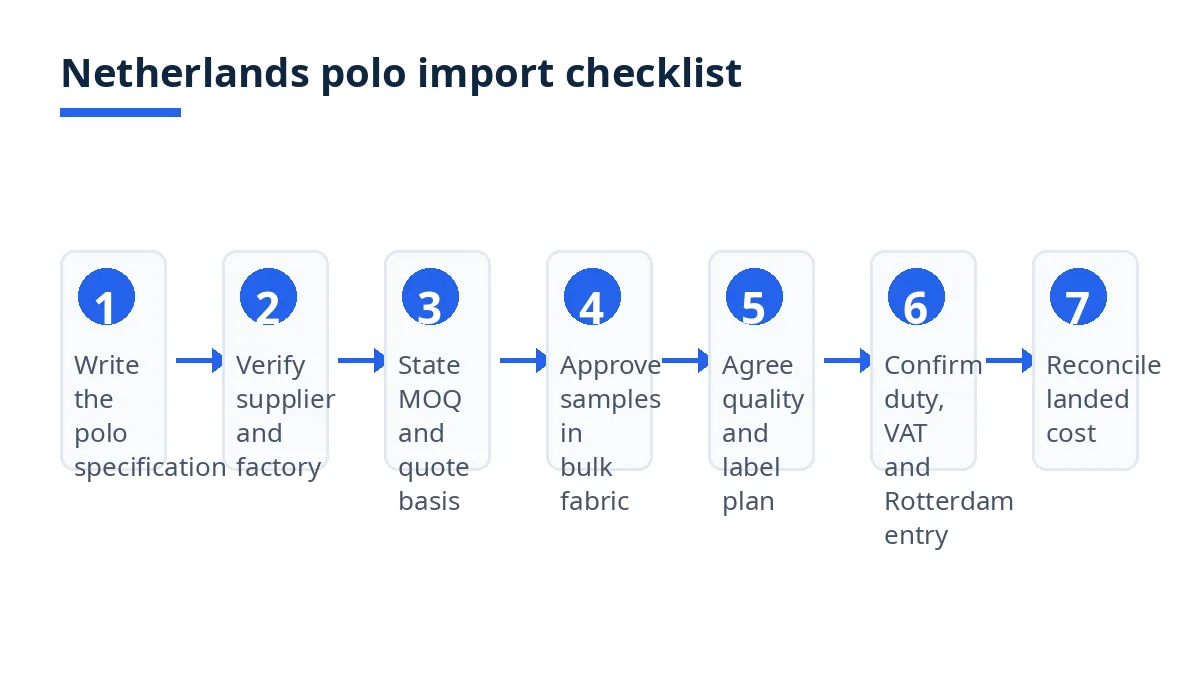
Write the polo specification: fabric, pique structure, collar and cuff construction, placket and buttons, fit and size chart, colour and shade standard, branding, packing, and Dutch label content.
Shortlist three to five suppliers, verify legal documents and the producing factory, and ask what origin evidence each supplier will supply for the EBA preference.
Ask each supplier to state its minimum in writing, per order, per style, per colour, or per size, and to quote on the same Incoterm and named place.
Approve the development sample, then the pre-production sample in actual bulk fabric and trims, in writing, and keep a sealed piece yourself.
Agree the quality plan: collar and shade tolerances, inspection level, acceptable quality limit, lab tests, and what happens to a rejected lot.
Confirm the label artwork against the bulk fabric and the EU fibre rules, including the Dutch wording, and confirm the classification, preference code, and import VAT treatment with your broker.
Confirm the Incoterm, named place, Rotterdam arrival, and production start event in the contract, and agree payment terms, sample credit, and rework terms.
Ask your tax adviser whether an Article 23 licence is available for your setup, and confirm with your broker whether VAT will be paid at Rotterdam or reported through the return.
Book the final inspection, assemble the invoice, packing list, transport document, and origin proof, and give the broker the full set before the vessel sails.
Clear the goods at Rotterdam, check the entry against the broker's answers, and reconcile the landed cost against the actual charges before you set the selling price.
Compare the bulk shipment with the approved sample on arrival, record any defect by style, colour, and size, and raise any claim within the period agreed in the contract.
How Exportain helps
Exportain is a marketplace that connects international buyers with Bangladeshi suppliers and trade service providers. You can search the supplier directory, post a request for quotation stating your specification, quantity, Incoterm, and deadline, and compare quotations against the same brief.
Exportain is not a party to the goods contract and does not inspect goods, book freight, or clear customs. Supplier verification, sample approval, inspection booking, and broker confirmation therefore remain your work, even when the supplier was found through the platform. To start an enquiry, post a free RFQ on Exportain with the specification from step 1, the quantity breakdown, and the Incoterm and named place.
FAQs
What is the typical MOQ for polo shirts from Bangladesh?
There is no single typical minimum that holds across styles, colours, fabrics, and dye lots. Ask each supplier to state its minimum in writing and whether it applies per order, per style, per colour, or per size, and compare suppliers only on the same basis.
How long does shipping take?
No article can give you a transit time for your shipment. It depends on the sailing schedule for your shipment date, the routing, the arrival port, and whether the container moves direct or transships. Ask your forwarder for the current schedule and arrival window for your actual shipment, and plan Dutch selling dates backwards from that window with buffer for examination and inland delivery.
What import duty applies?
If the EBA preference is proved with accepted origin proof, the preference figure in this guide is 0 percent. If the preference is not proved, the broker's TARIC third-country figure on the entry date applies instead. Confirm the classification, preference code, and proof with your broker before you price.
How do I verify a supplier?
Ask for the legal company name and registered address, trade licence, tax identification, and export registration certificate, and check that the same legal name appears on the quotation, proforma invoice, bank account, and shipping documents. Ask which factory will actually produce the order, whether it knits its own collars and cuffs, and what origin evidence it supplied on EU shipments. For larger orders, add a factory visit or independent audit and a small trial order.
Next steps on Exportain
Read the guide to importing from Bangladesh for the full import process that this Netherlands guide builds on.
Browse Exportain's supplier directory to shortlist polo suppliers against your specification.
Work through the landed-cost guide for imports from Bangladesh and rebuild the table above from your own quotations before you price.
Sources
- EU trade relations with Bangladesh. European Commission, (accessed )
- Generalised Scheme of Preferences. European Commission (accessed )
- Regulation (EU) No 1007/2011 on textile fibre names and related labelling and marking of the fibre composition of textile products. European Union, (accessed )
- Place of delivery & risk transfer in trade contracts. ICC Academy (accessed )
- HS Code 61051000 - Men's or boys' shirts of cotton, knitted or crocheted. Tariffnumber (accessed )
- HS Code 61061000 - Women's or girls' blouses, shirts and shirt-blouses of cotton, knitted or crocheted. Tariffnumber (accessed )
- Netherlands - Corporate - Other taxes. PwC (accessed )
- A Guide to the Article 23 License in the Netherlands. Stripe (accessed )
- How to obtain an EORI-number. Dutch Customs (accessed )
About the author
Sourcing from Bangladesh?
Post a request for quotation and suppliers on Exportain can send you their quotes directly.
Post an RFQ


