Polo Shirts From Bangladesh to Italy: Step-by-Step Guide
Polo shirts from Bangladesh to Italy: Italian entry file, Genoa, Livorno and La Spezia ports, supplier checks, samples, 61051000 and 61061000 classification, EBA preference, Italian VAT and a euro landed-cost example.
Short answer
To import polo shirts from Bangladesh to Italy, settle the Italian entry file: an EORI number via the Agenzia delle Dogane e dei Monopoli, a broker appointed, and VAT treatment confirmed. Specify pique fabric, collar, placket and cuffs, verify the supplier, approve a pre-production sample in bulk fabric, classify men's cotton shirts under 61051000 and women's under 61061000, claim the EBA 0 percent preference only with accepted origin proof, and price landed cost in euros to a named Italian port.
On this page
Key takeaways
The EBA preference figure used in this guide is 0 percent, applying only where the origin rule is met and the origin proof is accepted; if the preference is not proved, the broker's TARIC third-country figure on the entry date applies instead, and landed cost must be rebuilt on that figure before pricing.
Settle the Italian entry file before the goods sail: an EORI number through the Agenzia delle Dogane e dei Monopoli, a broker appointed, and the 22 percent Italian standard VAT treatment confirmed for your VAT position, with the Italian accounting summary document used for import VAT records.
Name the Italian arrival port on every quotation: Genoa, Livorno or La Spezia, chosen with your forwarder for your warehouse, because the inland leg from each port is a different cost and a quotation naming no port cannot be compared with one that does.
A polo specification must settle pique fabric, collar and cuff construction, placket and button details, and shade across body, collar and cuffs, and bulk production should not start before the pre-production sample in actual bulk fabric and trims is approved in writing.
Example figures only: 4,000 men's cotton polo shirts at 4.35 euros FOB Chattogram give a landed cost of 19,640.00 euros, or 4.91 euros per shirt excluding import VAT; the conditional 22 percent import VAT example is 4,320.80 euros on a broker-confirmed 19,640.00 euro base.
An Italy-based buyer ordering polo shirts from Bangladesh has to settle three Italian questions before the price can be trusted: which Italian port the container will clear through, whether the preferential duty rate is proved, and how Italian import VAT will be handled. This guide works through that sequence — the Italian entry file, the specification, the supplier, the sample, the shipment, the duty and VAT position, and a euro landed-cost example — so an Italian buyer can price a programme before bulk production begins.
As a least developed country, Bangladesh benefits from the EU's Everything But Arms arrangement, which grants duty-free, quota-free access for all exports except arms and ammunition, and Bangladesh is the largest beneficiary under that arrangement.1 That preference is not automatic: it depends on origin rules and accepted proof of origin, and this guide treats it as a condition to prove, not a discount to assume. Genoa, Livorno and La Spezia give different inland routes to an Italian warehouse, so the quotation should name the arrival port.
Why source polo shirts from Bangladesh
Bangladesh makes polo shirts inside a knitwear sector built around pique knitting, collar and cuff knitting, cutting, sewing, dyeing and finishing. The practical question for an Italian buyer is narrower: whether a given factory knits its own collars and cuffs, controls shade between body, collar and cuffs, and already ships polo programmes to EU buyers.
A polo shirt is a small set of decisions that all show on the finished garment: pique weight and hand, collar shape and stay, placket length and button stance, cuff rib, hem finish and shade match across every part. A factory that buys collars in, or dyes body and collar in separate lots, will struggle to hold shade across a programme, however good its price looks. Shortlist factories that can show current polo production, and ask which parts of the shirt are made in-house.
Treat the Italian market as the design constraint from the first draft. The fibre composition by component, the style split between men's and women's lines, the Italian arrival port named on the quotation, the language of consumer-facing label elements and the Incoterm on the quotation all affect labelling, VAT handling and the customs entry. Settling those points early is cheaper than correcting them after bulk production.
Find and verify suppliers
Where should an Italian buyer start the search
Start with a written specification, not with factory names. Write down every style first: men's or women's cut, pique weight as your own choice, fibre composition by component, collar and cuff construction, placket and button detail, size range, colour range and the quantity split by style, colour and size. Then shortlist knitwear exporters whose current range already includes polo shirts for EU buyers. A factory making only T-shirts or woven shirts is not a close substitute, because collar and cuff knitting, placket construction and shade control use different operations.
Send every candidate the identical specification and ask for the same reply format: fabric and trims assumed, price inclusions, validity and the minimum split by style, colour and size. Browse suppliers on Exportain and compare your approach with the how to import from Bangladesh guide before you open price talks.
How do you verify a supplier before you pay
Verification has three layers: company documents, checked so that name, address and bank account name agree across every document; capability, including monthly polo capacity, in-house pique and collar knitting, dyeing route and shade control; and payment discipline, keeping payments to the company account named in the documents and verifying any change of bank details separately.
MOQ, pricing and samples
What is the typical MOQ for polo shirts from Bangladesh
There is no single typical minimum order quantity for polo shirts from Bangladesh, and an Italian buyer should not plan a programme around one. The minimum is set per style and usually per colour, because pique fabric is knitted and dyed in lots and a cutting plan is set up per size range. A plain navy men's polo and a women's polo in four colours with a contrast collar will not carry the same minimum. Ask each supplier how its minimum splits by style, colour, size range and dye lot.
How is the price built, and how should you compare quotes
Fabric is usually the largest cost element in a polo shirt, followed by knitting, cutting and sewing, dyeing, collar and cuff work, trims, testing, packing and the factory margin. Detail adds operations: a contrast collar, a longer placket, embroidered chest branding, a shaped hem or a special wash each cost more to process. Two quotes can differ because one assumes a lighter pique, a simpler collar, no embroidery or a different packing standard. Ask what each price is based on, in writing.
Which samples do you need, and how do you approve them
Work in stages. A development sample shows whether the factory understood the collar, placket and fit. A pre-production sample, made in the actual bulk pique, colour, collar fabric, buttons and labels, is the sample you approve for bulk. Shade between body, collar and cuffs cannot be approved from a sample in substitute fabric, because dyeing and finishing change shade and hand. Test the samples as your customers will use them: wash the shirt following your care label, measure it against your size chart after washing, check that the collar sits flat and the placket stays straight, and confirm that buttons, embroidery and labels survive the wash. Approve in writing and keep one sealed counter-sample.
Quality control and certifications needed
Which quality checks are specific to polo shirts
Against the approved sample and size chart, check pique fabric weight and hand, finished measurements within your agreed tolerances, and consistency across the size range. Then check construction shirt by shirt: collar shape and roll, collar and cuff shade against the body, placket length and button alignment, buttonhole finish, stitch density at stress points, hem finish and embroidery placement where specified. Check packing too: shirts per polybag, polybags per carton, carton marks and the size and colour assortment inside each carton, since a wrong assortment only shows up at your warehouse.
Which label rules apply to polo shirts sold in Italy
Fibre labelling applies to every component whose fibre differs from the body, including a contrast collar or cuffs. Regulation (EU) No 1007/2011 covers textile fibre names and labelling of fibre composition, and its Article 9 states that a textile product shall be labelled or marked with the name and percentage by weight of all constituent fibres in descending order.2 For a product with two or more components of different fibre content, Article 11 requires a label or marking stating the fibre content of each component.2 Agree the wording at sampling stage, component by component, and check that the percentages match the fabric you bought.
Language is a point to close early, not a detail to leave for the warehouse. Article 16 of the same regulation states that the labelling or marking shall be provided in the official language or languages of the Member State on the territory of which the textile products are made available to the consumer, unless the Member State concerned provides otherwise.2 Italian is the official language of Italy, so plan consumer-facing label elements in Italian and have your broker confirm how that rule applies to your sales channel before bulk label sewing begins. Ask your testing lab which chemical-substance checks your customer requires for the dyes and finishes in your programme; this guide states no limit or substance figure for that point, because none was confirmed from an opened source for this guide.
Which certifications do you actually need
No single certificate covers every polo order. What you need follows your customer: an Italian retailer or brand may name a specific test or scheme in its own supplier manual. Name any such requirement in the specification, ask for the matching report or certificate, and check its scope, product covered, issuing body and date.
Incoterms, shipping and transit time
Which delivery term should a first order use
Under the Incoterms 2020 rules, delivery typically triggers the transfer of risk, and in the C-family of rules the place of risk transfer and the destination differ, because the seller arranges and pays for transport to the destination while risk passes earlier.3 Under CIF, the place of delivery is when the goods are placed on board the vessel at the port of shipment, and risk transfers there, even though the seller pays freight to the destination.3 For goods in containers, the ICC Academy summary notes that FCA is typically a better choice than FOB, even for maritime transport, because a container is handed to the carrier before it is on board.3
For a first polo order shipped in containers to Italy, weigh FCA at the named terminal against FOB at Chattogram and CIF to your Italian arrival port. Under FCA, delivery happens when the goods are handed to your carrier, which matches how containerised cargo moves. Under CIF, the seller arranges freight and minimum insurance to the destination port, but risk still passes at loading. Name the Italian arrival port in the quotation, and ask your forwarder whether Genoa, Livorno or La Spezia suits your warehouse.
How long does shipping take
There is no single typical transit time for polo shirts from Bangladesh to Italy. Sea freight is the standard route for bulk programmes and it takes weeks rather than days, varying by routing, transshipment, season and the arrival port you named. Plan from your forwarder's current sailing schedule for your actual shipment and arrival port, and keep production time separate: an order is ready only when every shirt has finished knitting, dyeing, sewing, inspection and packing.
Import duty, taxes and documents
How are polo shirts classified for duty
Duty follows the classification of each style in the EU tariff, not the supplier's product name. Men's or boys' shirts of cotton, knitted or crocheted, sit under 61051000, excluding nightshirts, T-shirts, singlets and other vests.4 Women's or girls' blouses, shirts and shirt-blouses of cotton, knitted or crocheted, sit under 61061000, excluding T-shirts and vests.5 A men's polo and a women's polo in one order therefore sit on different lines, and a synthetic or blended polo sits on a further line by fibre. The chapter notes for headings 6105 and 6106 also exclude garments with pockets below the waist, a ribbed waistband or other means of tightening at the bottom, and garments below a stated stitch density, and heading 6105 does not cover sleeveless garments, so a sleeveless or pocketed variant needs its own classification check.4
What import duty applies
Your rate depends on each style's code, the origin and the preference in force on the entry date, so there is no single rate for a whole polo order. The opened TARIC-linked pages for headings 6105 and 6106 confirm the heading descriptions above but render no duty rate in their text, so this guide asserts no third-country rate figure of its own. Under Everything But Arms, Bangladesh benefits from duty-free, quota-free access for all exports except arms and ammunition, which is the basis for the 0 percent preference figure used in this guide.1 That 0 percent applies only where the origin rule is met and the origin proof is accepted. If the preference is not proved, the broker's TARIC third-country figure on the entry date applies instead.
What about Italian import VAT
The Italian standard VAT rate is 22 percent.6 Italian VAT applies to importations carried out by anyone, and input VAT on purchases related to business activity is generally allowed for recovery, subject to stated limitations.6 Import VAT is therefore separate from duty: a VAT-registered Italian buyer who can recover it treats it as a cash cost at clearance rather than a final cost, while a buyer who cannot recover it must add it in full. This guide shows the VAT effect only as a conditional example in the landed cost section below, with the base confirmed by your broker, and it asserts no VAT-base formula of its own. Ask your broker whether any return-based accounting route applies to your position: the opened EU-level guidance states VAT is payable at importation unless the Member State of importation allows it to be included in a periodical VAT return, and that general statement does not by itself settle the Italian position.7
Which documents do you need for clearance
The standard import set is the commercial invoice, packing list, bill of lading or air waybill, and proof of origin where a preference is claimed. The invoice should name each style plainly, for example men's cotton polo shirt, knitted, with composition, collar and cuff detail, quantities by size, unit prices and the delivery term, on its own line.
Before the first shipment, settle your Italian entry file. Any economic operator established in the customs territory of the Union needs an Economic Operators Registration and Identification number (EORI) for customs purposes, available from Member States' authorities, and must use it as an identification number in all customs procedures.7 EORI numbers are given out by national authorities, and a business can hold only one valid EORI number at the same time.7 For Italy, request the number through the Agenzia delle Dogane e dei Monopoli before your first customs operation, and give it to your broker with the shipment documents. Any person may appoint a representative in dealings with the customs authority, and for direct representation a forwarding agent holding the relevant licence must be appointed, with the representative established within the European Union.6 For your VAT records, operators in Italy download the accounting summary document for import VAT from their reserved area on the Italian customs authority website, and that document, rather than a forwarder's courtesy document, is the record to use for deducting the relevant import VAT.6
Landed cost example (table)
A landed cost is the full cost of one polo shirt, cleared and in your warehouse. Every number below is an example figure only.
Example figures: 4,000 men's cotton polo shirts, FOB Chattogram, sea freight to Genoa, duty at the EBA preference figure, import VAT shown separately.
Cost element | Example figures (per shirt) | How to obtain your figure |
|---|---|---|
Product price, FOB | 4.35 euros | Confirmed pro forma invoice |
International freight | 0.30 euros | Forwarder quote divided by shirts shipped |
Insurance | 0.02 euros | Policy or forwarder quote |
Duty at the EBA preference figure | 0.00 euros | Broker confirmation with accepted origin proof |
Port, clearance and broker fees | 0.09 euros | Broker invoices divided by shirts shipped |
Inland delivery to warehouse | 0.08 euros | Local carrier quote divided by shirts shipped |
Pre-shipment inspection | 0.07 euros | Inspection company quote divided by shirts shipped |
Total landed cost, excluding import VAT | 4.91 euros | Sum of all lines above |
The shipment total behind that per-shirt figure is 19,640.00 euros for 4,000 shirts. Import VAT is not included in the total, because its treatment depends on your VAT position. As a conditional example only: if your broker confirms the VAT base as that 19,640.00 euro total, 22 percent gives 4,320.80 euros of import VAT on the shipment, or 1.08 euros per shirt; if the base differs, the amount differs. Work the calculation twice: at quote stage and again after shipment with the actual invoices. See landed cost for imports from Bangladesh for the full method.
Step-by-step import checklist
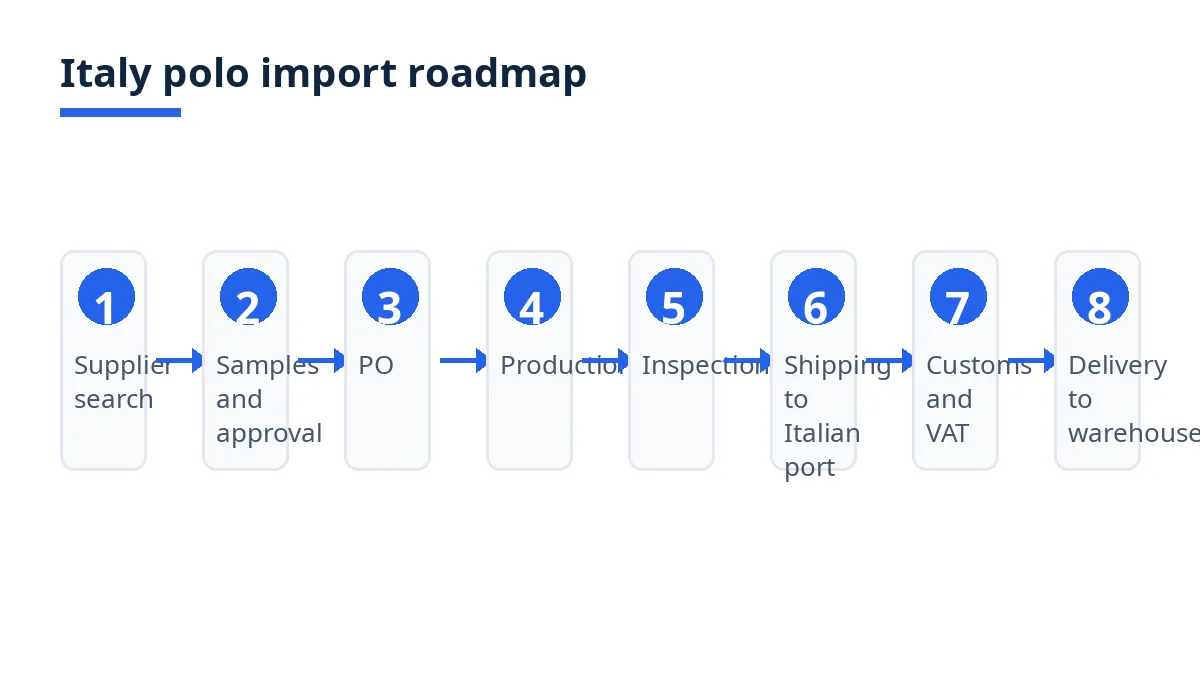
Settle the Italian entry file first: EORI number through the Agenzia delle Dogane e dei Monopoli, broker appointed, Italian VAT treatment confirmed.
Name the Italian arrival port on every quotation: Genoa, Livorno or La Spezia, chosen with your forwarder for your warehouse, not left to the seller.
Write the specification style by style: men's or women's cut, pique weight, fibre composition by component, collar and cuff construction, placket and button detail, size and colour split, Italian-language labels and packing.
Classify every style, starting from 61051000 for men's cotton knit shirts and 61061000 for women's cotton knit shirts, and confirm each full code and duty with your broker.
Shortlist knitwear exporters whose range includes polo shirts for EU buyers, and request comparable quotes on the identical specification and named Italian arrival port.
Verify the chosen supplier: company documents, polo capacity, in-house collar knitting, dyeing and shade control.
Order samples in stages, wash and measure them, check collar roll, placket alignment and shade across body, collar and cuffs, then approve a pre-production sample of each style in bulk fabric.
Confirm the order in writing: purchase order, pro forma invoice, delivery and payment terms, inspection plan, labelling, packing and shipment date.
Inspect during production and again on packed goods against the approved samples.
Ship on the agreed term to the named Italian port, clear customs with the confirmed code for each style and the accepted origin proof, and reconcile the actual landed cost.
How Exportain helps
Browse suppliers for Bangladeshi knitwear exporters and compare their ranges against your style list. Then post your specification, size and colour split and target quantity as an RFQ and compare replies on the same terms before you choose a factory for sampling. Exportain is a B2B marketplace where buyers post RFQs, receive quotations and message suppliers; it does not inspect goods, book freight or clear customs.
FAQs
What is the typical MOQ for polo shirts from Bangladesh?
There is no single typical minimum. It is set per style and usually per colour, because pique fabric is knitted and dyed in lots. Ask each supplier how its minimum splits by style, colour, size range and dye lot.
How long does shipping take?
Sea transit takes weeks rather than days and varies by routing, transshipment, season and the Italian arrival port you named.
What import duty applies?
Duty follows the confirmed classification of each style, the origin and the preference in force on the entry date. Men's cotton knit shirts sit under 61051000 and women's cotton knit shirts and shirt-blouses under 61061000.4 5 Under Everything But Arms, Bangladesh benefits from duty-free, quota-free access for all exports except arms and ammunition, so the preference figure is 0 percent only where the origin rule is met and the origin proof is accepted.1
How do I verify a supplier?
Check company documents first, so that name, address and bank account agree across the trade licence, export registration and invoices. Then check capability: polo capacity, in-house collar and cuff knitting, dyeing and shade control, and recent polo production for EU buyers. Keep payments to the company account named in the documents.
Next steps on Exportain
Read how to import from Bangladesh for the full process, then work through how to buy for the platform steps. When ready, post a free RFQ on Exportain and compare quotes on the same specification and named Italian arrival port.
Sources
- EU trade relations with Bangladesh. European Commission, (accessed )
- Regulation (EU) No 1007/2011 on textile fibre names and related labelling and marking of the fibre composition of textile products. European Union, (accessed )
- Place of delivery & risk transfer in trade contracts. ICC Academy (accessed )
- HS Code 61051000 - Men's or boys' shirts of cotton, knitted or crocheted. Tariffnumber (accessed )
- HS Code 61061000 - Women's or girls' blouses, shirts and shirt-blouses of cotton, knitted or crocheted. Tariffnumber (accessed )
- Italy - Corporate - Other taxes. PwC (accessed )
- European Commission FAQ. Agenzia delle Dogane e dei Monopoli (accessed )
About the author
Sourcing from Bangladesh?
Post a request for quotation and suppliers on Exportain can send you their quotes directly.
Post an RFQ