

Men's Woven Shirts From Bangladesh to Saudi Arabia: A Buyer's Import Checklist
Saudi buyer's checklist for men's woven shirts from Bangladesh: SABER conformity, Arabic labelling, 6205 duty, 15% VAT, Jeddah shipping and a worked landed-cost example.
Short answer
To import men's woven shirts from Bangladesh to Saudi Arabia, write a tech pack fixing fit, fabric, collar and cuff construction, and the Arabic label, then shortlist factories already making men's woven shirts. Confirm the SABER product certificate route before production, approve a pre-production sample, agree an inspection plan, classify shirts under heading 6205, confirm the 12-digit ZATCA duty line, and build the landed cost on duty plus 15% VAT before ordering bulk.
On this page
Key takeaways
Saudi SABER conformity is two certificates: a Product Certificate of Conformity (PCoC) valid for one year per product model, and a Shipment Certificate of Conformity (SCoC) for every consignment, which must be in place before the goods arrive.
Men's woven shirts fall in heading 6205, with cotton shirts under 6205.20; the full 12-digit ZATCA line decides the duty, with the GCC common external tariff at least 5% and finished garments reported in the 12 to 20 per cent range, plus 15% import VAT on the CIF value plus duty.
There is no single typical MOQ, price, or transit time for men's woven shirts: every figure in this guide is an example figure to be replaced by the supplier's written quote, the broker-confirmed duty line, and the forwarder's sailing.
Arabic labelling is mandatory: fabric composition, washing instructions, and country of origin in Arabic, with detention or market withdrawal as the consequence of non-compliance.
Plan on roughly three to four weeks port to port for a Chattogram-to-Jeddah ocean movement including transshipment, and six to nine weeks door to door for a first order.
Importing men's woven shirts from Bangladesh to Saudi Arabia is a conformity-first purchase, not just a price negotiation. Before bulk production finishes, the shipment needs a route through Saudi Arabia's SABER conformity system, an Arabic label, a confirmed 12-digit tariff line, and a landed cost built on duty plus 15% VAT. Settle those four items in writing, and the rest follows a predictable sequence.
This guide is for Saudi buyers — retailers, wholesalers, uniform programs, distributors — buying men's woven shirts (formal, business, smart-casual; cotton, cotton blends, man-made fibers) from Bangladeshi factories. Every price, minimum quantity, and transit figure here is an example figure: a worked structure to replace with your supplier's written quote, not a market rate.
Why source men's woven shirts from Bangladesh
Bangladesh is a woven-garment manufacturing base at scale. The Bangladesh Garment Manufacturers and Exporters Association (BGMEA) reports around 4,500 member factories, about 60 per cent of them woven-garment manufacturers, accounting for 100 per cent of woven garment exports.1 Bangladesh earned US$39.34 billion from ready-made garment exports in fiscal year 2025, according to official data cited in the same report.1 For a Saudi buyer, that depth matters: cutting, collar and cuff work, buttonholing, pressing, and carton packing are core operations for many factories, not side lines.
Assortment breadth is the commercial reason to buy here. One factory or factory group can often cover formal white and light-blue business shirts, checks and stripes, short-sleeve summer styles, and heavier poplin or twill options, across small to large and tall fits — a full shirt wall without splitting small orders across several countries.
Fit for the Saudi market is the second reason. Shirts in the Kingdom are worn in hot conditions for much of the year, so lightweight, breathable cotton and cotton-rich blends, collar stability after washing, and colorfastness under strong light and frequent laundering are qualities customers notice first. Specify them in the tech pack — fabric weight, yarn count, weave, collar construction, wash-care performance — rather than calling a shirt "premium."
Seasonality is the third reason to plan early: demand for formal and occasion shirts rises around Ramadan and Eid, weddings, and back-to-work periods, and factories book capacity by season.
Find and verify suppliers
Start with a specification, not factory names. Write down every style first: fit, collar and cuff style, placket, pocket, fiber composition, weave, fabric weight, color or print, size range, labeling, and packing (polybag, hanger, or flat pack). Then shortlist factories whose current range already includes men's woven shirts. A factory sewing only knit T-shirts or women's blouses is not a close substitute: collar and cuff work, buttonholing, and pressing to a sharp finish use different machines, skills, and checks.
Send every candidate the same specification, so quotes are comparable: current men's woven shirt styles and monthly capacity; BGMEA membership and any buyer or third-party audit reports it will share; fabric sourcing (in-house weaving, local mills, or imported fabric) and the lead time each route adds; in-house cutting, sewing, embroidery or printing, washing, pressing, and packing; quality team size, inspection stages, and acceptance of third-party final inspection; and Gulf export experience, including prior shipments requiring SABER product and shipment certificates.
Verify before paying a deposit. Ask for the trade licence, BGMEA membership details, and export registration, and cross-check the company name and address against the proforma invoice and packing list — document mismatches commonly cause customs delays. If possible, visit the factory or commission a short evaluation covering machines, workforce, storage, and finished-goods handling, rather than relying on photographs. For a first order, keep the style count small: one or two core styles, proven fabrics, and a single size curve. Treat directory labels as a starting point, not proof of capability; the real evidence is current shirt production, the fabric route, inspection records, and a pre-production sample in your fabric.
MOQ, pricing and samples
There is no single typical minimum order quantity (MOQ), price, or lead time for men's woven shirts: each depends on fabric, style complexity, color count, size range, and timing. The figures in this section are example figures only; confirm every figure in writing for your exact specification.
Example figures: a factory may set an MOQ of 1,000 to 3,000 pieces per style and color for a standard cotton poplin shirt, with smaller quantities possible when the fabric is in stock or shared across styles. MOQ is usually set by fabric, not sewing: a mill dyes or weaves fabric in minimum lots, so a factory cannot cut 300 shirts from a lot sized for 2,000. Below the fabric minimum, options include a stock fabric, fewer colors, one fabric shared across styles, or a surcharge — each priced separately.
Price structure, example figures: a quote typically breaks into fabric, trims, cut-make-trim labor, washing and finishing, packing, and margin. Example figures for a basic long-sleeve cotton shirt might show a free on board (FOB) price of US$6.00 per shirt at 2,000 pieces, falling for larger orders or simpler fabric, and rising for finer yarns, special finishes, or small quantities. Compare quotes only on the same specification — fabric, construction, packing, delivery term. A cheaper quote substituting a lighter fabric or a fused collar for a sewn collar is not the same shirt.
Samples follow a fixed sequence: a proto sample proves pattern and construction; a sales sample in the correct fabric and color confirms the look; a pre-production sample, made in bulk fabric with bulk trims, is the sample you approve before cutting begins — approve it in writing, list changes, and keep one sealed reference sample for final inspection. Sample and courier charges are normally separate; confirm whether they are credited against the bulk order. Never approve bulk production from a photograph: color, hand feel, collar shape, and button quality cannot be judged on screen. Tie payment terms to checkable milestones — sample approval, inspection pass, documents received — rather than dates alone.
Quality control and certifications needed
Quality control for woven shirts is a sequence of checks, not a single final look. Build these stages into the purchase order: fabric inspection on arrival (width, weight, shade, defects, with an approved shade band — shade variation between lots most commonly causes mismatched deliveries); in-line inspection during sewing (collar and cuff symmetry, stitch density, buttonholes, button attachment, pockets); end-line inspection after pressing (stains, loose threads, skipped stitches); final random inspection before packing, drawn from finished cartons against the approved sample, using an agreed sampling plan and defect classes with acceptance limits; and a packing check (count, size assortment, polybag and hanger standard, carton markings). Agree the plan, defect list, and inspector before production starts.
Conformity for Saudi Arabia sits on top of factory quality control, and it is the part first-time buyers most often underestimate. Saudi Arabia's product safety program, SALEEM, is operated through the SABER system, and all importers of regulated and non-regulated products must register their products in SABER to obtain a certificate of conformity; since February 15, 2020, all shipments entering the Kingdom must have the required SABER certifications.2 Two certificates are issued: a Product Certificate of Conformity (PCoC), valid for one year, and a Shipment Certificate of Conformity (SCoC) for each consignment, without which a shipment cannot pass Saudi customs.2 The PCoC is arranged once per product model and reused in its validity year; the SCoC is applied for on every shipment and must be in place before the goods arrive.
The Saudi importer registers the product in SABER and selects a SASO-approved conformity assessment body; the factory supplies the technical file — description, composition, test reports if required, and labeling artwork. Confirm before production whether your shirts are treated as regulated or non-regulated, and which test reports the body will ask for.
Labeling is a separate Saudi requirement. All apparel and textiles imported into Saudi Arabia must display fabric composition, washing instructions, and country of origin in Arabic, and failure to comply can result in shipment detention or market withdrawal.3 Build the Arabic label into the tech pack — composition, care instructions, "Made in Bangladesh," size, brand or importer details as your conformity body directs — and check the Arabic text with a native reader before printing. Other certificates depend on your claims: for organic cotton, request the transaction certificate for that lot.
Incoterms, shipping and transit time
Incoterms 2020 are the three-letter codes on a purchase order that decide who arranges and pays for each leg of transport, where risk transfers from seller to buyer, and who handles export and import clearance.4 They do not cover price, payment terms, ownership, or defective goods — those belong in the sales contract.4 For containerized shirts, the practical choices are FCA (Free Carrier: seller delivers the container to your nominated carrier; risk passes at handover — a better fit for containers than FOB, written for goods loaded over the ship's rail);4 FOB (Free on Board: seller loads goods on board at origin; freight, insurance, import clearance, and delivery from there are the buyer's);4 CIF (Cost, Insurance and Freight: seller pays freight and minimum insurance to destination, but risk still passes at loading at origin);4 DAP (Delivered at Place: seller bears cost and risk to the named destination, ready for unloading; clearance and duties remain the buyer's);4 and DDP (Delivered Duty Paid: seller delivers customs-cleared, duties paid — the only term under which the seller pays destination duty).4 Name term, place, and edition in the contract — for example, "FCA Chattogram, Incoterms 2020."
For routing, Chattogram (Chittagong) is Bangladesh's main container port, handling over 90 per cent of the country's freight.5 Saudi destinations are Jeddah Islamic Port, King Abdullah Port further north on the Red Sea coast, and Dammam for the Eastern Province. Your forwarder should confirm the routing and transshipment hub — commonly Singapore, Colombo, or Port Klang — since the hub determines transit time and rollover risk.
How long does shipping take? Plan on roughly three to four weeks port to port for a Chattogram-to-Jeddah ocean movement, including transshipment, and confirm the sailing for your shipment week. A published ocean-freight table lists the Jeddah-to-Chittagong LCL transit time at 25 days,5 and the reverse lane follows a similar pattern, so 25 days is a reasonable planning anchor, not a guaranteed schedule. Add export handling, SABER certification before arrival, Jeddah clearance, and inland delivery: a realistic door-to-door plan for a first order is six to nine weeks from final inspection to warehouse receipt. Air freight suits urgent replenishment only for small, high-value, or deadline-critical quantities.
Import duty, taxes and documents
Classify first, price second. Men's woven shirts fall in heading 6205 (men's or boys' shirts, not knitted or crocheted), with cotton shirts under 6205.20; a Saudi apparel reference lists shirts and blouses under 6205–6206, giving 6205.20 as the cotton-shirt example.3 Fiber composition decides the subheading, so a 60/40 cotton-polyester shirt is not classified like a 100 per cent cotton shirt. Confirm the classification with your broker, and use the same code on the invoice, packing list, certificate of origin, and SABER registration — inconsistent codes invite inspection.
Saudi Arabia applies the GCC common external tariff: as a GCC member, it applies a common external tariff of at least five percent on most goods from outside the GCC, with duties calculated ad valorem on the CIF value.6 Effective January 2025, all GCC member states adopted the 2022 HS-based 12-digit tariff system,6 so your broker must confirm the full 12-digit Saudi line for your exact shirt. One Saudi apparel reference reports finished garments in the 12 to 20 per cent range, against around 5 per cent for raw fabrics,3 so budgeting at 5 per cent and being assessed higher is a material surprise. The example below therefore uses an explicitly labelled example duty assumption with a sensitivity, not a schedule rate for your shipment.
VAT is separate from duty and applies even when goods are duty-exempt: 15 per cent on the customs value — CIF value plus duty and other charges — and a VAT-registered importer may later claim it as input VAT for taxable business activity.7 The rate was raised from 5 per cent to 15 per cent in July 2020.6 If you are not VAT-registered, import VAT is a cost, so confirm your position with your tax adviser before the first shipment.
Documents for a standard shipment, checked against your broker's list: commercial invoice (same description, quantities, prices, total as the packing list); packing list by carton; certificate of origin, authenticated as Saudi Customs requires for textile imports;3 bill of lading or airway bill; SABER PCoC and SCoC;2 any test reports required for the PCoC; and an insurance certificate where insurance is arranged separately. Check names, addresses, quantities, and values across all documents before the vessel sails: one mismatch can hold a shipment at Jeddah.
Landed cost example
The table below is a worked example using example figures throughout. Replace every figure with your written quote, broker-confirmed duty line, and forwarder's charges before using it for pricing.
Cost line | Example figure | Notes |
|---|---|---|
Quantity | 2,000 shirts | One style, one color, mixed sizes |
FOB price per shirt | US$6.00 | Example figure; your specification decides the real price |
FOB value | US$12,000.00 | 2,000 × US$6.00 |
Ocean freight and insurance to Jeddah | US$1,800.00 | Example figure; confirm per sailing |
CIF value | US$13,800.00 | FOB value + freight and insurance |
Customs duty (example assumption: 12%) | US$1,656.00 | Example assumption only — confirm your 12-digit ZATCA line |
VAT at 15% on CIF + duty | US$2,318.40 | 15% × (US$13,800.00 + US$1,656.00) |
Clearance, SABER, and port handling | US$600.00 | Example figure; charges vary |
Total landed cost | US$18,374.40 | Sum of the lines above |
Landed cost per shirt | US$9.19 | US$18,374.40 ÷ 2,000 |
Sensitivity check, example figures: at a 5 per cent duty line instead of 12 per cent, duty falls to US$690.00, VAT to US$2,173.50, and the total to US$17,563.50, or US$8.78 per shirt — a US$0.41 gap that is material across a season's volume. Confirm the duty line before setting retail prices. The table excludes Jeddah-to-warehouse delivery, warehousing, and post-clearance costs.
Step-by-step import checklist
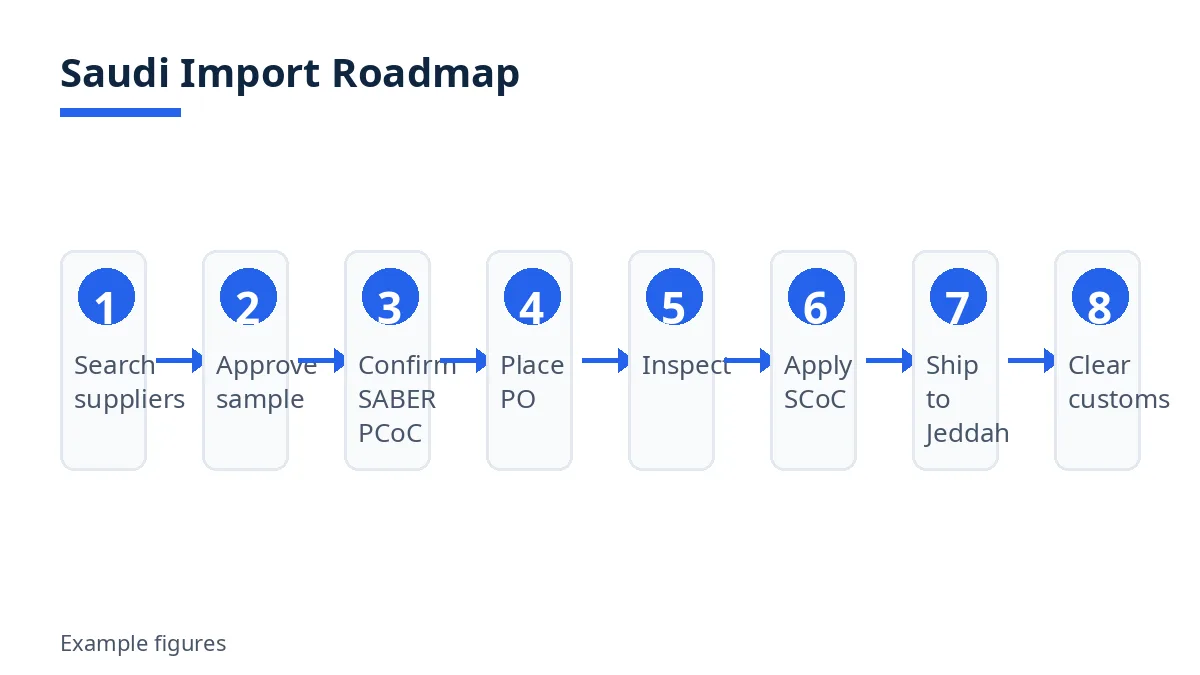
Define the assortment: styles, fits, fabrics, colors, sizes, season.
Write the tech pack: measurements, construction, stitching, buttons, labels (including Arabic), packing.
Shortlist factories already making men's woven shirts; send all the same specification and questions.
Check company documents and BGMEA membership; confirm current woven-shirt production.
Order proto and pre-production samples; approve the pre-production sample in writing.
Confirm the SABER route with your conformity body: regulated status, technical file, PCoC application.
Confirm the 12-digit ZATCA line and duty rate with your broker; build the landed cost.
Agree the Incoterm, milestone payment terms, inspection plan, and defect limits in the purchase order.
Approve bulk production only after the sample and Arabic label artwork are signed off.
Run in-line and final inspections; hold shipment on a failed final inspection.
Apply for the SCoC; confirm issue before the goods arrive in Saudi Arabia.
Check all shipping documents for consistency before the vessel sails.
Clear customs at Jeddah or your chosen port; pay duty and import VAT; arrange inland delivery.
Inspect on arrival; record damage against the inspection report; file documents for reorders.
How Exportain helps
Exportain connects Saudi buyers with Bangladeshi suppliers through its sourcing platform, where a buyer can search supplier listings, compare factory profiles, and submit a request for quotation describing the shirt specification, quantity, and delivery requirement. The platform's buying guides explain supplier checks, documentation, and cost structure in general terms; this guide covers the Saudi-specific conformity, duty, and VAT steps.
For this purchase, use the platform to shortlist factories already making men's woven shirts, send them the same tech pack, and compare quotes on identical terms. Keep conformity and duty checks outside the platform: confirm the SABER route with a SASO-approved body and the tariff line with your broker.
FAQs
What is the typical MOQ for men's woven shirts from Bangladesh?
There is no single typical MOQ for every shirt, because the minimum is usually set by fabric rather than sewing. Example figures here use 1,000 to 3,000 pieces per style and color for a standard cotton shirt, but the real minimum depends on the fabric lot, color count, and whether the fabric is in stock or dyed to order. Ask each factory for its MOQ on your exact fabric and color, what would lower it, and confirm quantity and any small-quantity surcharge in writing.
How long does shipping take?
Plan on roughly three to four weeks port to port for a Chattogram-to-Jeddah ocean movement including transshipment, and six to nine weeks door to door for a first order including inspection, SABER certification, clearance, and inland delivery. A published table lists the Jeddah-to-Chittagong LCL transit time at 25 days,5 a reasonable anchor for the reverse lane, but schedules, hubs, and congestion change week to week. Confirm each sailing with your forwarder, and build Ramadan and Eid deliveries around the confirmed schedule.
What import duty applies?
No single duty rate can be quoted for every shipment without the exact 12-digit Saudi tariff line. Saudi Arabia applies the GCC common external tariff of at least five percent on most goods from outside the GCC, calculated on the CIF value,6 and since January 2025 it uses a 12-digit tariff system,6 so the rate depends on the full line for your fiber composition and product type. One Saudi apparel reference reports finished garments in the 12 to 20 per cent range,3 which is why the landed-cost example uses an explicitly labelled 12 per cent example assumption with a 5 per cent sensitivity. Ask your broker to confirm the line and rate in writing before setting retail prices. Import VAT of 15 per cent is charged separately, on CIF value plus duty.7
How do I verify a supplier?
Verify a supplier in four steps. First, confirm company documents — trade licence, BGMEA membership, export registration — and check the name and address match the proforma invoice. Second, confirm current production: the factory should already be making men's woven shirts, with the cutting, collar and cuff, and pressing operations your styles need. Third, order a pre-production sample in bulk fabric and approve it in writing; a sample proves more than any listing. Fourth, agree an inspection plan and defect limits before bulk production, using an independent inspector for a first order if you cannot visit. SABER conformity is separate: confirm the PCoC route with a SASO-approved body before production.2
Next steps on Exportain
Start with the specification, not the search: write the tech pack, the Arabic label requirements, and the season the delivery serves. Then read the general guide to how to import from Bangladesh, the landed cost guide for imports from Bangladesh, and browse suppliers and the buying guide. Send every candidate the same tech pack, confirm the SABER route and tariff line before production, and approve the pre-production sample in writing.
Sources
- BGMEA sets new membership criteria to ensure factory safety, operational standards. The Financial Express, (accessed )
- Navigating SASO & Imports into Saudi Arabia. QIMA (accessed )
- Apparel and Textiles HS Codes in Saudi Arabia. Palm Horizons (accessed )
- Incoterms 2020 Guide for Importers. Importivity (accessed )
- Freight Shipping to Bangladesh by Air & Ocean. Shipa Freight (accessed )
- Saudi Arabia - Import Tariffs. United States International Trade Administration (accessed )
- VAT on Imports and Exports in Saudi Arabia (KSA). ClearTax, (accessed )
About the author
Sourcing from Bangladesh?
Post a request for quotation and suppliers on Exportain can send you their quotes directly.
Post an RFQ


