Australia Import Guide: Men's Woven Shirts From Bangladesh — Costs, Duties and Suppliers
Australia import guide for men's woven shirts from Bangladesh: 6205 classification, supplier checks, samples, duty-free treatment, 10% GST, shipping and landed cost.
Short answer
To import men's woven shirts from Bangladesh to Australia, classify each fabric under heading 6205 — 6205.20 cotton, 6205.30 man-made fibres, 6205.90 other materials — then send an identical tech pack to woven-shirt factories, verify documents and capability, and approve a pre-production sample in fabric and wash. Confirm the preferential treatment with your broker, lodge an Import Declaration for consignments over AUD 1,000, and build the landed cost with 10% GST on customs value plus duty plus freight and insurance.
On this page
Key takeaways
Men's woven shirts sit in heading 6205 — 6205.20 cotton, 6205.30 man-made fibres, 6205.90 other materials — classify each fabric separately.
Australia's duty-free quota-free treatment for Bangladeshi exports is the rate to test first with your broker, but it is a preferential claim, not an automatic discount.
GST is 10% of the value of the taxable importation — customs value plus duty plus transport and insurance — so freight and insurance raise the GST bill.
A commercial order over AUD 1,000 needs a full Import Declaration (N10), with duties, taxes and charges paid before release.
There is no single typical MOQ, price or transit time for woven shirts: confirm each one in writing for your exact fabric, size range and shipment date.
This guide explains how to import men's woven shirts from Bangladesh to Australia, from tech pack to cleared delivery in Sydney. It is written for Australian brands, retailers and uniform suppliers who buy woven shirts — not knitted shirts — and who need the Australian duty, GST and labelling rules. Bangladesh was the world's largest exporter of non-knit men's shirts in 2024, with exports of $2.55 billion in that category.1 That scale does not set your price, minimum order or transit time: those are fixed by your fabric and entry date.
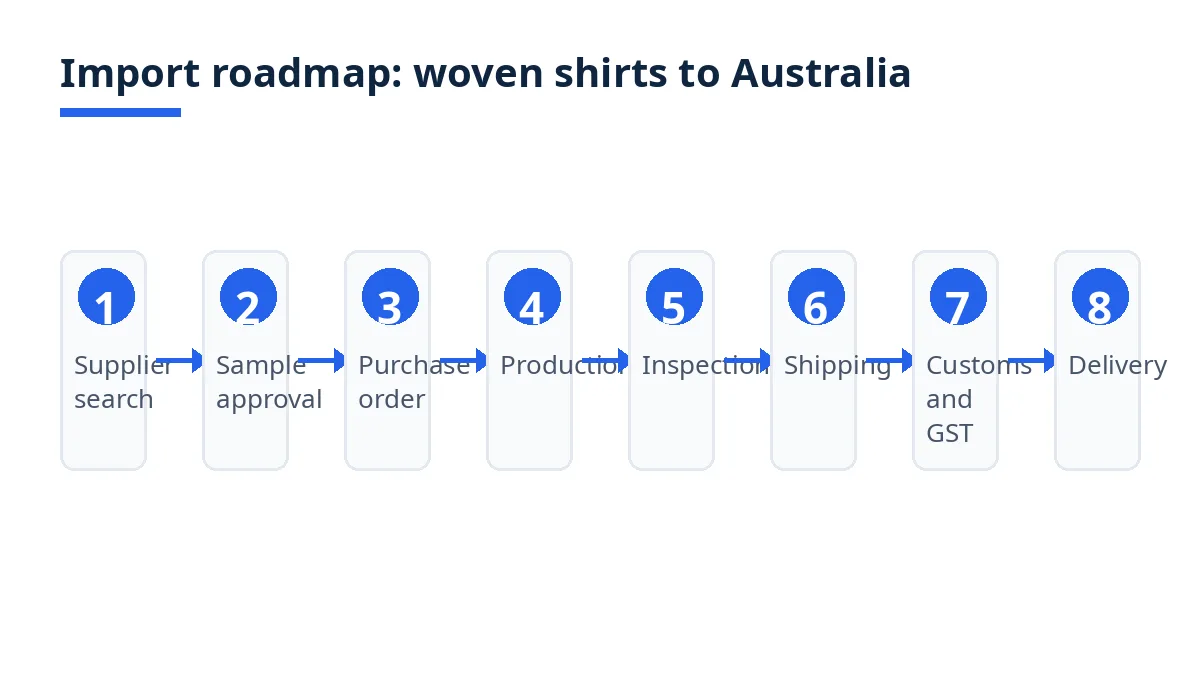
A woven shirt order is a specification order: collar, cuff, placket, pocket, button, stitch density and wash are choices you make before a factory quotes. Work in this order: classify, specify, verify, sample, then price the landed cost with GST included.
Why source men's woven shirts from Bangladesh
Woven shirts are a core woven-garment product for Bangladesh. Export data reported from the Export Promotion Bureau shows that just five items — t-shirts, trousers, shirts, sweaters and underwear — accounted for over 80 percent of Bangladesh's $46.99 billion readymade garment export earnings in the fiscal year cited.2 The practical meaning is depth: many factories already run woven-shirt lines with collar and cuff fusing, buttonholing and single-needle stitching.
That depth helps most when your range is wide: a fused-collar dress programme, a soft-collar casual programme and a reinforced-pocket uniform programme are different production jobs. Shortlist by the shirt you actually sell, and ask what share of current production is woven shirts, not knitwear or trousers. The landed cost also turns on two Australian items generic guides skip — the preferential duty treatment and the GST base, including freight and insurance.
Find and verify suppliers
Where should you start the search?
Start with the tech pack, not with factory names. A complete tech pack fixes the fabric (fibre, weave, weight and finish), collar and cuff construction, placket type, pocket and yoke details, button type and count, stitch density, seam type, wash, size and colour range, labelling and packing. Send every candidate the identical tech pack and ask for the same reply format: fabric assumed, price inclusions, validity, minimum per style and per colour, and lead time from approved sample. Browse suppliers on Exportain, and compare your approach with the general guide to importing from Bangladesh.
Shortlist factories whose current range already includes men's woven shirts in your fabric. A factory making only knitwear is not a substitute: woven cutting, fusing, collar turning and buttonholing use different machines and skills. Ask for a current production sample in a comparable fabric, and check the collar roll, cuff edge and buttonhole finish.
How do you verify a supplier before you pay?
Verification has three layers: company documents — trade licence, export registration and association membership where applicable — checked so name, address and bank account name agree across every document; capability — monthly woven-shirt capacity, whether fabric is woven in-house or bought in, fusing and washing routes, and recent shirt styles the factory can show; and payment discipline — pay only the company account named in the documents, and verify any change of bank details separately.
On Exportain, supplier profiles carry document and photo review badges — a review of documents and photos, not a factory inspection or a guarantee, and Exportain is not a party to the goods contract. For a first order, add your own check: a video walkthrough of the cutting, sewing and finishing floors, or an in-person visit where the order value justifies it. Read how to buy on Exportain before you post a request.
MOQ, pricing and samples
What is the typical MOQ for men's woven shirts from Bangladesh?
There is no single typical minimum order quantity for men's woven shirts from Bangladesh. The minimum is set per style and usually per colour, because fabric is woven, dyed or printed in batches, cutting markers are laid per size range, and collar and cuff components are cut and fused per style. A plain white dress shirt and a checked casual shirt will not carry the same minimum, nor will a small size range and a full range from small to 3XL. Ask how the minimum splits by style, colour, fabric and size range.
How is the price built, and how should you compare quotes?
Fabric is usually the largest cost element in a woven shirt, followed by cutting, fusing, sewing, washing or finishing, trims, testing, packing and the factory margin. Detail adds operations: a fused collar with a separate collar band, a French placket, a pattern-matched pocket, contrast stitching and a garment wash each cost more than a plain shirt. Two quotes can differ because one assumes a lighter fabric, a simpler collar, no wash or a shorter size range — ask what each price is based on, in writing.
Compare quotes on the same basis: same tech pack, size and colour range, delivery term and packing. Ask what is excluded — buttons, special labels, testing, washing or export packing — and confirm the price validity period. Example figures only: a quote structure for one style might show fabric, trims, sewing and finishing as separate lines per shirt.
Which samples do you need, and how do you approve them?
Work in stages. A development sample shows whether the factory can construct the collar, set the sleeve cleanly and finish the buttonholes to your standard. A pre-production sample, made in the actual production fabric, colour, trims and wash, is the sample you approve for bulk. Collar roll, shade and hand feel cannot be approved from a sample in substitute fabric.
Test samples as customers will wear and wash them: measure collar, chest, sleeve length and body length against your size chart, wash to your care label and re-measure for shrinkage, check button security, and check that checks or stripes match across pocket and placket. Approve in writing and keep one sealed counter-sample of each style and colour.
Quality control and certifications needed
Which quality checks are specific to woven shirts?
Against the approved sample and chart, check fabric composition and weight, finished measurements across the size range within your agreed tolerances, and consistency from smallest to largest size. Then check construction shirt by shirt: collar symmetry and roll, fusing without bubbling, button attachment and buttonhole finish, placket straightness, pocket position and pattern matching, sleeve setting without puckering, and hem finish. A shirt can pass flat measurements and still fail on the body if the collar stands unevenly or a sleeve twists after washing.
Agree the inspection method and defect limits before production. The acceptable quality limit (AQL) is defined in ISO 2859-1 as the maximum number of defective items that can be considered acceptable during random sampling inspections of a production batch.3 Inspect in stages: an inline check during cutting, fusing and sewing catches drift while correction is still possible, and a final random inspection on packed goods checks quantity, workmanship, measurements, labels and packing.
Which label rules apply in Australia?
Two Australian label systems meet on one shirt. The first is the care label: Australia's mandatory standard, the Consumer Goods (Care Labelling) Information Standard 2023, sets out mandatory requirements for clothing and textile products, and from 5 March 2024 suppliers may provide care instructions written in English or by using the international care symbols.4 Agree the care wording and symbols at sampling stage.
The second is the trade description at the border. Commerce markings for clothing require a true description and the country of origin: all trade descriptions must be in English, in prominent and legible characters, on a principal label attached in an obvious and permanent position, and shirt labels should be affixed in the collar and facing outwards.5 An example of a correct description is "100% cotton" on a shirt, providing that description is correct.5 Agree fibre composition, size and origin wording before bulk label sewing, and check that the percentages match the fabric bought.
Which certifications do you actually need?
No single certificate covers every woven-shirt order. What you need follows your customer: a retailer or uniform buyer may name a specific test or scheme in its own supplier manual — fibre composition testing, colourfastness, shrinkage or a restricted-substance list. Name any such requirement in the tech pack, ask for the matching report or certificate, and check its scope, product covered, issuing body and date.
Incoterms, shipping and transit time
Which delivery term should a first order use?
For containerised shirts, weigh FOB at the Bangladeshi port against FCA at a named terminal. Under FOB, risk passes when the goods are loaded on board the vessel, and under FCA risk passes when the goods are handed to the buyer's nominated carrier — and FCA is the correct term for containerised sea freight, because a container is handed to the carrier before it is on board.6 Under every rule except EXW the seller handles export clearance, and under every rule except DDP the buyer handles import clearance and pays import duties.6 Unless you buy DDP, the Australian declaration, duty and GST are your job.
Confirm the named place in writing, not just the three letters: "FOB Chattogram" and "FCA Chattogram container terminal" are different handover points. State the port, terminal where applicable, and who pays terminal handling on each side.
How long does shipping take?
There is no single typical transit time for woven shirts from Bangladesh to Australia. Sea freight is the standard route for bulk orders and takes weeks rather than days, varying by port pair, routing, transshipment and season. Plan from your forwarder's current sailing schedule for Chattogram to Sydney or Melbourne, and keep production time separate: an order is ready only when every shirt has finished sewing, washing, pressing, inspection and packing.
Import duty, taxes and documents
How are men's woven shirts classified for duty?
Duty follows the classification of each fabric in your order, not the supplier's product name. Heading 6205 covers men's or boys' shirts, splitting by fibre: 6205.20 for cotton, 6205.30 for man-made fibres and 6205.90 for other textile materials.7 Chapter notes add two traps: heading 6205 does not cover sleeveless garments, and shirts are garments designed to cover the upper part of the body, having long or short sleeves and a full or partial opening starting at the neckline.7 A sleeveless style is not a 6205 shirt, and a knitted shirt sits in the knitted chapter instead. Confirm the full Australian tariff item for each fabric before you price or ship.
What import duty applies in Australia?
Your rate depends on the tariff item, the origin and any preference in force on the entry date, so there is no single rate for a whole shirt order. Start with the preferential question, not the general rate. Australia has extended duty-free quota-free access to least developed countries including Bangladesh, and has assured that this treatment will continue even after Bangladesh's graduation from least developed country status in 2026, at the first Joint Working Group under the Australia-Bangladesh Trade and Investment Framework Arrangement.8
Treat that as the claim to test, not a concluded rate for your shipment. Ask your broker to confirm, for your entry date, the preferential rate for your tariff item, the origin evidence your supplier must provide, and the general rate if the claim fails. Agree the proof of origin at order stage, and do not let a supplier quote assume a duty rate your broker has not confirmed.
What GST applies, and how is it calculated?
GST is the Australian cost most first-time importers under-budget, because it is charged on more than the shirt price. GST on a taxable importation is 10% of the value of the taxable importation: the customs value, any customs duty payable, the amount paid or payable to transport the goods to their place of consignment in Australia, and the insurance cost for that transport.9 The Australian Border Force states the same calculation: GST is the value of the taxable importation multiplied by the GST rate, currently 10%.10 Freight and insurance therefore raise the GST bill: every dollar of international freight in the GST base adds ten cents of GST.
GST is generally payable before the goods are released, unless you are registered under the deferred GST scheme, which allows an eligible GST-registered importer to defer payment until the first activity statement lodged after importation.9 If you are GST-registered and import the shirts for a creditable purpose, you may be able to claim a GST credit — but only with documentation showing the goods were imported and the GST was paid or deferred.9 Keep the finalised declaration and the official receipt; without them, do not claim the credit.
Which documents do you need for clearance?
For a commercial consignment over AUD 1,000, you must lodge a full Import Declaration (N10) and pay all duties, taxes and charges, including an import processing charge, before the goods can be released.11 The Australian Border Force encourages first-time or infrequent importers to use a licensed customs broker.11 The standard import set is the commercial invoice, packing list, bill of lading or air waybill, and proof of origin where a preference is claimed. The invoice should name each style plainly — for example, men's woven cotton dress shirt, long sleeve — with composition, size range, quantities, unit prices and delivery term on its own line. Quantities, weights and carton counts must agree across every document, and you must keep them for five years.11
A sample shipment at or below AUD 1,000 follows a different path: for most goods there are no duties, taxes or charges to pay, through a Self-Assessed Clearance declaration.11 That threshold is per consignment, not per order, so do not split a commercial order to chase it.
Landed cost example (table)
A landed cost is the full cost of one shirt. Every number below is an example figure only. Example figures: 5,000 men's cotton woven shirts, FOB Chattogram, sea freight to Sydney.
Cost element | Example figures (per shirt, AUD) | How to obtain your figure |
|---|---|---|
Product price, FOB | 9.20 | Confirmed pro forma invoice |
International freight | 0.85 | Forwarder quote divided by shirts shipped |
Insurance | 0.07 | Policy or forwarder quote |
Duty | 0.00 | Broker calculation — example assumes the duty-free treatment is confirmed; if the general rate applies instead, add it here before GST |
Broker fee and import processing charge | 0.22 | Broker invoice divided by shirts shipped |
Local delivery to warehouse | 0.30 | Local carrier quote divided by shirts shipped |
GST (10% of customs value + duty + freight + insurance = 10% of 10.12) | 1.01 | Broker calculation; GST-registered buyers may claim a GST credit |
Total landed cost | 11.65 | Sum of all lines above |
Work the calculation twice: at quote stage, style by style, and again after shipment with actual invoices. See landed cost for imports from Bangladesh for the full method — duty feeds GST.
Step-by-step import checklist
Classify every fabric: 6205.20 cotton, 6205.30 man-made fibres, 6205.90 other materials, and confirm each full Australian tariff item with your broker.7
Write the tech pack style by style: fabric, collar and cuff, placket, pocket, buttons, stitch density, wash, size and colour range, labelling and packing.
Shortlist factories whose current range includes men's woven shirts in your fabric, and request comparable quotes on the identical tech pack and delivery term.
Verify the chosen supplier: company documents, woven-shirt capacity, fabric source, fusing and washing route, and a video or in-person check for a first order.
Order samples in stages, wash and measure them against your size chart, check collar roll and pattern matching, then approve a pre-production sample of each style.
Confirm the order in writing: purchase order, pro forma invoice, delivery and payment terms, inspection plan with AQL and defect limits, labelling and packing.
Agree the proof of origin at order stage, so the preferential duty claim is supported on arrival.
Inspect during production and again on packed goods against the approved samples, checking measurements, collar and cuff finish, and shade consistency.
Ship, clear customs with the confirmed tariff item for each fabric, pay duty and GST, and reconcile the landed cost.
How Exportain helps
Browse suppliers for Bangladeshi woven-garment exporters and compare their ranges against your tech pack before approaching any factory. Then post your specification and target quantity as an RFQ and compare replies on the same terms — same fabric, size range and delivery term — before you choose a factory. Exportain is a B2B marketplace where buyers post RFQs, receive quotations and message suppliers.
FAQs
What is the typical MOQ for men's woven shirts from Bangladesh?
There is no single typical minimum. It is set per style and usually per colour, because fabric is woven, dyed or printed in batches and cutting markers are laid per size range.
How long does shipping take?
Production time and transit time are separate, with no single typical figure for either. Sea transit from Bangladesh to Australia takes weeks rather than days and varies by routing, transshipment and season.
What import duty applies?
Duty follows the confirmed tariff item for each fabric, the origin and the preference in force on the entry date. Men's woven shirts sit in heading 6205: 6205.20 for cotton, 6205.30 for man-made fibres and 6205.90 for other textile materials.7 Australia's duty-free quota-free access for Bangladesh is assured to continue after graduation in 2026, but confirm the preferential rate and origin evidence with your broker for your entry date.8 GST is separate from duty.9
How do I verify a supplier?
Check company documents first, so name, address and bank account agree across the trade licence, export registration and invoices. Then check capability: woven-shirt capacity, fabric source, fusing and washing route and recent shirt production in a comparable fabric. Keep payments to the company account named in the documents, and approve a pre-production sample of each style before bulk production.
Next steps on Exportain
Read how to import from Bangladesh for the full process, then work out your numbers with landed cost for imports from Bangladesh. When ready, post a free RFQ on Exportain and compare quotes.
Sources
- Non-Knit Men's Shirts (HS: 6205) Product Trade, Exporters and Importers. The Observatory of Economic Complexity (accessed )
- Bangladesh remains mired in basic items. The Financial Express (accessed )
- Understanding Acceptable Quality Level (AQL) in Quality Control. Investopedia (accessed )
- Australia - Update Care Labelling Regulation for Clothing and Textiles. Intertek (accessed )
- Labelling your imported goods and clothing. Magellan Logistics (accessed )
- A Quick Guide to Incoterms. Flexport (accessed )
- Heading 6205 - Men's or boys' shirts - UK Integrated Online Tariff. GOV.UK (accessed )
- Aus to continue duty-free facility for Bangladesh's exports after 2026. Fibre2Fashion (accessed )
- GST and imported goods. Australian Taxation Office (accessed )
- Goods And Services Tax. Australian Border Force (accessed )
- Import declarations. Australian Border Force (accessed )
About the author
Sourcing from Bangladesh?
Post a request for quotation and suppliers on Exportain can send you their quotes directly.
Post an RFQ