USA Live Crabs Imports From Bangladesh: Step-by-Step Guide
Live crabs from Bangladesh to the USA, animal-first: air acceptance under the IATA Live Animals Regulations, HTS 0306.33.40, the SIMP line check, FDA verification and Prior Notice, packing for live arrival, and a USD 28.00 per kilogram landed-cost example.
Short answer
To import live crabs from Bangladesh to the USA, book the consignment as live animals by air, classify whole live crabs on HTS line 0306.33.40, check that line against the October 2026 SIMP list, and build the FDA Part 123 verification file before ordering. Confirm species identity for the wildlife declaration, agree packing and airline acceptance in writing, file Prior Notice at least 4 hours before arrival by air, and enter the goods within 15 calendar days after landing.
On this page
Key takeaways
Book live crabs as live animals by air under the IATA Live Animals Regulations: a separate air waybill, a Shipper's Certification, and a completed acceptance checklist are gates before departure, not paperwork after it.
Whole live crabs enter on HTS line 0306.33.40 at Free General on Revision 16 (2026); crabmeat, frozen crab, and Other-block lines are different entries and must not be borrowed.
The October 2026 SIMP list flags 0306.33.4000 for not-specifically-provided-for crab, so collect chain of custody data lot by lot before shipment and have the broker confirm the reporting position.
Build the written Part 123 verification file before ordering, confirm facility registration and the United States agent, and file Prior Notice at least 4 hours before arrival by air.
Prove species identity in writing: Scylla mud crabs are not Eriocheir mitten crabs, the wildlife declaration and licence position must be confirmed, and APHIS listed-species requirements must be checked for the exact species.
A live crab order is settled while the animals are still alive. Price, grade, and duty matter, but none of them matters if the airline will not accept the consignment, if the crabs arrive dead, or if the wildlife declaration names the wrong species.
It is written for United States importers, wholesalers, live-seafood distributors, restaurant groups, and retailers buying whole live crabs from Bangladesh for sale alive. Every cost figure is an example figure, and every duty figure is indicative until a broker confirms it on the exact line. No typical minimum, transit time, mortality figure, or temperature figure is stated in this guide.
Start with the live animal, the aircraft, and acceptance
Live crabs travel by air, not in a reefer container. Any person or company shipping animals by air needs to follow the IATA Live Animals Regulations (LAR) when shipping animals for life science, agricultural, zoological, conservation, or other purposes.1 A reservation check covers the species and its handling requirements, container requirements, carrier regulations, destination, country regulations, direct routing, container fit in the hold, and the shipment date.1
Acceptance is a separate gate from booking. Routing and facilities must be confirmed, a transshipment container received in advance, the container and contents weighed or measured and compliant, the container labelled correctly, shipper and consignee details and a 24-hour emergency contact attached, duplicate care instructions fixed outside, and any medication recorded.1 Carriers should only accept live animals that appear to be in good condition and health, and every checklist criterion must be cleared.1
Three documents decide whether the consignment moves: a Shipper's Certification for Live Animals for each shipment, in English and signed in duplicate; its own air waybill, since live animals cannot share an air waybill with other items, carrying a 24-hour emergency contact; and the IATA Live Animal Acceptance Checklist, completed in full and verified before acceptance or rejection.1 Ask the forwarder in writing which edition of the Regulations the carrier will apply, before the purchase order.
Name the crab: species, sex, grade, and live condition
The export product is the mud crab, genus Scylla. Mud crabs harvested from wild sources are traditionally fattened in pens in tidal rivers, ghers, and earthen ponds in Bangladesh, in a study of the south-west Sundarbans region covering Bagerhat, Satkhira, and Khulna districts; most farmers fattened male lean crabs and female gonadally immature crabs.2 Ask whether the consignment is wild-collected, fattened, or mixed, and whether the crabs are lean or fattened, male or female.
Fix the specification identically in every document: scientific and common name, wild-caught or farmed and fattened, sex, grade, live weight range, and treatment of out-of-range crabs. State how liveness is judged at packing, airline handover, and arrival, and agree who counts dead-on-arrival crabs, how the count is evidenced, how quickly it must be reported, and what remedy follows. The price must say whether it is charged on shipped weight, arrived live weight, or another basis.
Classify whole live crabs on 0306.33.40 and work the Free duty position
Classification follows state first: live, fresh or chilled is one block of heading 0306, and frozen is another. In the Harmonized Tariff Schedule of the United States, Revision 16 (2026), the live, fresh or chilled block carries crabs at 0306.33, split into crabmeat at 0306.33.20 and Other at 0306.33.40.3 Whole live crabs, other than crabmeat, fall on 0306.33.40, at a General rate of Free with a column 2 rate of Free, on a kilogram quantity basis.3 The broker must confirm in writing, before a price is fixed, the General rate on the exact 10-digit line, whether any Special program applies, and whether any additional duty under Chapter 99 applies on the entry date. The column 2 rate is not the working rate.
Three neighbouring lines must not be borrowed: crabmeat on 0306.33.20, with a General rate of Free under listed Special programs and a column 2 rate of 7.5 percent; frozen crabs in the frozen block at 0306.14; and the Other block at 0306.93, which is not the live block.3 If any document names 0306.14 or 0306.93 for live crabs, stop and reclassify before quoting.
Crab product | HTS line, Revision 16 (2026) | Indicative General rate |
|---|---|---|
Whole live crabs, other than crabmeat | 0306.33.40 | Free |
Crabmeat, live, fresh or chilled | 0306.33.20 | Free under listed Special programs; column 2 7.5% |
Frozen crabs, other than crabmeat | 0306.14.40 | Free |
Check SIMP on the exact line before you order
The Seafood Import Monitoring Program is a risk-based traceability program requiring the importer of record to report key chain of custody data, from harvest to entry into United States commerce, for fish and fish products particularly vulnerable to illegal, unreported, and unregulated fishing or seafood fraud.4 More than 1,100 unique species, in 13 species groups, are included.4
The flag follows the tariff line. The October 2026 list flags 0306.33.4000, live, fresh or chilled not-specifically-provided-for crabs other than crabmeat, under the not-specifically-provided-for crab group, and also flags the crabmeat, frozen crab, and Other-block crab lines.5 Do not assume a live mud crab escapes monitoring because the program overview names Atlantic blue crab and red king crab: the broker must confirm the reporting position for the exact line and species. Where flagged, collect chain of custody data lot by lot before shipment: harvesting or producing entity, authorization evidence, farm or facility name, gear types, species code, landing dates and points, product form at landing with quantity and weight, harvest area, and landing entity, plus importer details, the trade permit number, transshipment information, and processing records.4 The importer of record must keep those records.4
Clear the wildlife file: declaration, licence check, and species identity
Live crustaceans are wildlife for United States import purposes. Upon an exporter filing a written declaration with the District Director of Customs at the port of entry as required under the declaration rule, live or dead fish, mollusks, and crustaceans may be imported, transported, and possessed in captivity without a permit, except as the rule provides.6 No such animal may be released into the wild except by the state wildlife conservation agency having jurisdiction, or with its prior written permission.6
Species identity is the key control. Importation, transportation, or acquisition of live mitten crabs, genus Eriocheir, or their viable eggs, is prohibited except as provided under the permit terms in the injurious wildlife rule.6 Scylla mud crabs are not Eriocheir mitten crabs; prove it with matching scientific names on the invoice, packing list, health documents, and declaration. If the supplier cannot name the genus and species in writing, do not order.
Close the file with two checks: Form 3-177, the Declaration for Importation or Exportation of Fish or Wildlife, signed and filed where Service clearance is requested, certifying the information is true and complete;7 and the import/export licence position, since commercial wildlife importers must obtain a licence beforehand, except as the licence rule provides, and food is listed as requiring one.8 Ask the broker and the Service in writing whether a licence is required for the exact shipment, and hold the shipment if the position cannot be confirmed before departure.
Build the Part 123 verification file for a live product
The importer carries the verification duty under the fish and fishery products rule at 21 CFR Part 123. Every importer shall either obtain the product from a country with an active memorandum of understanding or similar agreement with the Food and Drug Administration covering the product, or have and implement written verification procedures.9
The procedures must list specifications ensuring the product is not adulterated, and affirmative steps from the rule: lot HACCP and sanitation records, a certificate from a foreign government inspection authority or competent third party, regular facility inspections, an English HACCP plan with a written guarantee, periodic testing with a written guarantee, or other equivalent measures.9 A competent third party may perform any of these activities, and the importer must keep English records of the performance and results.9 Without evidence of compliant processing, the product will appear adulterated and will be denied entry.9 Adapt the file to the animal: specifications must cover live condition, species, and handling from harvest or fattening through packing, proved lot by lot. Juice and seafood in compliance with the HACCP regulations at 21 CFR Part 120 or 123 are exempt from the Foreign Supplier Verification Programs rule; record the exemption position and ask the broker to confirm it for live crabs.10
Two clocks run before arrival. Confirm that the packing facility is registered, details match the invoice and Prior Notice, and the United States agent named in the registration form is current: the agent is the facility's communications link with the Food and Drug Administration.11 File Prior Notice early: for air arrivals it must be received and confirmed no less than 4 hours before arrival, and food with inadequate notice is subject to refusal and hold at the port of entry.12
APHIS: confirm the species is not on the listed-species page
Do not assume an animal health import permit is required for crabs, and do not assume none is required. The Animal and Plant Health Inspection Service page for importing fish, fertilized eggs, and gametes lists susceptible species only for spring viremia of carp and tilapia lake virus: named carp and tilapia species, and no crab species as opened.13 Listed species need a USDA import permit, a veterinary export health certificate, and entry through a designated port; applications must be submitted at least 7 business days before shipping, and a permit is valid for 30 days.13 For Scylla crabs, ask APHIS or the broker through the Veterinary Services Permitting Assistant whether any requirement applies to the exact species, and keep the written answer with the shipment file.
Agree the label: allergen, origin, and production method
Agree the label before packing: carton, retail pack, and entry must name one product. Crustacean shellfish, with crab, lobster, and shrimp as examples, is a major food allergen, and labels must identify the food source names of major allergens, in parentheses after the ingredient name or in a contains statement.14 Agree what the retail label, carton mark, and any accompanying statement must say, approve the finished artwork, and state the scientific name, live weight basis, lot code, and holding instruction on every carton, as on the invoice and packing list.
Country of origin labeling requires certain retailers, principally full-line grocery stores and supermarkets licensed under the Perishable Agricultural Commodities Act, to provide origin information at the point of purchase; fish and shellfish, wild and farm-raised, are covered, and must also be labelled with the method of production: farm-raised, farmed, wild caught, or wild.15 Fish markets and butcher shops that do not sell fruits and vegetables need not provide this information, and food service establishments are exempt.15 Fix "Product of Bangladesh" and "wild" or "farm-raised" in the specification, and confirm the method lot by lot.
Find and check suppliers against the live file, not the price list
Shortlist suppliers whose current range already includes live crabs in the species, sex, and grade needed, packed for air freight to the United States. Browse suppliers on Exportain and read each profile against the live specification, not a headline price. Send three or four suppliers the identical specification and ask for the same reply format: species and scientific name, sex and grade, live weight range, packing format, price inclusions, validity, and minimum.
Verify in three layers before payment: company documents, so name, address, and bank account agree across trade licence, export registration, and invoices; capability and file, including holding and packing capacity, HACCP records, facility registration, and a trial consignment record; and payment discipline, paying only the named company account and verifying any bank detail change through a different channel. Profiles carry document and photo review badges, not a factory inspection or a guarantee.
MOQ, pricing, and live samples without a stated typical minimum
There is no single typical minimum for live crabs from Bangladesh, and this guide states none. The minimum is set per species, sex, grade, and packing format, because crabs are collected, fattened, graded, and packed in lots. Ask how it splits, and get the split in writing.
Ask for the price on the identical specification, in United States dollars, with inclusions line by line: product, grading, tying, packing, labelling, inspection where agreed, and the delivery term with its named place. Ask what the price excludes, whether it is charged on shipped or arrived live weight, and how air freight is charged. Approve a trial consignment in writing and keep its arrival record: packed count, arrived live count, dead-on-arrival count, condition, and time from landing to handover.
Packing, oxygen, and the airport clock
Agree packing in writing before the order: how each crab is restrained, how crabs are separated in the carton, what damp packing or water is used, how oxygen or ventilation is provided, how cartons are marked and labelled, and what care instructions are fixed outside each container. Container construction, size, ventilation, handling, and labelling vary by species, and the list of container requirements by species sits in the Live Animals Regulations.1 Ask the supplier and airline to name the container requirement for the crab species.
Build the airport clock backwards from arrival, with a named person at each step: holding, packing, origin handover, flight routing, and destination collection. Ground handling must be by trained, competent people, with ventilation always available and sick or deceased animals removed or separated where necessary.1 Inspect before signing: count live and dead crabs against the packing list, photograph the count, and report within the contract time.
Incoterms for a live air consignment
State the delivery term in full in every document: rule, named place, and version, confirmed by forwarder and broker. The Incoterms 2020 rules provide 11 rules with a clear allocation of cost, risk, and obligations, used globally since 1936 and updated in 2020.16 Do not borrow sea terms for air freight: the CIF rule is reserved for maritime trade, and the FCA revision on an agreed on-board bill of lading addresses carriage by sea.16 A live air consignment needs an air term with an air waybill.
The choice usually sits between FCA at the origin airport, with the buyer controlling the air leg, and DAP or DPU at a named United States place, with the seller controlling delivery further. Whichever term is chosen, agree in writing who books the flight, files Prior Notice and the entry, pays duty and fees, and bears an examination hold or a loss while waiting. The former Delivered at Terminal rule was renamed Delivered at Place Unloaded, under which the seller unloads, while under DAP the seller does not.16
Confirm the Bangladesh export file in writing for the exact line
No Bangladesh export document list is stated here. Do not borrow a list from a frozen fish, frozen shrimp, or dried fish order: the export file for one heading does not prove the file for another. Ask the supplier in writing to name every export document, certificate, and clearance for the exact line, its issuing authority, and its stage, and to send them before packing. Ask the forwarder and broker to confirm which documents the United States entry needs, and hold the shipment if any document cannot be confirmed before packing.
Landed cost example in United States dollars
Every number below is an example figure only, not a quote, for whole live crabs on line 0306.33.40 shipped by air, with duty at the indicative Free General rate and no Special program or additional duty claimed.
Cost element | Example figures (per kilogram) | How to obtain your figure |
|---|---|---|
Product price, FCA origin airport | USD 18.50 | Pro forma invoice |
Air freight and insurance, per kilogram | USD 6.40 | Forwarder and insurer quotes |
Customs value, per kilogram | USD 24.90 | Price plus freight and insurance |
Duty at indicative Free General rate | USD 0.00 | Broker calculation on the exact line |
Airport, examination, broker, and handling fees, per kilogram | USD 1.85 | Broker and airport invoices |
Delivery to buyer premises, per kilogram | USD 1.25 | Local carrier quote |
Total landed cost, per kilogram | USD 28.00 | Sum of all lines above |
Work the calculation again after arrival, with actual invoices and arrived live weight.
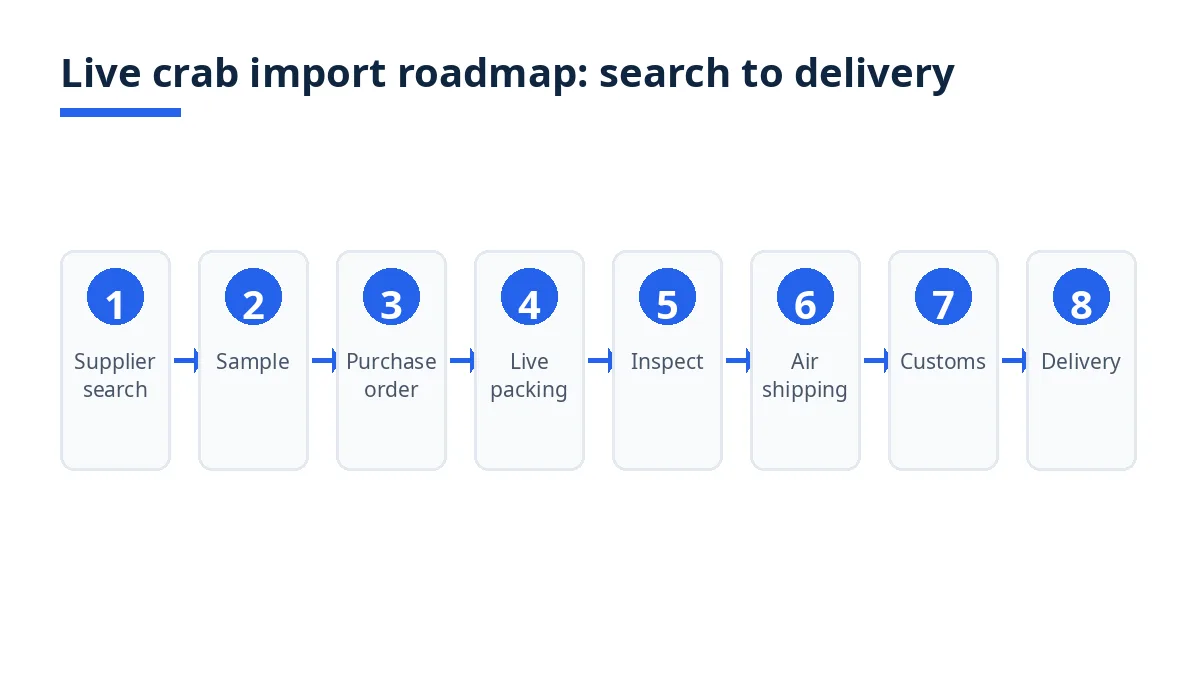
USA live-crab import sequence, step by step
Fix the species, sex, grade, and live condition, named identically everywhere.2
Confirm airline acceptance, container requirement, and routing before ordering.1
Classify on 0306.33.40 and confirm the duty position.3
Check the current SIMP list and collect chain of custody data lot by lot.4 5
Clear the wildlife file: declaration, licence check, and species identity.6 7 8
Build the Part 123 file and record the Foreign Supplier Verification Programs position.9 10
Confirm facility registration, the United States agent, and the APHIS position.11 13
Confirm the Bangladesh export file in writing, before packing.
Send one specification to every supplier, verify in three layers, and run a trial consignment.
Agree packing, the airport clock, and the delivery term.16
File Prior Notice, confirmed no less than 4 hours before arrival by air, enter the goods within 15 calendar days after landing, and reconcile the landed cost.12 17 18
What is the typical MOQ for live crabs from Bangladesh?
There is no single typical minimum, and no figure is stated here. Ask how it splits by species, sex, grade, and pack format, get the split in writing, and compare minimums only on the identical specification and trial record.
How long does shipping take?
Collection, holding, grading, packing, the airport clock, the flight, and clearance and delivery are separate blocks, and no combined figure is stated here. Plan from the forwarder's current flight schedule, and staff the arrival window before departure.
What import duty applies?
Duty follows classification, state, form, and entry date. The example line is 0306.33.40, whole live crabs other than crabmeat, at Free General with a column 2 rate of Free on Revision 16 (2026).3 Treat Free as indicative and have the broker confirm the rate, any Special program, and any additional duty on the exact 10-digit line.
How do I verify a supplier?
Check company documents first, so name, address, and bank account agree across trade licence, export registration, and invoices. Then check capability and the United States file: holding and packing, Part 123 records, SIMP data where flagged, facility registration, wildlife declaration details, and airline acceptance documents.4 9 11 Then check the trial arrival record before a full order.
Next steps on Exportain
Read the general guide to importing from Bangladesh and the classification guide for live crabs before you price, and use the landed cost guide for imports from Bangladesh for the full cost picture. When the species, line, and verification file are fixed, post a free RFQ with the United States airport of arrival and delivery date. For the buying journey, see how to buy.
Sources
- Questions and Answers for Shipping Live Animals by Air. International Air Transport Association (accessed )
- Mud Crab (Scylla spp.) Aquaculture in the South-West Sundarbans Region of Bangladesh. FAO AGRIS (accessed )
- Harmonized Tariff Schedule of the United States, Chapter 3. United States International Trade Commission (accessed )
- Seafood Import Monitoring Program Facts and Reports. National Oceanic and Atmospheric Administration, NOAA Fisheries (accessed )
- NMFS Trade Monitoring Program - Harmonized Tariff Schedule (HTS) Codes. NOAA Fisheries (accessed )
- 50 CFR 16.13 - Importation of live or dead fish, mollusks, and crustaceans, or their eggs. Legal Information Institute, Cornell Law Institute (accessed )
- 50 CFR 14.61 - Import declaration requirements. Legal Information Institute, Cornell Law Institute (accessed )
- 50 CFR 14.91 - When do I need an import/export license?. Legal Information Institute, Cornell Law Institute (accessed )
- 21 CFR 123.12 — Special requirements for imported products. GovRegs (accessed )
- Final Rule on Foreign Supplier Verification Programs (FSVP) At-A-Glance. U.S. Food and Drug Administration (accessed )
- Food Facility Registration User Guide: Summary of Fields. U.S. Food and Drug Administration (accessed )
- Guidance for Industry: What You Need to Know About Prior Notice of Imported Food Shipments. U.S. Food and Drug Administration, (accessed )
- Importing Fish, Fertilized Eggs, and Gametes into the United States. Animal and Plant Health Inspection Service, USDA (accessed )
- Food Allergies: What You Need to Know. U.S. Food and Drug Administration (accessed )
- Country of Origin Labeling (COOL): Common Questions and Answers. USDA Agricultural Marketing Service (accessed )
- Incoterms® 2020. International Chamber of Commerce (ICC) (accessed )
- 19 CFR 142.3 - Entry documentation required. Legal Information Institute, Cornell Law School (accessed )
- 19 CFR 142.2 - Time for filing entry. Legal Information Institute, Cornell Law Institute (accessed )
About the author
Sourcing from Bangladesh?
Post a request for quotation and suppliers on Exportain can send you their quotes directly.
Post an RFQ