Saudi Arabia Live Crab Imports: SFDA, SABER and ZATCA Gates
Live crabs from Bangladesh to Saudi Arabia through the SFDA, SABER and ZATCA gates: Ghad registration, Fasah clearance, health papers, air acceptance, and a riyal landed-cost example.
Short answer
To import live crabs from Bangladesh to Saudi Arabia, register the establishment and product on Ghad, confirm the SFDA import-permit, health-certificate and accredited-establishment answers, check that SABER certificates do not apply to food, secure carrier acceptance under the IATA Live Animals Regulations, use an air-suited Incoterms rule, and have the broker confirm duty and VAT before pricing.
On this page
Key takeaways
Register the establishment and the product on Ghad and file clearance through Fasah before ordering: the SFDA guide makes both registrations mandatory general requirements for food clearance.
Confirm the import-permit, health-certificate and accredited-establishment answers for the exact product and supplier, including Circular No. 41072, and hold the answers in writing.
Food products are not under the Saudi Product Safety Program, so SABER Product and Shipment Certificates do not apply; ask separately whether any other certificate of conformity applies.
Get carrier acceptance in writing under the IATA Live Animals Regulations before packing, and use air-suited Incoterms rules such as FCA, CIP or DAP, never CIF for air cargo.
No Saudi duty rate is stated in this guide because no Saudi tariff schedule was opened; have the broker confirm the 12-digit code and duty line, work VAT at the 15 percent standard rate as a working figure only, and price on surviving weight.
A Riyadh buyer ordering live crabs from Bangladesh faces three clocks at once: the animals must stay alive, the aircraft leaves on schedule, and Saudi clearance depends on registrations and papers completed before departure. Price is not the first decision. The first decisions are the Ghad registrations, the exact species name, and carrier acceptance, and this guide takes them in that order.
It is written for a Saudi Arabia buyer importing live crabs from Bangladesh for sale as food, by air. Points the sources opened for this guide did not settle are flagged as questions for SFDA or the broker, to be answered in writing.
Ghad, Fasah and the health paper come before the order
SFDA clearance guidance for food sets mandatory general requirements: the food must meet approved technical regulations and circulars, the establishment and food items must be registered on Ghad, and clearance requests go through SFDA electronic systems and Fasah.1 A licensed warehouse is part of the same list, subject to limited exemptions.1 Confirm whether any exemption applies to your consignment size, and keep the answer with the order file.
Fasah submissions, sent electronically, cover these papers:
Origin certificate, copy.
Commercial invoice, copy, showing product details, quantities, expiration dates, and batch numbers.1
Bill of lading, copy.
Health certificate, copy.1
How expiration dates and batch numbers appear for live animals needs a broker answer before drafting the invoice. The same guide lists a certificate of conformity as optional for all countries and mandatory for some.1 Ask the broker to check the country list for Bangladesh and live crabs, and file the answer.
Importers must also follow the list of food establishments exporting to Saudi Arabia, and Circular No. 41072, which covers importing meat, poultry, fish, shellfish, and aquatic life.1 Ask the broker where the named supplier stands on the list, and what the circular requires for live crabs. Samples can be taken for analysis at importer cost, and original clearance documents must be kept for five years.1 Allow time and money for sampling.
For fish and seafood, the guide adds health certificates covering the source of raw materials, an import permit, and import from accredited establishments.1 Whether a live-crab lot sits in that group as processed seafood does was not stated in the material opened here. Ask SFDA or the broker to settle the permit, health-certificate, and accreditation questions for the exact product and supplier before packing starts.
Fasah is the single window linking the agencies that touch a shipment: environment, commerce and agriculture authorities, customs, and the ports authority.2 Requested documents can be sent 72 hours before arrival.2 Papers sent early leave the arrival day for inspection and counting.
One specification, one species name, used everywhere
Every ruling in this file depends on naming the animal correctly. Use one specification, worded the same in the RFQ, quotation, health-certificate request, air waybill description, and declaration:
Field | What to fix |
|---|---|
Scientific name | The name that will appear on export papers |
Trade name | The common name used in buying and selling |
Origin of lot | Wild-caught or farmed, lot by lot |
State on arrival | Live, as distinct from chilled, frozen, or cooked |
End use | Food for human consumption |
Grading | Size grading, and how it is checked |
A ruling for one scientific name does not cover another. A farmed-lot ruling does not cover a wild-caught lot packed beside it. Keep lots in separate cartons, on separate packing-list lines. A trade name alone is not enough: get the scientific name the supplier will use on export papers, and have the broker check the same name in the Ghad registration, health certificate, and any permit request.
No wildlife-listing status is given here for any crab species. IATA notes that a specimen of a species in a CITES appendix in the Live Animals Regulations manual must travel with a CITES document.3 Have the broker check the exact scientific name and file the answer; do not ship while that question is open.
Probing Bangladesh supply before discussing price
A useful supplier can hold live crabs, grade them, pack them for air movement, and hand them to a carrier on a fixed flight. Before price is discussed, test whether the supplier in front of you can do each of those things, and who does each one. Ask whether crabs are held by the supplier or bought in from collectors, who grades, who packs, and who attends handover. A step with no named person is a gap in the Saudi file, because the health certificate, invoice, and packing list must all describe the same lot.
Continuity matters as much as capability. Ask in writing which months the graded size is available, and how much notice a lot of your size needs. On packing, ask how moisture is maintained, how crabs are kept apart, how labels match the packing list and air waybill unopened, and how count and weight are recorded. Ask for a photograph of a packed carton from a recent lot, label visible.
Filing supplier evidence, answer by answer
Shortlist on evidence, not catalogue range. For each candidate, file the table items, marking each received, missing, or refused, with the date.
Evidence | Check |
|---|---|
Legal identity | Legal name, registered address, export registration details, and the signatory for export documents |
Establishment list | Position on the SFDA list of food establishments exporting to Saudi Arabia, with evidence1 |
Specification wording | Species name, wild-caught or farmed status, and end use in your exact wording |
Certification | Any government certification Saudi conditions require, obtained before departure |
Trial lot | Willingness to run a trial lot on full paperwork, and the remedy if many arrive dead |
References | Named buyers or shipments that can be contacted |
Badge information on Exportain is one input among these. Badges record document and photo reviews, not a factory inspection, an inspection of your goods, or a guarantee. It sits beside the checks above; it does not replace them.
Quantity, price basis, and a trial lot that tests the file
No typical minimum, price, or transit time appears in this guide: no such figure was found in a Saudi or supplier source opened for it. Agree every figure supplier by supplier and shipment by shipment, in writing:
Quantity: kilograms of live weight, and carton count.
Count basis: weight only, number only, or both, plus an agreed allowance for short weight and short count.
Pricing rule for a short shipment.
Currency and price per kilogram.
The weight the price tracks: shipped weight, or weight alive on arrival.
Who bears the loss when crabs die in transit.
The trial lot uses the same paperwork as a full order: specification, packing, health-certificate wording, and carrier acceptance. Reduced paperwork only tests the flight. Agree payment triggers for the trial lot separately: the share paid on order, on handover, and on the arrival count, and what happens to each share if clearance refuses the shipment.
Counting at packing, at handover, and on arrival
Quality control here is a repeated count, a look, and a record. Agree the method and the named person for each check before shipment.
At packing: match the lot to the specification, species name and grading included, with no mixing of wild-caught and farmed lots. Photograph cartons, labels, and the count sheet, and keep them with the packing list.
At handover: match count, weight, and carton labels to the packing list and documents, and note the flight and accepting person.
On arrival: count at once, broker or handler present where possible, recording live numbers, dead numbers, and the weight of each group. Agree beforehand who counts, where, and how soon after landing.
A count a day later, after holding outside supplier control, says little about the shipment. Put the failure plan in the same document as the count method: short shipment, high dead share, mismatched lot, and clearance refusal separately, since refusal brings different costs and papers.
SABER certificates do not belong in a food file
Buyers often meet SABER first in Saudi conformity advice. For live crabs, that route does not apply. The Saudi Product Safety Program, known as SALEEM, works through technical regulations for specific products, and SABER is the information-technology system managing the program for the Saudi Standards, Metrology and Quality Organization.4 A conformity-assessment procedure for the SASO program states the boundary plainly: food products, cosmetic products, pesticides, new vehicles, and tobacco products sit outside the Saudi Product Safety Program, so SABER Product and Shipment Certification do not apply to them.4 Do not plan time or money for those certificates, and do not accept a supplier charge for them. Ask the broker and SFDA in writing whether a different certificate of conformity applies, since the SFDA guide lists such a certificate as optional for all countries and mandatory for some, without giving the Bangladesh position in the material opened here.1
Carrier acceptance comes before packing
The carrier decides whether live crabs fly. Under IATA rules, every animal shipment by air falls under the Live Animals Regulations, including shipments for life science, agricultural, zoological, and other purposes.3 Before booking, work through the reservation points IATA sets out, carrier named, answers written down:
Species and handling needs.
Container and carrier rules for the species.
Destination and importing-country rules for the species.
Direct routing allowed, and container fit in the hold.
Shipment date.
Acceptance turns on verification. Before preparing an animal for travel, IATA lists these checks: confirmed routing and facilities; container weight and size within the rules; correct labelling; shipper and consignee details on the container; a 24-hour emergency contact; duplicate care instructions fixed outside the container; and any medication recorded on the container.3 Carriers should accept animals only when they appear in good condition and health, after checking documentation, container build, marking and labelling, and the reservation and routing, with every checklist item cleared.3 Get the carrier acceptance in writing, covering species, container, and routing, before packing begins.
IATA names three minimum shipper documents for international animal shipments: import permit, health certification, shipper certificate.3 The shipper certificate is completed for each shipment, in English, with a translation added if needed, and signed twice.3 Live animals use their own air waybill, apart from other items, with the 24-hour emergency contact shown in the handling information, and each container needs at least one compliant live animals label.3 The captain learns the species, location, and quantity of live cargo through the Notification to Captain.3 Decide before booking who holds the 24-hour contact, who meets the aircraft, and who counts.
Choosing delivery terms for an aircraft hold
Incoterms 2020 rules divide delivery, risk, cost, and customs duties between the two sides. The International Chamber of Commerce describes eleven three-letter trade terms, the global standard for the most common terms in foreign trade, with Incoterms 2020 in force from 1 January 2020.5 Put the chosen rule, named place, and version in the contract.
The mode split decides the choice. Seven rules say nothing about transport mode, so they cover road, rail, air, and sea. Four rules are built for port-to-port movement and, in their current form, do not suit container shipments.6 FAS, FOB, CFR, and CIF are the sea and inland-waterway set; EXW, FCA, CPT, CIP, DAP, DPU, and DDP are the any-mode set. For an air consignment, work from the any-mode set.
Rule | What it means for a live air lot |
|---|---|
FCA | Seller hands the goods to the carrier; risk moves at that handover |
CIP | Seller contracts carriage and provides insurance for the buyer risk |
DAP | Seller delivers at the named destination, ready for unloading, carrying risk on the main carriage |
Settle the live-arrival count, dead-on-arrival remedy, and clearance failure plan as separate written points; no Incoterms rule divides refusal costs at the Saudi port of entry. Insurance needs a separate written point too: only CIP and CIF place a seller insurance obligation for the buyer risk, and under the other rules the seller carries risk until delivery and the buyer after.6 State the insured value and the papers the insurer will require before the flight.
Duty, VAT, and the declaration
Duty
Start classification from HS code 0306.33, covering live, fresh, or chilled crabs, with regional extensions adding digits and GCC countries using 12-digit codes.7 The broker must confirm the full 12-digit Saudi code for the exact consignment. This guide states no duty rate: no Saudi tariff schedule was opened for it, so do not price from a rate in a search result, a supplier quotation, or another destination. Have the broker run the ZATCA customs and tax calculator on the confirmed code and declared value, and file the dated result.
VAT
ZATCA states that importing goods, and supplying most goods and services in the Kingdom, attracts VAT at the standard rate of 15 percent, with a zero percent rate for certain specifically defined supplies, including certain supplies linked to qualifying activities in Special Economic Zones.8 Treat 15 percent as a working figure; have the broker and tax adviser settle the VAT base, any zero rating or exemption, and recoverability in writing.
The declaration
The broker files the declaration through Fasah. The World Customs Organization account records supporting documents falling from 12 to 2, the invoice and the bill of lading, with other papers, such as the origin certificate and conformity certificate, exchanged between agencies through Fasah.2 The SFDA papers stay in the file regardless. Check description, quantity, weight, and species name across every document before the flight.
Riyal arithmetic: costing on survivors, not on shipped weight
Every figure here is an example figure, showing the arithmetic. The duty figure is illustrative only, not the Saudi rate; the VAT figure is a working figure only, at the ZATCA standard rate, on a base the broker must confirm.8 The loss figure is an open assumption, not a survival promise.
Cost line | Example figure (SAR) | Basis |
|---|---|---|
Goods: 100 kg at SAR 75.00 per kg | 7,500.00 | Illustrative only |
Freight and insurance to Saudi Arabia | 3,000.00 | Illustrative only |
Duty: illustrative figure only | 420.00 | Not the Saudi rate |
Subtotal used for the VAT working figure | 10,920.00 | Sum of the three lines above |
VAT: 15 percent working figure | 1,638.00 | 15 percent of 10,920.00; base to confirm |
Broker and handling | 780.00 | Illustrative only |
Total cash outlay | 13,338.00 | Sum of all lines above |
Per kg on shipped weight: 100 kg | 133.38 | 13,338.00 divided by 100 |
Per kg on surviving weight: 92 kg | 144.98 | 13,338.00 divided by 92; 8 percent loss assumed |
In figures: 7,500 + 3,000 + 420 = 10,920; VAT at 15 percent on 10,920 = 1,638; adding 780 gives 13,338. That is 133.38 per kg at 100 kg shipped, and 144.98 per kg at 92 kg surviving, after an assumed 8 percent loss. Rework the table from the first line when the broker confirms duty, the VAT base, or a different loss. Costing on shipped weight hides the loss in margin.
The Saudi gates, in the order to clear them
Clear the gates in this order, holding each written answer before moving on:
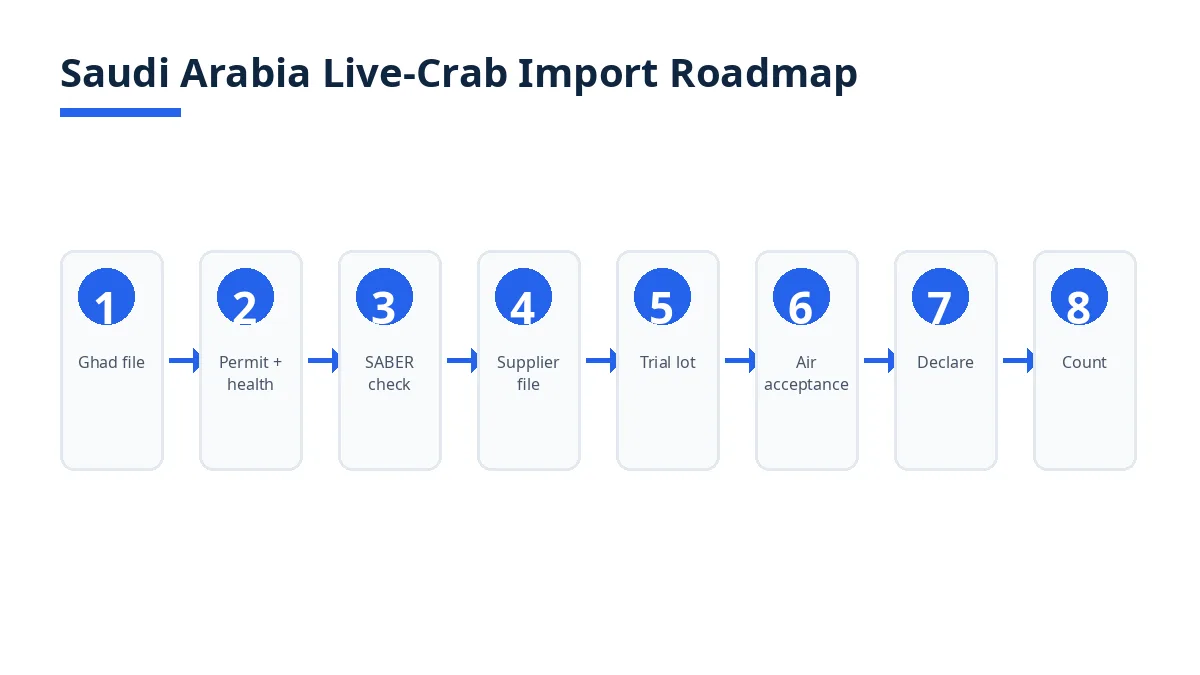
Write the specification: scientific name, lot origin, live state, end use, grading, count method.
Settle Ghad: establishment registration, product registration, warehouse requirement.
Settle permit, health certificate, and establishment accreditation, including Circular No. 41072.
Check the wildlife document position for the exact scientific name.
Settle the SABER exclusion and the separate conformity-certificate question.
Shortlist suppliers on the evidence table, and file every answer.
Agree commercial terms, the trial lot, payment triggers, the arrival count, and the failure plan.
Get carrier acceptance in writing, and confirm container, labelling, and the 24-hour contact.
Pack, photograph, count, and hand over, on documents that match each other.
Declare through Fasah, clear, count on arrival, keep originals five years.
What is the typical MOQ for live crabs from Bangladesh?
A minimum is not set here. The sources opened for it contain no Saudi minimum figure for this commodity, and a figure from one catalogue would describe one supplier, not the market. Settle the minimum with each supplier, for each shipment, in writing: kilograms of live weight, cartons, and an allowance for short weight and short count. Test it with a fully papered trial lot, checking it works for supplier, carrier, and Saudi file together.
How long does shipping take?
No transit figure is given in this guide: the sources opened for it contain no Saudi transit figure for this commodity. The time between packing in Bangladesh and arrival in Saudi Arabia turns on routing, carrier acceptance, connections, and clearance. Get routing and scheduled times from the carrier in writing; ask the broker what clearance and sampling can add at the Saudi airport. Use the longest realistic elapsed time for the trial lot.
What import duty applies?
This guide gives no duty rate, because no Saudi tariff schedule was opened for it. Start from HS code 0306.33, live, fresh, or chilled crabs, with GCC 12-digit extensions, and have the broker confirm the full 12-digit Saudi code and duty line for the exact consignment before ordering.7 VAT sits apart from duty: ZATCA states the standard rate at 15 percent, zero percent for certain specifically defined supplies.8 Have the broker and tax adviser confirm zero rating, the VAT base, and recoverability.
How do I verify a supplier?
Begin with the Saudi file, not a price list. Check legal identity, establishment-list position, health-certificate readiness, packing evidence, and references, filing each answer as received, missing, or refused. Get written confirmation of species name, lot origin, and end use in your exact specification wording, and any government certification Saudi conditions require, obtained before departure. Finish with a trial lot on full paperwork, counted on arrival by the agreed method. A supplier that answers in writing, packs as agreed, and accepts the arrival count is the one to carry forward.
Next steps on Exportain
Read the importing from Bangladesh overview first, then run your own broker-confirmed numbers through the landed-cost worksheet built from your broker's confirmed rates. Use the supplier directory and the buying guide to shortlist suppliers and run RFQs with the specification from this guide included.
Post a free RFQ on Exportain and get quotes from verified Bangladeshi suppliers.
Sources
- Conditions and Requirements for Food Clearance. Saudi Food and Drug Authority (accessed )
- Saudi Zakat, Tax and Customs Authority (ZATCA) introduces Clearance Within Two Hours Initiative. World Customs Organization (accessed )
- Questions and Answers for Shipping Live Animals by Air. International Air Transport Association (accessed )
- Standard Operation Procedure - SASO Program (FA-SOP-CP-SS-7-00). FAHES (accessed )
- Incoterms® rules. International Chamber of Commerce (ICC) (accessed )
- Insider thoughts: Bob Ronai on Incoterms 2020 Rules; What are they about?. International Chamber of Commerce (accessed )
- HS Code for Crabs. FreightAmigo (accessed )
- SEZ Tax and Customs Procedures. Zakat, Tax and Customs Authority (ZATCA) (accessed )
About the author
Sourcing from Bangladesh?
Post a request for quotation and suppliers on Exportain can send you their quotes directly.
Post an RFQ