Italy Live Crab Imports From Bangladesh: Seven Gates to Delivery
Import live crabs from Bangladesh to Italy gate by gate: name the lot, clear the supplier file, run a trial lot, assemble the CHED-P and CATCH border file for the Italian BCP, confirm duty and IVA with the broker, pass airline acceptance, and count survivors.
Short answer
To import live crabs from Bangladesh to Italy, name the species and settle the wild-caught or farmed fork, verify the supplier establishment on the TRACES-NT list, run a trial lot on full paperwork, agree pricing on surviving weight, build the CHED-P and CATCH border file for the Italian BCP, confirm the TARIC duty line and IVA with the broker, and pass IATA airline acceptance before flying.

On this page
Key takeaways
Only listed-country goods are admitted, and checks happen at designated Border Control Posts under Regulation (EU) 2017/625; the Italian BCP must confirm the CHED form, deadline, and language in writing.
Bangladesh is listed in Annex IX to Regulation (EU) 2021/405 for all fishery products including crustaceans, but the broker must re-check the current country lists for the entry date, and the establishment must be checked on TRACES-NT.
Wild-caught lots run through CATCH since 10 January 2026; farmed lots need a broker-confirmed farm-lot traceability file instead of an assumed exemption.
No duty rate, transit time, MOQ, or price is stated as fact: the broker confirms the TARIC line and IVA treatment, and every commercial figure is agreed in writing per lot.
Price on surviving weight with a written dead-on-arrival counting rule, and confirm airline acceptance under the IATA Live Animals Regulations before packing.
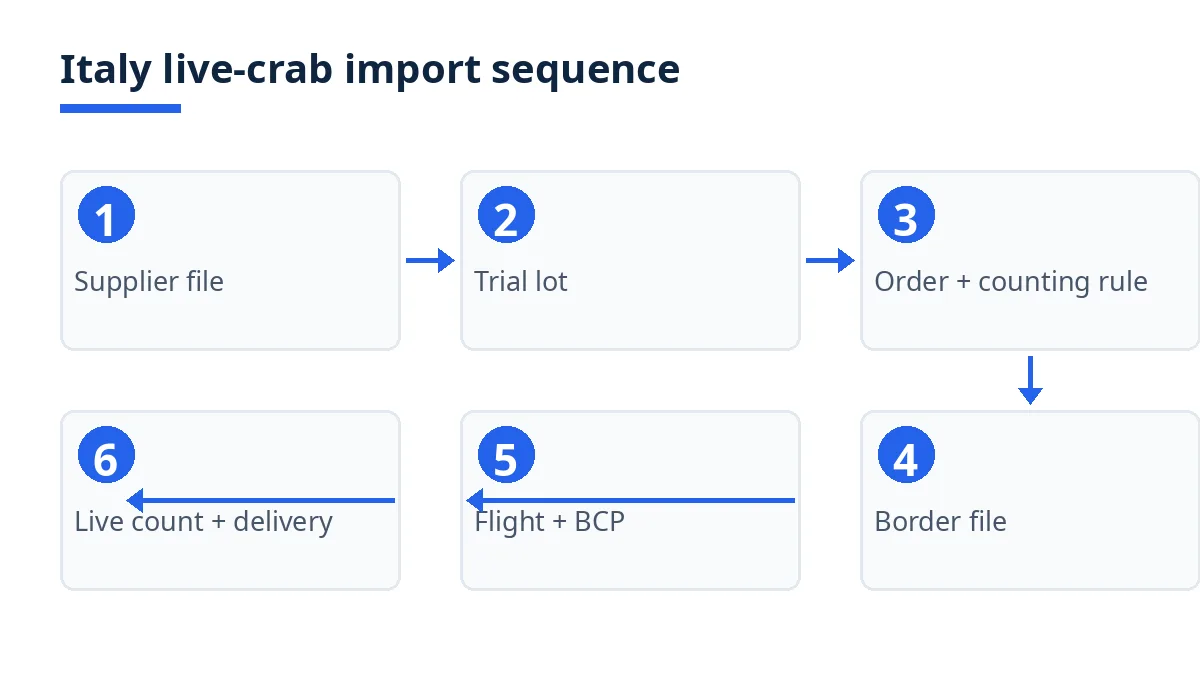
To import live crabs from Bangladesh to Italy, work through a sequence of gates, and close each gate in writing before the next one opens. A live consignment cannot wait while paperwork is repaired. This guide runs the import in gate order: name the crab, clear the supplier file, run a trial lot, agree the order, assemble the border file, confirm duty and IVA, choose delivery terms, pass airline acceptance, and only then fly, clear, and count. Admission covers only goods of animal origin from authorised countries, and consignments face documentary, identity, and physical checks at designated Border Control Posts (BCPs).1
The sequence in one view: seven gates from first enquiry to live delivery
Gate | Decision that closes it |
|---|---|
1. Crab and lot | Species, scientific name, wild-caught or farmed |
2. Supplier file | Listed establishment, written answers |
3. Trial lot | Packing, holding, grading, live count |
4. Order | Minimum, price basis, counting rule |
5. Border file | BCP, CHED form, certificates, catch proof |
6. Duty and IVA | Tariff line, rate, preference, IVA treatment |
7. Flight and clearance | Airline acceptance, BCP decision, live count |
Step one: settle the crab, the lot, and the Italian name
Start with the lot description, not with a price list. The purchase order must name the species and its scientific name, the size band, the grade, whether the lot is wild-caught or farmed, and the production method as it will appear on the label. Every later document repeats those facts, so a vague lot description becomes a mismatch at the border. Settle it before shortlisting, since it also decides the tariff line, health certificate, and catch or farm proof.
Many small holdings feed this supply, so lot identity, grading, and holding time must be settled lot by lot. The chain suits live orders: mud crabs of the genus Scylla are taken from the wild and held until they gain condition. Researchers in Bagerhat, Satkhira, and Khulna recorded the south-west Sundarbans practice of holding wild-harvested crabs in river pens, ghers, and earthen ponds, mostly lean males and females with immature gonads.2 No species for trade was identified; the supplier must state the species and scientific name for the exact lot in writing.
Run the wildlife gate on the named species before the order. Any specimen of a species included in one of the CITES appendices listed in the IATA Live Animals Regulations manual must be accompanied by a CITES document, which may be an export permit, an import permit for Appendix I species, a re-export certificate, or another listed certificate.3 No CITES status is stated for any crab species in this guide. The broker must confirm in writing whether a permit or certificate is needed for the named species before the supplier ships.
Step two: test the supplier against the border file, not the catalogue
A supplier is ready for an Italian order when its border file is ready, and the catalogue comes second. Ask each supplier, in writing before price discussion closes, for the listed establishment name and approval number, the species and scientific name, whether each lot is wild-caught or farmed, the catch certificate or farm-lot record route, the health certificate model, and the packing and airline acceptance plan. A supplier that cannot produce those items in writing is not ready for an Italian order.
Have the broker confirm the fishery products entry on the current TRACES-NT list for the entry date before shortlisting. The Commission keeps the published lists in TRACES, on proposals from approved, listed countries, while the non-EU country's competent authority carries responsibility for the details being right.4 Before listing, that authority verifies that a plant turning out food of animal origin for export meets the Annex III hygiene rules in Regulation (EC) No 853/2004, whose Section VIII covers fishery products.4
The broker must re-check the current country lists for the entry date, not rely on the version opened here. Entry to the European Union is limited to non-EU countries whose names appear on those lists: Regulation (EU) 2021/404 carries the animal-health list, and Regulation (EU) 2021/405 carries the public-health list.4 Fishery products sit in Annex IX to the 2021/405 list, whose consolidated version consulted here, dated 15 December 2022, gives Bangladesh the marker (1), denoting a country permitted to send the fishery-products range: finfish, products of finfish, and crustaceans.5
Step three: run a trial lot on full border paperwork
A trial lot is useful only if it runs on the same file as a full order: the same listed establishment, certificate model, packing, airline route, and BCP, at a smaller agreed quantity. Agree the trial quantity, species and grade, packing unit, and counting method in writing before the trial ships.
Use the trial to settle quality control in observable terms: grading, holding time before packing, removal of weak or damaged animals, keeping the lot alive to the airport, and counting and evidencing live arrival. Put grade definitions in writing, with the size band and live condition the buyer will accept, and agree what happens to animals that arrive dead or weak: who counts, where, what evidence is needed, and how the invoice adjusts.
Step four: agree the order on surviving weight
This guide gives no typical minimum order quantity and no typical price: no opened source states a market-wide figure for live crabs from Bangladesh to Italy. Treat every minimum and price as supplier-specific, agreed in writing for the named species, grade, size band, and live condition.
The minimum is shaped by the holding batch size, the packing unit the airline accepts, and the quantity that fills the agreed routing without splitting the lot. Ask each supplier to state its minimum in the same units as the price, per kilogram of live weight shipped, and whether it applies per lot, per shipment, or per packing unit. Price on surviving weight, with the counting rule, counter, timing, and invoice adjustment for dead animals agreed in writing. The sale contract must also state who bears the loss to the counting point and what happens if the BCP refuses the consignment.
Step five: assemble the border file for the Italian entry point
Fix the Italian BCP of entry before routing is agreed. All European Union BCPs apply the same official control rules under Regulation (EU) 2017/625, and consignments face documentary, identity, and physical checks at designated BCPs.1 The Italian BCP must be confirmed as designated for this consignment category and must confirm in writing which entry document it expects, by when, in which language, and who the responsible operator is.
The entry document for products of animal origin is the Common Health Entry Document for products, CHED-P. TRACES divides the CHED by consignment type, CHED-A for live animals and CHED-P for products of animal origin, and issuance in TRACES or in connection with TRACES is mandatory.6 The operator pre-notifies arrival by completing Part I for the BCP of entry, and the BCP processes Part II with its decision.6 Implementing Regulation (EU) 2019/1715 provides CHED-P for consignments of products referred to in point (b) of Article 47(1) of Regulation (EU) 2017/625, and the CHED carries English alongside one official language of the destination country.7 Have the Italian BCP confirm in writing that CHED-P is the correct form and which language version it expects, because live crabs sit at the boundary between live animals and products of animal origin.
Decide wild-caught or farmed for each lot, because that decides the catch file. Fishery products may only be imported when accompanied by a catch certificate conforming to the IUU Regulation, validated by the flag State of the vessel that made the catches.8 The validated certificate must be submitted at least three working days before estimated arrival, although the deadline may be adapted by product type, distance, or transport means.8 Confirm which deadline applies to the air route and agree who submits it. Verification suspends release, with storage costs on the operator, and importation must be refused where no valid certificate is submitted or products differ from those certified.8 A mixed lot is two lots with two files.
Since 10 January 2026, the wild-caught file runs through CATCH, the digital catch certification system integrated as a component of TRACES, compulsory for European Union operators and authorities for imports of fishery products from that date, while voluntary for non-EU countries.9 The Commission confirms the digital system came into force on 10 January 2026, replacing the paper-based process.10 For a farmed lot, the broker and the Italian BCP must confirm in writing whether a catch certificate is needed or a farm-lot traceability record is the correct file, with farm unit, lot identity, and chain from harvest to packing in writing. Traceability information for imported products must include a reference to the catch certificate number where one applies.9
Carry the health certificate on the current model, and check a copy before packing. For fish and crustaceans, the amended model is FISH-CRUST-HC, and certificates must conform with the revised models or the products risk refusal at the border; errors may cause rejection, and TRACES digital use reduces error chances.11 Before departure, confirm the current model and that species, quantity, weight, establishment number, and lot identity match the invoice, packing list, and air waybill. The document set travels together: catch certificate or farm-lot record, health certificate, CHED-P notification, matching invoice and packing list, separate air waybill, Shipper's Certificate, and acceptance checklist.7 8 11 The Bangladesh export file is a supplier confirmation: no export-requirements page for a live-crab line was opened for this guide, so the supplier must name its export documents in writing for the exact line.
Step six: confirm classification, duty, and IVA with the broker
Classify on heading 0306 and leave the full line to the broker. Heading 0306 covers crustaceans, whether in shell or not, live, fresh, chilled, frozen, dried, salted or in brine, smoked, and cooked in shell by steaming or boiling, and subheading 0306.33 covers crustaceans, live, fresh or chilled, crabs, whether in shell or not.12 A genuinely live consignment starts from 0306.33, while frozen crabs fall under 0306.14.12 The broker must confirm the full 10-digit TARIC line for the entry date, since the six-digit subheading alone does not complete an Italian declaration. Traps to avoid: a live consignment on a frozen code mismatches the certificate and CHED-P, and crabmeat figures must never be applied to whole live crabs. All codes are indicative and must be verified against the tariff for the entry date.
This guide states no customs duty rate, because no European Union TARIC schedule for the exact live-crab line was opened in its research. The broker must confirm the rate on the exact TARIC line for the entry date, with any preference, origin rule, and proof of origin. The generalised scheme of preferences allows developing countries to pay lower tariffs, and its Everything But Arms strand gives full tariff- and quota-free imports for all goods from United Nations-defined least-developed countries, except arms.13 That summary names no country; beneficiary status and proof of origin are broker-confirmed in writing before any duty figure is used.
Import IVA is separate from duty, and its rate for this line is also a broker and tax adviser question. In Italy, the standard IVA rate is 22 percent, with reduced rates of 10, 5, or 4 percent on certain products, and the import IVA base includes the customs value, transport and insurance to the European Union border, customs duties, and inland transport to the first destination on the consignment note.Whether live crabs take a reduced rate is for the broker and tax adviser on the exact line; this guide does not assert it.14
Step seven: choose delivery terms that leave mortality and refusal in writing
Agree CIP to the named Italian place for an air consignment, with FCA at the airport as the alternative where the buyer controls the air leg, two of the eleven Incoterms 2020 rules, issued in 1936, dividing cost, risk, and duties between the parties.15 CIP calls for carriage and insurance to the broader Institute Cargo Clauses (A), while a maritime term falls back to the narrower Institute Cargo Clauses (C).15 CIF, Cost Insurance and Freight, cannot move onto an air shipment: it belongs to sea transport; FCA has the seller deliver to the carrier the buyer nominates.15 Get written insurer confirmation of cover for mortality, delay, and BCP refusal before the term is fixed.
The delivery term alone does not settle the live question. The sale contract must separately state how dead-on-arrival animals are counted, who bears the loss to the counting point, how the price adjusts, and what evidence the count requires, and who bears the cost if the Italian BCP refuses the consignment.
Step eight: book the flight only after airline acceptance is confirmed
Live crabs travel by air as live animals, and airline acceptance is a gate before departure. Anyone sending animals by air must work to the IATA Live Animals Regulations (LAR), and reservation checks cover the species and its handling requirements, the container, the carrier's rules for the species, the destination and transit countries' rules, the most direct routing the importing country allows, container fit in the hold, and the shipment date.3 Confirm the booking, routing, and carrier species requirements in writing before packing, and work certificate submission, CHED-P notification, and acceptance checks backwards from the agreed flight.
Acceptance checks precede preparation: routing, container readiness, weighing, labelling, 24-hour contact details, care instructions, and medication records.3 The shipper's minimum documents are the import permit, health certification, and the Shipper's Certificate.3 Live animals require their own air waybill, with a 24-hour emergency contact in the Handling Information box, and the carrier advises the captain through a Notification to Captain (NOTOC) of species, location, and quantity.3 The IATA Live Animal Acceptance Checklist must be completed in full, with every criterion cleared before acceptance.3 This guide states no crab-specific container, oxygen, water, or temperature figure, because the LAR manual was not opened for this guide; agree the exact container, packing, moisture, and ventilation arrangements in writing with the carrier against the current LAR requirement for the named species.3 It also states no transit time, because no opened source states one for live crabs from Bangladesh to Italy.
Step nine: present, clear, and count at the Italian BCP
At the Italian BCP, the consignment faces documentary, identity, and physical checks, with high-risk goods such as seafood subject to systematic controls.1 If it does not meet European Union requirements, it may be refused entry, and the authority may order destruction, re-dispatch, special treatment, or another appropriate measure, with reinforced controls possible on future consignments from the same origin.1
Settle the Italian sale label before the cartons are printed, because it must carry the same facts as the certificates. Under Regulation (EU) No 1379/2013, fishery and aquaculture products put before the final consumer or a mass caterer must carry the commercial designation and scientific name, production method, catch or farming area with fishing gear category, whether defrosted, and date of minimum durability where appropriate.16 Member States publish lists of accepted commercial designations with scientific names in their official language or languages.16 Use the Italian designation from Italy's published list, not a trade name from a price list. The area indication follows Article 38: sea-caught products state the FAO sub-area or division name, or, outside the Northeast Atlantic and the Mediterranean and Black Sea, the FAO fishing area name; aquaculture products state the country of more than half the final weight or rearing period, or, for shellfish, of a final rearing stage of at least six months.16 Annex II to Regulation (EU) No 1169/2011 lists crustaceans among substances causing allergies or intolerances, so confirm the crustacean declaration with the label adviser.17 Prepare the label in Italian and have the label adviser confirm the artwork before packing.
Count live arrival at the agreed point, reconcile it against the invoice and the BCP decision, and file the full document set.
Landed-cost arithmetic on surviving kilograms
Example figures. Every figure is illustrative: no figure is a market price, a typical minimum, or a duty rate. Duty and import IVA are broker-confirmed, since no TARIC rate for the exact line was opened. The 5 percent mortality adjustment is an explicit assumption, not a typical survival rate.
| Cost line | EUR per kg shipped | Basis | |---|---| | Product price, FCA named place | 12.00 | Example figures | | Air freight and insurance to Italy | 5.50 | Example figures | | Subtotal before duty and import IVA | 17.50 | 12.00 + 5.50 | | BCP, clearance, and broker charges | 0.90 | Example figures | | Delivery from the BCP to the buyer | 0.60 | Example figures | | Total before duty and import IVA, per kg shipped | 19.00 | 17.50 + 0.90 + 0.60 | | Customs duty | Broker-confirmed | TARIC line for the entry date | | Import IVA | Broker and tax adviser confirmed | Base includes customs value, freight and insurance to the EU border, duty, and inland transport to the first destination | | Total before duty and import IVA, per surviving kg at 5% assumed loss | 20.00 | 19.00 / 0.95 |
The landed cost guide explains the wider build-up; it does not replace broker confirmation for this line.
What is the typical MOQ for live crabs from Bangladesh?
No market-wide minimum appears in this guide: no opened source states one. The minimum is supplier-specific, agreed in writing per lot in the same units as the price, per kilogram of live weight shipped.
How long does shipping take?
No transit time is stated: no opened source states one for live crabs from Bangladesh to Italy. Agree routing, flight, and airport and BCP timetables with the carrier and the Italian BCP in writing before packing.
What import duty applies?
No duty rate is stated. The broker confirms the rate on the exact TARIC line for the entry date, with any preference, origin rule, and proof of origin. Everything But Arms gives full tariff- and quota-free imports for goods from United Nations-defined least-developed countries except arms, but that summary names no country and decides no consignment.13 Import IVA is separate, with the live-crab rate broker- and adviser-confirmed.14
How do I verify a supplier?
Verify against the border file: listed establishment and approval number on the TRACES-NT list, species and scientific name, the wild-caught or farmed position lot by lot, the catch certificate or farm-lot record route, the current health certificate model, and the written packing and airline acceptance plan.4 5 8 11
Next steps on Exportain
Start with the guide to importing from Bangladesh, check classification in the HS code guide for live crabs, and build the costing with the landed cost guide. Browse suppliers and read how to buy. When the border file is ready to test, post a free RFQ describing the species, the lot fork, the establishment check, and the counting rule, and compare replies on the same written basis.
Sources
- Import controls of food and feed Q&As. European Commission (accessed )
- Mud Crab (Scylla spp.) Aquaculture in the South-West Sundarbans Region of Bangladesh. FAO AGRIS (accessed )
- Questions and Answers for Shipping Live Animals by Air. International Air Transport Association (accessed )
- Non-EU countries authorised establishments. European Commission (accessed )
- Commission Implementing Regulation (EU) 2021/405 — list of third countries authorised for fishery products. European Union (accessed )
- Modules. European Commission (accessed )
- Commission Implementing Regulation (EU) 2019/1715. legislation.gov.uk (accessed )
- Council Regulation (EC) No 1005/2008, Chapter III: Catch certification scheme for importation and exportation of fishery products. legislation.gov.uk, (accessed )
- Revised EU rules and digitalisation of fisheries control. AGRINFO (accessed )
- New digital certification system to tackle illegal fishing. European Commission, (accessed )
- Updates to model animal/official health certificates for animal products and live fish/aquatic animals. AGRINFO, (accessed )
- HS 2017 Code 0306. United Nations Statistics Division (accessed )
- Preferential European Union import tariffs for developing countries. EUR-Lex (accessed )
- How to Import into Italy in 2026? Procedure & Documents. Eurofiscalis, (accessed )
- Incoterms® 2020. International Chamber of Commerce (ICC) (accessed )
- Regulation (EU) No 1379/2013 on the common organisation of the markets in fishery and aquaculture products. legislation.gov.uk, (accessed )
- Regulation (EU) No 1169/2011. legislation.gov.uk (accessed )
About the author
Sourcing from Bangladesh?
Post a request for quotation and suppliers on Exportain can send you their quotes directly.
Post an RFQ