Germany Live Crabs Imports From Bangladesh: Border-File Checklist
Import live crabs from Bangladesh to Germany by building the EU border file first: the German BCP and CHED-P, the TRACES-NT establishment listing, the CATCH catch certificate or farm-lot proof, the health certificate, and airline acceptance, with a mortality-adjusted landed-cost example.
Short answer
To import live crabs from Bangladesh to Germany, fix the German Border Control Post and confirm the CHED-P form and deadline, verify the supplier's establishment on the TRACES-NT fishery products list, and settle the wild-caught or farmed fork lot by lot, with a CATCH catch certificate for wild-caught lots. Confirm the FISH-CRUST-HC health certificate, the German label, the TARIC duty line, and airline acceptance in writing before booking, and price on surviving weight.
On this page
Key takeaways
Fix the German BCP and CHED-P file first: only listed-country goods are admitted, and checks happen at designated Border Control Posts under Regulation (EU) 2017/625.
Bangladesh is listed in Annex IX to Regulation (EU) 2021/405 for all fishery products including crustaceans, but the broker must re-check the current list for the entry date.
Wild-caught lots need a validated catch certificate submitted through CATCH since 10 January 2026; farmed lots need farm-lot traceability instead.
No duty rate, transit time, MOQ, or price is stated as fact: the broker confirms the TARIC line, and every commercial figure is agreed in writing per lot.
Price on surviving weight with a written dead-on-arrival counting rule, and confirm airline acceptance under the IATA Live Animals Regulations before packing.
This guide explains how to import live crabs from Bangladesh to Germany by building the European Union border file first and the commercial order second. Live crabs are food of animal origin, a wild-caught or farmed fishery product, and a live animal consignment at the same time, so three files run in parallel: the border control file, the catch or farm proof, and the airline acceptance file. Get every confirmation named here in writing before you pay a deposit.
Build the border file first: the border control post, CHED-P, and TRACES
Only goods of animal origin from authorised countries are admitted, and consignments are subject to documentary, identity, and physical checks at designated Border Control Posts (BCPs).1 All EU BCPs apply the same official control rules under Regulation (EU) 2017/625, whether entry is by air, sea, or land.1 Fix the German BCP of entry before routing is agreed, and have it confirm in writing which entry document it expects and by when. Obtain the deadline, responsible operator, and document language from the German BCP in writing before booking.
The entry document for products of animal origin is the Common Health Entry Document for products, CHED-P. Implementing Regulation (EU) 2019/1715 provides CHED-P for consignments of products referred to in point (b) of Article 47(1) of Regulation (EU) 2017/625, and CHEDs are the documents operators use to give prior notification and authorities use to record the outcome of official controls.2 Ask the German BCP to confirm in writing that CHED-P is the correct form for the exact consignment, because live crabs sit at the boundary between live animals and products of animal origin. Non-compliance can mean refusal, destruction, or re-dispatch, with reinforced controls on future consignments.1
Prove the country and the establishment are listed
Animals and goods can only enter the EU from non-EU countries which are listed, with the lists published in Regulation (EU) 2021/404 for animal health and Regulation (EU) 2021/405 for public health.3 For fishery products, the list is Annex IX to Regulation (EU) 2021/405. In the consolidated version opened for this guide, dated 15 December 2022, Bangladesh appears in Annex IX with the marker (1), which the annex footnote explains as countries that can export all fishery products: finfish, products of finfish, and crustaceans.4 The broker must re-check the current list for the entry date.
Lists of food-producing establishments for non-EU countries are proposed by approved, listed countries and maintained by the Commission, with details held in the TRACES platform managed by DG SANTE, and accuracy is the responsibility of the non-EU country competent authority.3 Establishments producing food of animal origin for export to the EU must comply with Annex III to Regulation (EC) No 853/2004, checked by the competent authority before the establishment is proposed for listing; fishery products fall under Section VIII of that categorisation.3
Wild-caught or farmed? The fork that decides the IUU file
Settle this fork lot by lot. Fishery products may only be imported when accompanied by a catch certificate conforming to the IUU Regulation, validated by the flag State of the vessel that made the catches.5 The validated certificate must be submitted by the importer at least three working days before the estimated time of arrival at the place of entry, although the deadline may be adapted by product type, distance, or transport means.5 Confirm whether the three-working-day period or an adapted deadline applies to the air route. Verification suspends release, with storage costs on the operator, and importation must be refused where no valid certificate is submitted or products differ from those certified.5
Since 10 January 2026, that file runs through CATCH, the EU IT system for the catch certification scheme, which is part of TRACES NT.6 Use of CATCH is compulsory for EU importers submitting catch certificates and related documents for fish or fishery products under Chapter 3 and headings 1604 and 1605 subject to IUU controls, and the Commission confirms the digital system came into force on 10 January 2026, replacing the paper-based process.6 7 Farmed crabs take the other fork: CATCH is only for wild-caught produce subject to the scheme, with no change for exempt produce listed under Regulation (EC) No 202/2011, covering aquaculture and freshwater species.6 A farmed lot needs farm-lot traceability instead: the farm or fattening unit, lot identity, and chain from harvest to packing, in writing. Where a lot mixes wild-caught and farmed crabs, treat it as two lots with two files.
The health certificate and the FISH-CRUST-HC model
Consignments of animals and animal products from non-EU countries must be accompanied by an official health certificate, with model certificates laid down for animal products, composite products, and live fish.8 For fish and crustaceans, the amended model is FISH-CRUST-HC, and certificates must conform with the revised models or the animal products risk refusal at the border.8 Errors may cause rejection, and TRACES digital use reduces error chances.8 Before departure, confirm the current model and that species, quantity, weight, establishment number, and lot identity match the invoice, packing list, and airwaybill. The supplier sends a copy for the broker to check before packing.
Name the crab: species, production method, and the German label
The label must carry the same facts as the certificates. Under Regulation (EU) No 1379/2013, fishery and aquaculture products marketed within the Union may be offered for sale to the final consumer or a mass caterer only if labelling indicates the commercial designation and scientific name, the production method (caught, caught in freshwater, or farmed), the catch or farming area with the fishing gear category, whether the product has been defrosted, and the date of minimum durability where appropriate.9 Article 35 applies without prejudice to Regulation (EU) No 1169/2011, so the label adviser must confirm the final artwork against both instruments.9
Member States publish lists of accepted commercial designations with scientific names, in the official language or languages of the Member State.9 Use the German designation for the named species, not a trade name from a price list. The area indication follows Article 38: sea-caught products state the FAO sub-area or division name, or, outside the Northeast Atlantic and the Mediterranean and Black Sea, the FAO fishing area name; aquaculture products state the country where the product reached more than half its final weight or stayed for more than half the rearing period, or, for shellfish, underwent a final rearing stage of at least six months.9 Annex II to Regulation (EU) No 1169/2011 lists crustaceans and products thereof among substances causing allergies or intolerances, so confirm the crustacean declaration with the label adviser for the channel supplied.10
Why Bangladesh fits a German live-crab order, and where it does not
Bangladesh supplies mud crabs of the genus Scylla through a fattening chain suited to live orders: wild-harvested mud crabs are traditionally fattened in pens in tidal rivers, ghers, and earthen ponds, and a study of the practice in the south-west Sundarbans region covered Bagerhat, Satkhira, and Khulna districts, where fattening is predominantly undertaken; most farmers fattened lean males and gonadally immature females.11 Consolidation from many small holdings means lot identity, grading, and holding time must be specified lot by lot. Bangladesh also appears on the EU fishery-products authorised-country list described above.4 That listing and the fattening chain make the order workable, but neither removes the file work here.
Classify on heading 0306: the 0306.33 line and the traps around it
Heading 0306 covers crustaceans, whether in shell or not, live, fresh, chilled, frozen, dried, salted or in brine, smoked, and cooked in shell by steaming or boiling.12 Subheading 0306.33 covers crustaceans, live, fresh or chilled, crabs, whether in shell or not.12 A genuinely live, fresh, or chilled crab consignment starts from 0306.33, while frozen crabs fall under subheading 0306.14 and smoked or prepared products fall elsewhere.12 The broker must confirm the full EU Combined Nomenclature code for the exact consignment on the entry date, since the six-digit subheading alone does not complete a German declaration. Three traps: a live consignment on a frozen code mismatches the certificate and CHED-P; crabmeat figures must never be applied to whole live crabs; the form on all documents must match the cartons. All codes here are indicative and must be verified against the tariff for the entry date.
Find and verify suppliers against the border file
Ask each supplier, in writing before price discussion closes, for the listed establishment name and approval number in TRACES-NT for the fishery products section, the species and scientific name, whether each lot is wild-caught or farmed, the catch certificate or farm-lot record route, the health certificate model, and the packing and airline acceptance plan.3 5 8 Keep the written answers with the purchase order. Ask how the supplier grades and holds crabs and counts live arrival, in the same exchange. Request a trial shipment on the same file as a full order: same establishment, certificate model, packing, and airline route, at a smaller agreed quantity. Use the guide to importing from Bangladesh for the wider search, with the Germany-specific checks here as the gate.
MOQ, pricing, and live samples without a stated typical minimum
This guide states no typical minimum order quantity and no typical price: no opened source states a market-wide figure, and an invented figure would mislead the first buyer who relies on it. Treat every minimum and price as supplier-specific, agreed in writing for the named species, grade, size band, and live condition. The minimum is shaped by the holding batch size, the packing unit the airline accepts, and the quantity filling the agreed routing without splitting the lot. Ask each supplier to state its minimum in the same units as the price, per kilogram of live weight shipped, and whether it applies per lot, per shipment, or per packing unit. Price on surviving weight, with the counting rule, counter, timing, and invoice adjustment for dead animals agreed in writing, and grade definitions written down.
Live transport: airline acceptance under the IATA rules
Live crabs travel by air as live animals, and airline acceptance is a gate before departure. Anyone shipping animals by air needs to follow the IATA Live Animals Regulations (LAR), and reservation checks include species and handling requirements, container requirements, carrier regulations for the species, destination and country regulations, the most appropriate direct routing allowed by the importing country, container fit in the hold, and the shipment date.13 Acceptance checks precede preparation: routing and facilities, container readiness, weighing, labelling, 24-hour contact details, care instructions, and medication records.13
The shipper's minimum documents are the import permit, health certification, and the Shipper's Certificate.13 Live animals require their own air waybill, separate from other items, including a 24-hour emergency contact in the Handling Information box, and the carrier advises the captain through a Notification to Captain (NOTOC) of species, location, and quantity.13 The IATA Live Animal Acceptance Checklist must be completed in full, with every criterion cleared before acceptance.13 This guide states no crab-specific container, oxygen, water, or temperature figure, because the LAR manual was not opened for this guide. Container requirements by species are set out in the LAR manual; agree the exact container, packing, moisture, and ventilation arrangements in writing with the carrier against the current LAR requirement for the named species.13
Incoterms for a live consignment: FCA, CIF, and who bears a dead arrival
Incoterms 2020 allocates cost, risk, and obligations under eleven rules, used globally since 1936 and updated in 2020.14 FCA, Free Carrier, fits an air departure where the seller delivers to the carrier nominated by the buyer; the 2020 revision covers agreement that the buyer instructs the carrier to issue an on-board bill of lading to the seller once goods are loaded.14 CIF, Cost Insurance and Freight, is reserved for maritime trade, with Institute Cargo Clauses (C) as default cover, while CIP requires the higher Institute Cargo Clauses (A) cover.14 Do not use a maritime term for air, and confirm insurer cover for mortality, delay, and BCP refusal in writing. The delivery term alone does not settle the live question: the sale contract must separately state how dead-on-arrival animals are counted, who bears the loss to the counting point, how the price adjusts, and what evidence the count requires. DAT was renamed Delivered at Place Unloaded (DPU) in 2020, with the seller unloading under DPU and not under DAP.14
Import duty, taxes, and documents: no rate without the TARIC line
This guide states no customs duty rate, because no EU TARIC schedule for the exact live-crab line was opened in its research. The broker must confirm the rate on the exact TARIC line for the entry date, with any preference, origin rule, and proof of origin. The EU generalised scheme of preferences allows developing countries to pay lower tariffs, and its Everything But Arms strand gives full tariff- and quota-free imports for all goods from United Nations-defined least-developed countries, except arms.15 Beneficiary status, origin rules, and proof of origin are broker-confirmed in writing before any duty figure is used.
Import VAT is separate. German Customs states the import VAT base is the customs value plus customs duty, plus excise duties for excise goods, the rate is currently 19 percent, and a reduced rate of 7 percent applies to selected goods such as food products and books.16 Whether live crabs take the reduced rate is for the broker and tax adviser on the exact line; this guide does not assert it. Where a preference exempts customs duty, only import VAT and any excise duty must be paid, subject to written proof of preferential status.16 The document set, assembled before departure, is: catch certificate or farm-lot record, health certificate on the current model, CHED-P notification through TRACES, invoice and packing list matching the certificate, separate live-animals air waybill, Shipper's Certificate, and completed acceptance checklist.2 5 8 13 The Bangladesh export file is a supplier confirmation: no export-requirements page for a live-crab line was opened, so the supplier must name its export documents in writing for the exact line.
Landed cost example with a mortality adjustment
Example figures. Every figure in this table is illustrative. No figure is a market price, a typical minimum, or a duty rate. Duty and import VAT are broker-confirmed, since no TARIC rate for the exact line was opened. The 5 percent mortality adjustment is an explicit assumption showing the arithmetic, not a typical survival rate.
Cost line | EUR per kg shipped | Basis |
|---|---|---|
Product price, FCA named place | 12.00 | Example figures |
Air freight and insurance to Germany | 5.50 | Example figures |
Subtotal before duty and import VAT | 17.50 | 12.00 + 5.50 |
BCP, clearance, and broker charges | 0.90 | Example figures |
Delivery from the BCP to the buyer | 0.60 | Example figures |
Total before duty and import VAT, per kg shipped | 19.00 | 17.50 + 0.90 + 0.60 |
Customs duty | Broker-confirmed | TARIC line for the entry date |
Import VAT | Broker and tax adviser confirmed | Base is customs value plus duty; 19% standard or 7% reduced if the line qualifies |
Total before duty and import VAT, per surviving kg at 5% assumed loss | 20.00 | 19.00 / 0.95 |
The landed cost guide explains the wider build-up; it does not replace broker confirmation for this line.
Step-by-step import checklist
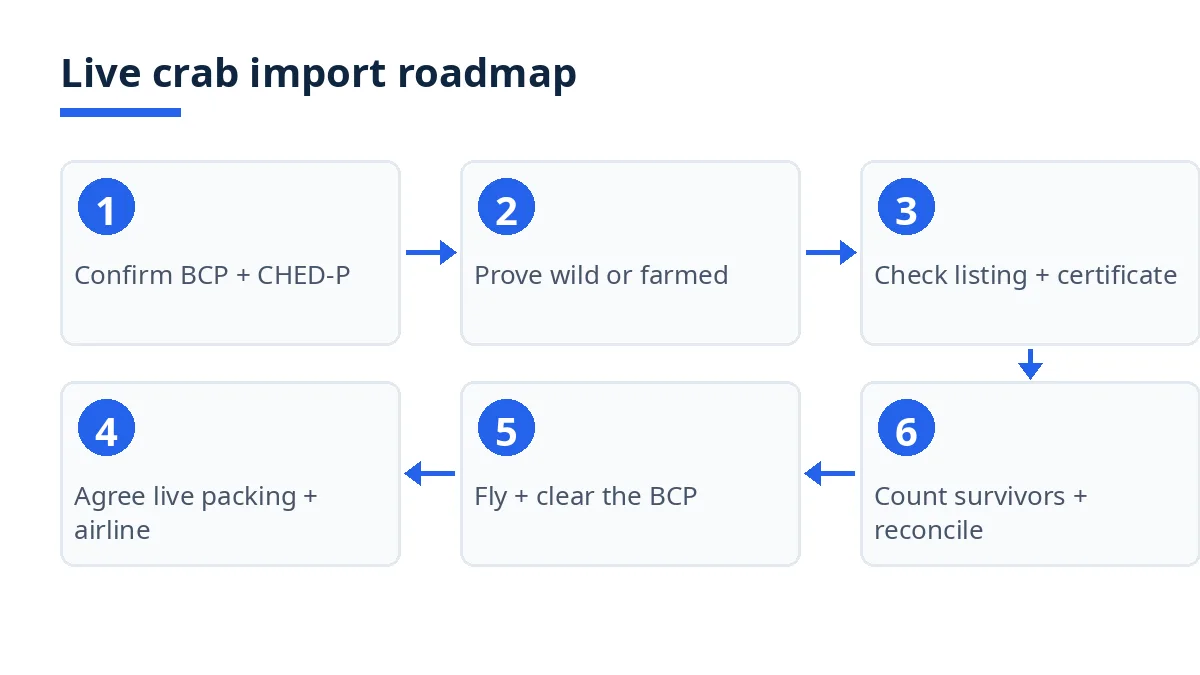
Fix the German BCP and obtain written confirmations on the CHED-P form, deadline, responsible operator, and document language.
Confirm the supplier's listed establishment on the TRACES-NT list.
Settle the lot fork in writing: wild-caught with a CATCH catch certificate, or farmed with a farm-lot record.
Submit the validated catch certificate within the deadline the German authority confirms, and agree who enters the CATCH submission.
Obtain the health certificate copy on the current FISH-CRUST-HC model before packing for broker checking.
Agree species, scientific name, production method, and area fact for the German label, and confirm the allergen declaration.
Confirm the full Combined Nomenclature code, duty rate, preference, proof of origin, and import VAT treatment with the broker in writing.
Agree container, packing, and handling with the carrier against the current LAR requirement, and confirm booking and routing.
Complete the acceptance checklist, Shipper's Certificate, and separate air waybill before the animals reach the airport.
Agree the Incoterms rule, counting rule, and price adjustment in the sale contract, and confirm insurance cover in writing.
Count live arrival at the agreed point, reconcile against the invoice and BCP decision, and file the full document set.
What is the typical MOQ for live crabs from Bangladesh?
No typical minimum is stated here, because no opened source states a market-wide figure. The minimum is supplier-specific, agreed in writing per lot in the same units as the price, per kilogram of live weight shipped, shaped by holding batch size, the accepted packing unit, and flight routing. Compare suppliers only on the same stated basis.
How long does shipping take?
No transit time is stated, because no opened source states one for live crabs from Bangladesh to Germany. Agree routing, flight, and airport and BCP timetables with the carrier and the German BCP in writing before packing, and work certificate submission, CHED-P notification, and acceptance checks backwards from the agreed flight.
What import duty applies?
No duty rate is stated. The broker confirms the rate on the exact TARIC line for the entry date, with any preference, origin rule, and proof of origin. Everything But Arms gives full tariff- and quota-free imports for goods from United Nations-defined least-developed countries except arms, but that summary names no country and decides no consignment.15 Import VAT is separate: base is customs value plus duty, at 19 percent standard or 7 percent reduced for selected goods, with the live-crab position broker- and adviser-confirmed.16
How do I verify a supplier?
Verify against the border file: listed establishment and approval number on the TRACES-NT list, species and scientific name, the wild-caught or farmed position lot by lot, the catch certificate or farm-lot record route, the current health certificate model, and the written packing and airline acceptance plan.3 5 8 13 Run a trial shipment on the same file and check the certificate copy with the broker before packing. A supplier that cannot produce those items in writing is not verified for a German order.
Next steps on Exportain
Start with the guide to importing from Bangladesh, check classification in the HS code guide for live crabs, and build the costing with the landed cost guide. When the border file is ready to test, post an RFQ describing the species, the lot fork, the establishment check, and the counting rule, and compare replies on the same written basis.
Sources
- Import controls of food and feed Q&As. European Commission (accessed )
- Commission Implementing Regulation (EU) 2019/1715. legislation.gov.uk (accessed )
- Non-EU countries authorised establishments. European Commission (accessed )
- Commission Implementing Regulation (EU) 2021/405 — list of third countries authorised for fishery products. European Union (accessed )
- Council Regulation (EC) No 1005/2008, Chapter III: Catch certification scheme for importation and exportation of fishery products. legislation.gov.uk, (accessed )
- CATCH - NEW EU SYSTEM. Sea-Fisheries Protection Authority (accessed )
- New digital certification system to tackle illegal fishing. European Commission, (accessed )
- Updates to model animal/official health certificates for animal products and live fish/aquatic animals. AGRINFO, (accessed )
- Regulation (EU) No 1379/2013 on the common organisation of the markets in fishery and aquaculture products. legislation.gov.uk, (accessed )
- Regulation (EU) No 1169/2011. legislation.gov.uk (accessed )
- Mud Crab (Scylla spp.) Aquaculture in the South-West Sundarbans Region of Bangladesh. FAO AGRIS (accessed )
- HS 2017 Code 0306. United Nations Statistics Division (accessed )
- Questions and Answers for Shipping Live Animals by Air. International Air Transport Association (accessed )
- Incoterms® 2020. International Chamber of Commerce (ICC) (accessed )
- Preferential European Union import tariffs for developing countries. EUR-Lex (accessed )
- Assessment of taxes and duties. German Customs (Zoll) (accessed )
About the author
Sourcing from Bangladesh?
Post a request for quotation and suppliers on Exportain can send you their quotes directly.
Post an RFQ