Canada Live Crab Imports From Bangladesh: CFIA Permit-First Guide
Live crabs from Bangladesh to Canada on a CFIA-first file: the SFC licence and preventive control plan, the aquatic animal health permit, supplier checks, air acceptance, LDCT duty, GST, and a worked landed-cost example in Canadian dollars.
Short answer
To import live crabs from Bangladesh to Canada, hold an SFC import licence with a preventive control plan and traceability records, run AIRS for the exact species to settle the aquatic animal health permit, agree the species specification, trial lot, price basis and failure plan in writing, get airline acceptance under the IATA Live Animals Regulations, classify on tariff item 0306.33.00, and have the broker confirm duty and GST before pricing.
On this page
Key takeaways
Two gates decide the order: the SFC food-import licence with a preventive control plan, and the aquatic animal health permit that turns on species susceptibility. Clear both, in writing, before paying a deposit.
Scylla serrata and Scylla tranquebarica are on the CFIA susceptible-species list; live freshwater mitten crab (Eriocheir) may not be imported at all. Name the exact scientific name in every document.
Tariff item 0306.33.00 shows MFN 5 percent and LDCT Free in the T2023 schedule; claim the LDCT rate only with broker-confirmed origin proof, and have the broker confirm the current schedule and GST treatment.
Get airline acceptance in writing under the IATA Live Animals Regulations before packing, and use air-suited Incoterms rules such as FCA, CIP or DAP, never CIF for air cargo.
Agree quantity, price basis, trial lot, live-arrival count and failure plan in writing, and price on surviving weight using example figures reworked with broker-confirmed numbers.
To import live crabs from bangladesh to canada, a buyer must clear two Canadian gates before the first carton is packed: the food-import gate administered by the Canadian Food Inspection Agency (CFIA) and the aquatic animal health gate that applies because the crabs arrive alive. This guide covers both gates, then suppliers, pricing, packing, delivery terms, duty and tax, and a landed-cost example in Canadian dollars.
The two gates that decide a Canada live-crab order
The first gate is the food-import gate under the Safe Food for Canadians Regulations. A commercial food importer needs a Safe Food for Canadians (SFC) licence, a written preventive control plan, traceability records, and a complaints and recall procedure, and must give the CFIA information about each shipment before or at importation.1 The CFIA sequence is: understand the food and its hazards, learn the requirements, select a supplier that can show its controls, build the plan and the recall procedure, and only then apply for the licence.1
The second gate is the animal-health gate under the Health of Animals Regulations. Whether an aquatic animal needs an import permit and a zoosanitary certificate turns on whether the species is susceptible to one of Canada's diseases of concern, and the CFIA directs importers to its Automated Import Reference System (AIRS) for the current requirements for the exact commodity, origin, destination, and end use.2 An SFC licence does not answer the susceptibility question, and an animal-health permit does not replace the licence, the plan, or the declaration. Start both tracks before paying a deposit.
Settle the crab on paper before you settle the price
Name the animal by its scientific name in every document, starting with the first enquiry. The CFIA susceptible-species list is written in taxonomic names, and the import declaration must carry the scientific name as well.3 4 Common names such as mud crab cover several species. Ask the supplier to state the scientific name, life stage, number, birth or germplasm country, and captive-or-wild status.4
Both Scylla serrata, listed as giant mud crab, and Scylla tranquebarica appear on the CFIA susceptible-species list as susceptible to white spot disease.3 Do not assume a related species shares the same status: check the exact scientific name on the current list, lot by lot, and keep the dated result in the file.3
One species must be kept out of the order entirely. Live freshwater mitten crab of the genus Eriocheir may not be imported into Canada under section 105 of the Safe Food for Canadians Regulations, because the crab is a host for the lung fluke parasite that can infect humans.5 Eriocheir sinensis also appears on the susceptible-species list.3 If a supplier offers mitten crab, or cannot confirm the genus in writing, the lot does not proceed.
Keep crabs separate from the molluscan-shellfish regime: in the Regulations, "shellfish" means bivalve molluscs or carnivorous marine gastropods, and live or raw molluscan shellfish come only from listed authorized countries and establishments, which do not include Bangladesh.6
Permit conditions are set case by case on disease risk, origin, commodity, and end use, so record the lot's origin evidence in the declaration, invoice, and trial-lot file.2
The SFC licence, the preventive control plan, and the records you keep
The licence is the importer's own credential. To import food, a person must hold a licence, and the food and the licence holder must meet the Safe Food for Canadians Regulations.7 Apply through a My CFIA account; the licence is valid for two years.1
Build the preventive control plan before applying for the licence. It is the written document showing how the importer ensures the food is safe and meets Canadian requirements.1 Its core demand is supplier evidence: imported food must have been manufactured, prepared, stored, packaged, and labelled under conditions providing at least the same level of protection as the preventive controls in the Regulations.7 Reassess it when the supplier or its controls change.1
Traceability runs one step in each direction: back to the immediate supplier and forward to the immediate customer, with names, addresses, and dates recorded.1 Records must be accessible in Canada for two years, provided to the CFIA on request, and in English or French.1 Before applying, develop written complaints and recall procedures and simulate a recall once every 12 months.1 Enforcement runs from corrective measures up to suspension or cancellation of a licence.7
The aquatic animal health permit: AIRS, the certificate, and the new-commodity route
AIRS shows the import requirements for CFIA-regulated commodities by commodity, origin, destination, and end use.8 It is a reference tool only, updated frequently; importers remain responsible for the accuracy of their information at importation.8 Run it for the exact species, origin, destination, and end use; keep a dated copy.2
When the species is susceptible, the importer applies for an Aquatic Animal Health Import Permit on form CFIA/ACIA 5670 through a My CFIA account, after checking AIRS that a permit is required.2 Susceptible animals may also require export health certification, and import is allowed from countries that have negotiated zoosanitary certificates with the CFIA.2 If AIRS refuses the commodity for lack of a negotiated certificate, the importer may file a formal Request to Import a New Commodity or Import from a New Country of Origin through My CFIA.2
When the species is not on the list, no permit is required, but the consignment must still carry documentation with the exporter and importer names and addresses, the taxonomic name, life stage, and number of animals, the birth or germplasm country, and the captive-or-wild status.2 Do not book freight until the permit answer is written.
What the border does with a live consignment
Importers must ensure imported fish and seafood meet the Safe Food for Canadians Regulations and the Food and Drug Regulations.9 At the border, the Canada Border Services Agency (CBSA) imposes duties and admissibility requirements, and the CFIA must be notified of food shipments destined for sale.1 The declaration can be submitted electronically up to 90 days before arrival; submit it as far in advance as possible.1 Declare the right Harmonized System code and Other Government Department extension, with the scientific name matching the AIRS code.1 4
The SFC licence number must be declared correctly or the transaction will be rejected, and the licence must be active, issued for importing food, and issued for the commodities being imported.1 Enter the number exactly as issued in the registration number field of the Integrated Import Declaration.1 If rejected, the shipment is denied entry until the errors are corrected and the declaration resubmitted.1 Check the number, the species code, and the AIRS coding with the broker before the flight.
Confirm the inspection position with the CFIA and the broker before ordering, and put the answer in the failure plan.1 7
Why Bangladesh supply fits, and where the file strains
Bangladesh is a live-crab source Canadian buyers already consider. The compliance case turns on evidence: the supplier must tie each lot to a species, an origin, and a handling history the buyer's plan can rely on. The strain points are species identity, origin evidence, and handling evidence, since the buyer must show the food was prepared, stored, packed, and labelled under conditions providing at least the same level of protection as the Canadian preventive controls.7 No Bangladesh export list is stated here; have the broker confirm the export papers match the Canadian file.
Check a supplier against the Canadian file
Judge suppliers on the evidence the Canadian file needs, not on catalogue claims. Hold the following evidence before ordering, lot by lot. No company names are given in this guide, and no supplier is described as approved.
Evidence to hold before ordering | What it must show | Why Canada asks for it |
|---|---|---|
Species and origin record | Scientific name, life stage, number, birth or germplasm country, captive or wild, for the lot | |
Handling and packing record | How the lot was held, handled, packed, and labelled before export | Same-level-of-protection test for imported food7 |
Health documentation | Permit position, zoosanitary certificate position, and any test evidence, confirmed through AIRS | Susceptible species need a permit and may need export certification2 |
Labelling proof | Common name, lot code, and origin details as they will appear on the cartons | Labelling and traceability requirements for imported fish10 |
Commercial terms in writing | Quantity, weight basis, count method, price basis, trial lot, and failure plan | The landed-cost example and the arrival count depend on them |
Record every answer with a date, and re-check the AIRS result when the supplier, species, or origin changes.
Quantity, price basis, and the trial lot
No typical minimum order quantity for live crabs from Bangladesh is stated in this guide, and none should be assumed from another market's guide. Agree the quantity for the specific shipment in writing, with the weight basis and the count method in the same written clause, stating whether the price is set on shipped weight or on surviving weight, how the arrival count is taken, and who bears the loss for animals that do not survive to the count.
Run a trial lot on full paperwork before committing to a bulk order, using the same species record, AIRS check, permit and certificate file, packing, and count method as the bulk lot, so that what it tests is the whole file, not just the animals. Judge it on the file as well as the arrival condition. Handle samples as trial lots with the same file, not as informal parcels.
Packing, labelling, and the live-arrival count
Labelling for imported fish must carry the common name, net quantity, ingredients list, Nutrition Facts table, lot code or other unique identifier, and principal place of business.10 For imported prepackaged fish, the country of origin must be clearly identified on the label, meaning the country where the fish product was last substantially transformed.10 Agree the carton label before packing, using the CFIA Fish List common name for the species, and confirm with the CFIA or the broker which labelling rules apply to the exact sales format, including any language and allergen statements.
Packing is agreed with the carrier, not improvised at the packing table. Agree the packing method, the moisture and ventilation arrangements, and the handling instructions in writing with the supplier and the carrier, and state no temperature, oxygen, or moisture figure in the contract unless the carrier has confirmed it for the species and the routing. Count on arrival against the invoice number the same day: the invoice must already carry the scientific name, the number of animals, the life stage, and the captive-or-wild statement.4 Count live animals separately from animals that arrive dead or moribund, keep the count record with the lot code, and apply the failure plan agreed in writing.
Air acceptance comes before the booking
Live crabs fly as live animals, and the airline decides whether they fly. The IATA Live Animals Regulations bind everyone moving animals by air, and the booking checks look at the species, its handling needs, the container, the carrier's species rules, the destination and its country rules, the most appropriate direct routing allowed by the importing country, whether the container fits the aircraft hold, and the shipment date.11 Before preparation, confirm routing and facilities, weigh, measure, and label the container, attach shipper and consignee details and a 24-hour emergency contact, affix duplicate care instructions outside, and record any medication on the container.11 The shipper's documents include the Shipper's Certificate, the health certification, and the import permit, completed in English and signed in duplicate; live animals travel on their own air waybill, and the captain is notified through a Notification to Captain.11 Every item on the IATA Live Animal Acceptance Checklist has to be cleared before acceptance.11 Get the carrier's acceptance in writing before packing; a freight quotation is not acceptance.
Delivery terms for live air cargo
Four of the eleven Incoterms 2020 rules are written for sea and inland waterway transport only: FAS, FOB, CFR, and CIF. The remaining rules, including CPT, CIP, DAP, DPU, and DDP, are written for any mode of transport, including air.12 CIF is therefore the wrong rule for an air consignment: the ICC limits CIF to maritime trade, its default cover being Institute Cargo Clauses (C), while CIP, usable for any mode, calls for the broader Clauses (A) level of cover.12 For live air cargo, FCA, CIP, and DAP are the practical starting points, with the delivery point and the import-clearance duty stated in the contract. Under DAP the seller does not unload, while under DPU the seller does unload.12 Settle separately, in writing, who bears the loss if the consignment is refused, who pays for holding and care during a delay, and how the live-arrival count affects payment.
Duty, GST, and the documents that travel together
Classify live crabs on tariff item 0306.33.00, live, fresh or chilled crabs, measured in kilograms. The schedule shows a Most-Favoured-Nation (MFN) rate of 5 percent, with the Least Developed Country Tariff (LDCT) shown among the preferential tariffs at Free.13 Bangladesh is an LDCT beneficiary, a program providing duty-free treatment for virtually all goods from least developed countries, renewed to December 31, 2034, with a stated three-year transition intent after Bangladesh's prospective 2026 United Nations graduation.14 Claim the LDCT rate only with the origin proof the broker confirms; otherwise price at the 5 percent MFN rate. Have the broker confirm the current schedule for the entry date; the schedule opened here is the T2023 edition.
GST applies at 5 percent outside the Harmonized Sales Tax (HST) provinces, with HST at 13 percent in Ontario and 15 percent in New Brunswick, Newfoundland and Labrador, Nova Scotia, and Prince Edward Island.15 GST and HST on imported goods is payable on the duty-paid value to the CBSA at import.16 Have the broker and tax adviser confirm the provincial part and any zero-rating before pricing; the example prices GST at 5 percent as a working figure only.
The commercial invoice carries the scientific name, number, life stage, birth or germplasm country, and captive-or-wild statement.4 The packing list, air waybill, SFC licence number, permit, certificate, proof of origin, and Shipper's Certification complete the set.1 2 11 Keep copies with the lot code, with names, numbers, and species matching across all documents.
Landed cost example in Canadian dollars
All figures here are example figures, to be reworked with broker-confirmed numbers. The example assumes 100 kilograms shipped, a customs value of CAD 2,400, LDCT duty at Free with proof held, GST at 5 percent, and a 5 percent loss to the arrival count, in Canadian dollars.
Cost line | Example figure (CAD) | Basis |
|---|---|---|
Goods, 100 kg shipped | 2,400.00 | CAD 24.00 per kg, example price |
Duty at LDCT Free | 0.00 | Origin proof held; MFN fallback below |
GST at 5 percent on duty-paid value | 120.00 | 5 percent of CAD 2,400 |
Air freight | 900.00 | Example freight for the lot |
Insurance | 60.00 | Example insurance for the lot |
Broker and handling | 150.00 | Example broker and handling charges |
Total landed cost | 3,630.00 | Adding the rows above |
Cost per kg shipped | 36.30 | CAD 3,630.00 divided by 100 kg |
Cost per kg surviving, 95 kg | 38.21 | CAD 3,630.00 divided by 95 kg at an assumed 5 percent loss |
Without the LDCT proof, duty is CAD 120.00, GST CAD 126.00, and the total CAD 3,756.00 (CAD 37.56 per kg shipped, CAD 39.54 per surviving kg). Rework every line with the broker's figures, keeping the loss assumption explicit.
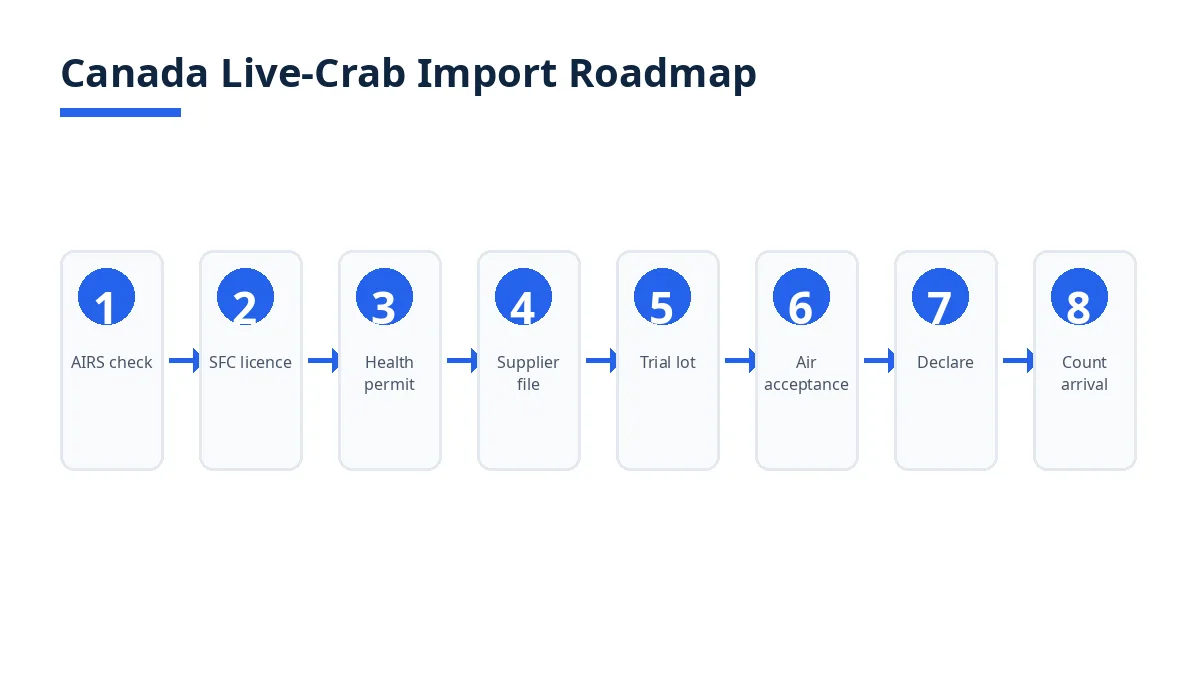
The Canada import run, in order
Run the AIRS check for the exact species, from Bangladesh, for human consumption, to the Canadian destination, and keep the dated result.8
Confirm the species on the susceptible-species list and the permit and certificate position in writing.2 3
Confirm the SFC licence position, build the preventive control plan and the complaints and recall procedure, and apply for the licence through My CFIA.1
Check the supplier against the evidence table and agree all terms in writing.
Run the trial lot on full paperwork, count on arrival, and judge the file as well as the animals.
Agree the delivery term, packing, labelling, and carrier acceptance in writing before packing.11 12
Confirm classification on 0306.33.00, the LDCT origin proof, and the GST treatment with the broker and tax adviser.13 14 15 16
Submit the import declaration as far in advance as possible, with the SFC licence number entered exactly as issued and the AIRS coding matching the scientific name.1
Ship on the accepted routing with the full document file, including the permit, the certificate, the proof of origin, and the Shipper's Certification.2 11
Count on arrival, record live and dead numbers by lot code, and apply the failure plan.1 4
What is the typical MOQ for live crabs from Bangladesh?
Set the quantity lot by lot: no typical minimum order quantity is stated in this guide, and no figure from another market should be carried into a Canadian order. Agree the quantity per shipment in writing, with the weight basis and the count method in the same clause, and run a trial lot on full paperwork first.
How long does shipping take?
No figure is given here for transit time, because the time depends on the routing, the carrier, the acceptance checks, and the declaration position for the specific shipment. Agree the flight, the routing, and the carrier acceptance in writing before packing, and plan around the live-animal clock from packing to the arrival count.
What import duty applies?
Live crabs classify on tariff item 0306.33.00, where the schedule shows an MFN rate of 5 percent and the LDCT at Free among the preferential tariffs.13 Bangladesh is an LDCT beneficiary, so the Free rate applies where the origin proof the broker confirms is held; otherwise price at the 5 percent MFN rate.14 GST is priced separately, at 5 percent on the duty-paid value as a working figure, with the provincial part to be confirmed.15 16
How do I verify a supplier?
Start from the Canadian file, not from a catalogue or a price list. Hold the species and origin record, the handling and packing record, the health documentation position confirmed through AIRS, the labelling proof, and the commercial terms in writing, and test all of it on a trial lot run on full paperwork. Re-check the AIRS result and the susceptible-species list when the species, supplier, or origin changes.
Next steps on Exportain
Read the how-to-import guide for the general Bangladesh import file and the landed-cost guide to rework the example with broker-confirmed figures, then search Bangladeshi suppliers and ask each one for the species, origin, and health-document evidence this guide lists. Post a free RFQ on Exportain and get quotes from verified Bangladeshi suppliers → https://exportain.com/rfqs.
Sources
- Importing food to Canada: a step-by-step guide. Canadian Food Inspection Agency (accessed )
- Aquatic animal imports. Canadian Food Inspection Agency (accessed )
- Susceptible species of aquatic animals. Canadian Food Inspection Agency (accessed )
- Memorandum D19-8-5: Import Prohibitions and Requirements — Aquatic Invasive Species. Canada Border Services Agency, (accessed )
- Regulatory requirements: Fish. Canadian Food Inspection Agency (accessed )
- Importing live and raw molluscan shellfish. Canadian Food Inspection Agency (accessed )
- Regulatory requirements: Trading food. Canadian Food Inspection Agency (accessed )
- Automated Import Reference System (AIRS). Canadian Food Inspection Agency (accessed )
- Importing fish and seafood products. Canadian Food Inspection Agency (accessed )
- Fish and seafood labelling and traceability requirements. Canadian Food Inspection Agency, (accessed )
- Questions and Answers for Shipping Live Animals by Air. International Air Transport Association (accessed )
- Incoterms® 2020. International Chamber of Commerce (ICC) (accessed )
- Chapter 3: T2023 — Fish and crustaceans, molluscs and other aquatic invertebrates. Canada Border Services Agency (accessed )
- Canada's unilateral tariff preference programs for imports from developing countries. Department of Finance Canada (accessed )
- The Continuation of GST/HST Relief for Tla'amin Citizens (Notice 328). Canada Revenue Agency (accessed )
- Taxes and duties. Public Services and Procurement Canada (accessed )
About the author
Sourcing from Bangladesh?
Post a request for quotation and suppliers on Exportain can send you their quotes directly.
Post an RFQ