Belgium Live Crab Imports From Bangladesh: Costs, Duties and Suppliers
Live crabs from Bangladesh through Belgium: the Antwerp gateway, the FASFC border file, species and catch proof, live-air acceptance, and a EUR 23.50 per kilogram landed-cost example.
Short answer
To import live crabs from Bangladesh to Belgium, enter through a Belgian border control post, pre-notify FASFC at least one working day before arrival through TRACES with a CHED, and prove the country and establishment are listed. Carry the FISH-CRUST-HC certificate, settle the wild-caught or farmed fork in CATCH, classify on heading 0306.33, and have the broker confirm duty and import VAT on the TARIC line. Book as live animals by air and agree the mortality count before ordering.
On this page
Key takeaways
Enter through Belgium and plan the onward journey first: once the border control post accepts the consignment, it is released for free circulation throughout the EU, from the veterinary point of view, so the Antwerp gateway serves customers beyond Belgium.
Pre-notify FASFC at least one working day before arrival through TRACES with a CHED, and get the border control post to confirm the CHED model in writing before booking, since live crabs sit between the food and live-animals files.
Bangladesh appears in Annex IX of Regulation (EU) 2021/405 with remark (1), covering all fishery products including crustaceans, and the packing establishment must be listed in TRACES-NT; re-check both for the entry date.
CATCH is compulsory for EU importers from 10 January 2026 for wild-caught Chapter 3 products, while aquaculture is exempt; settle the wild-caught or farmed fork lot by lot, never with one label for a mixed lot.
No duty or import VAT rate is stated: the broker must confirm the TARIC line, the rate, and any Everything But Arms preference for heading 0306.33. The example lands at EUR 23.50 per kilogram shipped, or EUR 24.74 per surviving kilogram at an assumed 5 percent loss.
To import live crabs from Bangladesh to Belgium is to buy a border decision as much as a cargo. The same clearance can serve a buyer in Brussels or a customer in another member state. Fix the border file before you fix the price.
This guide covers the gateway choice, the FASFC border file, species and catch proof, the health certificate, classification, labeling, supplier checks, live-air acceptance, delivery terms, duty and import VAT, and a worked landed-cost example. No duty rate, import VAT rate, transit time, temperature, mortality, or typical minimum is stated as fact. Every cost figure is an example figure.
Enter through Belgium, and plan the onward journey first
Belgium works as a gateway because clearance in Belgium does not end the journey. Once the border control post has carried out its checks and accepted the consignment, the FASFC states that it is released for free circulation throughout the entire European Union, from the veterinary point of view.1
The Port of Antwerp-Bruges presents Antwerp and Zeebrugge as one combined port: Antwerp strong in containers, breakbulk, and chemicals, Zeebrugge strong in roll-on/roll-off traffic, containers, and liquefied natural gas.2 The brochure states that the entire EU customs territory can be served through the port, with customs formalities completable in Antwerp or Bruges.2 Live crabs arrive by air, clear at the airport border control post, and move onward by road. Bonded warehousing defers duties and tax until delivery, but live crabs must move without delay.2
Fix the Belgian border file before you order
The FASFC is the Belgian authority for import controls on products of animal origin for human consumption. Each consignment must be notified to the FASFC at the border control post of arrival at least one working day before its estimated arrival on EU territory, as a CHED through TRACES, with a CHED-P drawn up under the model in Commission Implementing Regulation (EU) 2019/1715.1
At the post, each consignment faces a documentary check, an identity check, and, where selected, a physical check.1 The documentary check examines the original certificate and the CHED-P, including whether the document complies with the prescribed model and whether the consignment comes from an approved country and establishment.1 Physical checks follow Commission Implementing Regulation (EU) 2019/2129, at 1, 5, 15, or 30 percent of consignments depending on product and origin.1 A consignment that does not meet EU requirements may be refused, destroyed, or re-dispatched.3
Prove the country and the establishment are listed
Only goods of animal origin from countries authorized to export to the EU are admitted, with official certificates confirming compliance and traceability from production to import.3
Animals and goods can only enter from listed countries, published in Regulation (EU) 2021/404 for animal health and Regulation (EU) 2021/405 for public health, and only a listed country may propose establishments for listing.4 Establishments producing food of animal origin for export must comply with Annex III to Regulation (EC) No 853/2004, checked by the competent authority before proposal.4 Ask for the establishment name and approval number exactly as listed, check it in TRACES-NT before ordering, and require the same name and number on the invoice, packing list, and certificate.
For Bangladesh, the consolidated text of Regulation (EU) 2021/405 lists BD Bangladesh with remark (1) in Annex IX, and footnote (1) states that those countries can export all fishery products: finfish, products of finfish, and crustaceans.5 That text is consolidated to 15 December 2022. Re-check the current Annex IX for the entry date.
Name the crab, and keep Eriocheir out of the file
The traded product here is the mud crab, genus Scylla. In the south-west Sundarbans region, mud crabs harvested from wild sources are traditionally fattened in pens in tidal rivers, ghers, and earthen ponds, in Bagerhat, Satkhira, and Khulna.6 Ask in writing whether the consignment is wild-caught, wild-harvested and fattened, or farmed, and whether the crabs are lean or fattened, male or female.
Species identity is a Belgian problem too. The Chinese mitten crab, Eriocheir sinensis, has been present in Belgium since 1933, and is now widespread in Flanders.7 The same source states that the species is on the list of Invasive Alien Species of Union concern under Regulation (EU) No 1143/2014, so trade, possession, and introduction are prohibited.7 Scylla mud crabs are not Eriocheir mitten crabs. Prove the difference with matching scientific names on the invoice, packing list, health certificate, and catch file. Ask the forwarder whether any CITES document is required for the exact species.8
Settle the wild-caught or farmed fork lot by lot
The catch certificate guarantees that products imported into the EU do not originate from IUU fishing, is validated by the flag state, and accompanies fishery products through the supply chain.9 Under amending Regulation (EU) 2023/2842, the digital CATCH system became compulsory for imports of fishery products from 10 January 2026.9
The Irish Sea-Fisheries Protection Authority states that CATCH is compulsory for EU importers for fish or fishery products under Chapter 3 and headings 1604 and 1605 subject to IUU controls from 10 January 2026, that CATCH is part of TRACES NT and only for wild-caught produce.10 For a wild-caught lot, obtain the validated catch certificate before shipment and confirm submission through CATCH.10 For a fattened or farmed lot, obtain the farm-lot record naming the holding site, the lot, and the harvest record, and ask the broker in writing whether any catch-certificate requirement still applies.
Carry the FISH-CRUST-HC certificate, not a generic health paper
The health certificate for live crustaceans has a named model. Canadian Food Inspection Agency guidance for exports to the EU lists model FISH-CRUST-HC, under Regulation (EU) 2020/2235, as the certificate for live fish, live crustaceans, and products of animal origin from those animals intended for human consumption, issued through TRACES NT.11 Ask the supplier and certifying authority to name the model in writing before packing, and require the current FISH-CRUST-HC model for the exact species, product form, and establishment.
The FASFC documentary check tests whether the certificate is an original, complies with the prescribed model, and comes from an approved country and establishment.1 A wrong model fails that check before the crabs are examined. Keep a copy with the CHED, invoice, and packing list.
Classify on 0306.33 and leave the duty rate to the broker
Classification follows state first. Heading 0306 covers crustaceans, in shell or not, in all states, and within it the live, fresh or chilled block carries crabs at subheading 0306.33, described as crustaceans, live, fresh or chilled, crabs, whether in shell or not.12 Whole live crabs fall in that block; frozen crabs sit at 0306.14 and other crabs at 0306.93.12
Crab product | HS subheading, HS 2017 |
|---|---|
Whole live crabs, in shell or not | 0306.33 |
Frozen crabs | 0306.14 |
Other crabs, smoked or otherwise prepared | 0306.93 |
No duty rate is stated in this guide. The broker must confirm the TARIC line, the duty rate, whether any preference applies, and what proof of origin is required, before a price is fixed. The Everything But Arms arrangement is the mechanism to test, not a rate to assume. Bangladesh, as a least developed country, benefits from the arrangement and 19 billion euros in exports from Bangladesh benefited from the preferences in 2024 at a 96 percent utilization rate.13 Those figures describe the arrangement as a whole, dominated by textiles, and do not prove a zero rate for live crabs.
Agree the Belgian sales label before packing
Labeling is decided before packing, because the carton, retail pack, and entry documents must name one product. Fishery and aquaculture products marketed in the Union may be offered for sale to the final consumer or a mass caterer only if marking or labeling indicates the commercial designation and scientific name, the production method using the words caught, caught in freshwater, or farmed, the catch or production area and the category of fishing gear, whether the product has been defrosted, and the date of minimum durability where appropriate.14 State each item identically on carton, invoice, and packing list.
Belgium keeps its own list. Member states must draw up and publish the commercial designations accepted in their territory with their scientific names, using the FishBase or FAO ASFIS scientific name where relevant, and the species name in the official language or languages of the member state.14 Ask the buyer to confirm the Belgian commercial designation in writing. Annex II to Regulation (EU) No 1169/2011 lists crustaceans and products thereof among the substances causing allergies or intolerances, so agree how allergen information appears on the retail pack and keep it consistent with the designation and scientific name.15
Why Bangladesh fits a Belgian live-crab order, and where it does not
Bangladesh fits when the buyer needs Scylla mud crabs, collected or fattened in the coastal south-west, packed for air freight, and shipped live. The Sundarbans study describes wild-harvested crabs fattened in pens, ghers, and earthen ponds in Bagerhat, Satkhira, and Khulna.6 That suits a buyer who can grade by sex and condition and run a trial consignment first. It does not suit a buyer needing one uniform grade in every lot. The fit also depends on the two listings holding for the exact order: Bangladesh in Annex IX for fishery products and the packing establishment in TRACES-NT.4 5 If either listing lapses, the Belgian file fails regardless of price or quality.
Find and check suppliers against the Belgian file
Shortlist suppliers whose current range already includes live crabs in the species, sex, and grade needed, packed for air freight to Belgium. Browse suppliers on Exportain and read each profile against the Belgian specification, not a headline price. Send three or four suppliers the identical specification and ask for the same reply format: species and scientific name, wild-caught or fattened, sex and grade, live weight range, packing format, price inclusions, validity, establishment name and approval number, and the certificate model to be used.
Verify in three layers before payment: company documents, so name, address, and bank account agree across the trade license, export registration, and invoices; capability and file, including holding and packing capacity, the TRACES-NT listing, the FISH-CRUST-HC position, the catch or farm-lot file, and a trial consignment record; and payment discipline, paying only the named company account. Profiles carry document and photo review badges, not a factory inspection or a guarantee, and Exportain is not a party to the contract for the goods.
MOQ, pricing, and live samples without a stated typical minimum
There is no single typical minimum for live crabs from Bangladesh, and this guide states none. The minimum is set per species, sex, grade, and packing format, because crabs are collected, fattened, graded, and packed in lots. Ask how it splits by those factors, get the split in writing, and compare minimums only on the identical specification and trial record. Ask for the price on the identical specification, in euros, with inclusions line by line: product, grading, tying, packing, labeling, inspection where agreed, and the delivery term with its named place. Ask what the price excludes and whether it is charged on shipped or arrived live weight.
Approve a trial consignment in writing and keep its arrival record: packed count, arrived live count, dead-on-arrival count, condition, and time from landing to handover.
Quality checks, packing, and the live-arrival clock
Quality control is a condition check at three points: packing, airline handover, and arrival. Agree how liveness is judged at each point, who counts dead-on-arrival crabs, how the count is evidenced with photographs and a signed count sheet, how quickly it must be reported, and what remedy follows. Inspect before signing, count live and dead crabs against the packing list, and report within the contract time.
Three documents decide whether the consignment moves: a Shipper's Certification for Live Animals for each shipment, in English and signed in duplicate; its own air waybill, since live animals cannot share an air waybill with other items, carrying a 24-hour emergency contact; and the IATA Live Animal Acceptance Checklist, completed in full and verified before acceptance or rejection.8 Agree packing in writing before the order: restraint, separation, damp packing or water, oxygen or ventilation, marking, labeling, and care instructions fixed outside each container. No oxygen, water, or temperature figure is stated here. Build the airport clock backwards from the arrival window, staffed before departure.
Delivery terms for a live air consignment into the gateway
State the delivery term in full in every document: rule, named place, and version, confirmed by forwarder and broker. The Incoterms 2020 rules provide 11 rules with a clear allocation of cost, risk, and obligations, .16 Do not borrow sea terms for air freight. The CIF rule is reserved for maritime trade, with Institute Cargo Clauses (C) as the default cover, while CIP requires the higher Institute Cargo Clauses (A) cover.16
The choice usually sits between FCA at the origin airport, with the buyer controlling the air leg and border file, and CIP, DAP, or DPU at a named Belgian place, with the seller controlling delivery further. Agree in writing who books the flight, files the CHED, pays duty and fees, and attends the border check. Fix the mortality count, evidence, and remedy in the contract, under the same term, before the first shipment.
Duty, import VAT, and the documents that travel together
Duty and import VAT are broker figures, not guide figures. The broker confirms the TARIC line, duty rate, preference position and proof, import VAT treatment and base. Test the Everything But Arms position line by line with the broker.13 Import VAT is separate from duty; no rate is stated here.
No Bangladesh export document list is stated here. Ask the supplier in writing to name every export document, certificate, and clearance for the exact line, and to send the documents before packing.
Document | Who confirms it | Check before packing |
|---|---|---|
CHED, model confirmed by the border control post | Border control post, through TRACES | Model, pre-notification, and receipt confirmed |
FISH-CRUST-HC health certificate | Certifying authority, through TRACES NT | Current model, species, establishment |
Catch certificate through CATCH, or farm-lot record | Flag state or farm, broker confirms fork | Wild-caught or farmed, lot by lot |
Commercial invoice and packing list | Supplier | Species, establishment, lot, weight basis |
Air waybill, live animals only | Carrier and forwarder | 24-hour contact, handling information |
Proof of origin for any preference claim | Broker | Statement on origin accepted for the line |
Label artwork | Buyer | Designation, method, area, allergen |
Landed cost example in euros, with a mortality adjustment
Every number below is an example figure only, not a quote, for whole live crabs on subheading 0306.33 shipped by air to Belgium, with duty at the broker-confirmed position used for this example and import VAT at a broker figure. Rework the example with quoted prices, broker-confirmed duty and import VAT, and actual invoices before ordering.
Cost element | Example figures, per kilogram shipped |
|---|---|
Product price, FCA origin airport | EUR 13.50 |
Air freight and insurance, per kilogram | EUR 6.20 |
Customs value, per kilogram | EUR 19.70 |
Duty, broker-confirmed position for this example | EUR 0.00 |
Import VAT, broker figure for this example | EUR 1.35 |
Border, broker, examination, and handling fees, per kilogram | EUR 1.55 |
Delivery to buyer premises in Belgium, per kilogram | EUR 0.90 |
Total landed cost, per kilogram shipped | EUR 23.50 |
Total per surviving kilogram, at an assumed 5 percent loss | EUR 24.74 |
The mortality adjustment is an assumption, not a forecast. At an assumed 5 percent loss, each surviving kilogram carries the cost of the crabs that did not survive, so 23.50 euros divided by 0.95 gives 24.74 euros per surviving kilogram.
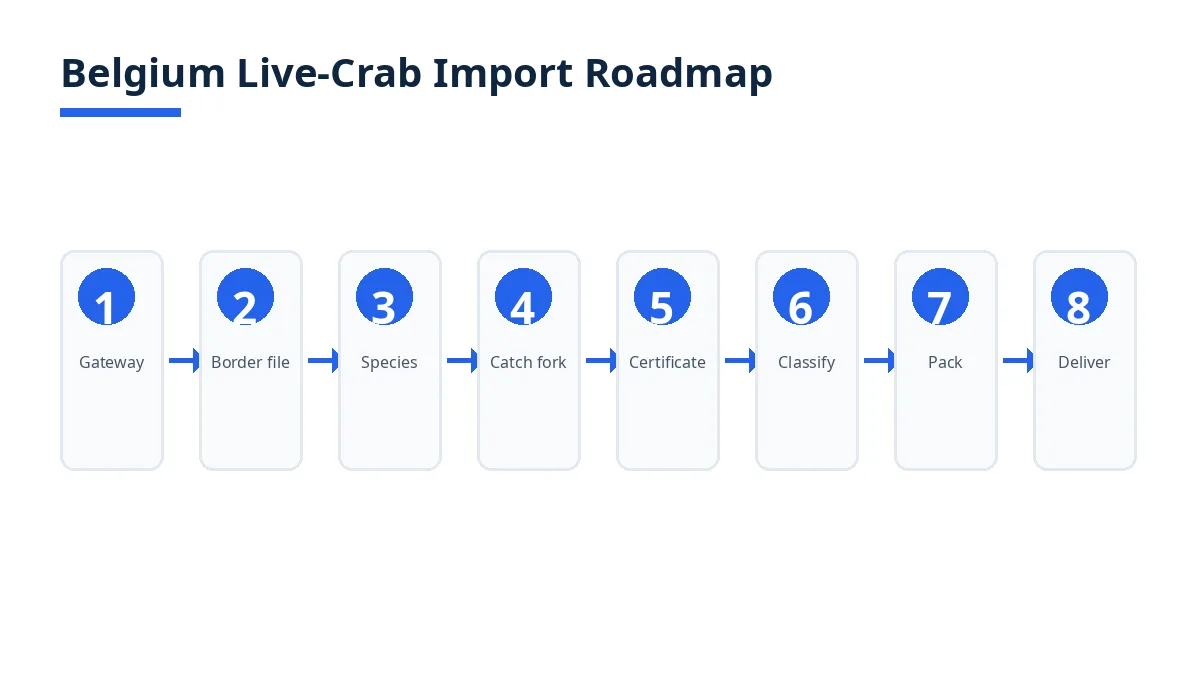
Belgium live-crab import sequence, step by step
Fix the destination and onward route, and choose the border control post.2 1
Ask the border control post in writing which CHED model applies, and confirm pre-notification through TRACES.1 17
Check the country and establishment listings in TRACES-NT, and re-check Annex IX for the entry date.4 5
Fix species, sex, grade, production method, and live condition, named identically everywhere.6 7
Settle the wild-caught or farmed fork lot by lot, through CATCH or the farm-lot record.9 10
Confirm the FISH-CRUST-HC certificate model and certifying authority before packing.11
Classify on 0306.33, and have the broker confirm the TARIC line, duty, preference proof, and import VAT.12 13
Confirm the Bangladesh export file in writing for the exact line, before packing.
Send one specification to every supplier, verify in three layers, and run a trial consignment on arrived live weight.
Agree packing, the airport clock, acceptance, and the delivery term, with the mortality count and remedy in the contract.8 16
File the CHED, clear the border check, and reconcile the landed cost on arrived live weight.1
What is the typical MOQ for live crabs from Bangladesh?
There is no single typical minimum, and no figure is stated here. Ask how the minimum splits by species, sex, grade, and pack format, get the split in writing, and compare minimums only on the identical specification and trial record.
How long does shipping take?
Collection, holding, grading, packing, the airport clock, the flight, the border check, and onward delivery are separate blocks, and no combined figure is stated here. Plan from the forwarder's current flight schedule and the border post's confirmed pre-notification and check arrangements, and staff the arrival and onward windows before departure.
What import duty applies?
Duty follows classification, state, form, origin proof, and entry date, and no rate is stated in this guide. The working subheading is 0306.33 for whole live crabs, and the broker must confirm the full TARIC line, the duty rate, and any preference on the exact line.12 Test the Everything But Arms position with the broker, with an accepted statement on origin.13
How do I verify a supplier?
Check company documents first, so name, address, and bank account agree across the trade license, export registration, and invoices. Then check capability and the Belgian file: the TRACES-NT establishment listing, the FISH-CRUST-HC certificate position, the catch or farm-lot file, airline acceptance documents, and the trial arrival record.4 11 A supplier who cannot produce the listing, certificate model, and production method in writing has not been verified for Belgium.
Next steps on Exportain
Read the general guide to importing from Bangladesh and the classification guide for live crabs before you price, and use the landed cost guide for imports from Bangladesh for the full cost picture. When the destination, the border file, and the specification are fixed, post a free RFQ with the Belgian airport of arrival, the onward destination, and the delivery date. For the buying journey, see how to buy.
Sources
- Food of animal origin. Federal Agency for the Safety of the Food Chain (FASFC) (accessed )
- Supply Chain. Port of Antwerp-Bruges (accessed )
- Import controls of food and feed Q&As. European Commission (accessed )
- Non-EU countries authorised establishments. European Commission (accessed )
- Commission Implementing Regulation (EU) 2021/405 — list of third countries authorised for fishery products. European Union (accessed )
- Mud Crab (Scylla spp.) Aquaculture in the South-West Sundarbans Region of Bangladesh. FAO AGRIS (accessed )
- Eriocheir sinensis. Flanders Marine Institute (VLIZ) (accessed )
- Questions and Answers for Shipping Live Animals by Air. International Air Transport Association (accessed )
- Eliminating illegal, unreported and unregulated (IUU) fishing. EUR-Lex (accessed )
- CATCH - NEW EU SYSTEM. Sea-Fisheries Protection Authority (accessed )
- Aquatic animal export: certification requirements for the European Union. Canadian Food Inspection Agency (accessed )
- HS 2017 Code 0306. United Nations Statistics Division (accessed )
- EU trade relations with Bangladesh. European Commission, (accessed )
- Regulation (EU) No 1379/2013 on the common organisation of the markets in fishery and aquaculture products. legislation.gov.uk, (accessed )
- Regulation (EU) No 1169/2011. legislation.gov.uk (accessed )
- Incoterms® 2020. International Chamber of Commerce (ICC) (accessed )
- Import controls. Federal Agency for the Safety of the Food Chain (FASFC) (accessed )
About the author
Sourcing from Bangladesh?
Post a request for quotation and suppliers on Exportain can send you their quotes directly.
Post an RFQ