UAE LED Bulb Imports From Bangladesh: Costs, Duty and Suppliers
For UAE buyers importing LED bulbs from Bangladesh: settle the lighting-products certificate and ECAS file for the exact lamp first, test suppliers against the UAE file, and price duty and 5% VAT only on broker-confirmed figures, reworking the example landed-cost table.
Short answer
To import LED bulbs from Bangladesh to the UAE, settle the lighting-products file first: registration under Cabinet Decision No. 34 of 2013 through ECAS, a certificate of conformity for that lamp from a MoIAT-approved notified body, and the RoHS and Gulf mark answers for that model. Then agree the specification, sample and inspection in writing, name the UAE port and delivery term, and have the broker confirm classification, duty and 5% VAT base before pricing the landed cost.
On this page
Key takeaways
LED lamps fall under the UAE system for lighting products in Cabinet Decision No. 34 of 2013, with ECAS registration and a certificate of conformity for the exact model.
An ECAS certificate is valid for one year with annual renewal; an EQM certificate is valid for three years and adds a factory audit.
The RoHS position, the Gulf mark list question and the Arabic pack wording must each be answered for the exact lamp; no one certificate answers all three.
Dubai duty is 5 percent of CIF value as a general tariff position and VAT is 5 percent, but the LED-specific line and the VAT base must be broker-confirmed before pricing.
Price the landed cost on labelled example figures only, excluding VAT, and rework every line with broker-confirmed duty, VAT base and certificate costs before ordering.
You are buying LED bulbs in Bangladesh for customers in the UAE. The bulbs will not reach those customers on price alone. They reach them on paper: a lighting-products registration, a certificate that names the exact model, pack information in the wording the UAE system requires, and a customs file in which every document describes the same consignment. Sort the paper first and the price comparison that follows is honest. Sort the price first and the paper will undo it later, at the border, at the buyer's cost. This guide sorts the paper first. It gives no typical price, order size, transit time or LED-specific duty rate as fact, because no such figure was established in a UAE source opened for this product.
The UAE lighting file comes first
Before you compare suppliers, answer five questions and write the answers down against the model number they belong to. The UAE system for lighting products, set out in Cabinet Decision No. 34 of 2013, covers LED lamps, control gear for general lighting and luminaires for general lighting, among other lighting products.1 Registration under the Emirates Conformity Assessment Scheme (ECAS) is the route described for lighting products entering the UAE market, with the Emirates Authority for Standardization and Metrology (ESMA) named as the authority behind the process.1 The scheme is now administered by the Ministry of Industry and Advanced Technology (MoIAT), working through approved notified bodies; the scheme name and the certificate remain the ones buyers ask for.2 3
Which UAE technical regulation and which standard govern this exact lamp? The notified body or your MoIAT-route adviser puts the references in writing.
Who applies, and under whose UAE trade license? The UAE importer or its appointed representative applies, and the application record names the applicant.
Which notified body reviews the file? The appointment is recorded in writing before testing starts.
Does the certificate schedule name one model or a range? Every model you intend to ship must appear on the schedule.
When does the certificate expire, and who renews it? The expiry date and the renewal owner go into the order file on day one.
A certificate written for another model, another wattage or another driver gives this lamp nothing. When the driver, the LED package, the cap or the housing changes, ask whether the change needs a fresh assessment, and insist on notice in writing before any changed unit is shipped. Paperwork promised for later is not paperwork. A brochure is not evidence.
Why Bangladesh earns a second look from a UAE buyer
Start with the arithmetic of the whole order, not the bulb price. Duty and VAT are worked on the customs value and the confirmed tariff line, not on the bulb price alone, so a low bulb price paired with a wrong classification can still land expensively. The UAE file costs money and time wherever the bulbs are made, so that cost belongs in the order economics from the start rather than arriving as a surprise at the border. The sea move rewards a full, well-packed load, so carton planning and order size move the per-bulb freight figure more than small differences in the bulb price do.
Bangladesh earns a second look when the comparison itself is disciplined: one specification, sent to several suppliers, with their answers set side by side on the same delivery term, the same certificate file and the same counting basis. A supplier who answers the specification line by line, with a report behind each claimed value, gives you something to check. A supplier who answers with a catalogue page and a single unit price gives you nothing to check, and the cheapest of those prices is the least informative number in the file.
Nothing in the sources opened for this product establishes a duty preference for LED bulbs from Bangladesh entering the UAE, and no preference claim is made anywhere in this guide. The worked example uses no zero-duty pricing. Your broker confirms the tariff line and the duty position for the exact lamp before any price is set beside another.
Test suppliers on the UAE file
Judge a supplier by the file it can put together for the exact model, and by whether the names, figures and artwork inside that file agree. A factory photograph proves that a bulb exists. It proves nothing about whether the bulb in the photograph is the bulb in the conformity file, or whether anyone in the UAE holds a certificate for that model.
Request the evidence in this sequence, and stop the shortlist where a step fails:
The certificate of conformity for the exact model, with the model schedule visible and the notified body named.
The test reports behind the certificate, naming the lamp type, the cap and the driver, and identifying the laboratory.
The hazardous-substances position for the exact model, with any exemption claimed and its scope stated.
The product information that must travel with the lamp, in the wording the UAE system requires, checked on artwork before printing.
A change-control promise in writing: notice before any change to the driver, LED package, cap, housing or packaging.
The export-paperwork names: the legal name and registered address of the company signing the export documents, matched across the quotation, the invoice and the origin documents.
Where a test report names a different company from the quotation, ask for the reason and keep the explanation in writing. Where the supplier cannot name the notified body, cannot show a certificate schedule for the model, or answers a document request with a brochure, the file is not ready and the order is not ready either.
Three questions remain for you alone. Who stands as the UAE importer on the customs declaration? Who holds the certificate, renews it before expiry, and answers a market surveillance question in the UAE? Who keeps the declaration, the test reports and the certificate together for the life of the model? A supplier without answers to those questions has not sold this lamp into the UAE before, whatever its export record elsewhere. Date-stamp each reply, and revisit the file whenever the supplier, the model or the driver changes.
Describe the lamp in words the laboratory can test
Freeze the product description in writing before anyone quotes a code or orders a test. The description decides which tests apply and which certificate is needed, and a description that changes after testing starts the work again from the beginning. The international safety standard for self-ballasted LED lamps covers lamps with integrated means for stable operation, intended for domestic and similar general lighting, with a rated wattage up to 60 watts, a rated voltage above 50 volts up to 250 volts, and caps set out in its Table 1.4 The standard sets safety and interchangeability requirements together with the test methods and conditions for showing compliance, and its requirements relate to type testing.4
Write these points into the specification before any price is discussed:
Lamp form: a finished screw-cap or bayonet-cap bulb swapped by the householder, a bare board or module that works only inside a fitting you build, or a finished fitting with built-in LED sources. The luminaire description applies to the last of these; test and certificate treatment differ for the middle one, so confirm it before quoting.
Cap or connector type, and whether the driver is integrated or separate.
Dimming behaviour, where dimming is claimed, and any wireless control, app or sensor. A model with wireless control may raise a further UAE approval beyond the checks in the next section, so ask in writing whether any further approval covers that model, and ask before ordering.
The exact wording the broker, the laboratory, the notified body and the supplier will all use. One wording, in one document, for everyone.
Certificates, materials and the Gulf mark
Three separate questions sit behind every lamp in this guide: the lighting-products certificate, the hazardous-substances position and the Gulf mark. Answer each one for the exact model. An answer to one question never stands in for another.
Lighting products must comply with consumer safety, energy conservation and environmental protection, and are tested and monitored against electrical safety, performance and energy efficiency, functionality, hazardous chemicals and safe disposal.1 Registration calls for a valid UAE industry or trade license, IEC CB test reports and certificates, a product identity declaration where the models in the test reports differ from the models in the application, photographs of the rating label or plate, packaging that complies with the parameters in Cabinet Decision No. 34 of 2013, a performance and RoHS test report and an electronic declaration of conformity.1 Hold the whole set for the exact model before shipment, and check the rating-label photographs against the sample bulb itself.
A MoIAT-approved notified body conducts the conformity assessment and issues the certifications MoIAT requires, and its authorised categories include lighting products, low voltage electrical products and RoHS.2 Under ECAS, the applicant files online through a MoIAT-approved portal, uploads the technical documents, undergoes a technical review of test reports and supporting documentation, and receives a certificate of conformity once compliance is confirmed.2 The Emirates Quality Mark (EQM) route follows the same application path and adds a factory audit, with a technical review of test reports and audit documentation before the certificate is issued.2 Establish which route the lamp takes. Never assume the EQM route when only the ECAS route has been applied for.
The two routes expire on different clocks, and the clock decides who diaries what. An ECAS certificate is valid for one year and subject to annual renewal, while an EQM certificate is valid for three years.3 A certificate that lapses before the goods clear customs leaves the shipment without the paper the border asks for, so the expiry date goes into the order file with the renewal owner's name beside it. Where a component changes during the certificate period, the certificate holder must keep the certified product in compliance and update the technical file at renewal, on the RoHS account set out below.5
For hazardous substances, the UAE RoHS regulation, Cabinet Decision No. 10 of 2017, was issued by ESMA under Law No. 28 of 2001, and is described as the same in its requirements as the European RoHS directive.5 It covers lighting equipment among its product categories, and it defines electrical and electronic equipment by dependence on electric currents or electromagnetic fields and by a voltage rating not exceeding 1,000 volts for alternating current and 1,500 volts for direct current.5 The regulation summary sets these maximum threshold limits:
Substance | Maximum threshold limit |
|---|---|
Lead | 0.1 percent |
Mercury | 0.1 percent |
Cadmium | 0.01 percent |
Hexavalent chromium | 0.1 percent |
Polybrominated biphenyls (PBB) | 0.1 percent |
Polybrominated diphenyl ethers (PBDE) | 0.1 percent |
DEHP, BBP, DBP, DIBP (each) | 0.1 percent |
Request the hazardous-substances position for the exact model in writing, covering the test evidence, any exemption relied on, the scope of that exemption, and whether it remains in force.5 Put one further question directly to the notified body instead of assuming the answer: one law-firm summary lists products for general lighting covered under UAE Cabinet Decision No. 24 of 2012 among products exempt from the requirement to obtain registration under the RoHS regulation.5 Ask how that position interacts with the lighting-products registration for the exact lamp, and keep the answer in writing. A lighting-products certificate is not proof of a hazardous-substances position, and a RoHS test report is not a lighting-products certificate.
The Gulf mark question stays open until a GSO-approved notified body answers it. The Gulf Conformity Mark is governed by the Gulf Standardization Organization (GSO), and covers the Gulf Technical Regulation for Low Voltage Equipment and Appliances and the regulation for children's toys.6 GSO regulates low voltage equipment in two categories: List 1 products, which do not require G-Mark certification by a notified body and where manufacturers self-comply during production, and List 2 products, which are subject to conformity assessment by a notified body and must carry the Gulf Conformity Mark and meet the requirements in BD-142004-01.6 Ask, in writing, which list the exact lamp falls in, and whether a G-Mark assessment is needed in addition to the UAE certificate. The two assessments must not be confused with each other, and the answer goes into the file beside the model, with its date.
Pack wording belongs inside the certificate file, not after it. Instruction manuals and energy efficiency labels supplied with the product should include the Arabic language, and safety warnings for the direct user should be in Arabic as well as English.1 Special purpose lamps should state their intended purpose and why they are not fit for household illumination.1 Before purchase, the packaging must visibly show nominal lamp power, nominal luminous flux, nominal lifetime in hours, color temperature, lamp mercury content, lamp power factor, starting time, color rendering, instructions for cleaning lamp debris if a lamp breaks, and a suggestion for disposal at the end of the lamp's life.1 Check each item on the artwork before printing, and check it again on the sample bulb and its carton. A pack that fails the wording check fails the file, even when the bulb itself passes its tests.
Specification and lot inspection, tied to the same evidence
Write one specification document. Every claimed value in it carries its evidence beside it, and the document also carries the rule for a lot that fails. Use this shape:
Cap type and rated voltage, with the test report reference naming the lamp. A value with no report is treated as unproven and stays out of pricing, labelling and advertising until the report exists.
Claimed wattage and lumen output, with the report and the test method cited. A lumen figure with no report behind it is not used anywhere.
Color temperature and color rendering, with the report reference. Without it, neither value goes on the label.
Any lifetime claim, with the endurance or lifetime test evidence behind it. Without that evidence, no lifetime claim is used.
Driver type, integrated or separate, with the report naming the driver. A driver change reopens the conformity file.
Dimming behaviour, where dimming is claimed, with test evidence. Without it, no dimming claim is used.
Certificate schedule and model numbers, naming the exact model. No shipment goes against a certificate that names another model.
Any outdoor or ingress protection claim, with test evidence. Without it, no protection claim is used.
The same document settles how the goods are counted and packed: bulbs or cartons as the counting unit, bulbs per carton and per master carton, carton markings, where the certificate mark and the rating label sit, and the rule for a short carton. Packaging artwork is approved before printing, and the sample's marking and label are photographed before bulk ships. The failure rule, written in the same document, states the consequence of a failed lot, who pays for re-testing, and the evidence that closes the matter.
Inspect each lot against that document, goods and papers together. Count the goods. Check the caps, the markings, the labels, the pack information, the carton markings, the model number on the certificate schedule and the condition of the packs. Confirm that the reports cover this lot and this model. The goods on their own cannot establish a lumen, lifetime or efficacy figure, so the certificate, the reports, the label artwork and the pack information must all name the same model number, and the pack values must agree with the test evidence. The sample travels on bulk paperwork and is tested against the same document; bulk is approved only after the sample passes. The inspection point is agreed in writing: who inspects, where, against which document, and what happens to a lot that fails. One photograph of one bulb proves nothing about the lot.
Samples, order size and quotation parts
Split each quotation into parts before you compare it with another. Compare only quotations that share a delivery term and a certificate file, and work through the parts in this order: test and file costs, certificate and renewal costs, the bulb itself, packaging and labelling, carriage and insurance under the agreed term, plus artwork, inspection and re-test charges. A low bulb price without a certificate, a rating label or a pack-information set looks different once the file is built, so keep the file costs visible as their own lines.
No typical order size or price is quoted here, because no UAE source opened for this product gave one. Settle the figures in writing supplier by supplier, shipment by shipment and variant by variant, stating the counting basis in the same document. A minimum tied to one model, cap, color temperature and pack variant is not the same commitment as a minimum spread across a mixed order, and counting in cartons is not the same as counting in bulbs. State the basis for the sample order too, and the short-carton rule.
Order the sample before bulk, under bulk paperwork, with identical specification, marking, label and packaging, so its result forecasts the bulk result. The order also states the currency and the price basis, whether payment follows shipped quantity or usable quantity on arrival, who absorbs the loss on bulbs that arrive unusable, and who pays for the UAE certificate work, a cost no supplier quotation shows. Tie each payment to a document you can check: evidence of the signed specification and file before production, the inspection report before shipment, and shipping papers matching the specification.
Choose the delivery term for a container move
Name the UAE port of entry and the terminal inside it in the contract, and obtain the carrier's routing and timetable in writing, before you argue about delivery terms. Two UAE container ports frame the choice. Jebel Ali Port in Dubai serves over 80 weekly services connecting more than 150 ports, with multimodal access by sea, air and land, and quayside operations built for containerised, break-bulk and dry-bulk cargo.7 Khalifa Port in Taweelah, halfway between Abu Dhabi and Dubai, is the flagship port of Abu Dhabi Ports, with a container terminal and the adjacent Kizad trade and logistics zone.8 Confirm which terminal takes the container, and confirm who moves the goods from the terminal to your warehouse and at whose cost. A contract naming only "UAE port" leaves you paying for a guess.
Container loads usually change hands at a terminal rather than over a ship's rail, so the delivery term should follow that handover. FCA fits container freight, because delivery and risk can pass at handover to the carrier, before loading, whereas FOB turns on loading on board.9 CPT and CIP leave risk moving at handover to the carrier even though the seller pays for carriage to the named place; CIP adds insurance the seller must arrange.9 The Incoterms 2020 rule you choose decides delivery, risk, costs and customs duties, so choose the rule matching the actual movement, and name each place precisely: the handover point, the destination port, and who unloads.
The sea-only set is narrow. Only FAS, FOB, CFR and CIF are confined to sea and inland waterway transport. CPT is an any-mode rule. DPU is an any-mode rule. DDP is an any-mode rule, under which the seller clears the goods for import and pays duty. Under DAP, DPU and DDP, delivery happens, and risk passes, at the named destination.9 No transit figure is given, because none was established for this route. Ask your broker how much time customs, declarations and inspection may add at the UAE border.
Settle three plans in writing, separately, before production starts. The conformity failure plan: no delivery term assigns the cost of a border refusal caused by a failed UAE file. The import clearance plan: a seller handling clearance under DDP does not by that fact settle the certificate or VAT position. The holding plan: who holds the goods, where, and at whose cost, if customs holds them. Where delivery runs into a free zone or a designated zone, ask the broker and tax adviser before shipment how duty and VAT timing differ on that route, and record the answer. Never assume a mainland treatment applies inside a zone, or a zone treatment applies on the mainland.
Duty, VAT and border papers
Ask the broker to confirm the classification line for the exact lamp before anything is priced. No tariff code and no LED-specific duty rate appears in this guide, because no UAE tariff schedule page for this product was opened. Government tariffs in the UAE range from 0 to 5 percent, and in Dubai the customs tariff is 5 percent of the CIF value except for alcohol and cigarettes.10 The UAE uses the Harmonized System, with products classified using numeric codes of up to six digits, and extensions added at national level or within the Gulf Cooperation Council.10 The broker confirms the code for the exact lamp, including any GCC extension, the rate in force on the import date, and the value the duty is charged on. Price duty only on that confirmed line. Never let a rate borrowed from a foreign schedule, a search result or a supplier quotation enter the UAE entry. The Dubai 5 percent CIF figure is a general tariff position, and it becomes a working figure for the example table only once the broker confirms it for the exact lamp.
VAT sits apart from duty. VAT was introduced in the UAE on 1 January 2018, and the rate of VAT is 5 percent.11 A business must register for VAT where its taxable supplies and imports exceed AED 375,000 per annum, and registration is optional above AED 187,500 per annum.11 No VAT base is stated in this guide for LED bulbs, because the base for this consignment was not established in an official source opened for this product. Confirm with the broker and tax adviser what value the VAT is charged on, whether duty sits inside that base, and how the VAT is accounted for in your UAE VAT position, including whether any deferment or reverse-charge treatment applies. Work out import VAT only from the base and rate they confirm. A VAT-registered buyer who can recover input VAT still needs the cash or return treatment settled before the goods move, so settle it in writing.
Treat one consignment as one file. The papers describing it are the commercial invoice, the packing list, the certificate of conformity with its test file, the transport document, the certificate of origin where the broker asks for it, and the label and pack information set. Every paper must name the same model, the same parties and the same quantities. Sort out any mismatch before the goods move, not at the border. The certificate schedule, the invoice and the packing list must agree on the model number, or the border file does not describe one consignment.
Worked landed cost in dirhams, with example figures
Every figure in this table is an example figure. The table shows the working, not a forecast of price. Duty appears at 5 percent of the CIF value only as a working figure, on the broker confirming the Dubai general tariff for the confirmed code. VAT is left out of the total: the 5 percent rate is established, but the VAT base for this consignment must be confirmed by the broker and tax adviser before the cash need is final. Replace every line with a broker-confirmed figure before ordering.
Line | Example amount (AED) | Note |
|---|---|---|
Bulbs: 12,000 at 3.90 dirhams each | 46,800.00 | Example figure |
Freight and insurance to the UAE | 9,600.00 | Example figure |
CIF value: bulbs, freight and insurance added | 56,400.00 | Sum of the two lines above |
Duty: 5 percent of CIF value, example figure only | 2,820.00 | Broker confirmation of code and rate required |
VAT at 5 percent | Left out | Broker and tax adviser to confirm the base |
Brokerage and handling | 1,650.00 | Example figure |
Cash needed before VAT | 60,870.00 | Sum of the lines above |
Per bulb on shipped quantity: 12,000 bulbs, before VAT | 5.07 | Total divided by shipped quantity, rounded |
Per bulb on usable quantity: 11,520 bulbs at 4 percent assumed loss, before VAT | 5.28 | Total divided by usable quantity, rounded |
The arithmetic runs: 46,800.00 plus 9,600.00 gives a CIF value of 56,400.00; 5 percent of that is 2,820.00; adding 1,650.00 gives 60,870.00, or 5.07 dirhams per bulb shipped and 5.28 dirhams per usable bulb at a 4 percent assumed loss. Ask the broker if brokerage and handling sit inside the VAT base or outside it for the actual consignment, and redo every line after duty if the 5 percent figure is not confirmed. Add the VAT amount, once confirmed, to the total before you compare the landed cost with a domestic purchase.
The UAE import run, in order
The diagram below condenses the run into eight stages. Work through them in order, and do not start a later stage until the earlier one is evidenced in writing.
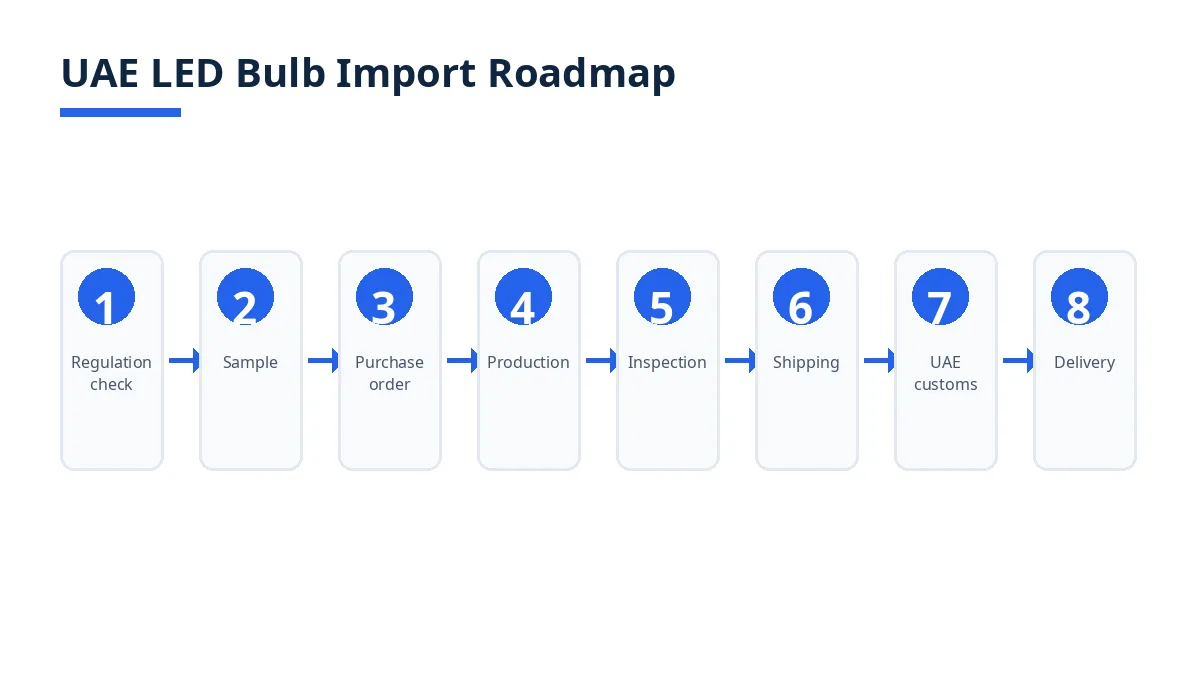
Confirm the UAE technical regulation and standard for the exact lamp, and record the notified body appointment.
Write the product description: self-ballasted lamp, module or luminaire, cap type, driver, dimming and any wireless control.
Put the pack-wording questions to the notified body: Arabic wording, safety warnings, rating label and pack information.
Work the UAE gates for that product: lighting-products certificate, hazardous-substances position, Gulf mark question.
Ask the broker to confirm the classification line and the duty position before pricing.
Shortlist suppliers against the UAE file, with a date on every answer.
Put in writing the specification, the counting basis, the quotation parts, the sample, the inspection points and the failure rule.
Place the sample order under bulk paperwork, verify it against specification and file, and photograph the marking and label.
Agree in writing the delivery term, the named port and terminal, the clearance plan, the certificate renewal owner and the failure plan.
Approve the artwork, the rating label, the Arabic wording and the pack information before printing. Produce and inspect lot by lot. Ship with the certificate file, the invoice, the packing list, the transport document and the origin document where asked for. Declare, pay duty and VAT as confirmed, and check the goods on arrival. Keep the certificate, the payment records and the lot file together in one place.
How Exportain helps
You can search the Exportain catalogue by keyword and category, narrow the results by verification badge, sample availability and OEM or ODM capability, and order the results by MOQ or lead time. You can post an RFQ that sets out the quantity and unit, the target price, the destination, the Incoterm, the certifications you require and the deadline, and suppliers in that category can view the requirement and quote against it. A supplier profile shows the verification level, the location, the main products and the certifications the supplier has declared. Badges such as Exportain Verified record which checks the Exportain team has reviewed; a badge guarantees neither capacity nor quality, so check what each badge covers before relying on it. Exportain does not take part in the sale contract for the goods, and it does not inspect the goods, book the freight or clear the customs entry, so the certificate file, the inspection and the border file in this guide remain with you, the supplier, the notified body and the broker.
What order size should a UAE buyer agree for LED bulbs from Bangladesh?
No typical order size is set in this guide, because none was established for this product and market. Agree it with each supplier and each variant in writing, stating the counting unit: model, cap type, color temperature or packaging variant, in bulbs or cartons. Sample first, on full paperwork, before bulk, with the UAE certificate and file costs carried as a separate line, since no supplier quotation shows them.
How long should a UAE buyer allow for LED bulbs to reach Jebel Ali or Khalifa Port from Bangladesh?
No transit time appears here, because no figure for this route was established. Duration turns on routing, carrier timetables, the delivery term, the declaration process, customs and inspection. Get the carrier's routing and timetable in writing, name the UAE port and terminal in the contract, and ask the broker what extra time border customs and inspection may add.
What import duty and VAT will a UAE buyer pay on LED bulbs from Bangladesh?
No LED-specific duty rate appears in this guide. Government tariffs in the UAE range from 0 to 5 percent, and the Dubai customs tariff is 5 percent of the CIF value except for alcohol and cigarettes, but the rate for the exact lamp must be confirmed on the broker-confirmed classification line.10 VAT in the UAE is charged at 5 percent.11 Ask the broker to confirm the current code for the exact lamp, including any GCC extension, the duty rate on that line, and the VAT base and accounting treatment, before pricing. Price duty and VAT only on the broker-confirmed answers.
How does a UAE buyer check a Bangladeshi LED bulb supplier before ordering?
Request the evidence in the sequence set out above: the certificate of conformity and schedule for the exact model, the test reports behind it, the hazardous-substances position, the Gulf mark answer from a GSO-approved notified body, and the pack wording checked on artwork. Names and model numbers must match on the quotation, invoice, certificate, reports and packaging, and the sample must carry the same marking, Arabic wording and pack information that bulk will carry. Insist on advance written notice of any change to driver, LED package, cap or housing.
Next steps on Exportain
Start from the Bangladesh import guide, and use it with the specification and file questions from this guide beside you. Then browse supplier profiles on Exportain with the UAE certificate and conformity questions ready, and read the Exportain buying walkthrough before you place an order. Rework the worked example with the landed-cost guide, using figures confirmed by the broker. Post a free RFQ on Exportain and get quotes from verified Bangladeshi suppliers → https://exportain.com/rfqs
Sources
- How to get the conformity certificate from ESMA for lighting products?. JCA Trademark UAE (accessed )
- MOIAT ECAS Product Certification Services in UAE. TÜV SÜD Middle East (accessed )
- United Arab Emirates UAE PCA Program. SGS (accessed )
- IEC 62560:2011 - Self-ballasted LED-lamps for general lighting services by voltage > 50 V - Safety specifications. International Electrotechnical Commission, (accessed )
- Compliance with UAE Regulations on the Restriction of Hazardous Substances (RoHS): What You Need to Know. Al Tamimi & Company (accessed )
- Gulf Conformity Mark. TÜV SÜD (accessed )
- Jebel Ali Port | Port Operations. DP World (accessed )
- Khalifa Port - Abu Dhabi's gateway to the future. AD Ports Group (accessed )
- Place of delivery & risk transfer in trade contracts. ICC Academy (accessed )
- Customs duty and tariff. UAE Government (accessed )
- Register for VAT. The Official Portal of the UAE Government (accessed )
About the author
Sourcing from Bangladesh?
Post a request for quotation and suppliers on Exportain can send you their quotes directly.
Post an RFQ