Germany LED Bulb Imports From Bangladesh: Buyer's Checklist
Germany buyers importing LED bulbs from Bangladesh: settle ElektroG producer registration through a German authorised representative first, hold the CE, ecodesign and energy-label file for the exact lamp, and confirm EBA duty and 19% import VAT with a broker before ordering.
Short answer
To import LED bulbs from Bangladesh to Germany, settle the German producer position first: appoint a Germany-based authorised representative for Stiftung EAR registration before shipment. Then hold the EU file for the exact lamp — safety, EMC, RoHS, ecodesign and the energy label with its product database entry. Have the broker confirm the TARIC code, any Everything But Arms preference and 19% import VAT, and price landed cost on broker-confirmed figures.
On this page
Key takeaways
A foreign company cannot register itself with Stiftung EAR; it needs a Germany-based authorised representative under a written German mandate of at least three months.
The EU file for the exact lamp covers safety, EMC, RoHS, ecodesign and the energy label, with label and product information sheet values entered in the product database.
No duty rate is stated: Everything But Arms preference depends on the broker-confirmed TARIC code, the origin rules and a valid REX statement on origin.
Import VAT in Germany is charged at the standard 19% rate on customs value plus duty; the broker and tax adviser must confirm the base for the actual consignment.
Price landed cost on labelled example figures only, and rework every line with broker-confirmed duty, VAT and origin proof before ordering.
A buyer in Germany who orders LED bulbs from Bangladesh takes on two jobs at once. One is the ordinary buying job: find a supplier, agree a price and get the bulbs shipped. The other is a German market job that starts before any order is placed: someone must stand as the producer for waste equipment in Germany, and the bulbs must carry an EU conformity file that fits the exact model. This guide works in that order: the German producer question first, then the product description, then the EU file, and only then price, shipping and duty. No typical price, minimum order, transit time or duty rate is stated as fact here, because no such figure appears in a German or EU source opened for this product.
Settle the Germany points first
Decide, before contacting suppliers, who will be the producer for waste electrical equipment in Germany and how that producer will be registered. The Bangladeshi supplier cannot carry this duty from Dhaka.
Fix the product description first: lamp, module or containing product, cap type, and whether any wireless control is present. The description drives classification, conformity and labeling.
Hold the EU file for the exact model before shipment: safety, electromagnetic compatibility, RoHS, ecodesign and the energy label, with the declaration of conformity and the test reports behind it.
Agree every commercial figure with each supplier in writing. This guide states no typical minimum order or price.
Have the broker confirm the tariff code, the preference position and the import VAT treatment for the exact consignment. Price duty at zero only on a broker-confirmed preference answer with valid origin proof.
Who counts as the producer when bulbs reach Germany
Waste electrical and electronic equipment rules in the EU start from producer responsibility, and Germany runs its own register for it. Member States must draw up a register of producers, including producers supplying equipment by means of distance communication, and that register serves to monitor compliance with the directive.1 Producers supplying equipment by distance communication must be registered in the Member State they sell to, and where such a producer is not registered there, registration runs through an authorised representative.1 A producer established in another Member State may appoint a person established on the territory as the authorised representative responsible for fulfilling that producer's obligations there, and the appointment is made by written mandate.1
For a company outside Germany, the Stiftung Elektro-Altgeräte Register (stiftung ear) states the position plainly: a foreign company that wants to place electrical and electronic equipment on the market in Germany cannot register itself, and needs an authorised representative located in Germany to take over its legal obligations as a producer.2 Once the representative is mandated and the authorisation is confirmed through ear, the legal obligations transfer to the chosen domestic authorised representative.2 Only one authorised representative may be mandated for all of a producer's brands and types of equipment, the mandate must be in written form and in the German language, signed by both parties, and it must run for a minimum of three months.2 An affiliated company in Germany can serve as the representative, or a service provider that offers the appointment can be used.2
Settle this before the first shipment, in writing, with the representative named: who registers, which brands and equipment types the registration covers, who reports the quantities placed on the market, who finances collection and treatment, and who holds the evidence. Do not assume that a supplier's registration in Bangladesh, or a registration in another EU country, answers the German question. The directive also requires producers to mark equipment placed on the market with the symbol shown in its Annex IX, preferably in accordance with the European standard EN 50419, printing the symbol on the packaging, instructions or warranty only in exceptional cases where the size or function of the product makes that necessary.1 Agree the marking artwork before printing, and check the mark on the sample.
Lamp, module or containing product: fix the product description
The ecodesign and energy labelling rules share one definition of a light source, and the definition is narrower than everyday language. The shared definition treats a light source as an electrically powered product made to give off light — or, for a non-incandescent source, made so it can be tuned to give off light — with defined optical traits: luminous flux from 60 to 82,000 lumen, a colour rendering index above zero, and a lighting technology covering inorganic light emitting diodes.3 The same definition appears in the energy labelling regulation, which also covers light sources sold inside a containing product.4 LED dies and LED packages are expressly excluded from the light source definition in both regulations, as are products containing light sources from which the sources can be removed for verification.3 4
For ordering, the distinction decides what is tested and what is labeled. A finished screw-cap or bayonet-cap bulb fitted and replaced by a householder is handled as a light source. A bare board that functions only inside a fitting built by the buyer is handled differently, and a finished fitting with built-in LED sources raises the containing-product questions of whether the sources can be removed for verification and what information about them must accompany the fitting.3 4 Write the description into the specification before anyone quotes a code or a test: lamp or module, cap or connector type, whether the driver is integrated or separate, whether the bulb is dimmable, and whether it can be controlled wirelessly. A model with wireless control, an app or a sensor may fall under a further regime beyond the checks in the next section, so get a written answer on whether radio equipment rules apply to that model before ordering. The broker, the test laboratory and the supplier must all work from the same words.
The EU file for one German sale: CE, safety, EMC and RoHS
Three directives build the conformity file behind the CE mark on a mains-voltage LED bulb, and each one must be answered for the exact model. Start with electrical safety. The Low Voltage Directive covers equipment designed for use at a voltage rating between 50 and 1,000 volts for alternating current and between 75 and 1,500 volts for direct current, and it allocates responsibilities among manufacturers, importers and distributors for equipment in that range.5 Equipment on sale in the EU must bear the CE marking as the sign that it meets the essential safety requirements, the manufacturer must run a safety and conformity assessment, prepare the technical documentation and issue and sign an EU declaration of conformity, and the importer must verify that the manufacturer carried out the conformity assessment procedure correctly.5 The declaration and the technical documentation are kept for 10 years, and instructions and safety information must appear in a language easily understood by end users as determined by the national authority concerned.5 In Germany that means German instructions and safety information.
Next, electromagnetic compatibility, which is not the same check as electrical safety. The EMC Directive seeks to ensure that equipment does not introduce intolerable electromagnetic disturbance and can perform as intended without degradation when such disturbance is present, and it allocates responsibilities among manufacturers, importers and distributors for electromagnetic apparatus.6 Apparatus on sale in the EU must bear the CE marking, the manufacturer must run a conformity assessment and prepare technical documentation, then draw up an EU declaration of conformity and affix the mark, and the importer must verify that the manufacturer carried out the assessment correctly and tell the national market surveillance body if the apparatus is considered not to conform.6 The documentation is kept for 10 years.6 The switching driver inside an LED bulb is the component most likely to raise this question. No emission or immunity limit is stated in this guide, because no limit was opened in an EU source for this product. Ask for the assessment evidence for the exact driver, and check that the declaration names the EMC Directive for this model.
The third check is RoHS. The directive restricts hazardous substances in electrical and electronic equipment, applies to equipment within the categories in its Annex I, and lighting equipment is one of those categories.7 Annex II sets the maximum concentration values tolerated by weight in homogeneous materials: lead 0.1 percent, mercury 0.1 percent, cadmium 0.01 percent, hexavalent chromium 0.1 percent, polybrominated biphenyls 0.1 percent, polybrominated diphenyl ethers 0.1 percent, and DEHP, BBP, DBP and DIBP at 0.1 percent each.7 Because the limits bite per homogeneous material rather than per finished bulb, one solder joint, housing plastic or cable sheath can fail the check on its own. Get the RoHS position for the exact model in writing, including any Annex III exemption claimed, the application it covers, and whether it remains in force.
Ecodesign, the energy label and the product database entry
Ecodesign and energy labelling are two different instruments, and a bulb must satisfy both. The ecodesign regulation establishes ecodesign requirements for the placing on the market of light sources and separate control gears, and the requirements also reach light sources and control gears sold inside a containing product.3 From 1 September 2021, the declared power consumption of a light source must not exceed a maximum allowed power, Ponmax, defined as a function of the declared useful luminous flux and the declared colour rendering index, using threshold efficacy and end loss factor values set out in the regulation's Table 1.3 The threshold efficacy is a constant used for the computation and is not itself the minimum required efficacy. Standby power must not exceed 0.5 watts, and networked standby power for a connected light source must not exceed 0.5 watts, with the two allowances not added together.3 Functional requirements also apply from the same date, including colour rendering of CRI 80 or above, subject to stated exceptions, a lumen maintenance factor after endurance testing tied to the declared L70B50 lifetime, flicker at Pst LM 1.0 or below at full load, and a stroboscopic effect value of SVM 0.4 or below at full load.3 Ask the supplier to show the Ponmax calculation for the exact model from its declared flux and CRI, and to hold the endurance test evidence behind the lifetime claim.
The packaging information requirements are part of the same regulation and must be checked on artwork before printing. For a light source sold on its own, not inside a containing product, where the packaging carries information to be visibly displayed at the point of sale before purchase, the packaging must clearly and prominently display the useful luminous flux in a font at least twice as large as the display of on-mode power, the correlated colour temperature, the beam angle for directional sources, cap type and power supply, the L70B50 lifetime, on-mode power, standby and networked standby power, and the colour rendering index.3 A warning is required if the source cannot be dimmed or can be dimmed only with specific dimmers or methods, and a warning that the source must not be disposed of as unsorted municipal waste is required where the source falls within the scope of the WEEE Directive or contains mercury.3
The energy label sits on top of the ecodesign file. The labelling regulation establishes requirements for the labelling of, and the provision of supplementary product information on, light sources with or without integrated control gear, with the same reach for light sources sold inside a containing product.4 Suppliers must ensure that a light source sold on its own, in its own packaging, carries the label printed on that packaging in the format set out in the regulation's Annex III, that the product information sheet values and the technical documentation content are entered into the product database, and that an electronic label and product information sheet are made available to dealers for each model.4 The energy efficiency class is calculated in accordance with Annex II, on the basis of total mains efficacy, the declared useful luminous flux divided by the declared on-mode power, and the class bands run from A at 210 lumen per watt or above, through B, C, D, E and F, to G below 85 lumen per watt.4 Ask for the label artwork, the product information sheet values and the product database entry for the exact model, and check that the class, flux, power and lifetime on the label match the ecodesign file and the test reports.
Judge a supplier on the German file, not the catalogue
Start from the file, not the factory tour. A supplier's catalogue shows that a bulb can be photographed; it shows nothing about whether the bulb in the photograph matches the bulb in the conformity file, or whether anyone in Germany is registered to place that bulb on the market. The test is whether the supplier can assemble the German file for the exact model and whether the names, numbers and artwork inside that file line up. Get the legal name and registered address of the entity signing the export documents, then compare that name across the quotation, invoice, declaration and origin proof. Where a test report names another company, get the reason in writing. Change control is the next test: the driver, LED package, cap, housing and packaging can each change while the model name stays put, so ask what change forces a new test, a new declaration or a new label, and require notice before any such change ships. A brochure in answer to a document request, or a promise that paperwork will follow, means the file is incomplete.
The German questions only the buyer can close come next. Who is named as importer on the product? Who keeps the declaration of conformity and the technical documentation for 10 years and responds to a market surveillance request in German? Who provides the label artwork and the product information sheet values, and who enters them in the product database? A supplier with no answers to those questions has not sold into Germany before, whatever its export record elsewhere. Date every answer, and open the file again whenever the supplier, the model or the driver changes.
Specification, samples and lot inspection
Put the specification in one table where each claimed value carries its proof. Record the cap type, rated voltage, claimed wattage, claimed lumen output, colour temperature, any lifetime claim with its L70B50 basis, driver type and whether it is integrated or separate, dimming behaviour where dimming is claimed, the energy efficiency class with the values behind it, and any outdoor or ingress protection claim. Beside each value, note the method or standard the supplier cites and the report relied on. A value with no report is written as unproven and stays out of pricing, labeling and advertising until the report exists. The same document states the counting and packing rules: bulbs or cartons, bulbs per carton and per master carton, carton markings, how the WEEE symbol and the energy label will appear, and how a short carton is handled. Packaging artwork needs approval before printing, and a photograph of the sample's marking and label is needed before bulk ships. The failure rule belongs in the same document: what a failed lot triggers, who re-tests, and who pays.
Before shipment, inspect each lot against that table, goods and documents together. Count and check caps, markings, labels, product information sheet data, carton markings, the declaration's model number and pack condition, and confirm that report coverage matches the lot and the model. Looking at the goods alone cannot confirm a lumen, lifetime or efficacy value, so the declaration, test reports, label artwork and database entry must all carry the same model number. The sample is ordered on the same paperwork as bulk and checked against the same table before bulk is approved.
MOQ, price parts and the sample order
No typical minimum order quantity or price is quoted in this guide, because no such figure appears in a German or EU source opened for LED bulbs from Bangladesh. Each supplier, each shipment and each variant needs its own written figures, and a sample order comes first. The counting basis changes the commitment: a minimum per model, cap type, colour temperature and packaging variant is not the same as a minimum spread across a mixed order, and a minimum in cartons is not the same as a minimum in bulbs, so the order states the basis and the rule for a short carton.
Split each quotation into parts before comparing it with another: the bulb, packaging and labeling, test and file costs, the product database and label work, transport and insurance under the agreed delivery term, and artwork, inspection or re-testing charges. Quotations are compared only on the same delivery term and the same file: a lower bulb price with no declaration, no label and no database entry is not lower once the file is built. The order also states the currency, the price basis, whether the price follows the quantity shipped or the quantity usable on arrival, who bears the loss on unusable bulbs, and who pays for the German registration work and the authorised representative, a cost that never shows on a supplier quotation. Payments are tied to checkable documents: the signed specification and file evidence before production, the inspection report before shipment, and shipping documents that match the specification.
Duty, import VAT, EORI and the document set at the German border
The broker confirms the classification line for the exact lamp first. No tariff code and no duty rate for LED lamps is stated in this guide, because no EU tariff schedule page for this product was opened. The broker confirms the current 10-digit TARIC code for the exact lamp and the rate applying on the import date, plus the supplementary unit the declaration needs, and duty is priced only on that confirmed line. A rate taken from another country's schedule, a search result or a supplier quotation is never carried into the German entry.
Preference can change the duty answer, but only with origin and proof in order. Bangladesh is one of the 46 least developed countries covered by the EU's most generous preference scheme, Everything But Arms, which removes duty and quota limits on every export except arms and ammunition.8 Claiming preferential treatment needs proof of origin: self-certification is a statement on origin made out on the invoice or another commercial document by exporters registered in the REX system, and unregistered exporters may make out statements on origin for consignments of originating products up to EUR 6,000 on an ex-works basis.9 Whether preference applies depends on the origin rules for the exact goods and on a valid statement, so the broker confirms the origin position, the REX registration and the statement wording before duty is priced at zero.
Import VAT is separate from duty and is charged in Germany at the standard rate. German customs puts the import VAT base as the goods' customs value plus any customs duty, plus excise duties where the goods are excise goods; the standard rate currently stands at 19 percent, and a 7 percent reduced rate covers selected goods such as food products and books.10 Confirm with your broker and tax adviser what value the import VAT is charged on for the actual consignment.
The customs and security file must be ready before the goods move. Every consignment moving to or through the EU needs a complete Entry Summary Declaration in the ICS2 system before it arrives, and customs authorities use that information for pre-loading or pre-arrival safety and security risk analysis.11 Connecting to ICS2 requires an Economic Operators Registration and Identification (EORI) number obtained from one of the EU Member States' customs authorities.11 An incomplete declaration may be rejected or may draw a risk-mitigating referral asking for more information, screening or a do-not-load instruction, and the referral must be answered before the risk assessment can resume.11 The carrier and the broker agree in writing who files the Entry Summary Declaration and with whose EORI number, and the description, tariff code and parties' details in the filing must match the commercial invoice and the packing list.
Delivery terms and the container move to Germany
Containerised LED bulbs are usually handed to a carrier at a terminal rather than loaded over a ship's rail, and the delivery term should follow that reality. FCA fits container freight because delivery and the passing of risk can happen at handover to the carrier, before loading, where FOB's point is the goods going on board the vessel.12 With CPT and CIP the seller arranges and pays the carriage to the named place, risk still passes at handover, and CIP adds the seller's duty to insure.12 The chosen Incoterms 2020 rule fixes delivery, risk, costs and customs duties, so it must follow the actual movement of the goods.
The sea and inland waterway set has four members only: FAS, FOB, CFR and CIF. CPT sits outside that set, and so do DPU and DDP; all three are any-mode rules, and DDP adds the seller clearing the goods for import and paying duty, while DPU adds the seller unloading the goods at the named place.12 DAP, DPU and DDP all place delivery and the passing of risk at the named destination.12
Three plans are settled separately, in writing. The conformity failure plan: no delivery term assigns the cost when a failed EU file causes a refusal at the border. The import clearance plan: a DDP seller clearing the goods does not by itself settle the German producer registration or the import VAT position. The German delivery point, named precisely, including who unloads and who holds the goods if customs or market surveillance holds them. No transit time is stated in this guide, because no transit figure was opened for this route. Routing and scheduled times come from the carrier in writing, and the broker gives a view of how long customs, the Entry Summary Declaration process and any inspection may add at the border.
Landed cost example in euros
The figures below are illustrative, included to show the working, not to forecast a price. Every line is replaced with a broker-confirmed figure before ordering. Duty appears at 0.00 euros as an illustrative figure only, on the broker confirming a zero rate for the confirmed code, with qualifying origin proof and a valid statement on origin. Import VAT appears at 19 percent on the customs value plus duty, as a working figure only.
Cost line | Illustrative figure (EUR) | Basis |
|---|---|---|
Bulbs: 6,000 at 1.40 euros each | 8,400.00 | Illustrative only |
Freight and insurance, international | 1,650.00 | Illustrative only |
Duty: 0.00 illustrative only | 0.00 | Broker must confirm code, rate and origin proof |
Value for import VAT: bulbs plus freight and insurance | 10,050.00 | Sum of the lines above |
Import VAT: 19 percent, working figure only | 1,909.50 | 19 percent of the value shown |
Brokerage and handling | 380.00 | Illustrative only; outside the VAT value here |
Total cash needed | 12,339.50 | Sum of the lines above |
Per bulb shipped: 6,000 bulbs | 2.06 | Total divided by shipped quantity, rounded |
Per usable bulb: 5,820 bulbs, 3 percent loss assumed | 2.12 | Total divided by usable quantity, rounded |
Adding 8,400.00 and 1,650.00 gives 10,050.00; nineteen percent of that is 1,909.50; adding 380.00 gives 12,339.50, which is 2.06 euros per bulb shipped and 2.12 euros per usable bulb at the assumed 3 percent loss. Ask the broker whether brokerage and handling sit inside or outside the VAT value for the actual consignment. Where the broker does not confirm a zero duty rate, the duty line is added at the confirmed rate and every line after it is reworked.
The Germany import run, in order
Work through the steps in this order; the diagram shows the same run at a glance.
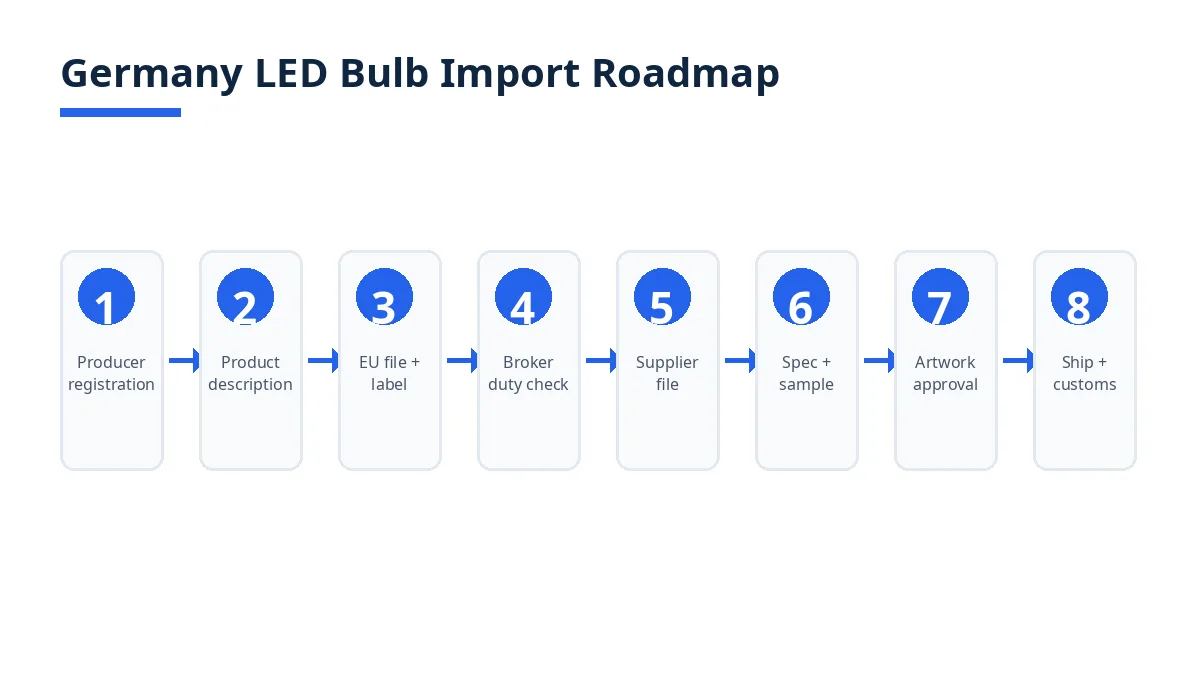
Name the authorised representative and confirm the registration scope, quantity reporting and financing in writing.
Write the product description: lamp, module or containing product, cap type, driver, dimming and any wireless control.
Check the EU gates for that product: safety, electromagnetic compatibility, RoHS, ecodesign, energy labelling and the product database entry.
Get the broker to confirm the classification line, the duty position and the preference and origin position, before pricing.
Shortlist suppliers against the German file, dating every answer.
Put in writing the specification, the counting basis, the price parts, the sample, the inspection points and the failure rule.
Order the sample under bulk paperwork, verify it against the specification and the file, and take a photograph of its marking and label.
Put the delivery term, named places, import clearance plan, Entry Summary Declaration filing and conformity failure plan in writing.
Approve the packaging artwork, energy label, WEEE marking and product information sheet data before printing.
Produce, inspect lot by lot, and ship with the conformity file, invoice, origin proof, packing list and transport document for the same consignment; then declare, pay duty and import VAT as confirmed, check the goods on arrival, and file the declaration, payment records and lot file together.
What minimum order should a German buyer agree for LED bulbs from Bangladesh?
No typical minimum is quoted in this guide, because no minimum figure was opened in a German or EU source for this product. The minimum is agreed with each supplier and for each variant in writing, with the counting basis stated: per model, cap type, colour temperature or packaging variant, and in bulbs or in cartons. A sample order on full paperwork comes before bulk, and the German registration and file costs are added to the order economics separately, since they never appear on a supplier quotation.
How long does shipping LED bulbs from Bangladesh to Germany take?
No transit time is given in this guide, because none was opened for this route. Loading-to-release time turns on routing, carrier schedules, the delivery term, the Entry Summary Declaration process, customs and any inspection or market surveillance check. Routing and scheduled times are obtained from the carrier in writing, and the broker gives a view of how long customs and inspection may add at the German border.
What import duty and import VAT apply to LED bulbs entering Germany?
This guide gives no duty rate for LED lamps: no EU tariff schedule page for this product was opened. Everything But Arms removes duty and quota limits for least developed countries including Bangladesh on every export except arms and ammunition, but preference for a consignment turns on the origin rules and a valid statement on origin.8 9 Have the broker confirm the current TARIC code, the duty rate on that line, and whether preference applies with qualifying origin and valid proof.9 Import VAT is charged separately: the German standard rate is 19 percent, charged on customs value plus duty.10 Price import VAT only on the broker and tax adviser confirmed base.
How does a German buyer check an LED bulb supplier in Bangladesh?
The German file is the check, not the catalogue. The buyer asks for the supplier's legal name and address, the declaration and test reports for the exact model, the label artwork with product information sheet values and the product database entry, the origin proof position, and answers to the German producer questions in this guide. The quotation, invoice, declaration, reports and packaging must carry matching names and model numbers; the sample must show the marking and label bulk will show; and the supplier must promise written notice before changing the driver, LED package, cap or housing.
Next steps on Exportain
Read the step-by-step Bangladesh import guide before contacting any supplier, and work through it with the specification questions from this guide in hand. Search the Bangladesh supplier directory for manufacturers, then read Exportain's buying walkthrough before placing an order. Compare the example table with the landed-cost worked example, reworked with your broker's numbers.
Post a free RFQ on Exportain and get quotes from verified Bangladeshi suppliers
Sources
- Directive 2012/19/EU on waste electrical and electronic equipment (WEEE). European Union (EUR-Lex) (accessed )
- Applying for WEEE number as a foreign company. stiftung elektro-altgeräte register (accessed )
- Commission Regulation (EU) 2019/2020 laying down ecodesign requirements for light sources and separate control gears. European Union, (accessed )
- Commission Delegated Regulation (EU) 2019/2015 on energy labelling of light sources. European Union (accessed )
- Directive 2014/35/EU on electrical equipment designed for use within certain voltage limits — summary. European Union (accessed )
- Directive 2014/30/EU on electromagnetic compatibility — summary. European Union (accessed )
- Directive 2011/65/EU on the restriction of the use of certain hazardous substances in electrical and electronic equipment (RoHS) (consolidated version, 1 September 2020). European Union (EUR-Lex) (accessed )
- EU trade relations with Bangladesh. European Commission, (accessed )
- Proof of origin. European Commission (accessed )
- Assessment of taxes and duties. German Customs (Zoll) (accessed )
- Import Control System 2. European Commission (accessed )
- Place of delivery & risk transfer in trade contracts. ICC Academy (accessed )
About the author
Sourcing from Bangladesh?
Post a request for quotation and suppliers on Exportain can send you their quotes directly.
Post an RFQ