Canada LED Bulb Imports From Bangladesh: Costs, Duty and Suppliers
For Canada buyers importing LED bulbs from Bangladesh: register in CARM first, build the Canadian approval, interference and energy-efficiency file for the exact lamp, and price duty and tax only on broker-confirmed figures, reworking the example landed-cost table.
Short answer
To import LED bulbs from Bangladesh to Canada, register the business in CARM first, with a business number, an import-export program account and broker delegation in place. Then build the Canadian file for the exact lamp: electrical approval through a Standards Council of Canada accredited body, an ICES-005 report and label, and an NRCan report, verification mark and bilingual label. Have the broker confirm classification, the Least Developed Country Tariff position and the tax base before pricing.
On this page
Key takeaways
Register in CARM before pricing: business number, RM account, business account managers, broker delegation and the Release Prior to Payment and security position settled by the importer.
A CE mark proves nothing in Canada: hold certification report and mark evidence from a Standards Council of Canada accredited body for the exact model and driver.
Build the ICES-005 report and declaration label plus the NRCan report, verification mark and bilingual pack label before the first import, and check label values against test evidence.
Price duty at zero only on broker confirmation of the classification number, the Least Developed Country Tariff content test and valid origin proof; add tax on the confirmed base and rate.
A Canada buyer ordering LED bulbs from Bangladesh should settle two matters before comparing quotations: the import account the shipment will travel under, and the Canadian approval file for the exact lamp. This guide states no duty rate, tax rate or transit time as fact, and every price-like figure is a labeled example needing a broker-confirmed replacement before an order is placed.
Register in CARM before you price a single bulb
The CBSA Assessment and Revenue Management system, known as CARM, is the CBSA system that records and collects duties and taxes on commercial imports, and businesses that import register in the CARM Client Portal to manage their accounts with the Canada Border Services Agency (CBSA).1 Registration starts with a nine-digit business number from the Canada Revenue Agency. Most new resident businesses can obtain that number during portal registration; a non-resident business must request its number first, because portal registration without it produces an error the helpdesk must resolve.1
The import-export program account, the RM account, is the six-digit number a business receives on enrolling in a CBSA commercial program, shown in the guidance with RM0001 as the first example.1 A business that already holds an RM number enters it during registration; one without it can enroll while registering.1 The first person to register the business becomes the business account manager, who actions employee access requests, and the guidance recommends a second manager as backup.1
Two points change how buyers plan the work. Importers register their own business in the portal; customs brokers cannot register a client's business for it.1 Importers using a broker or consultant should also review their delegation of authority, and consider enrolling in Release Prior to Payment and reviewing the financial security part of that enrollment.1 A broker still does useful work after registration, but registration itself, and who holds authority inside the account, belong to the importer.
Task | Who does it | What to hold |
|---|---|---|
Business number and RM account | Importer, in the CARM Client Portal | Business number, RM number and portal access details |
Business account manager roles | Importer | Named first and backup managers |
Delegation to the broker | Importer, inside the portal | Delegation record showing what the broker may do |
Release Prior to Payment and financial security | Importer, with broker advice | Enrollment decision and security arrangement in writing |
Ask the broker, before pricing the first shipment, whether the business is registered, delegation is in place, and release before payment is enrolled and secured.
Why Bangladesh still earns a place on a Canada shortlist
Bangladesh offers a Canada buyer two things worth testing rather than assuming: factory capacity in lighting assembly, and a tariff position that can remove duty where the origin rules are met. The tariff position is the part this guide can describe from official sources. Canada's Customs Tariff legislation supports unilateral preference programs for eligible developing countries, under which originating goods receive treatment more liberal than the standard Most-Favoured-Nation tariff.2 Under the Least Developed Country Tariff, nearly every product from a least developed country enters duty-free, with supply-managed dairy, poultry and egg products outside that treatment.2 The Department of Finance page lists Bangladesh among the beneficiaries of both the General Preferential Tariff and the Least Developed Country Tariff, and records the Least Developed Country Tariff as renewed in legislation to December 31, 2034.2
Two qualifications travel with that position into pricing. The United Nations review process has identified Bangladesh, Laos and Nepal for prospective graduation from the least developed country list in 2026, and Canada states its intent to apply a three-year transition policy letting beneficiaries keep full benefits for three more years after a formal change of status.2 Separately, the General Preferential Tariff Plus program, which would add benefits for countries meeting standards on human rights, labor rights and sustainable development, is not yet in force.2 The broker must confirm, for each consignment's import date, which treatment applies and what proof the claim needs; the duty section sets out the origin proof. Capacity is the part only evidence can settle: ask how the lamp is built, which parts arrive from outside Bangladesh, and what share of the ex-factory price originates in Bangladesh or Canada, since the duty section turns on those shares.
Name the lamp: self-ballasted lamp, module or luminaire
Before any test is ordered or any code is quoted, fix the product description in words every party will use. Three descriptions behave differently in Canada, and mixing them up sends the wrong file to the laboratory and the wrong code to the broker.
A self-ballasted lamp is the familiar screw-base or pin-base bulb with its driver built in. The Canadian standard for self-ballasted lamps and lamp adapters covers devices rated 120 to 347 volts alternating current for screw-base, pin-base and recessed single contact lampholders, for use under the Canadian Electrical Code, Part I, in non-hazardous locations.3 The devices use resistance, reactance or electronic ballasts or power supplies, and the listed technologies include light-emitting diodes.3 The standard does not apply to medium-to-medium base fittings adding controls such as photocells, motion detectors, radio controls or dimmers covered by other standards, nor to use with emergency exit fixtures or lights.3 A smart bulb with radio control, an app or a sensor needs a separate question about which further rules reach it, asked before ordering rather than after the goods land.
A module or bare board that only works inside a fitting the buyer builds is a different product again, and a finished fitting with built-in LED sources is a luminaire, not a lamp. Record whether the product is a lamp, a module or a luminaire; the base or connector type; whether the driver is integrated or separate; whether dimming is claimed; and whether any wireless control is present. The laboratory, the certification body and the broker then work from identical wording, and a change to any of those points reopens the file.
The Canada safety file: approval marks, the 1993 standard and the CE trap
Canada does not run its electrical safety system on self-declaration. In Ontario, the Electrical Safety Code and Ontario Regulation 438/07 recognize certification bodies accredited by the Standards Council of Canada to approve electrical equipment, and only equipment bearing one of the recognized marks is deemed acceptable by the Electrical Safety Authority.4 Equipment must be approved to a recognized Canadian standard, and the bulletin states the point in plain terms: the European Conformity mark is a manufacturer's self-declaration mark that is not recognized in Canada.4 A CE mark on a bulb, a test report written for a European file, or a declaration of conformity drawn up for the European market proves nothing about Canadian approval on its own.
For a self-ballasted LED bulb, start from CSA C22.2 No. 1993, the harmonized standard described in the previous section.3 Ask for the certification report and mark evidence for the exact model, naming the certification body, the standard edition applied, the driver and the model number. Check that the mark on the sample matches the report, and that the company in the report is the company on the quotation and invoice. A report for a different model, driver or company leaves the file incomplete, whatever the catalogue says.
Approval rules in Canada are applied province by province, and this guide works through the Ontario bulletin as its example because that bulletin states the recognition rule and the CE position in full. Ask your adviser to confirm the approval position in each province where the bulbs will be sold, and hold the answer, with its date, before artwork is approved. Record who keeps the certification report and who answers a regulator or inspector who asks for it. Require written notice before any altered unit ships, since a component change can reopen the approval question even when the model name stays the same.
Interference and energy rules: ICES-005, NRCan efficacy and the bilingual label
Electrical safety approval is one file. Two further Canadian files sit beside it, and both must be built for the exact model: radio interference, and energy efficiency with its label.
On interference, equipment under the interference-causing equipment standards faces no formal certification or licensing. It is instead subject to a supplier's declaration of compliance, and must carry a label representing the manufacturer's or importer's declaration against the applicable standard before marketing or import into Canada.5 Interference-Causing Equipment Standard 005 sets limits and measurement methods for radiated or conducted radio frequency emissions from lighting equipment, with administrative requirements, and its examples expressly include lighting fixtures and lamps.5 Ask for the ICES-005 test report for the exact model and its driver, and check the declaration label on the trial order before bulk ships. No emission limit is stated here, since none was established in a source opened for this article; request the report, and re-check it when the driver changes.
On energy efficiency, the federal rules reach dealers, a term covering a person who imports a regulated energy-using product into Canada for sale or lease.6 Dealers must ensure each model meets the standard in the Regulations, file an energy efficiency report with Natural Resources Canada (NRCan) before import, give the CBSA the necessary import information, ensure the product bears an energy efficiency verification mark, and ensure any prescribed label is affixed.6 The mark confirms compliance and must come from a Standards Council of Canada accredited certification body.6 NRCan checks the report, lists compliant models, and can stop a non-compliant product at customs, with CBSA importation information cross-matched against the database.6
General service lamps are the regulated category covering the bulbs in this guide. The NRCan definition covers an electrical device used in general lighting with a base complying with ANSI C81.61, able to operate, for an integrated lamp, at voltages including 100 to 130 volts, with an initial lumen output from 310 to 3,300 lumens, and it expressly includes general service LED lamps.7 Confirm the exact lamp falls inside the definition, which excludes fixtures, retrofit kits, appliance, colored and marine lamps and other listed types, before building the file.7 All general service lamps defined in the Regulations must meet 45 lumens per watt, with a compliance date of manufacture on or after January 1, 2027 for lamps other than incandescent types.7 The report covers description, lumen output, power, efficacy, life, color temperature and color rendering index, submitted through the Compliance Regulatory Energy Efficiency Database.7
Labeling follows the same file. General service lamps manufactured on or after January 1, 2027 must carry a principal display panel on the package showing, in order, light output, efficacy, power, life and light appearance, each with its French equivalent, Flux lumineux, Efficacité, Puissance, Durée de vie and Apparence de la lumière, with the model number on both the packaging and the lamp itself.7 Check artwork against report values before printing: lumen, watt, life and color temperature figures on the pack must agree with the test evidence and the report. Provinces may also run their own energy efficiency regulations for federally regulated products, so ask which provincial rules reach the provinces of sale.7 An English-only pack, or a catalogue value with no report behind it, fails this file before the goods reach a shelf.
End-of-life duties: settle the provincial question before the first sale
This guide could not establish, from a provincial scheme page opened in full, which stewardship registration, fee or reporting duty applies to LED bulbs in any particular province. That gap is itself the instruction. Ask your adviser, in writing, which stewardship or producer-responsibility registration, if any, applies in each province of sale, who must register, what must be reported and how often, and whether any fee or plan membership must be in place before the first sale. Record each answer with its date; a registration in one province, or an arrangement by a supplier in Bangladesh, does not settle another province. Approve no artwork or first shipment until the answers arrive.
Judge a supplier on the Canada file, in writing
A supplier earns a shortlist place by producing the Canada file for the exact model, in this order, with a date on every answer:
The certification report and mark evidence for the exact model, with the certification body, the standard applied, the driver named and the model number visible.
The ICES-005 test report and the declaration label, for the same model and driver.
The NRCan file: the verification mark evidence, the energy efficiency report position, and the bilingual label artwork with values that match the report.
The specification evidence: test reports behind the lumen, watt, life and color claims, with the test method cited.
The origin proof position: the criterion claimed, the content calculation behind it, and the form the proof will take.
The importer answers: who is the importer of record, who holds the CARM account, and who keeps the certification and NRCan records and answers a regulator.
Next, the questions only the buyer can settle: whose name and contact details appear on the product and pack, in which language; who keeps each record and for how long; and who checks the NRCan report position for a model already listed. Require document references, not brochures: a certification report, a test report and a label for a model already sold in Canada, model number visible on each.
Fix the specification, sample and lot inspection
Put the specification in one table, with an evidence column beside each claimed value, and settle the failure rule in the same document.
Field to fix | Evidence beside it | When evidence is absent |
|---|---|---|
Base type, rated voltage and driver | Certification report reference naming the driver | The value stays unproven |
Claimed lumen output and efficacy | Test report with the test method cited | Leave it out of pricing and advertising |
Color temperature and color rendering | Report reference | Leave it out of labeling |
Rated life and its basis | Test evidence or the method behind the estimate | Make no life claim |
Dimming and wireless control, where claimed | Test evidence and the further rules checked | Make no dimming or wireless claim |
Approval mark and verification mark | Report and mark evidence for the exact model | Do not ship the goods |
Label values and model number | Report values and artwork proof | Print no label |
Outdoor or ingress protection claim | Test evidence | Make no protection claim |
The document also covers counting and packing: the counting unit, bulbs per carton and master carton, carton marks, positions for the marks and labels, and the rule for short cartons. Sign off artwork before print, keep photos of the trial order's marking and label, and settle the failure rule: trigger, re-test, payer, and closing evidence.
Begin with the papers: check that the reports match this lot and model, then count the goods and examine bases, markings, labels, carton marks, the model number on the report and pack condition. A lumen, life or efficacy figure cannot rest on the goods alone. Every report, the label artwork and the NRCan report position must carry the same model number, with label values matching the test evidence.7 6 Run the trial order through the same documents and the same table as bulk, and approve bulk only once the trial order passes. Put the inspection arrangement in writing: inspector, place, table, and consequence for a failing lot. Photographs support an inspection; they do not replace one.
Order size, price parts and the sample that earns bulk
No typical order size or price appears in this guide: none was established for LED bulbs from Bangladesh for the Canadian market. Settle figures in writing for each supplier, each shipment and each variant, and run the trial order first, on the same documents and with the same specification, marking, label and packaging as bulk, so its result predicts the bulk result.
Minimums differ by how they are counted. A minimum fixed per model, base type, color temperature and packaging variant commits the buyer differently from a minimum spread across a mixed order, while a minimum counted in cartons is a third, different basis again. State the counting basis for the trial order as well, and the rule for short cartons. Before comparing quotations, break each one into parts: the bulb itself; carriage and insurance on the agreed delivery term; certification and file costs; NRCan report and label work; packaging and labeling; and artwork, inspection and re-testing charges. Compare only quotations whose delivery term and file match. A low bulb price with no certification report, no declaration label and no NRCan report position stops looking low once the file is built. The order should also record currency, price basis, whether payment follows shipped or usable quantity, who bears the loss on unusable bulbs, and who pays the Canada file work and any stewardship step, since no supplier quotation shows those costs. Tie payment milestones to documents: file evidence with the signed specification before production, the inspection report before shipment, and shipping papers that match the specification. Show Canada file costs as their own line.
Delivery terms, advance filing and the move into Canada
The advance filing comes before the delivery term in practice, because the carrier's information must be ready before the goods move. Under the Advance Commercial Information program, carriers and freight forwarders submit electronic cargo, house bill and conveyance data to the CBSA before arriving at a first port of arrival, and CBSA electronic data interchange applications support that advance information, eManifest cargo data and integrated import declarations.8 Importers and customs brokers are among the partners that must use electronic data interchange to transmit trade data.8 Agree in writing who transmits each part of the filing, and keep the description, classification number and parties in it identical to the invoice and packing list.
The sea and inland waterway set holds four rules only: FAS, FOB, CFR and CIF. CPT, DPU and DDP each work for any mode of transport. Where DDP is agreed, the seller clears the goods for import and pays the duty. Pick the rule that matches how the goods really move, and name the places with precision: handover point, destination, who unloads, and who clears the goods for import. Most container loads change hands at a terminal rather than over the side of a ship, so ask the broker, before signing, whether the chosen rule fits a container handed over at a terminal. Put the Canadian port of entry in the contract, and obtain the carrier's routing and scheduled times in writing. No transit figure appears in this guide, since none was established for this route. Ask the broker how much time customs, the declaration process and inspection may add at the Canadian border.
Before production, put three fallback plans in writing: a holding plan, naming who keeps the goods, where, and at whose cost, if customs or a regulator holds them; a conformity failure plan, since no delivery term pays for a border refusal caused by a failed Canadian file; and a clearance plan, since a seller handling clearance under a delivered-duty term does not by itself settle CARM registration, the NRCan report position or the provincial stewardship question.
Duty, GST and the document set at the Canadian border
Start with preference, since it decides whether the duty discussion matters at all. The Least Developed Country Tariff removes duty from nearly every product of a least developed country, Bangladesh included.2 Preference needs proof of origin satisfying the rules of origin. For goods other than textile and apparel goods of Harmonized System Chapters 50 to 63, the importer may rely on a Form A certificate of origin or an exporter's statement of origin, and the CBSA memorandum says exporters should in most cases find the exporter's statement easier to complete and provide than the alternate Form A.9
The content rule for the Least Developed Country Tariff is a value test. Under subsection 4(1) of the origin regulations, inputs from outside Canada and the least developed countries, plus inputs from an undetermined location, may make up no more than four fifths of the price as packed for shipment to Canada, measured ex-factory. At least one fifth of that price must therefore come from one or more least developed countries or from Canada.9 For the calculation, treat every least developed country as one area, and treat Canadian content as originating in the least developed country of origin.9 On Form A, Field 8 carries P, F or G for wholly produced, at least one fifth produced in the least developed country, or at least one fifth produced cumulatively across least developed countries or Canada.9 Ask for the calculation and the criterion claimed before shipment, and check the exporter named on the proof finished the goods in that country.
The importer declares possession of the required proof on the Commercial Accounting Declaration, entering Code 008 for the Least Developed Country Tariff or Code 009 for the General Preferential Tariff in the tariff treatment code field.9 The CBSA may ask for the proof at any time. If the importer cannot produce it, the goods fall back to Most-Favoured-Nation treatment or another appropriate treatment, and an administrative monetary penalty may follow.9 The preference also depends on direct shipment: goods must travel directly to Canada from the beneficiary country, transhipment through intermediate countries included, and the importer must be able, on request, to show the through bill of lading or papers tracing the route and every point of shipment and transhipment.9 Keep the through bill of lading with the file, the goods under customs control in transit, and no further production beyond what transport requires.9
This guide names no classification number and no duty rate for LED lamps. The Canadian tariff schedule page for this product was not opened. Canada classifies goods with a ten-digit number: the first six digits are the Harmonized System code shared worldwide, and the last four digits are Canada's own, fixing the duty rate and the statistics.10 The broker must confirm the ten-digit number for the exact lamp, the rate in force on the import date, and the tariff treatment claimed. Use only that confirmed line for pricing duty. Do not price from a rate found in a foreign schedule, a search result or a supplier quote.
Goods and Services Tax is separate from duty. The CBSA guidance states that the tax is worked out on the value of the goods together with any duties that apply.10 Value for duty normally follows the price paid under the first valuation method, declared in Canadian currency at the exchange rate from the date the goods began their direct journey to Canada.10 Work out the tax only from the base and rate the broker confirms, including which province's treatment applies at entry. The CARM duties and taxes calculator estimates amounts in advance, but only as an estimate, since the exchange rate used is the one from the date of direct shipment.10 Where classification, origin or value is uncertain, request an advance ruling or national customs ruling through the CARM Client Portal; a classification advance ruling assigns the ten-digit number and binds the CBSA and its recipient.10
Treat each consignment as a single file: commercial invoice; proof of origin where preference is claimed; packing list; certification report and test file; declaration label and NRCan label evidence; transport document; and the CARM account and delegation records. The same model, parties and quantities must appear on every document. Correct any mismatch before the goods move, rather than at the border.
Landed cost example in Canadian dollars
All figures in the worked case below illustrate the arithmetic; none of them forecasts a price. Duty shows 0.00 Canadian dollars only because this worked case assumes the broker has confirmed a zero rate, with qualifying origin proof under the Least Developed Country Tariff. Goods and Services Tax stays outside the total, to be added at the broker-confirmed rate and base. Replace each row with a broker-confirmed number before ordering.
Item in the working | Example amount (CAD) | How the row was set |
|---|---|---|
8,000 bulbs at 1.80 dollars each | 14,400.00 | Example figure |
Carriage and insurance into Canada | 2,300.00 | Example figure |
Duty in this worked case only | 0.00 | Needs broker confirmation of the code and the origin proof |
Tax base: the three rows above added together | 16,700.00 | Arithmetic on the rows above |
Goods and Services Tax | Excluded | Broker to confirm the rate and the base |
Brokerage and handling charges | 520.00 | Example figure, kept outside the tax base in this working |
Cash required before Goods and Services Tax | 17,220.00 | Arithmetic on the rows above |
Cost for each bulb shipped: 8,000 bulbs, before Goods and Services Tax | 2.15 | Cash required divided by bulbs shipped, rounded |
Cost for each usable bulb: 7,680 bulbs remain after 320 lost or unusable, before Goods and Services Tax | 2.24 | Cash required divided by usable bulbs, rounded |
The rows add to 16,700.00, and with 520.00 the cash required is 17,220.00: 2.15 dollars per bulb shipped, 2.24 per usable bulb when 320 of the 8,000 are lost or unusable. Ask the broker whether the tax base includes brokerage and handling, and redo the working from the duty row onward if zero duty is not confirmed. Add confirmed Goods and Services Tax before setting this cost beside a domestic purchase.
The Canada import run, in order
Follow the steps below in sequence; the diagram gives the same run at a glance.
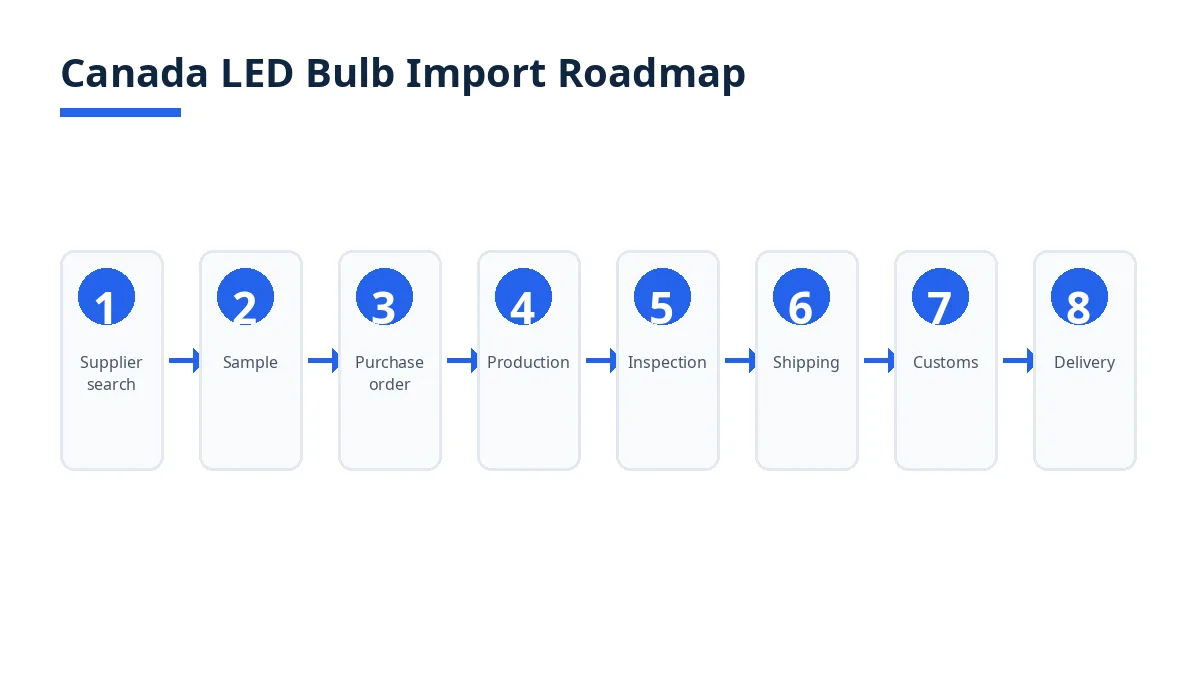
Complete CARM registration, appoint the business account managers, delegate authority to the broker, and settle Release Prior to Payment and financial security.
Record the product description: lamp, module or luminaire, base type, driver, dimming and wireless control.
Put the provincial questions to your adviser: electrical approval, energy efficiency rules and stewardship duties for each province of sale.
Assemble the Canadian files for that product: certification and mark evidence, the ICES-005 report and declaration label, and the NRCan report, verification mark and bilingual label.
Obtain the broker's classification number, duty position and preference and origin answers before pricing anything.
Shortlist suppliers against the Canada file, and put a date on each answer received.
Record, in one document, the specification, the counting rule, the price split, the trial order, the inspection points and the failure rule.
Place the trial order on the same documents bulk will use, test it against the specification and the file, and keep photographs of its marking and label.
Put in writing the delivery term, the named places, the clearance plan, the advance filing and the fallback plans.
Sign off artwork, label, French wording and marks before printing. Produce, inspecting each lot as it is made. Ship with the origin proof, transport document, packing list, invoice and certification file. Declare, pay duty and tax as confirmed, and check the goods on arrival, keeping the declaration, payment records and lot file together.
Does a Canadian buyer need a CARM account before the first LED bulb shipment?
Yes, in practical terms. CARM records and collects duties and taxes on commercial imports, and registration needs a nine-digit business number plus an import-export program account.1 The importer registers its own business; a broker cannot do that step for it. Delegation and any Release Prior to Payment enrollment follow registration.1 Start well before pricing the first shipment, since a missing account, delegation or security arrangement can hold up release.
Will LED bulbs from Bangladesh enter Canada duty-free under the Least Developed Country Tariff?
Duty-free entry is possible, but it rests on the origin rules and the proof, never on a supplier's assurance alone. The program removes duty from nearly every product of a least developed country, Bangladesh is listed among its beneficiaries, and renewal runs to December 31, 2034.2 The value test asks for at least one fifth of the ex-factory price, as packed for shipment to Canada, to come from one or more least developed countries or Canada. Proof takes the form of a Form A certificate or an exporter's statement of origin, entered on the Commercial Accounting Declaration under Code 008.9 Before pricing duty at zero, have the broker confirm the classification number, the treatment in force on the import date, the content calculation and the direct shipment position.9 10
Is a CE mark enough to sell an LED bulb in Canada?
No. The Ontario bulletin states that only equipment bearing a recognized mark from a Standards Council of Canada accredited certification body is deemed acceptable, and that the European Conformity mark, a self-declaration mark, is not recognized in Canada.4 A bulb sold in Canada needs approval to a recognized Canadian standard, with the report and mark evidence for the exact model. For a self-ballasted lamp, start from CSA C22.2 No. 1993, covering LED lamps at 120 to 347 volts alternating current.3 Hold the report and mark evidence before shipment, and confirm the position in each province of sale.
What energy-efficiency and labeling rules apply to LED lamps sold in Canada?
A dealer importing a regulated product must ensure the model meets the standard, file an energy efficiency report with NRCan before import, ensure the product bears a verification mark from a Standards Council of Canada accredited certification body, and ensure any prescribed label is affixed.6 General service LED lamps inside the NRCan definition must meet 45 lumens per watt for lamps manufactured on or after January 1, 2027, and carry a bilingual principal display panel with light output, efficacy, power, life and light appearance, plus the model number on packaging and lamp.7 Lighting equipment must also meet ICES-005 and bear the declaration label before marketing or import.5 Check every label value against the test evidence and the report.
How long should a Canada buyer allow for LED bulbs to reach a Canadian port from Bangladesh?
This guide gives no transit time, because none was established for this route. Routing, carrier schedules, delivery term, the advance filing, customs and inspection all affect the total. Obtain routing and scheduled times from the carrier in writing, put the Canadian port of entry in the contract, and ask the broker how much extra time customs and inspection may add at the border. Advance information must reach the CBSA before the goods arrive at a first port of arrival, so build the filing step into the schedule instead of treating it as paperwork that follows the vessel.8
How does a Canada buyer check a Bangladeshi LED bulb supplier before ordering?
Work through the Canada file in the sequence this guide sets out: certification report and mark evidence for the exact model; the ICES-005 report and declaration label; the NRCan report and verification mark position with bilingual label artwork; test evidence behind the lumen, life and efficacy claims; the origin proof position with its content calculation; and the CARM and importer answers. Check that names and model numbers match across the quotation, invoice, certification report, test reports and packaging, and that the trial order carries the same marking, French wording and label bulk will carry. Insist on written notice before any change to the driver, LED package, base or housing.
Next steps on Exportain
Start from a walkthrough of importing goods from Bangladesh, keeping the CARM and file questions from this guide beside it. Then look through supplier profiles on Exportain with the Canada approval and origin questions ready, and read the buying process on Exportain before ordering anything. Recalculate the example table with how landed cost is worked out, line by line, substituting figures the broker has confirmed in writing. Post a free RFQ on Exportain and get quotes from verified Bangladeshi suppliers
Sources
- Get started with CARM. Canada Border Services Agency (accessed )
- Canada's unilateral tariff preference programs for imports from developing countries. Department of Finance Canada (accessed )
- C22.2 NO. 1993-09. CSA Group (accessed )
- Bulletin 2-7-41: Approval of electrical equipment. Electrical Safety Authority (accessed )
- Interference-Causing Equipment Standards. Innovation, Science and Economic Development Canada (accessed )
- Introduction to the Regulations. Natural Resources Canada (accessed )
- General service lamps. Natural Resources Canada (accessed )
- How the CBSA's commercial clients use electronic data interchange (EDI). Canada Border Services Agency (accessed )
- Memorandum D11-4-4: Rules of Origin Respecting the General Preferential Tariff and Least Developed Country Tariff. Canada Border Services Agency (accessed )
- Select the duties and taxes that apply. Canada Border Services Agency (accessed )
About the author
Sourcing from Bangladesh?
Post a request for quotation and suppliers on Exportain can send you their quotes directly.
Post an RFQ