Australia LED Bulb Imports From Bangladesh: RCM, GEMS and Duty
For Australia buyers importing LED bulbs from Bangladesh: settle the Responsible Supplier, Level 3 certificate and GEMS registration for the exact lamp first, then price duty and GST only on broker-confirmed figures, reworking the example landed-cost table.
Short answer
To import LED bulbs from Bangladesh to Australia, settle the Australian file first: a registered Responsible Supplier, a valid Certificate of Conformity and EESS registration for the lamp as Level 3 equipment, and GEMS registration with test reports under the LED Lamps Determination 2025. Then have a customs broker confirm the tariff classification, any LDC preference, duty and the GST base before pricing, and agree the specification, sample, inspection and delivery term in writing.
On this page
Key takeaways
Settle the Australia file first: a registered Responsible Supplier, a Level 3 Certificate of Conformity and EESS registration, and GEMS registration with test reports for the exact lamp.
Mains-voltage self-ballasted and double-capped LED lamps are Level 3 equipment: a CE mark or a European file does not register the lamp in Australia.
No duty rate is stated for LED lamps: the broker must confirm the tariff classification, any LDC preference with origin proof, and the GST base before pricing.
Price the landed cost on labelled example figures only, including GST at 10 percent of the value of the taxable importation, and rework every line with broker-confirmed figures before ordering.
An Australia buyer who orders LED bulbs from Bangladesh is buying into two Australian systems at once, and neither system is run by the factory. One system decides whether the lamp may be sold in Australia at all. The other decides what the shipment costs at the border. A bulb can be bright, cheap and well packed, and still be unsellable in Australia if its certificate, its registration or its energy file names the wrong model. This guide works through the Australian systems first, then the buying steps. It states no duty rate, no transit time and no typical order size as fact.
The Australia file comes before the catalogue
Three questions settle whether a lamp belongs on an Australia shortlist. First, who is the Australian Responsible Supplier for the lamp, and is that supplier registered? Second, does the lamp hold the certificate its risk level demands, with the registration to match? Third, is the model registered under the energy rules that took effect in March 2026, with test reports and pack information to match? Price comparisons make sense only after those three answers exist in writing for the exact model, cap type and driver on offer. Keep one folder per model holding the certificate, the registrations, the test reports, the artwork and the broker's advice, and open a new version when a driver, cap, housing or pack changes.
Why Bangladesh still belongs on an Australia shortlist
Bangladesh gives an Australia buyer a reason to test, not a reason to assume. Lighting assembly capacity exists in Bangladesh, and the tariff system gives Bangladesh a route to a preferential rate that a broker must confirm line by line. Australia lists a Least Developed Country (LDC) rate among its other preferential arrangements, pointing to Part 2 of Schedule 1 to the Customs Tariff Regulations 2004.1 That listing proves a preference arrangement exists. It does not prove a zero rate for LED bulbs, and it does not remove the origin rules or the proof a claim needs.
Only evidence settles the capacity question. Ask how the lamp is assembled, where its parts come from, and what share of the finished cost originates in Bangladesh. A preference claim turns on origin rules, and an assembly operation that adds little in Bangladesh may not meet them. Ask the same question of every shortlisted supplier, in the same words, and record the answers side by side.
Who stands behind the lamp in Australia: the Responsible Supplier and Level 3
Under the Electrical Equipment Safety System (EESS), a Responsible Supplier is the Australian or New Zealand manufacturer or importer who first places in-scope electrical equipment on the market. For Level 3 equipment, the EESS page sets out a short chain with no shortcuts: the Responsible Supplier must be registered, the equipment must hold a valid and current Certificate of Conformity from a recognised certifier, listed on the national register, and the equipment must be registered and marked with the Regulatory Compliance Mark (RCM).2 Registration runs for one, two or five years, and it cannot run past the expiry date of the certificate it rests on.2
Mains-voltage self-ballasted LED lamps sit in the high-risk group. The Western Australia regulator's fact sheet reproduces the Level 3 extract from AS/NZS 4417.2:2020 and names both the light emitting semiconductor lamp (self-ballasted) and the double capped light emitting semiconductor lamp in that extract.3 The same fact sheet states the Level 3 duties in one line each: a registered Responsible Supplier, registration on the national database, a valid Certificate of Conformity from a recognised certifier, and the RCM.3 A lighting industry brief from 2018 records the same reclassification for mains-voltage, 240 volt alternating current, self-ballasted LED lamps and states that the certificate must show compliance with AS/NZS 62560, the Australian Standard for mains-voltage self-ballasted LED lamps.4 Treat a CE mark, a European test report or a European declaration as a different file for a different market. None of them is an Australian certificate, and none of them registers the lamp in Australia.
The RCM itself carries two meanings at once. The EESS page describes it as a trade mark owned by the electrical regulators and the Australian Communications and Media Authority (ACMA), representing compliance with two independent schemes, the EESS and ACMA labelling requirements, with the marking rules set out in AS/NZS 4417.1 and AS/NZS 4417.2.5 A lamp that carries the mark for electromagnetic compatibility reasons alone has not shown its electrical safety file. Check both sides: the safety certificate and registration on the EESS side, and the ACMA records on the interference side.
Do not let a lamp be entered at the wrong risk level. The EESS Level 1 page defines Level 1 as in-scope equipment outside the Level 2 and Level 3 definitions, with an input rating of 50 volts alternating current or more, or 120 volts direct current or more, and it warns that registering Level 2 or Level 3 equipment as Level 1 is not permitted and could result in penalties.6 Level 1 registration is voluntary, evidence must be held and made available to regulators within 10 business days when asked, and evidence must be retained for five years from the date the equipment type was last imported or manufactured.6
Australia question | Answer to hold | Document that proves it |
|---|---|---|
Who is the Responsible Supplier? | Named Australian or New Zealand entity | EESS Responsible Supplier registration |
What risk level is this lamp? | Level 3 for a mains self-ballasted or double-capped lamp | Classification advice naming AS/NZS 4417.2 |
Which certificate covers this model? | Certificate number, certifier, standard and expiry date | Certificate of Conformity on the national register |
How long does the registration run? | Term chosen, capped at the certificate expiry date | Equipment registration record |
Where is the RCM placed? | On the lamp, or on the pack where the standard allows | Artwork and sample photographs |
Name the exact lamp: self-ballasted, double-capped or luminaire
Three product descriptions behave differently in Australia, and mixing them sends the wrong file to the certifier and misleads the broker on classification. A self-ballasted lamp carries its driver inside the lamp body and fits a lampholder by its cap. A double-capped lamp, the tube form, carries caps at both ends and falls in the Level 3 extract under its own name.3 A luminaire is the fitting itself, with the light source built in or fitted inside it.
Wireless control changes the file. Record, before any test is ordered, the cap type, the rated voltage, whether the driver sits inside the lamp or apart from it, whether dimming is claimed, and whether any wireless control, sensor or app is present. A lamp that talks to a phone or a hub contains a transmitter or receiver as well as a light source, and the ACMA rules for radiocommunications equipment reach transmitters inside other products. Ask in writing, before ordering, whether the radio rules add a further set of standards, records and labels for that model, and hold the answer with the date. The same applies to a lamp with a sensor that switches the light: the sensor may be a small addition to the build and a large addition to the compliance file. Freeze the description in the specification, and require the supplier to give written notice before shipping any change to the lamp, the driver, the cap or the control method.
GEMS registration: MEPS, test reports, families and the pack
Since 3 March 2026, LED lamps in scope of the Greenhouse and Energy Minimum Standards (LED Lamps) Determination 2025 must meet minimum energy performance standards (MEPS), carry mandatory packaging information and meet the other requirements of the determination, and must be registered before they can be sold or supplied in Australia, subject to grandfathering for stock imported before that date.7 The Energy Rating page states the position without qualification: all in-scope models need to meet MEPS and be registered.7 Registration runs through the Energy Rating Product Registration system, as a single model, as a standard family of up to 100 models with similar characteristics, or as a special purpose family of up to 10 models.7 If one model in a family is found non-compliant, the whole family registration is cancelled or suspended.7
Test evidence follows the model, not the catalogue. Every model registered needs a test report, and the report must be accessible and made available to the regulator on request.7 For a standard family, the application must include a test report for the least efficient model, with further reports for the highest colour temperature model where a blue light hazard test is required, and for the highest ultraviolet output model where an ultraviolet hazard test is required.7 Allow time for testing in the order plan: the Energy Rating page warns that the specified 3,600 hour combined luminous flux maintenance and endurance test takes time.7 Registrations are valid for five years from 3 March 2026 unless the regulator determines otherwise.7 A lamp imported after that date with no registration, and no grandfathering, cannot lawfully be offered for sale, whatever its safety certificate says.
Pack information is part of the same determination, not an afterthought for the printer. The determination summary lists, for packaging, the model number, luminous flux, on-mode power, efficacy, correlated colour temperature, beam angle for directional lamps, cap type, rated life, standby power and network standby power where they are not zero, dimmability and dimming compatibility, and colour rendering index, with additional markings where the index sits below 80.8 The lamp itself must carry lumens, colour temperature and beam angle where they fit.8 Other quality parameters in the determination cover colour rendering, displacement factor, lumen maintenance and survival factor, colour consistency, flicker and stroboscopic effect, and ultraviolet and blue light hazard.8 Compare the pack, the lamp marking, the test report and the registration entry line by line before artwork is approved.
The regulator's March 2026 notice confirms the practical consequence: in-scope LED lamps must now be registered in the Energy Rating Product Registration system to be sold or supplied legally in Australia, the determination was made on 26 February 2025 and came into effect on 3 March 2026, and market surveillance in stores and online will check whether models are registered and whether packaging meets the determination.9 Ask who will hold the registration and who will answer a regulator enquiry, and put the answers in the order before production starts.
The second mark on the same lamp: ACMA and electromagnetic compatibility
A mains LED lamp switches power inside its driver, and switching creates electromagnetic disturbance. ACMA regulates electrical and electronic products, including most common household products, under electromagnetic compatibility rules, and the rules sit in the Radiocommunications Labelling (Electromagnetic Compatibility) Notice 2017, the electromagnetic compatibility standard and the General Equipment Rules.10 Supplying a product without the required label, or labelling it before the rules are met, can attract a fine of up to 500 penalty units, and failing to keep the required records can attract a fine of up to 30 penalty units.10 Keep the ACMA compliance folder with the same care as the safety file: test report, declaration of conformity, product description and labelling records, held for the period the arrangement specifies and produced on request. The EESS Level 1 page states that only listing standards related to ACMA or EMC requirements is not a valid EESS equipment registration.6 An EMC test report does not prove electrical safety, and a safety certificate does not prove electromagnetic compatibility. Ask for both files for the exact model and driver, and reopen both when the driver changes.
Find suppliers and test them against the Australia file
Start with a shortlist of three to five suppliers, and send every one the same request in the same words. The request should name the lamp description from the previous section, the quantity basis, the destination, the Incoterm and named place, the certificate and registration evidence required, the pack and labelling requirements, and the date by which a quotation is needed.
Judge each supplier on the Australia file, in this order, and date every answer:
The Certificate of Conformity for the exact model, with the certifier, the standard, the driver and the expiry date visible, and the equipment registration that rests on it.2
The GEMS registration for the model, alone or inside a named family, with the test report for the model or, for a family, for the least efficient model.7
The ACMA file for the model and driver: test report, declaration and labelling records.10
The pack and lamp artwork, with the model number, the GEMS pack information and the RCM placement matching the registrations.5 8
The origin position: how the lamp is built, where its parts come from, and what origin evidence the supplier will supply with the shipment.
The business documents: the legal company name and registered address, the export registration, and the name that will appear on the invoice, the packing list and the transport document. Names must agree across every document, or the difference needs a written explanation before ordering.
A catalogue page, a brochure, or an assurance that documents will follow later leaves the file incomplete. Ask for one document set for a model already sold in Australia, with the model number visible, and check the sample against it. A supplier that has sold into Australia before will answer the Responsible Supplier, certificate and GEMS questions without hesitation. Note who will act as Responsible Supplier in Australia, who keeps the certificate and the test reports, and who answers a regulator. If the buyer is the importer, the buyer carries the Responsible Supplier duties, and the supplier's help with test reports does not transfer them.
Order size, price parts and the sample order
This guide states no typical minimum order and no typical price. No such figure for LED bulbs from Bangladesh for the Australian market was established from an opened source, and a figure copied from another market would mislead. Agree the minimum separately with every supplier, variant by variant, and put it in writing with the unit it is counted in: per model, per cap type, per colour temperature or per packaging variant, in bulbs or in cartons. A minimum spread across a mixed order commits the buyer differently from a minimum tied to one variant, and a carton-based minimum commits differently again from a bulb-based one. Fix the basis for the sample order in the same writing, and the rule for short cartons.
Split every quotation into parts before placing one beside another: the certificate and registration work, the GEMS testing and registration work, the pack and label work, the bulb price itself, carriage and insurance under the agreed delivery term, and the artwork, inspection and retesting charges. Compare quotations only where the delivery term and the compliance file match. A low bulb price without a certificate, a GEMS registration or a compliant pack stops looking low once the file is built. The order must also state the currency and the price basis, whether pricing runs on shipped count or on usable count at arrival, who bears the loss on bulbs that cannot be used, and who pays for the Australian registration and certificate work.
Get the sample first, under the paperwork bulk will use, carrying the specification, marking, label and packaging bulk will use, so what the sample shows is what bulk will show. Photograph the sample's RCM, lamp markings, pack information and carton marks before bulk ships, and keep the photographs with the file.
Quality control: three failures to catch before the goods leave Bangladesh
Most LED bulb failures in an import file fall into three groups, and each group needs a different check. The first group is a paper failure: the model number, the driver or the company name on one document differs from the others. The second group is a marking failure: the RCM, the lamp marking or the pack information is missing, wrong or placed where the standard does not allow it. The third group is a performance failure: the lumen output, colour temperature, colour rendering or lifetime claim on the pack has no test evidence behind it, or the evidence names a different model. Put the specification in a single table, attach an evidence reference to each claimed value, and record the failure rule alongside it.
Claimed value | Proof to record before shipment | If proof is missing |
|---|---|---|
Cap type and rated voltage | Certificate and test report reference | Value stays unproven and off the pack |
Wattage, lumen output and efficacy | Test report with the method cited | No lumen or efficacy figure is used |
Colour temperature and colour rendering | Report reference and pack check | No colour claim is used |
Lifetime claim and its basis | Endurance test evidence | Lifetime claims stay off the pack unless test evidence supports them |
Driver type, integrated or separate | Report naming the driver | Both the safety and ACMA files reopen |
Dimming behaviour, where claimed | Test evidence for the dimming claim | No dimming claim is used |
GEMS registration and pack information | Registration entry and artwork proof | Goods do not ship as an Australian sale |
RCM and lamp marking | Sample photographs | Marking is corrected before packing |
At inspection, tally the goods and examine the caps, markings, labels, data sheet, carton marks, the model number shown on the certificate and the state of the packs. Check that the reports relate to this lot and this model. The goods on their own prove nothing about a lumen, lifetime or efficacy figure: the certificate, the reports, the label artwork and the registration entry must all show the same model number, and the pack values must match the test evidence.7 8 Put the inspection arrangement in writing: the inspector, the place, the table used as the reference, and the consequence for a lot that fails.
Incoterms, the sea move and the Australian declaration
The delivery term decides where delivery happens, where risk passes, and who pays for carriage, insurance and clearance. It does not decide whether the lamp may be sold in Australia, and it does not settle the Responsible Supplier or GEMS questions. Name the rule, the edition and the named places with precision in the contract. The ICC Academy article on delivery and risk transfer stresses the same point from the contract side: parties should set out the place of delivery and the passage of risk explicitly, because vague wording about a destination port leads to disputes over freight differences, storage and delay.11
For container loads, the handover usually happens at a terminal, before the container goes on board. FCA fits that handover: delivery and risk can move when the carrier takes the goods, while FOB turns on the goods going on board the vessel nominated by the buyer.11 With CPT and CIP, carriage to the named place is booked and paid for by the seller, yet risk still moves when the carrier takes the goods, while CIP places an insurance duty on the seller.11
Only FAS, FOB, CFR and CIF are confined to sea and inland waterway transport. The other seven Incoterms 2020 rules work for any mode of transport. Under DDP, the seller also handles import clearance and pays the duty. With DAP, DPU and DDP, the handover point and the passing of risk sit at the named destination.11 Clearance handled by a DDP seller leaves the Responsible Supplier registration, the GEMS registration and the GST position untouched, so a DDP price still needs the Australia file checked separately. Ask the carrier for its routing and scheduled times in writing, and ask the broker which border steps — customs, declaration, inspection — may add time after arrival. This guide gives no transit time: no transit figure for this route was established from an opened source.
The border declaration is a separate step from the delivery term. An Import Declaration (N10) is required when a consignment has a combined value over A$1,000 and is cleared into home consumption, and all applicable duties, taxes and charges must be paid before the goods can be released.12 The declaration is a statement by the importer, or by a licensed customs broker acting as agent, covering the goods, the importer details, how the goods are transported, and the tariff classification and customs value.12 The importer remains responsible for completing and submitting it, and the ABF states plainly that it cannot complete the declaration for the importer.12 For consignments of A$1,000 or less, a Self-Assessed Clearance declaration applies instead, and the ABF encourages first-time or infrequent importers to use a licensed customs broker.12 Keep every relevant document for five years after the declaration, as the ABF requires.12
Duty, GST, charges and the border document set
Duty comes first in the pricing order, because it feeds the GST calculation. This guide carries neither a tariff code nor a duty rate for LED lamps. The Australian tariff schedule page for this product was not opened, and a rate copied from another country, a search result or a supplier quotation must not be imported into an Australian entry. The broker must confirm the tariff classification for the exact lamp, the rate applying on the import date, and the supplementary unit the declaration needs.
A preference may reduce the duty, but only on the broker's confirmation for the exact consignment. The ABF lists the LDC rate as one of Australia's other preferential arrangements, with the countries covered set out in Schedule 1, Part 2 of the Customs Tariff Regulations 2004.1 The broker must confirm whether the LDC rate applies to the confirmed tariff line, whether the origin rules are met for the way the lamp is built, and what proof the claim needs. If a preference claim fails for lack of evidence, the general rate applies, and any duty and GST short-paid becomes payable.
GST is charged separately from duty, at 10 percent of the value of the taxable importation. The ABF states the value as the sum of the customs value, any duty payable, the amount paid or payable for international transport to Australia and insurance for that transport, to the extent not already included in the customs value, and any wine equalisation tax payable, which does not apply to LED bulbs.13 GST is payable at the time of clearance unless the importer is approved for GST deferral.13 A GST-registered buyer may be able to claim the GST paid on an import as an input tax credit; confirm the treatment with an accountant before deciding whether GST belongs in the final landed cost or is tracked as cash flow only.
Two further charges sit on the declaration itself. The ABF applies Import Processing Charges when a declaration is made, and the published table charges A$50 for an electronically lodged Import Declaration on a consignment over A$1,000 and under A$10,000, and A$152 for a consignment of A$10,000 or more, with higher documentary lodgement charges.14 Biosecurity cost recovery charges collected by the ABF for the Department of Agriculture, Fisheries and Forestry apply to full import declarations over A$1,000: A$48 by air and A$71 by sea, as listed on the same page.14 Confirm both charges with the broker before pricing, since the page notes a recent increase to the biosecurity charge. Ask the broker in the same enquiry what biosecurity conditions apply to the timber packaging and dunnage in the consignment, and what packing declaration the supplier must supply.
Keep one file per consignment. It holds the transport document, the commercial invoice, the packing list, the Certificate of Conformity and registration evidence, the GEMS registration and test evidence, the origin evidence if a preference is claimed, and the packing declaration. Model, parties and quantities must read the same on every document. Sort out any difference while the goods are still in Bangladesh, not at the border.
Landed cost example in Australian dollars
Every number in this table is an illustration only. The working is shown so a buyer can follow it; it is not a forecast of price. Duty sits at A$0.00 in this illustration only, on the broker confirming a zero rate for that tariff line, with origin evidence that qualifies. GST is included in the total, because it is payable at clearance on the value of the taxable importation, and a buyer who can claim it back should track it separately as cash flow. Rebuild each line from figures the broker has confirmed before ordering.
Cost line | Example figure (AUD) | Basis |
|---|---|---|
Goods: 8,000 bulbs at A$1.60 each | 12,800.00 | Example figure |
Freight and insurance to Australia | 2,400.00 | Example figure |
Duty: A$0.00, illustration only | 0.00 | Broker to confirm classification, rate and origin evidence |
Value of the taxable importation: goods, freight and insurance, plus duty | 15,200.00 | Sum of the three lines above |
GST at 10 percent of the value of the taxable importation | 1,520.00 | Rate and base from the ABF page; broker to confirm |
Import Processing Charge, electronic, consignment A$10,000 or more | 152.00 | ABF published charge; broker to confirm the current charge |
Biosecurity charge, sea, full import declaration over A$1,000 | 71.00 | ABF published charge; broker to confirm the current charge |
Brokerage and handling | 420.00 | Example figure, treated as outside the GST base here |
Total cash needed at clearance | 17,363.00 | Lines above added together |
Per-bulb cost on shipped quantity: 8,000 bulbs | 2.17 | Total split across the shipped quantity, rounded |
Per-bulb cost on usable quantity: 7,760 bulbs at 3 percent assumed loss | 2.24 | Total split across the usable quantity, rounded |
The table adds up as follows: A$12,800.00 plus A$2,400.00 plus A$0.00 gives A$15,200.00; GST at 10 percent is A$1,520.00; adding A$152.00, A$71.00 and A$420.00 gives A$17,363.00, or A$2.17 per bulb shipped and A$2.24 per usable bulb at a 3 percent assumed loss. Confirm with the broker whether brokerage and handling, and any destination port charges not shown here, belong inside or outside the GST base on the actual consignment. Add inland delivery, inspection and bank charges, which this illustration leaves out, before setting the landed cost beside a domestic purchase.
The Australia import run, in order
Follow the run below from the first question to the last. The diagram gives the same run at a glance.
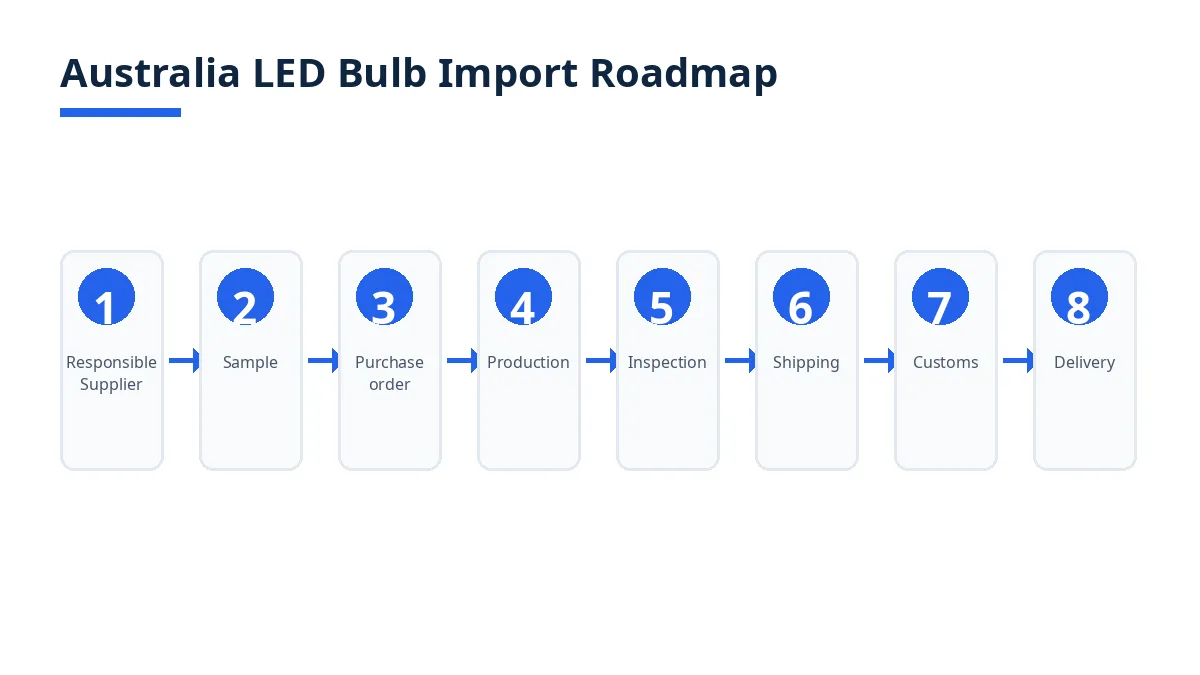
Name the Responsible Supplier, and confirm the registration position for the lamp before shortlisting a supplier.
Fix the product description: lamp type, cap, voltage, driver, dimming and any wireless control.
Take the certificate, GEMS and ACMA questions to an adviser: risk level, standard, family registration, pack information and radio rules.
Ask the broker for the tariff classification, the duty and preference position, the GST base and the declaration charges before pricing.
Shortlist three to five suppliers against the Australia file, and date every answer.
Write down the specification, the counting basis, the price parts, the sample terms, the inspection points and the failure rule.
Check the sample against the specification and the file under bulk paperwork, and photograph the markings and the pack.
Set down in writing the delivery term, the named handover and destination points, the clearance plan, how the declaration is lodged, and the failure plan.
Approve the artwork, the label, the pack information and the RCM placement before anything is printed, then produce and inspect lot by lot.
Ship with the certificate and registration evidence, the GEMS file, the invoice, the packing list, the transport document, the origin evidence and the packing declaration. Declare, pay the duty, GST and charges the broker confirmed, then check the goods when they arrive. Keep the documents for five years.12
What minimum order should an Australia buyer settle for LED bulbs from Bangladesh?
No typical minimum is set here, because none was established for this product and market from an opened source. Agree the minimum separately with every supplier, variant by variant, and put it in writing with the unit it is counted in: model, cap type, colour temperature or packaging variant, in bulbs or in cartons. Put the sample on the same paperwork bulk will carry, before bulk, and carry the Australian certificate, registration and testing costs as separate lines in the order economics: no supplier quotation shows them on its own.
How long should an Australia buyer allow for LED bulbs to reach Australia from Bangladesh?
This FAQ gives no transit time: none was established for this route from an opened source. Time turns on routing, carrier schedules, the delivery term, the declaration process, customs and inspection. Ask the carrier for routing and scheduled times in writing, and ask the broker what extra time customs, biosecurity and inspection may add at the Australian border.
What import duty and GST will an Australia buyer pay on LED bulbs from Bangladesh?
This guide carries no duty rate for LED lamps, because the tariff schedule page for this product was not opened. The ABF lists an LDC preferential rate, with the countries covered in Schedule 1, Part 2 of the Customs Tariff Regulations 2004, but a preference for a given consignment still needs broker confirmation of the tariff line, the rate on that line, the origin rules and the proof held.1 GST is charged at 10 percent of the value of the taxable importation, which is the customs value plus any duty payable plus international transport and insurance to Australia, to the extent not already in the customs value.13 Price duty and GST only on the broker-confirmed answers.
How does an Australia buyer check a Bangladeshi LED bulb supplier?
Ask for the Australia file, in the order set out in this guide: the Certificate of Conformity and equipment registration for the exact model, the GEMS registration with its test reports, the ACMA file for the model and driver, the pack and lamp artwork with matching model numbers, and the origin position with the build described. Names and model numbers must agree across the quotation, the invoice, the certificate, the reports and the packaging, and the sample must show the same marking and pack information bulk will show. Require the supplier to give written notice before any change to the driver, the LED package, the cap or the housing, and reopen the certificate, GEMS and ACMA files when a change is notified.
How Exportain helps
Exportain lists Bangladeshi suppliers and lets a buyer search published products, review supplier profiles, and filter for suppliers holding trust badges, sample availability and OEM or ODM capability. A badge records which checks the Exportain team has reviewed; it is not a capacity or quality guarantee, and it does not replace the buyer's own checks on the certificate, the registrations and the sample. A buyer can post an RFQ stating quantity and unit, target price, destination, Incoterm, required certifications and deadline, so suppliers in the category can quote against the same brief. Payment is settled directly with the supplier on the accepted terms, with inspection and shipment conditions agreed in writing first. Exportain is not a party to the contract for the goods, and it does not inspect goods, book freight or clear customs.
Next steps on Exportain
Read the Bangladesh import walkthrough, keeping the Responsible Supplier, certificate and GEMS questions from this guide open beside it. Search Exportain's supplier directory once the Australia file questions are ready to ask. Before any order, read the buying-process explainer. Rebuild the illustration in the worked landed-cost illustration from figures the broker has confirmed in writing. Post a free RFQ on Exportain and get quotes from verified Bangladeshi suppliers → https://exportain.com/rfqs
Sources
- Other Preferential Arrangements. Australian Border Force (accessed )
- Level 3 - Electrical Equipment. Electrical Equipment Safety System (EESS) (accessed )
- Electrical appliances and equipment - Selling, hiring or advertising. Government of Western Australia (Building and Energy) (accessed )
- LED Lamp Regulation. Lighting Council Australia (accessed )
- The Regulatory Compliance Mark (RCM) (General). Electrical Equipment Safety System (EESS) (accessed )
- Level 1 - Electrical Equipment. Electrical Equipment Safety System (EESS) (accessed )
- Light emitting diode (LED) lamps. Energy Rating (Australian Government) (accessed )
- Greenhouse and Energy Minimum Standards (LED Lamps) Determination 2025. Energy Rating (Australian Government) (accessed )
- You must now register Light Emitting Diode lamps under GEMS. Energy Rating (Australian Government), (accessed )
- Step 1: check the rules to follow. Australian Communications and Media Authority (accessed )
- Place of delivery & risk transfer in trade contracts. ICC Academy (accessed )
- Import declarations. Australian Border Force (accessed )
- GST and other taxes when importing. Australian Border Force (accessed )
- Import Processing Charges. Australian Border Force (accessed )
About the author
Sourcing from Bangladesh?
Post a request for quotation and suppliers on Exportain can send you their quotes directly.
Post an RFQ