USA Knitted Underwear Imports From Bangladesh: CBP Entry, HTS Duty and FTC Labeling Guide
USA knitted underwear imports from Bangladesh: CBP entry, HTS duty lines, FTC fiber and care labeling, and a worked landed-cost example for buyers.
Short answer
To import knitted underwear from Bangladesh to the USA, write one specification per style, shortlist factories that already make that style, and approve a pre-production sample in production fabric, elastic and trim. Classify each style under heading 6107 or 6108, label fiber content and care to FTC rules, mark origin as Made in Bangladesh, and clear the goods through a USA port with a licensed customs broker.
On this page
Key takeaways
Duty follows the 10-digit line for each style: opened lines show 7.4 percent for men's cotton briefs under 6107.11.00 and 7.6 percent for women's cotton briefs under 6108.21.00, and a customs ruling states 14.9 percent for men's man-made fiber briefs under 6107.12.0010 and 16 percent for women's man-made fiber underwear under 6108.92.0005; every other line is confirm with broker.
The United States has no import VAT: the border charges on a formal entry are duty, the Merchandise Processing Fee at 0.3464 percent and, for ocean cargo, the Harbor Maintenance Fee at 0.125 percent, and duty is generally assessed on the transaction value, the price actually paid or payable, rather than on a freight-inclusive value.
United States labels must state fiber content by generic name with percentages by weight in descending order, the country of origin, and the manufacturer or marketer name or FTC Registered Identification Number, plus care instructions under the Care Labeling Rule, so agree the label wording at sampling stage and wash-test the sample by that method.
Most commercial underwear shipments need a formal entry backed by a bond: the Importer Security Filing is due 24 hours before ocean loading, entry within 15 calendar days after landing, the entry summary within 10 working days, and records kept for 5 years, and duty-free de minimis treatment was suspended for all countries from 29 August 2025.
Choose the United States port by warehouse location and inland cost, not by ocean freight alone: New York and New Jersey is the largest East Coast container port, Savannah serves the Southeast, and Los Angeles and Long Beach serve the West Coast, so price at least two gateways before fixing the route.
If you buy knitted underwear for the United States market, the order that matters is not the cheapest quote. It is the order where style, fabric, size curve, tariff line, label and entry filing all agree before bulk production starts. This guide walks through that order: shortlisting Bangladeshi factories that already make your style of underwear, agreeing a minimum and a price on one identical specification, meeting the United States labeling rules for fiber content and care, and clearing the goods through a United States port with a customs broker.
Knitted underwear is a poor product to buy on a generic specification. A brief, a panty, a boxer brief and a long underpant differ in fabric, elastic, gusset construction and size grading, and each difference changes the tariff line, the label and the quality checks. Write one specification per style, approve a pre-production sample in production fabric and trims, and confirm the tariff line and label wording before bulk cutting.
Why source knitted underwear from Bangladesh
Bangladesh has a knitwear sector built around circular knitting, dyeing and cut-and-sew production, and underwear sits inside that strength. The Bangladesh Knitwear Manufacturers and Exporters Association reports that it has grown from 200 members at its inception in 1996 to over 2,540 members, and that the sector employs approximately 1.9 million people.1 That depth matters because underwear production needs several skills in one factory: knitting or sourcing the body fabric, cutting small patterned pieces accurately, sewing stretch seams that recover, and attaching elastic, lace or trim without twisting or rolling in wear.
Source by style, not by general knitwear capacity. A factory that makes T-shirts well is not automatically a good underwear factory. Underwear needs coverstitch and flatlock capacity for stretch seams, pattern work that accounts for stretch and recovery across a full size curve, and elastic application that holds its tension after repeated washing. Ask for current production in your exact style family, and check a finished piece from a recent run for waistband recovery, leg elastic tension, gusset stitching and shade consistency across sizes.
Find and verify suppliers
Where should you start the search?
Start with a written specification, not with factory names: garment type, fabric composition and weight, stretch and recovery behavior, elastic type and width, lace or trim details, gusset construction, colors, size chart with finished measurements, label wording, and packing. Then shortlist factories whose current range already includes that style. Browse suppliers on Exportain, read the general route in how to import from Bangladesh, and send every candidate the identical specification with the same reply format. Quotes on different specifications cannot be compared.
Ask each candidate the same capability questions: which underwear styles it makes now, whether knitting, dyeing and elastic or lace sourcing are in-house or bought in, and whether it holds body fabric stock or knits to order.
How do you verify a supplier before you pay?
Verification has three layers. The first is documents: trade license, export registration and association membership where applicable, checked so that company name, address and bank account name agree across every document. The second is capability: current production in your style, seam and elastic quality on a finished piece, and a sample that matches your specification rather than a near substitute. The third is payment discipline: pay only to the company account named in the documents, never to a personal account, and check any change of bank details through a separate channel before you act on it.
On Exportain, supplier profiles carry document and photo review badges. A badge records that documents and photos were reviewed; it is not a factory inspection or a guarantee of quality or delivery.
MOQ, pricing and samples
What is the typical MOQ for knitted underwear from Bangladesh?
There is no single typical minimum for knitted underwear from Bangladesh. The minimum is set per style and usually per color, because body fabric is knitted and dyed in batches, elastic and lace are bought in widths and dye lots, and cutting is planned per size curve. A plain cotton brief in one color, a lace-trimmed panty in four colors and a modal thermal set in several sizes will not carry the same minimum. Ask each supplier how its minimum splits by style, color, trim and size range, and confirm the answer in writing before you approve a sample.
How is the price built, and how should you compare quotes?
Body fabric is usually the largest cost element in knitted underwear, followed by elastic and trims, cutting and sewing, dyeing, testing, packing and the factory margin. Elastane content, lace quality and elastic width move the price more than buyers often expect, and a quote that looks low often assumes a lighter fabric, a narrower elastic, a simpler trim, fewer sizes, or a delivery term that leaves freight and insurance to you. Compare quotes on the same basis only, and ask each supplier to state what is excluded, for example testing, special packing or carton marking.
Which samples do you need, and how do you approve them?
Work in stages, and approve each stage in writing. A development sample shows whether the factory can construct the garment, form stretch seams cleanly, apply elastic evenly and hold the size chart. A pre-production sample, made in the actual production fabric, color, elastic and trim, is the sample you approve for bulk. Fit, color and elastic recovery cannot be approved from a sample in substitute fabric or with substitute elastic, because dyeing and finishing change dimensions, shade and hand feel.
Test the samples the way your customers will use them: stretch every seam and waistband, wash the garment following your care label and measure it again, and check that elastic still recovers and lace has not distorted.
Quality control and certifications needed
Which quality checks are specific to knitted underwear?
Against the approved sample and size chart, check fabric composition and finished weight, finished measurements across the full size range within your agreed tolerances, and consistency from the smallest to the largest size. Then check construction piece by piece: stretch seam formation, stitch density, skipped stitches at curves, elastic width and tension, lace placement and symmetry, gusset stitching, waistband recovery, and shade consistency between pieces packed as a set. Agree the inspection method and defect limits before production, inspect inline and again on packed goods, and name the test method in the purchase order.
Which label rules apply in the United States?
United States labeling has two layers that both apply to underwear: the fiber content and origin label, and the care label. Product labels must accurately reflect fiber content, the country of origin, and either the name or registered identification number of the manufacturer or marketer, and apparel labels also must show a safe cleaning method.2 For fiber content, list each fiber by its generic name with its percentage by weight in descending order, using the percentages of the fabric you actually bought. A claim made elsewhere on the garment, such as a waistband print, must mirror the fiber content label.
The care label is a separate requirement. Apparel care labels are required under the Federal Trade Commission Care Labeling Rule, and the label must give instructions for at least one cleaning method that the garment can withstand.2 Agree the care wording at sampling stage, wash-test the sample by that method, and check the finished label before bulk label sewing begins.
Country of origin marking is the second origin check. The fiber content label states the country of origin, and the marking on the article or its container must also identify Bangladesh as the country of origin in a legible and permanent way, so that the ultimate purchaser can see it. If your brand name, a United States city or any other geographic wording appears on the garment or carton, confirm with your broker that the origin marking cannot mislead the purchaser about where the garment was made. For children's sizes, ask your broker whether any additional United States product safety rules apply, and confirm with broker before you place the order.
Which certifications do you actually need?
No single certificate covers every underwear order. What you need follows your customer: a retailer or brand may name a specific test, a restricted-substance list or a scheme in its own supplier manual. Name any such requirement in the specification, ask for the matching report or certificate, and check its scope, product covered, issuing body and date.
Incoterms, shipping and transit time
Which delivery term should you choose?
The delivery term decides where risk passes, who books the main carriage and who handles export and import formalities, so agree it before bulk production. For containerized underwear, weigh FOB at the Bangladeshi port against FCA at the named terminal, and weigh both against DAP to your United States warehouse. Under FOB, the factory delivers the goods on board and your forwarder handles the sea leg. Under FCA, delivery happens when the goods are handed to your carrier. Under DAP, the seller bears the transport risk to the named place while you still handle import clearance and pay duty and fees; under DDP the seller also handles import formalities and pays the duty and fees.
Which United States port should you clear through?
Choose the port by warehouse location and inland cost, not by ocean freight alone. Based on 2024 container figures, the Port of New York and New Jersey handled 8.70 million TEUs and was the largest container port on the United States East Coast, Savannah handled 5.55 million TEUs, and Los Angeles and Long Beach together handled nearly 20 million TEUs.3 For Northeast distribution, use New York and New Jersey. For Southeast distribution, price Savannah alongside Charleston and Virginia. For Texas or Gulf markets, price Houston. For West Coast distribution, price Los Angeles and Long Beach.
How long does shipping take?
There is no single transit figure for every order on this lane. Sea freight is the standard route for bulk underwear, and it takes weeks rather than days, varying by sailing schedule, port pair and season. Plan from your forwarder's current sailing schedule for your exact shipment date, add United States clearance and inland delivery, and keep production time separate.
For ocean cargo, the Importer Security Filing must be transmitted before loading. Eight data elements are due no later than 24 hours before the cargo is laden aboard the vessel at the foreign port, including seller, buyer, importer of record number, manufacturer or supplier, ship-to party, country of origin and the tariff number.4 A late or inaccurate filing can draw liquidated damages, so send your broker the filing data before the container is stuffed.
Import duty, taxes and documents
What duty applies to knitted underwear from Bangladesh?
Duty follows the classification of each style in the United States tariff, not the supplier's product name. Men's or boys' underpants, briefs and similar knitted articles sit in heading 6107, and women's or girls' slips, petticoats, briefs, panties and similar knitted articles sit in heading 6108.5 Each heading then splits by fiber, with a 10-digit statistical suffix for the exact garment and wearer. A single order can sit on several tariff lines, so confirm the full 10-digit line for each style before you price or ship, and read the HS code for knitted underwear guide alongside this section.
The schedule consulted for this guide shows a Column 1 General rate of 7.4 percent for men's or boys' cotton underpants and briefs under 6107.11.00, and 7.6 percent for women's or girls' cotton briefs and panties under 6108.21.00.5 A United States customs ruling on knitted undergarments states 14.9 percent ad valorem for men's man-made fiber underpants and briefs under 6107.12.0010, and 16 percent ad valorem for women's man-made fiber underwear under 6108.92.0005, and the ruling itself states that duty rates are provided for convenience and are subject to change.6 Treat those figures as the opened-schedule position for those lines only. For every other line, the rate is confirm with broker. Ask your broker to confirm the current 10-digit line, the rate in force on the entry date, and whether any additional duties under Chapter 99 apply.
Is there United States import VAT?
The United States has no import VAT. The border charges on a formal entry are duty, the Merchandise Processing Fee and, for ocean cargo, the Harbor Maintenance Fee, plus broker and clearance charges. The Merchandise Processing Fee applies to formal entries at 0.3464 percent ad valorem, with a fiscal year 2027 minimum of 34.58 dollars and maximum of 670.86 dollars per entry, and the Harbor Maintenance Fee is 0.125 percent of the value of commercial cargo unloaded at a covered port, applying to ocean shipments only.4 United States duty is generally assessed on the transaction value, the price actually paid or payable, rather than on a freight-inclusive value.4
Which documents does the United States clearance need?
Prepare one consistent document set. Under the entry documentation rule, the entry documentation required to secure release must consist of the entry on CBP Form 3461 or its electronic equivalent, evidence of the right to make entry, the commercial invoice, a packing list where appropriate, and any other documents required by CBP or another agency for the shipment.7 The invoice, packing list and bill of lading must agree on parties, quantities, values, tariff lines, delivery term and route.
Most commercial underwear shipments need a formal entry. Shipments not exceeding 2,500 dollars in value may generally be entered on an informal entry, while commercial shipments above that value require a formal entry backed by a bond, which must be on file before release.4 Merchandise must be entered within 15 calendar days after landing, and the entry summary on CBP Form 7501, with estimated duties, must be filed within 10 working days after the time of entry.4 Keep entry records for 5 years from the date of entry.4
One change to plan around: duty-free treatment under the de minimis exemption was suspended for all countries from 29 August 2025, so do not plan sample or small shipments as duty-free de minimis entries.4 Your broker should confirm the entry type for each shipment value.
Landed cost example (table)
All figures in this section are Example figures. They illustrate one ocean shipment of men's man-made fiber briefs under 6107.12.0010 through a United States East Coast port; they are not a quote, and your own figures will differ by style, fiber, quantity, route and broker terms. Duty in this example uses the 14.9 percent rate stated in the customs ruling cited above, applied to the transaction value, and the fees use the fiscal year 2027 rates cited above.
Cost element | Example figures |
|---|---|
Goods value, Example figures | USD 20,000 |
International freight and insurance to the United States port, Example figures | USD 2,500 |
Transaction value for duty, Example figures | USD 20,000 |
Customs duty at 14.9 percent on the transaction value, Example figures | USD 2,980 |
Merchandise Processing Fee at 0.3464 percent, Example figures | USD 69.28 |
Harbor Maintenance Fee at 0.125 percent on ocean cargo, Example figures | USD 25 |
Customs broker and clearance charges, Example figures | USD 600 |
Total landed cost in these Example figures, before inland delivery to your warehouse | USD 26,174.28 |
The table shows why classification matters: on these Example figures, duty alone is USD 2,980, and a different fiber on the same goods value would change that line. Add inland delivery, inspection, warehousing and any relabeling to reach a full landed cost, and compare that total with your selling price before confirming the order. See the landed cost imports from Bangladesh guide for the full build-up, and read how to buy for the buying route on Exportain.
Step-by-step import checklist
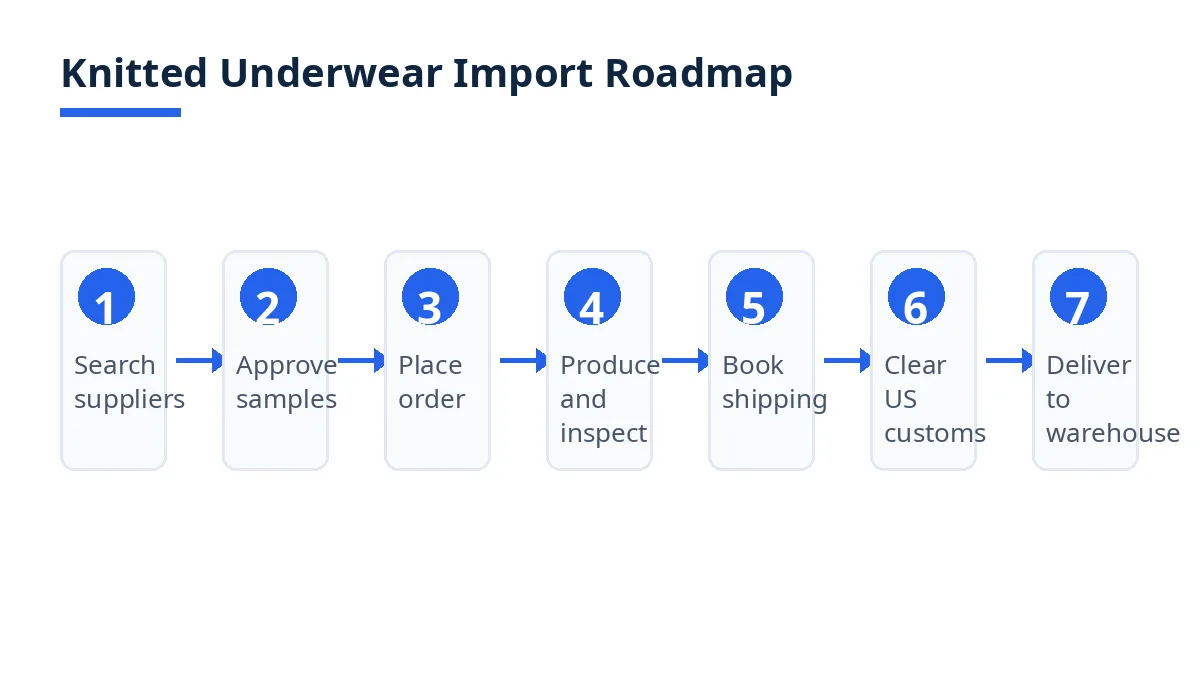
Write one specification per style: garment type, fabric, elastic and trim, gusset construction, colors, size chart and label wording.
Shortlist factories whose current production already includes that style, and send every candidate the identical specification.
Check documents, capability and bank details, and confirm the minimum per style and per color in writing.
Approve a development sample, then a pre-production sample in production fabric, color, elastic and trim.
Agree the delivery term, tariff lines, origin marking and United States label wording before bulk production.
Name the tests in the purchase order, and agree inspection stages and defect limits.
Send your broker the Importer Security Filing data before loading, and confirm the sailing, the United States port and the onward delivery.
File the entry with matching invoice, packing list, bill of lading and tariff lines, and fund duty and fees at entry summary.
Check the delivered goods against the sealed sample and size chart.
Review the first order before repeating it: which styles sold, which sizes ran out, and what changes next time.
How Exportain helps
Exportain connects United States buyers with Bangladeshi suppliers, and the platform carries supplier profiles, product listings and a request-for-quote route for buyers who want comparable quotes. Use the platform to shortlist, to send the identical specification to several factories, and to compare replies on the same basis.
FAQs
What is the typical MOQ for knitted underwear from Bangladesh?
There is no single typical minimum. The minimum is set per style and usually per color, because body fabric is knitted and dyed in batches, elastic and lace are bought in widths and dye lots, and cutting is planned per size curve. Confirm the split by style, color, trim and size range in writing before approving a sample.
How long does shipping take?
There is no single transit figure for every order. Sea freight is the standard route for bulk underwear and takes weeks rather than days, varying by sailing schedule, port pair and season. Confirm the sailing schedule and United States clearance steps with your forwarder for your exact shipment date.
What import duty applies?
Duty follows the 10-digit tariff line for each style. The schedule consulted shows 7.4 percent for men's cotton briefs under 6107.11.00 and 7.6 percent for women's cotton briefs and panties under 6108.21.00, and a customs ruling states 14.9 percent for men's man-made fiber briefs under 6107.12.0010 and 16 percent for women's man-made fiber underwear under 6108.92.0005, with rates subject to change.5 6 For every other line, the rate is confirm with broker.
How do I verify a supplier?
Check company documents so that name, address and bank account name agree, check capability against your exact style from current production, and keep payments to the company account named in the documents. Approve a development sample and then a pre-production sample in production fabric, elastic and trim.
Next steps on Exportain
Start with the general import route in how to import from Bangladesh, then shortlist factories through suppliers and compare your landed cost with the landed cost imports from Bangladesh guide. When your specification is ready, read how to buy and post a free request for quote.
Sources
- BKMEA. Bangladesh Knitwear Manufacturers and Exporters Association (accessed )
- Cachet of Cashmere: Complying with the Wool Products Labeling Act. Federal Trade Commission (accessed )
- Top 10 US Ports by Container Volume. iContainers (accessed )
- Customs Clearance Process: How US Entry Works, Step by Step. CargoTrans Inc. (accessed )
- Harmonized Tariff Schedule of the United States, Chapter 61. U.S. International Trade Commission (accessed )
- Customs Ruling NY N015551 - The tariff classification of undergarments from China. U.S. Customs and Border Protection (accessed )
- 19 CFR 142.3 | Entry documentation required. eCFR (accessed )
About the author
Sourcing from Bangladesh?
Post a request for quotation and suppliers on Exportain can send you their quotes directly.
Post an RFQ