Knitted Underwear From Bangladesh to Saudi Arabia: A Buyer's Import Checklist
Import knitted underwear from Bangladesh to Saudi Arabia: SABER Type 3 conformity, HS 6107 and 6108 classification, 15 percent import VAT, Arabic labels, MOQ, samples, shipping and landed cost.
Short answer
To import knitted underwear from Bangladesh to Saudi Arabia, classify each style under heading 6107 for men and boys or 6108 for women and girls, confirm the Saudi code and duty line with your broker, and start the SABER Type 3 route early. Agree Arabic fibre, size, and care labels, approve a pre-production sample in production fabric and elastic, set the inspection plan, and build the landed cost, including 15 percent import VAT, per style before bulk production.
On this page
Key takeaways
Knitted underwear for men and boys sits in heading 6107 and for women and girls in heading 6108, with subheadings by fibre. Treat the headings as indicative and have your broker confirm the full Saudi code for each style.
Underwear falls under Type 3 certification in the SASO Technical Regulation for Textile Products, which involves product testing and a product inspection or factory audit, unlike the testing-only route for most other textile products.
Saudi import VAT is 15 percent, charged on the customs value including freight and insurance, even where goods are exempt from customs duty. Confirm the duty line for each style with your broker, since no single duty rate was verified for this guide.
Labels must be in Arabic or in Arabic and English, sewn or firmly attached, and must state fibre composition by mass percentage in descending order, size, country of origin, and care instructions.
There is no single typical minimum order quantity, price, or transit time for knitted underwear from Bangladesh. Confirm each figure in writing for your exact fabric, size range, and route.
To import knitted underwear from Bangladesh to Saudi Arabia, start with the Saudi side of the order, not with a supplier shortlist. Confirm the classification, SABER route, Arabic label wording, and 15 percent import VAT before you agree a price. This checklist is for Saudi Arabia buyers: retailers, wholesalers, distributors, and brands. Waistband elastic, leg opening, rise, and fabric recovery decide whether a style sells again.
Saudi Arabia import at a glance
Headings 6107 (men and boys) and 6108 (women and girls), split by fibre. Treat them as indicative; your broker confirms the full Saudi code.
Underwear needs Type 3 certification under the SASO textile regulation: testing plus inspection or factory audit, not testing only.
Saudi import VAT is 15 percent on the customs value including freight and insurance. Confirm the duty line with your broker; no duty rate was verified here.
Labels in Arabic or Arabic and English, sewn or firmly attached: fibre percentages in descending order, size, origin, and care instructions.
No single typical minimum, price, or transit time. Confirm each in writing for your fabric, size range, and route.
Why source knitted underwear from Bangladesh
Bangladesh has a large knitwear base, and knitwear is the larger of its two apparel segments. In July to September of fiscal year 2026-27, knitwear exports reached 5.96 billion dollars, up 6.88 percent year on year, per Export Promotion Bureau data reported at the time.1
Within one supply base, a buyer can place cotton briefs, man-made fibre boxer briefs, and blended styles with factories that already handle elastic waistbands, leg elastic, gussets, and seams for close-fitting garments. Capacity and quality systems differ widely, so the checks below separate a factory that can repeat a fit from one that can only sew a sample. Underwear is regulated more strictly than most clothing on entry to Saudi Arabia, so a supplier that has already taken a style through the Saudi route will move faster. Ask for that history by style.
Find and verify suppliers
Where should you start the search?
Start with a written specification: cut; wearer group; fibre composition; fabric weight; waistband type and width; leg finish; size range and curve; colours; waistband branding; labelling; and packing. Then shortlist knitwear factories whose current range already includes knitted underwear.
Send every candidate the identical specification and ask for the same reply format: fabric and elastic assumed, price inclusions, validity, minimum per style and colour, and lead times. Browse suppliers on Exportain, read how to import from Bangladesh for the full process, and compare your approach with the landed cost guide before you compare prices.
How do you verify a supplier before you pay?
Check company documents first: trade licence, export registration, and association membership, so name, address, and bank account agree across documents. Then check capability: fabric and dyeing route, underwear cutting and sewing lines, elastic sourcing, capacity, and recent production.
Keep payments to the company account named in the documents, never to a personal account, and verify any change of bank details separately through a known contact. On Exportain, supplier profiles may carry document and photo review badges: a review of documents and photos, not a factory inspection or a guarantee, and Exportain is not a party to the goods contract. For a first order, add a video walkthrough or visit, and ask whether the factory has supplied underwear into Saudi Arabia before, with test reports and shipment certificates, and whether it works with a conformity assessment body for the Type 3 route.
MOQ, pricing and samples
What is the typical MOQ for knitted underwear from Bangladesh?
There is no single typical minimum order quantity. The minimum is set per style and usually per colour, because fabric is knitted and dyed in batches, elastic is bought in widths and colours, and a cutting plan is set up per size range. A plain cotton brief in three sizes and a printed man-made fibre boxer brief in eight sizes will not carry the same minimum. Ask how the minimum splits by style, colour, size range, and fabric, and whether a smaller first order is possible at a higher unit price or with a surcharge, in writing on the quotation.
How is the price built, and how should you compare quotes?
Fabric is usually the largest cost element, followed by elastic, cutting and sewing, dyeing or printing, waistband branding, testing, and packing. Two quotes can differ because one assumes a lighter fabric, a narrower waistband, a different elastic, or a simpler pack, so ask what each price is based on, in writing. Compare quotes on the same basis: style, fabric and elastic, waistband, delivery term, packing, and testing and conformity costs. Ask what is excluded, for example testing, SABER fees, or special packing, and price testing and conformity as a line in the order from the start.
Which samples do you need, and how do you approve them?
Work in stages. A development sample shows whether the factory can construct the style, attach the waistband evenly, finish the leg opening, and hold the size. A fit sample checks rise, leg opening, and waistband tension. A pre-production sample, made in the actual production fabric, colour, elastic, waistband, and label, is the sample you approve for bulk. Fit, shade, and hand feel cannot be approved from substitute fabric, because dyeing, finishing, and washing change dimensions, shade, and elastic recovery. Test samples as customers will wear and wash them: measure each size after washing, check waistband recovery, seams, leg finish, and shade. Approve in writing, keep one sealed counter-sample, and send the approved set to the laboratory or conformity body where the SABER route requires it.
Quality control and certifications needed
Which quality checks are specific to knitted underwear?
Against the approved sample and size chart, check fabric composition and finished weight, finished measurements within your agreed tolerances, and consistency across the size range. Then check waistband attachment and tension, seams, gusset construction, leg elastic, and thread ends. Check shade across sizes and dye lots, and check packing: pieces per polybag, size and colour marking, assortment per carton, and carton weight.
Agree the inspection method and defect limits before production. ISO 2859-1:2026 defines sampling procedures for inspection by attributes, indexed by acceptance quality limit (AQL), described as the maximum average percentage of defective items considered acceptable during random sampling.2 Name the inspection level, the AQL values for critical, major, and minor defects, the sample size rule, and what happens to a failed lot.
Which certifications and conformity steps does Saudi Arabia require for underwear?
The SASO Technical Regulation for Textile Products applies to textile products containing at least 80 percent by weight of textile fibres, including clothing.3 The supplier putting the product on the market, usually the importer, must obtain a certificate of conformity from a Notified Body: Type 3 for children's products and underwear, Type A1 for other textile products, with a supplier declaration and a Product Safety Test Report.3
Type 3 involves product testing and a product inspection or factory audit; Type 1a involves only product testing.4 Testing covers pH value, colour stability, and hazardous chemicals, including formaldehyde, heavy metals, azo dyes and other dangerous dyes, flame retardants, insecticides, herbicides and fungicides, chlorinated organic compounds, phthalates, and organotin compounds.4 Ask which tests apply to your fabric and elastic, and keep the report with the order file. Name any retailer test or restricted-substance list in the specification and check the report's scope and date.
Which label rules apply in Saudi Arabia?
Label wording is fixed before production. Labels must meet the regulation and relevant standards, be legible, visible, clear, in a uniform character set, written in Arabic or in Arabic and English, indelible, and easy to read before purchase, sewn or firmly attached in a position commonly used in the textile industry, with all information correct.3 The label must include fibre composition by the name listed in the regulation and by mass percentage in descending order, product weight, size or dimension, supplier name and commercial registration on the external packaging, country of origin, and care instructions, including washing and cleaning symbols.3 4 Agree the Arabic wording at sampling stage and check the finished label on the pre-production sample. If any requirement is unclear, confirm it with your conformity body and broker before production.
Incoterms, shipping and transit time
Which delivery term should a first order use?
The Incoterms 2020 rules allocate cost, risk, and customs responsibility between seller and buyer. Under FOB, risk passes once the goods are on board at the origin port, and the buyer pays the main carriage, while under CIF the seller pays freight and minimum-cover insurance to the destination port but risk still passes on board at origin.5 Under FCA, risk passes when the goods are handed to the buyer's carrier, which matches containerised cargo.5 Weigh FOB at Chattogram against FCA at the named terminal. Under DAP the seller delivers ready for unloading at the named destination and the buyer clears for import, while under DDP the seller also clears for import and pays duty and tax.5 Confirm in writing who holds the SABER certificates and who files the Saudi declaration before you agree DDP. Read how to buy for how an order moves through Exportain, and fix the delivery term, named place, and insurance in the purchase order.
How long does shipping take, and which port should you use?
There is no single typical transit time for this route. Sea freight is the standard route for bulk orders, and the time depends on the sailing schedule, routing, transshipment, port congestion, and season. Plan from your forwarder's sailing schedule, keep production time separate, and add clearance and delivery. Ask for the routing, cut-off date at Chattogram, and arrival window in writing.
Jeddah Islamic Port, on the Red Sea, serves the western region, while King Abdulaziz Port in Dammam, on the Arabian Gulf, is the Kingdom's largest port on the Gulf and a key entry point for the eastern and central regions, linked to the railway network toward Riyadh.6 Ask the forwarder to quote Jeddah and Dammam separately with the inland cost to your warehouse. Most export cargo moves through Chattogram, which handles more than 92 percent of the country's export and import cargoes and 98 percent of its containers, according to port authority figures reported in early 2026.7
Import duty, taxes and documents
How are knitted underwear styles classified for duty?
Duty follows the classification of each style in the Saudi tariff, not the supplier's product name. Heading 6107 covers men's or boys' knitted underpants and briefs and similar articles; heading 6108 covers women's or girls' knitted slips, briefs, and panties and similar articles.8 Subheadings split by fibre: in 6107, underpants and briefs of cotton sit in 6107.11, of man-made fibres in 6107.12, and of other textile materials in 6107.19, as shown by codes used for men's briefs in trade records.9 In 6108, briefs and panties of cotton sit in 6108.21, of man-made fibres in 6108.22, and of other textile materials in 6108.29, as shown by codes used for ladies' underwear.8 Treat every code here as indicative and have your broker verify the full Saudi code for each style before you price or ship. Use the same code on the SABER record, invoice, and customs declaration.
What import duty applies?
Confirm the duty line with your broker for each style and entry date. No Saudi duty schedule line for headings 6107 or 6108 was verified from an opened official tariff for this guide, so this guide states no Saudi duty rate for knitted underwear. Ask your broker for the current rate beside the full Saudi code, the customs value basis, and any preference or exemption, and keep the written calculation in the order file.
The SABER side is separate from duty and must not be left until arrival. SASO manages SALEEM, the Saudi Product Safety Program, and under SALEEM the product and shipment conformity programmes run through SABER, which verifies whether a product is regulated based on its category or HS code at registration.10 The Product Certificate of Conformity is valid for one year, issued through SABER after compliance is shown through a SASO-approved body, and the Shipment Certificate of Conformity is required for each consignment, obtained through SABER with the product certificate or self-declaration and the shipment documents.10 Shipments without a shipment certificate are subject to re-exportation.10
What import VAT applies?
Saudi import VAT is 15 percent, imposed on all imports under the VAT law and its implementing regulations, even if the goods are exempt from customs duties, subject to specific exceptions.11 VAT is charged on the total customs value including insurance and freight, the CIF value, and can later be claimed as input VAT if the goods are used for taxable business activities.11 Importers file a customs declaration form, known as a Bayan, with the tariff code, value in Saudi riyals, and origin.11 The 15 percent rate has applied since July 2020, raised from 5 percent, after VAT was introduced on 1 January 2018 at 5 percent, administered by the Zakat, Tax and Customs Authority (ZATCA).12 Import VAT is a border cost even for a VAT-registered buyer, so confirm with your tax adviser whether it is recoverable.
Which documents do you need for clearance?
The standard import set is the commercial invoice, packing list, bill of lading, certificate of origin, and the SABER product and shipment certificates. The customs declaration is submitted electronically through FASAH, the Saudi customs clearance gateway, with documents typically including the commercial invoice, bill of lading or arrival notice, certificate of origin, packing list, customs reference number, and permits for specific goods.13 Quantities, weights, carton counts, values, and HS codes must agree across every document, and the invoice should name each style plainly with fibre composition, quantities, prices, and delivery term. Ask your broker to check the full document list before the goods sail. Keep test reports, the conformity declaration, and SABER certificates with the clearance file.
Landed cost example (table)
A landed cost is the full cost of one piece, ready for sale in Saudi Arabia. Every number below is an example figure only, not a quote; the duty figure is an example amount only, not the verified Saudi rate.
Example figures: 20,000 men's cotton knitted boxer briefs, FCA Chattogram, sea freight to Jeddah, duty at an example amount only, VAT shown separately.
Cost element | Example figures (per piece) | How to obtain your figure |
|---|---|---|
Product price, FCA Chattogram | $0.85 | Confirmed pro forma invoice |
International freight | $0.12 | Forwarder quote / pieces |
Insurance | $0.01 | Policy or forwarder quote |
Duty, example amount only | $0.05 | Broker calculation |
Port, clearance and broker fees | $0.04 | Broker invoices divided by pieces |
Local delivery to warehouse | $0.03 | Local carrier quote divided by pieces |
Total landed cost before VAT | $1.10 | Sum of all lines above |
Import VAT at 15 percent on CIF value plus duty, example calculation | $0.15 | 15% of $1.03, rounded |
Total landed cost including VAT | $1.25 | Sum of landed cost before VAT and VAT |
Import VAT is charged on the customs value including freight and insurance plus duty.11 See the landed cost guide for the full method, and replace every example figure with your confirmed figures before you set a selling price.
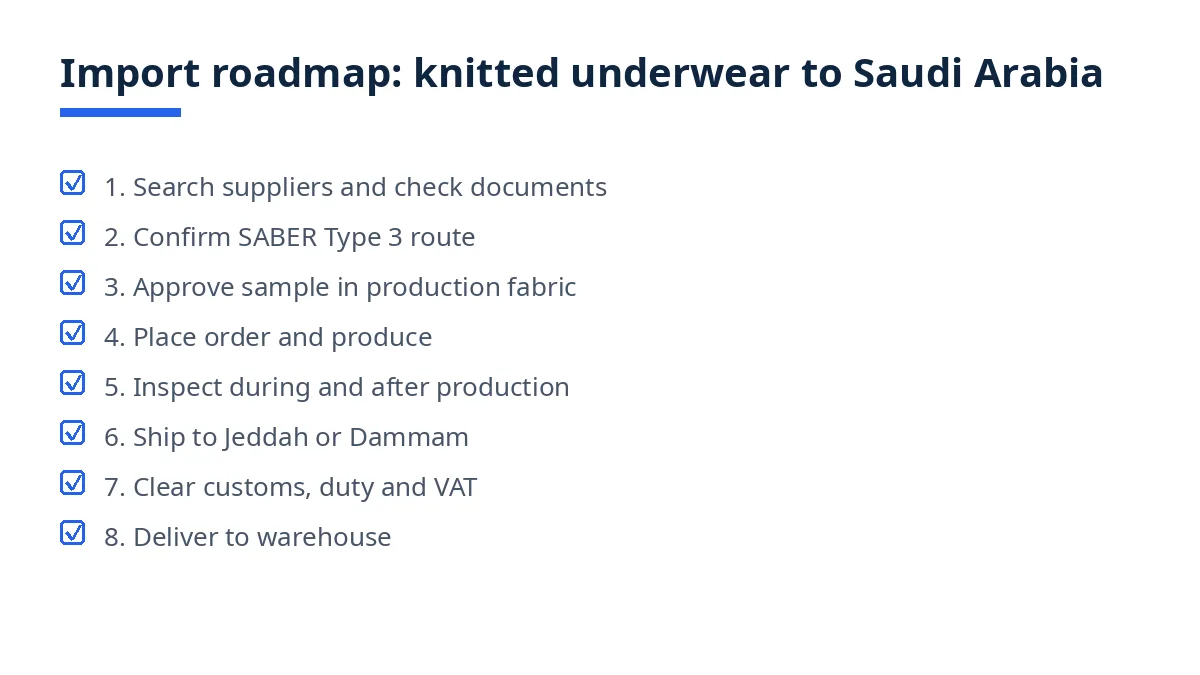
Step-by-step checklist to import knitted underwear from Bangladesh to Saudi Arabia
Write the specification style by style: wearer group, cut, fibre, fabric weight, waistband, leg finish, size range and curve, colours, branding, labels, and packing.
Classify every style from headings 6107 and 6108, and have your broker confirm each full Saudi code and duty line.
Confirm the SABER route with a SASO-approved body: Type 3 certification, tests, inspection or audit, and both certificates.
Agree the Arabic label wording at sampling stage: fibre percentages, size, origin, supplier details on the outer packing, and care instructions.
Shortlist factories already making knitted underwear, request comparable quotes on the identical specification, and verify documents, capability, and Saudi history.
Order samples in stages, test fit, measurements, waistband recovery, shade, and washing, then approve a pre-production sample in production fabric, elastic, waistband, and label.
Confirm the order in writing: purchase order, pro forma invoice, delivery and payment terms, inspection plan, labelling, packing, SABER responsibilities, and shipment date.
Inspect during production and on packed goods against the approved samples: waistband, seams, measurements, shade, labels, and cartons.
Ship, clear customs with the confirmed code for each style, the SABER certificates, and the full document set, and reconcile the actual landed cost against the quote-stage calculation.
How Exportain helps
Browse suppliers for Bangladeshi knitwear exporters already making knitted underwear. Then post your specification as an RFQ and compare replies on the same terms, including fabric, elastic, waistband, minimum, testing, and delivery term, before sampling. When ready, post your specification as an RFQ at Exportain RFQs and ask each respondent for the SABER history, test reports, and sample plan. Exportain is a B2B marketplace where buyers post RFQs, receive quotations, and message suppliers. It does not inspect goods, book freight, or clear customs, and supplier badges are document and photo reviews, not factory inspections or guarantees.
FAQs
What is the typical MOQ for knitted underwear from Bangladesh?
There is no single typical minimum. It is set per style and usually per colour, because fabric is knitted and dyed in batches and a cutting plan is set up per size range. Ask how the minimum splits by style, colour, size range, and fabric, in writing on the quotation.
How long does shipping take?
Production time and transit time are separate, and neither has a single typical figure for this route. Sea transit depends on the sailing schedule, routing, transshipment, congestion, and season, so ask your forwarder for the current schedule, routing, cut-off date, and arrival window, plus clearance and delivery.
What import duty applies?
Duty follows the confirmed classification of each style, and no Saudi duty rate for headings 6107 or 6108 was verified for this guide. Confirm the current rate beside each style's full Saudi code with your broker before you commit to a selling price. Import VAT is separate: 15 percent on the customs value including freight and insurance plus duty, even where goods are exempt from customs duty.11
How do I verify a supplier?
Check company documents so name, address, and bank account agree across the trade licence, export registration, and invoices. Then check capability and Saudi supply history by style, keep payments to the company account named in the documents, and approve a pre-production sample before bulk production.
Next steps on Exportain
Read how to import from Bangladesh, how to find suppliers in Bangladesh, and the HS code guide for knitted underwear. When ready, post an RFQ and compare quotes on the same terms.
Sources
- Exports rise 6.34% in first quarter as monthly momentum weakens. tob.news, (accessed )
- ISO 2859-1:2026 - Sampling procedures for inspection by attributes — Part 1: Sampling schemes indexed by acceptance quality limit (AQL) for lot-by-lot inspection. International Organization for Standardization (accessed )
- Saudi Arabia: Testing to the New SASO Technical Regulation. SGS (accessed )
- Importing Fashion to Saudi Arabia: What You Need to Know. QIMA, (accessed )
- Incoterms 2020 Explained: Complete Guide (2026 Update). Inecta (accessed )
- Saudi Arabia's 11 Major Ports: A Complete Guide. Tonlexing (accessed )
- Ctg Port breaks all previous records in 2025. The Financial Express (accessed )
- Ladies Underwear HSN Code used in Bangladesh. Volza (accessed )
- Mens Briefs HSN Code used in Japan. Volza (accessed )
- Navigating SASO & Imports into Saudi Arabia. QIMA (accessed )
- VAT on Imports and Exports in Saudi Arabia (KSA). ClearTax, (accessed )
- How VAT Works in Saudi Arabia — Rates, Registration & Calculation. Farahat & Co. (accessed )
- What is Customs Clearance. Wazen (accessed )
About the author
Sourcing from Bangladesh?
Post a request for quotation and suppliers on Exportain can send you their quotes directly.
Post an RFQ